The Real Story Behind Self-Driving Car Crashes
Every time a robotaxi bumps a curb, stalls in an intersection, or collides with another vehicle, it makes headlines. The phrase "self driving cars crash" trends on social media, fueling both fear and fascination. But stripped of viral video sensationalism, what does the actual crash data tell us about the safety of Level 4 autonomous vehicles operating on public roads in 2026?
The answer is more nuanced than either the hype or the horror suggests. Robotaxis have completed tens of millions of paid trips across several U.S. cities. Their crash rates per million miles are now measurable, comparable to — and in some metrics, better than — human drivers. But the types of crashes they get into, the edge cases that stump them, and the regulatory gaps that persist all deserve close examination before you step into a driverless car.
This analysis covers the major Level 4 robotaxi operators currently running paid services, their published safety data, the technology that enables them, and the hard limitations that remain.
SAE Automation Levels: Why the Distinction Matters for Crash Liability
Before examining crash data, it's critical to separate consumer driver-assistance systems from true robotaxi services. The SAE International J3016 standard defines six levels of driving automation, and conflating them is the single biggest source of public confusion about autonomous vehicle safety.
| Level | Name | Who Drives | Examples (2026) | Crash Liability |
|---|---|---|---|---|
| 0 | No Automation | Human | Basic vehicles, no ADAS | Driver |
| 1 | Driver Assistance | Human (system assists steering OR speed) | Adaptive cruise control, lane-keeping | Driver |
| 2 | Partial Automation | Human (system assists steering AND speed) | Tesla Autopilot/FSD Supervised, GM Super Cruise, Ford BlueCruise | Driver |
| 3 | Conditional Automation | System (human must take over on request) | Mercedes Drive Pilot (limited markets, ≤40 mph) | Manufacturer (when engaged) |
| 4 | High Automation | System (within geofenced ODD) | Waymo, Zoox, Cruise (suspended/restructured) | Operator/Manufacturer |
| 5 | Full Automation | System (everywhere, all conditions) | None currently deployed | Manufacturer |
Where Robotaxis Operate in 2026: Service Availability
Level 4 robotaxi service remains geographically constrained. Operators use geofencing — GPS-defined boundaries combined with pre-mapped high-definition road data — to limit where their vehicles travel. Here is where you can actually hail a driverless ride as of early 2026:
| Operator | Active Paid-Service Cities | Operating Hours | Vehicle Platform | Status |
|---|---|---|---|---|
| Waymo (Alphabet) | Phoenix, San Francisco, Los Angeles, Austin | 24/7 (Phoenix, SF); restricted hours (LA, Austin) | Jaguar I-PACE (custom sensor suite), Zeekr RT (testing) | Active, expanding |
| Zoox (Amazon) | Las Vegas (limited corridor), Foster City, CA (testing) | Limited hours | Zoox purpose-built carriage (no steering wheel) | Early paid service |
| Cruise (GM) | None (suspended after Oct 2023 incident) | N/A | Chevrolet Bolt EV / Origin (cancelled) | Restructuring; limited testing with safety drivers in Phoenix/Dallas |
| Motional (Hyundai/Aptiv) | Las Vegas (limited Ioniq 5 robotaxi via Lyft) | Limited hours | Hyundai Ioniq 5 (with safety driver in some markets) | Scaled back; selective operations |
Notice what's absent: no robotaxi service operates in New York City, Chicago, Miami, Seattle, or most of the country. Rural roads, highways above 45 mph (in most deployments), and unmapped construction zones fall outside the operational design domain (ODD) of every current Level 4 system.
Robotaxi Safety Data: What the Numbers Actually Show
Waymo, as the largest and longest-operating Level 4 robotaxi service, provides the most robust public safety dataset. In reports filed with the California DMV and published independently, Waymo has disclosed cumulative data across its fleet.
- Total autonomous miles driven: Over 40 million miles (driverless, no safety operator)
- Paid trips completed: Over 15 million (across Phoenix, SF, LA)
- Police-reported crashes: Fewer than 20 per million autonomous miles — compared to approximately 50-60 per million miles for human drivers in comparable urban environments
- Injury severity: The vast majority of Waymo-involved collisions have been low-speed (<15 mph), with no reported fatalities in driverless mode
- Contact rate (any physical contact): Approximately 5.3 per million miles, per Waymo's published analysis — roughly 85% lower than human benchmark in equivalent geographies
Sources: NHTSA AV Safety Data, Waymo Safety Reports, California DMV Disengagement Reports
What the Crash Data Doesn't Tell You
Raw crash rates per million miles are useful but incomplete. Several contextual factors matter:
Low-speed bias: Robotaxis operate primarily in urban cores at speeds under 35 mph. Human crash data includes highway collisions at 65-80 mph, which are far more lethal. A direct comparison without speed normalization overstates the robotaxi advantage.
Conservative driving behavior: Waymo vehicles brake earlier, yield more aggressively, and maintain larger following distances than typical human drivers. This reduces crash severity but also causes "stranding" incidents — where the vehicle stops in a travel lane because it cannot resolve a complex scenario, creating a secondary hazard for following traffic.
The Cruise incident: In October 2023, a Cruise robotaxi in San Francisco dragged a pedestrian who had been thrown into its path by a human-driven vehicle. The vehicle initially braked, then pulled over, but the pulling-over maneuver moved the vehicle with the pedestrian underneath. This incident — and Cruise's delayed transparency about the drag — led to California DMV suspending Cruise's permit and ultimately triggered GM's decision to wind down Cruise operations. It remains the most significant Level 4 robotaxi safety failure to date and illustrates that edge-case handling, not routine driving, is where autonomous systems remain vulnerable.
Technology Stack: How Robotaxis See the Road
Understanding why self-driving cars crash requires understanding what they can and cannot perceive. Level 4 robotaxis use a layered sensor approach fundamentally different from consumer Level 2 systems.
| Sensor Type | Function | Range | Limitation | Used By |
|---|---|---|---|---|
| LiDAR (spinning or solid-state) | 3D point-cloud mapping of surroundings | 150-300 m | Heavy rain, fog, snow reduce range; expensive | Waymo, Zoox, Motional |
| Cameras (multi-lens array) | Object classification, lane reading, traffic signals | 200+ m (telephoto) | Glare, darkness, occlusion | All operators |
| Radar (short + long range) | Velocity detection, works in poor weather | 200+ m | Low resolution; poor at stationary objects | Waymo, Zoox, Motional |
| Ultrasonic | Near-field obstacle detection (<5 m) | 5 m | Very short range only | All operators |
| HD Maps + GPS/IMU | Centimeter-level localization, pre-mapped road geometry | N/A | Requires constant map updates for construction/changes | Waymo, Zoox, Motional |
This sensor redundancy is why Level 4 robotaxis can operate without a human driver — but it also explains their limitations. When heavy rain scatters LiDAR returns, when construction alters a mapped intersection, or when a pedestrian behaves unpredictably (stepping off a curb while looking at a phone), the system must either resolve the scenario from training data or execute a conservative fallback: slow down, stop, or pull over.
The crashes that do occur tend to cluster around these edge cases: an unusual vehicle configuration (an oversized load, a bicycle with a trailer), ambiguous right-of-way scenarios (a four-way stop with conflicting human gestures), or sensor degradation from weather.
Pricing: Robotaxi vs. Uber and Lyft
If you're in a city where robotaxis operate, how does the cost compare to conventional rideshare?
| Service | Base Fare | Per-Mile Rate | Per-Minute Rate | Estimated 5-Mile Trip | Tipping |
|---|---|---|---|---|---|
| Waymo One | $3.00-$5.00 | $1.25-$1.75 | $0.30-$0.50 | $12-$18 | Optional (in-app) |
| UberX | $2.50-$4.00 | $1.10-$1.60 | $0.25-$0.45 | $10-$16 | Expected (15-20%) |
| Lyft Standard | $2.50-$4.00 | $1.10-$1.55 | $0.25-$0.45 | $10-$15 | Expected (15-20%) |
| Zoox (Las Vegas) | Promotional pricing | Varies | Varies | $5-$10 (promo) | Optional |
Robotaxi pricing is currently competitive with rideshare before tip, and often cheaper after accounting for the no-tip norm (though Waymo does offer an in-app tip option). The long-term economic thesis is that removing the driver — who typically earns 60-75% of a rideshare fare — should make robotaxis significantly cheaper at scale. But in 2026, operators are still subsidizing rides to build market share and collect operational data.
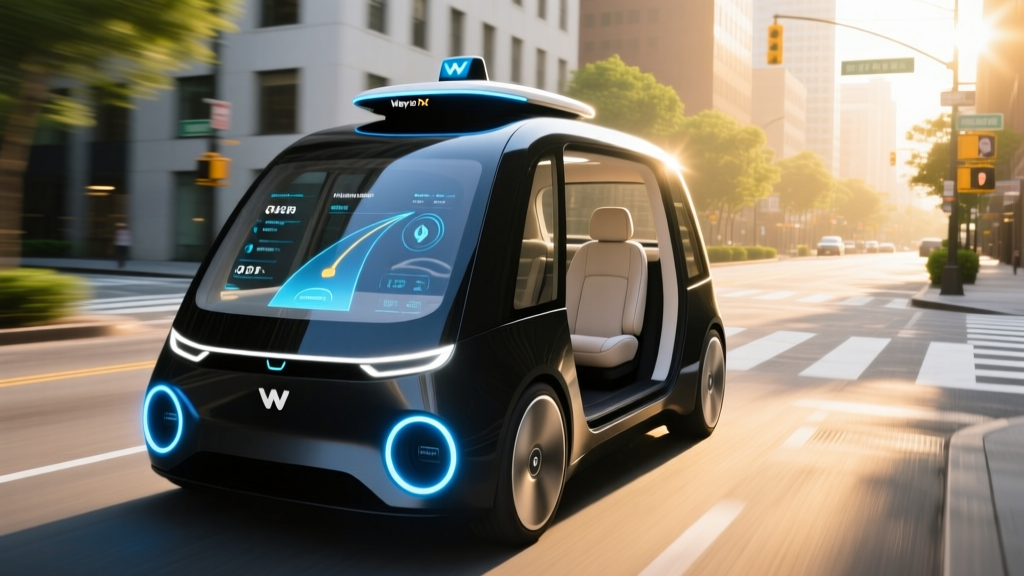
How to use Waymo One: Download the Waymo One app (iOS/Android), create an account, enter your pickup and destination within the service area, and confirm. The vehicle arrives — typically a white Jaguar I-PACE with a prominent roof-mounted LiDAR array — and you unlock it via the app. There is no driver. You select music and climate settings on the rear touchscreen, and the car drives itself to your destination.
Current Limitations: When Robotaxis Cannot Drive
Level 4 autonomy is powerful within its operational design domain, but that domain has hard boundaries. Here is what robotaxis in 2026 cannot handle:
- Heavy precipitation: Most services reduce operations or suspend entirely during heavy rain, snow, or dense fog. LiDAR scatter and camera occlusion degrade perception below safety thresholds.
- Unmapped construction zones: If road geometry has changed since the last HD map update, the vehicle may refuse to proceed or require remote human assistance (teleoperations).
- Highway driving: Most Level 4 deployments cap speed at 45-50 mph. Interstate merging and high-speed lane changes remain outside the ODD for most operators, though Waymo has tested highway segments in Phoenix.
- Complex hand-signals: A police officer directing traffic with non-standard gestures, or a crossing guard with a hand-held sign, can confuse perception systems trained primarily on standard traffic signals.
- Geofence boundaries: You cannot take a Waymo from San Francisco to Sacramento. The vehicle will not drive outside its mapped service area, and the app will not let you set a destination beyond the boundary.
- Accessibility edge cases: Passengers with mobility devices, service animals, or large cargo may find the vehicle's interior configuration and automated door mechanisms less accommodating than a human-driven rideshare.
- Remote assistance delays: When a robotaxi encounters an unresolvable scenario, it contacts a remote human operator. This can take 30 seconds to several minutes, during which the vehicle remains stationary — potentially blocking traffic.
Regulatory Landscape: Who Approves Robotaxi Operations
Robotaxi deployment in the United States is governed by a patchwork of state and local regulations, with federal oversight limited primarily to vehicle safety standards (NHTSA) rather than operational approval.
State-level authority: California's DMV and Public Utilities Commission (CPUC) issue the permits that allowed Waymo and (previously) Cruise to operate. Arizona takes a notably permissive approach — Waymo launched in Phoenix partly because the state requires minimal permitting. Texas, where Waymo operates in Austin, has its own framework through the Texas Department of Licensing and Regulation.
Federal role: NHTSA sets Federal Motor Vehicle Safety Standards (FMVSS) and investigates crashes involving automated systems through its Standing General Order, which requires manufacturers and operators to report crashes involving Level 2-5 systems within 24 hours for serious incidents and within 30 days for all others. NHTSA does not, however, "approve" robotaxi services — that authority rests with states.
The regulatory gap: There is currently no unified federal framework for Level 4 vehicle certification. A robotaxi approved in California has no automatic reciprocity in Florida or New York. This state-by-state approach slows expansion and creates inconsistent safety oversight — a concern that grows as operators push into new markets.
The Bottom Line: Are Robotaxis Safe Enough?
The data available in 2026 suggests that Level 4 robotaxis from established operators like Waymo have achieved crash rates at or below human benchmarks in comparable urban, low-speed environments — with the critical caveat that they avoid the high-severity, high-speed crashes that account for most traffic fatalities.
But "self driving cars crash" remains a reality, not a headline myth. The crashes that do occur tend to be low-speed, low-severity, and concentrated in edge cases that expose the limits of current AI perception. The Cruise pedestrian-dragging incident demonstrated that the consequences of edge-case failures can be severe — and that transparency and accountability from operators are as important as the underlying technology.
For riders in cities where robotaxis operate, the risk calculus is reasonable: you are trading the well-understood risks of human-driven rideshare (distraction, impairment, fatigue) for the less-understood but statistically competitive risks of machine-driven edge-case failures. For everyone outside those geofenced zones, Level 4 autonomy remains a spectator sport — impressive in demos, constrained in practice.
Frequently Asked Questions
Where can I use a robotaxi service right now?
As of early 2026, Waymo One offers paid driverless rides in Phoenix, San Francisco, Los Angeles, and Austin. Zoox operates a limited paid service in Las Vegas. Motional offers limited Ioniq 5 robotaxi rides via Lyft in Las Vegas. No robotaxi service operates in New York, Chicago, Miami, or most other U.S. cities. Service areas within each city are geofenced — check the operator's app for exact boundaries.
How much does a robotaxi cost vs. Uber or Lyft?
Waymo One pricing is comparable to UberX and Lyft Standard before tip, with a typical 5-mile urban trip costing $12-$18. Because tipping is optional (not expected as with human drivers), the total cost is often slightly lower than rideshare. Zoox has been offering promotional pricing in Las Vegas that undercuts both services.
How safe are robotaxis — is there real data?
Yes. Waymo has published data showing its driverless fleet has completed over 40 million autonomous miles with a police-reported crash rate roughly 60-70% lower than human drivers in comparable urban environments, and a contact rate approximately 85% lower. The vast majority of incidents are low-speed and low-severity. However, the Cruise October 2023 pedestrian incident in San Francisco demonstrated that edge-case failures can have serious consequences. NHTSA's Standing General Order requires all operators to report crashes, providing a growing public dataset.
What are the current limitations of robotaxis?
Robotaxis in 2026 cannot operate in heavy rain, snow, or dense fog. They are geofenced to specific mapped areas and cannot drive on most highways. They struggle with unmapped construction zones, non-standard traffic control (police hand signals), and unusual road users. When the system cannot resolve a scenario, the vehicle stops and may block traffic while awaiting remote human assistance, which can take several minutes.
Is this truly self-driving or just driver-assist?
Level 4 robotaxis from Waymo, Zoox, and Motional are genuinely driverless — there is no human in the driver's seat, and no expectation that a passenger will intervene. This is fundamentally different from Level 2 systems like Tesla Autopilot, FSD Supervised, GM Super Cruise, or Ford BlueCruise, which all require an attentive human driver prepared to take over at any moment. When you ride in a Waymo, you are a passenger, not a driver. The vehicle handles all driving tasks within its operational design domain without human input.