The phrase "self-driving car" gets thrown around loosely — applied to everything from a Tesla on Autopilot to a steering-wheel-free pod picking up strangers in Phoenix. As of 2026, the gap between marketing and reality has narrowed, but it hasn't disappeared. Fully driverless robotaxis are carrying paying passengers in a growing but still limited set of US cities, while consumer vehicles with advanced driver-assist remain firmly at SAE Level 2, requiring an attentive human behind the wheel.
This guide cuts through the noise with hard data: where you can actually hail a robotaxi right now, what it costs, how the safety record stacks up, and what the technology still can't do.
SAE Automation Levels: What "Self-Driving" Actually Means in 2026
Before comparing services, you need the SAE International framework. Every autonomy claim maps to one of six levels, and the distinction between Level 2 and Level 4 is the single most important thing to understand before you spend a dollar or trust your safety.
| SAE Level | Name | Who Drives? | 2026 Examples |
|---|---|---|---|
| Level 0 | No Automation | Human does everything | Basic cruise control |
| Level 1 | Driver Assistance | Human, with one assist (steering OR speed) | Adaptive cruise, lane-keep |
| Level 2 | Partial Automation | Human, with steering + speed assist simultaneously | Tesla Autopilot/FSD Supervised, GM Super Cruise, Ford BlueCruise |
| Level 3 | Conditional Automation | System drives in narrow conditions; human must take over on request | Mercedes Drive Pilot (limited markets, ≤40 mph traffic jams) |
| Level 4 | High Automation | System drives fully within a defined operational design domain (geofence); no human needed inside that domain | Waymo One, Zoox, Cruise (post-relaunch) |
| Level 5 | Full Automation | System drives everywhere, all conditions | Does not exist commercially |
Critical distinction: Tesla's Full Self-Driving (Supervised) is a Level 2 system. Despite the name, the driver must remain fully engaged, hands available, eyes on the road. Waymo One and Zoox are Level 4 — no driver, no steering wheel, but only inside a geofenced service area under approved conditions. Never conflate the two.
Where Can You Actually Hail a Robotaxi Right Now?
Robotaxi service areas have expanded since 2023, but coverage remains city-specific and geofenced. You can't summon one in rural Wyoming or even most suburbs. Here's where the major operators run commercial, driverless service as of early 2026:
| Operator | Vehicles | Live Driverless Cities (2026) | Service Hours | Access Model |
|---|---|---|---|---|
| Waymo One (Alphabet) | Jaguar I-PACE EV, 6th-gen sensor suite | Phoenix metro, San Francisco, Los Angeles, Austin | 24/7 in most zones | Open app (waitlist cleared in most markets) |
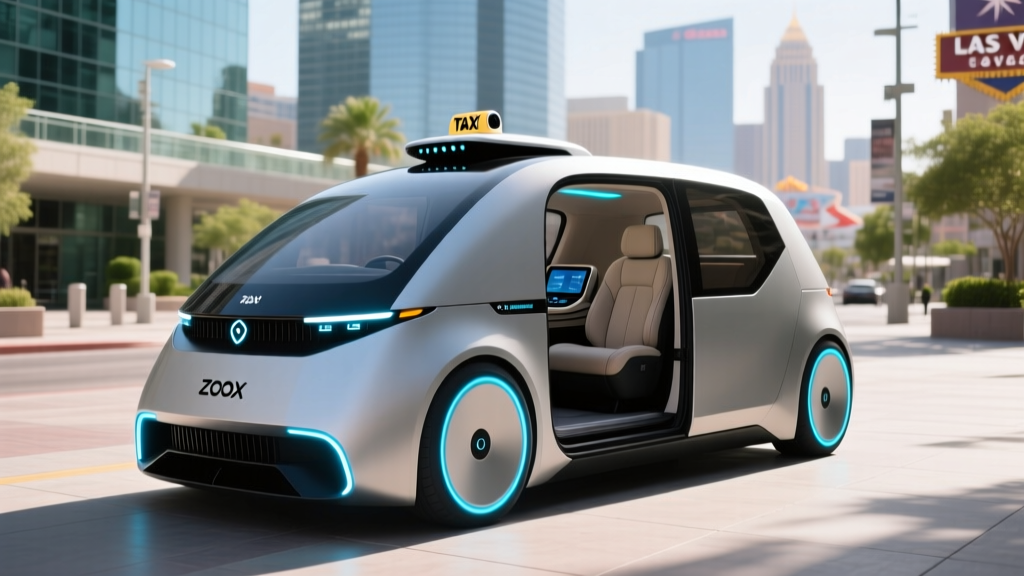
| Zoox (Amazon) | Zoox purpose-built pod (no steering wheel) | Las Vegas (Strip corridor + airport zone), Foster City, CA (limited) | Limited hours, expanding | Invite-only / waitlist |
| Cruise (GM) | Chevrolet Bolt EV / Origin (limited) | Phoenix, Houston, Dallas — post-relaunch scaled service | Daytime/evening; varies by city | App-based, waitlist in some cities |
| Motional (Hyundai/Aptiv) | Hyundai Ioniq 5 robotaxi | Limited Uber/Lyft integration in Las Vegas | Limited hours | Via Uber/Lyft app in designated zone |
Key caveat: "Phoenix" doesn't mean all of Phoenix. Waymo's geofence covers roughly 225 square miles of the metro — primarily the East Valley (Chandler, Tempe, Scottsdale, parts of Mesa). Downtown Phoenix, far-west suburbs, and Tucson remain outside the service area. Always check the app map before assuming coverage.
Robotaxi Pricing vs. Uber and Lyft: The Real Numbers
Robotaxis aren't yet cheaper than rideshare across the board, but on short, in-zone trips they can be competitive — especially with introductory pricing. Here's a representative comparison based on observed fares in Q4 2025 and early 2026:
| Scenario | Waymo One | UberX | Lyft Standard |
|---|---|---|---|
| 3-mile trip, midday, Phoenix | $8–$12 | $10–$15 | $9–$14 |
| 7-mile trip, weekday rush, SF | $18–$26 | $20–$32 | $19–$30 |
| Airport run (12 mi), Las Vegas | Not yet available (Zoox corridor-limited) | $28–$42 | $26–$40 |
| Surge pricing behavior | No surge multiplier; longer wait times at peak | 1.3x–3.0x surge common | Prime-time pricing 1.2x–2.5x |
Waymo has largely avoided surge pricing, which makes it predictable during bar-close hours and rainstorms when Uber and Lyft fares spike. The trade-off: wait times can stretch to 15–25 minutes during peak demand because fleet size is still limited (estimated ~1,000 vehicles in Phoenix, ~500 in SF). Tipping is not expected or prompted in the Waymo app.
How Safe Are Robotaxis? The Data Behind the Headlines
High-profile incidents — Cruise's October 2023 pedestrian dragging in San Francisco, Waymo's low-speed collisions with towed vehicles — dominate headlines. But aggregate data tells a more nuanced story. Let's look at what's actually been reported.
Waymo safety data (through 2025): Waymo has published safety performance reports covering over 20 million driverless miles. Their analysis, benchmarked against NHTSA crash-rate data for human drivers in comparable urban environments, showed:
- ~85% reduction in injury-causing crash rate vs. human baseline
- ~57% reduction in any police-reported crash rate
- Most recorded contacts were low-speed (<15 mph), property-damage-only events — often the robotaxi being rear-ended by a human driver
Cruise post-suspension record: After California DMV suspended Cruise's license in October 2023, the company relaunched with human safety drivers in early 2024 and gradually returned to driverless service in Phoenix and Houston by mid-2025. Cruise's scaled-back fleet has logged fewer driverless miles, making statistical comparison less robust. GM has reported zero serious-injury incidents in the post-relaunch driverless phase through late 2025.
Zoox: Zoox has accumulated millions of testing miles but its commercial driverless fleet is small and corridor-limited. No serious-injury incidents have been publicly reported in its Las Vegas passenger service as of early 2026.
NHTSA oversight: The National Highway Traffic Safety Administration requires all ADS-equipped vehicles involved in crashes to be reported under a Standing General Order. This data is publicly queryable and remains the most authoritative source for incident tracking across all operators.
Under the Hood: How Robotaxi Sensor Stacks Actually Work
The technology powering Level 4 robotaxis in 2026 converges on a similar architecture, though with meaningful differences in sensor philosophy.
Waymo 6th-Generation Driver
- LiDAR: Custom-built units with 360° coverage, ~250m range, improved performance in rain and direct sunlight vs. 5th-gen
- Cameras: 8+ high-resolution cameras with improved dynamic range for night and glare
- Radar: Imaging radar for velocity detection of distant objects
- Audio: External microphones to detect sirens, horns, construction noise
- Compute: Custom AI inference hardware; redundant systems for steering, braking, power
Zoox Purpose-Built Vehicle
- Symmetrical sensor layout: Identical sensor pods on all four corners — no "front" or "rear" bias
- LiDAR + cameras + radar: Triple-redundant perception on every axis
- Bidirectional driving: Vehicle can travel in either direction; four-wheel steering for tight urban maneuvers
- Battery: ~75 kWh usable, targeting all-day operation with opportunistic fast charging
The Camera-Only Question
Tesla's FSD remains the outlier — camera-only, no LiDAR, no radar. Tesla argues that a vision-only approach scales better and that LiDAR is a "crutch." Every commercial Level 4 robotaxi operator disagrees, using LiDAR as a core sensor for depth accuracy independent of lighting. As of 2026, no camera-only system has received regulatory approval for driverless commercial passenger service anywhere in the US.
Who Regulates Robotaxis — and How?
Robotaxi regulation in the US is a patchwork of state and federal authority, and understanding who holds the leash matters if you're evaluating the service's legitimacy in your city.
- Federal (NHTSA): Sets vehicle safety standards (FMVSS). Has granted limited exemptions for vehicles without steering wheels (Zoox, Cruise Origin). Investigates crashes via Standing General Order and can issue recalls.
- State DMVs/CPUCs: Control deployment permits. California DMV issues testing and deployment permits; the California Public Utilities Commission (CPUC) regulates commercial passenger service. Arizona takes a lighter-touch approach with executive-order-based permitting. Texas has created a state-level ADS permitting framework.
- Local/municipal: Cities control curb access, geofence boundaries, airport access, and can restrict operations via local ordinance. San Francisco's Board of Supervisors has repeatedly pushed back against expansion; Phoenix has been broadly permissive.
The practical result: a robotaxi approved in Phoenix cannot simply start operating in San Francisco. Each city requires separate permits, safety-case submissions, and often public hearings. Expansion is slow by design.
Current Limitations: What Robotaxis Still Can't Do
Level 4 autonomy is powerful — inside its operational design domain (ODD). Step outside that domain, and the system either refuses the trip or pulls over. Here are the concrete limitations you'll encounter in 2026:
- Geofence boundaries: You cannot hail a Waymo from Scottsdale to Sedona. The trip must start and end within the mapped service zone. Cross-city trips that exit the geofence are declined.
- Weather: Heavy rain, fog, and dust storms degrade LiDAR and camera performance. Waymo reduces speed or pauses service during monsoon conditions in Phoenix. Snow and ice remain a hard no — no Level 4 service operates in winter-climate cities.
- Construction zones: Temporary lane shifts, unmapped detours, and hand-flagger scenarios frequently require the vehicle to stop and request remote assistance (a human teleoperator reviews the scene and guides the vehicle). Expect 2–5 minute delays in active construction areas.
- Unprotected left turns: Still a challenging maneuver in heavy, unstructured traffic. Some robotaxis take conservative multi-point turns or choose alternate routes to avoid them.
- Parking and drop-off: Robotaxis pull to the curb but cannot enter parking garages, drive-through lanes, or private driveways. You'll be dropped at the nearest legal curb, which may be 50–100 feet from your actual destination.
- Emergency vehicles: Generally handled well (pull-over protocols are robust), but edge cases — like an ambulance approaching from an unexpected angle at a multi-lane intersection — can cause overly cautious stops.
- Passengers with accessibility needs: Waymo's Jaguar I-PACE requires passengers to enter a standard SUV-height vehicle. Zoox's pod is wheelchair-accessible by design but operates in limited areas. ADA compliance remains an evolving regulatory and engineering challenge.
Consumer Vehicles vs. Robotaxis: Why You Can't Buy Level 4
A common question: if Waymo can do it, why can't I buy a car that drives itself on the highway? The answer is liability, ODD scope, and economics.
Level 4 robotaxi operators carry commercial insurance, maintain fleet-level remote-assistance infrastructure, and limit their vehicles to meticulously mapped zones with known edge cases. A consumer vehicle must handle any road, any weather, any condition — and the automaker would assume full liability when the system is engaged. No manufacturer has crossed that threshold for a consumer product beyond Mercedes' narrow Level 3 Drive Pilot (approved in Nevada and California for traffic-jam speeds up to 40 mph on divided highways, with the driver permitted to look at the infotainment screen but required to resume control within ~10 seconds when prompted).
For context, Tesla's FSD (Supervised) — the most widely deployed consumer system — remains Level 2. The driver is legally and operationally responsible at all times. Elon Musk's long-standing predictions of unsupervised FSD have been repeatedly delayed, and as of 2026, no US regulator has approved Tesla's system for driverless operation.
Frequently Asked Questions
Is Tesla FSD considered a self-driving car in 2026?
No. Tesla Full Self-Driving (Supervised) is an SAE Level 2 driver-assist system. It can handle steering, acceleration, and braking on highways and many surface streets, but the driver must remain fully attentive and is legally responsible for the vehicle at all times. It is not a robotaxi, and no US regulator has approved it for driverless use.
How much does a Waymo ride cost compared to Uber?
On short in-zone trips (3–5 miles), Waymo One fares typically run $8–$15, comparable to or slightly below UberX. The biggest advantage is no surge pricing — Waymo fares don't multiply during peak demand, though wait times increase. On longer trips (10+ miles), pricing is similar to rideshare, typically $22–$35 depending on distance and time.
Can I use a robotaxi if I'm in a wheelchair?
Accessibility is limited. Waymo's Jaguar I-PACE is a standard SUV and is not wheelchair-accessible. Zoox's purpose-built pod was designed with level-floor boarding and wheelchair accommodation, but Zoox operates in limited areas (Las Vegas, Foster City) and is still scaling. Waymo has announced WAV (wheelchair-accessible vehicle) partnerships but availability remains sparse as of early 2026.
What happens if a robotaxi gets into an accident?
The operating company carries commercial liability insurance. In a collision, the vehicle is designed to pull over safely, contact emergency services if needed, and notify the rider. NHTSA's Standing General Order requires all ADS-involved crashes to be reported. Waymo, Cruise, and Zoox all publish periodic safety transparency reports, though reporting granularity varies.
Will robotaxis replace Uber and Lyft drivers?
Not in the near term. Robotaxi fleets are small (low thousands of vehicles nationally), geofenced to specific cities, and unable to handle the long tail of trip scenarios (rural areas, bad weather, complex drop-offs). Uber and Lyft have partnered with robotaxi operators (Motional rides appear in the Uber app in Las Vegas) rather than being replaced by them. Full displacement of human rideshare drivers would require Level 4 coverage in thousands of cities — a multi-decade prospect at minimum.
Are robotaxis safer than human drivers?
On a per-mile basis within their operational domains, the available data suggests yes — Waymo's published analysis shows significantly lower injury-crash rates than human benchmarks in comparable urban environments. But robotaxis operate in geofenced, mostly urban areas at moderate speeds, which is a favorable operating envelope. A direct comparison to human drivers on rural highways or in snowstorms isn't applicable because robotaxis don't operate in those conditions. The honest answer: within their domain, the data is encouraging; outside it, the comparison doesn't exist.
Robotaxis in 2026 are real, commercially available, and measurably safer than the alternative in the specific environments where they operate. They are not, however, a nationwide transportation solution — and won't be for years. If you live in or visit Phoenix, San Francisco, Los Angeles, Austin, or Las Vegas, downloading the Waymo or Zoox app is worth the experiment. If you're anywhere else, Level 2 driver-assist in your own vehicle remains the state of the art — with the understanding that you are still the driver.