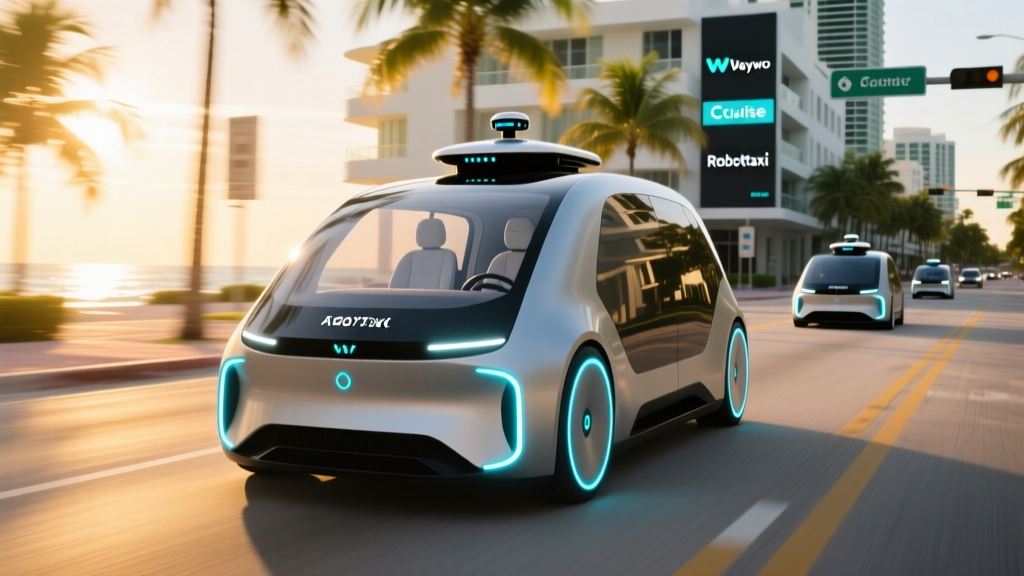
If you've searched for a self-driving car in Miami, you've likely seen a confusing mix of headlines — some promising driverless rides along Biscayne Boulevard, others describing Tesla owners navigating I-95 with Autopilot engaged. The reality in 2026 is nuanced: true driverless robotaxis (SAE Level 4) are expanding into South Florida, but Miami's dense urban grid, tropical downpours, and complex regulatory environment mean availability is still limited compared to cities like Phoenix or San Francisco.
This guide cuts through the hype. We'll explain exactly which robotaxi services operate in Miami today, how they differ from consumer driver-assist systems, what a ride actually costs, and what the safety data shows. Whether you're a resident, a frequent visitor, or an EV-curious buyer evaluating the autonomous landscape, here's what you need to know.
SAE Automation Levels: Why "Self-Driving" Needs a Precise Definition
The phrase "self-driving car" gets applied to everything from a Tesla Model 3 on Autopilot to a Waymo Jaguar I-PACE with no human behind the wheel. The SAE International J3016 standard defines six levels of driving automation, and understanding them is essential before you step into any vehicle claiming autonomy.
| SAE Level | Name | Who Drives? | Real-World Example |
|---|---|---|---|
| Level 0 | No Automation | Human does everything | Standard car, no assist features |
| Level 1 | Driver Assistance | Human + one system (steering OR speed) | Adaptive cruise control, lane-keeping |
| Level 2 | Partial Automation | Human supervises steering + speed together | Tesla Autopilot, GM Super Cruise, Ford BlueCruise |
| Level 3 | Conditional Automation | System drives in limited conditions; human on standby | Mercedes DRIVE PILOT (approved in NV, CA) |
| Level 4 | High Automation | System drives fully within a geofence; no human needed | Waymo One, Zoox |
| Level 5 | Full Automation | System drives everywhere, all conditions | Does not yet exist commercially |
Critical distinction: When you buy a Tesla with FSD (Supervised), a Ford with BlueCruise, or a GM vehicle with Super Cruise, you own a Level 2 system. You are the driver. You must remain attentive, hands on or near the wheel, and legally responsible. A Waymo robotaxi is Level 4 — no driver present, no steering wheel in the passenger experience, and the company assumes operational liability within its approved zone. These are fundamentally different products.
Where Can You Actually Ride a Self-Driving Car in Miami Right Now?
As of early 2026, Miami is in a transitional phase for robotaxi services. Here's the current landscape:
| Service | Miami Status (2026) | Operational Area | Hours | Access |
|---|---|---|---|---|
| Waymo One | Limited commercial launch | Designated zones: Downtown, Brickell, Wynwood, Design District (expanding) | 24/7 in approved zones | Open to public via Waymo app |
| Cruise (GM) | Testing with safety driver; no paid public rides | Select corridors, primarily daytime | Limited testing hours | Invite-only / employees |
| Zoox (Amazon) | Not yet operational in Miami | N/A — active in Phoenix, Las Vegas, Foster City | N/A | N/A |
| Tesla Robotaxi (announced) | Announced for 2026–2027 launch; not yet live anywhere | N/A | N/A | N/A |
Waymo One is the only service where Miami residents and visitors can currently hail a fully driverless ride. Waymo began its Miami commercial service following successful testing phases, initially covering a geofenced area encompassing Downtown Miami, Brickell, and parts of Wynwood. The service has been gradually expanding its operational design domain (ODD), but it does not yet cover Miami Beach, Coral Gables, Homestead, or Fort Lauderdale.
To use Waymo One in Miami, download the Waymo app, enter your pickup and dropoff locations within the service area, and request a ride. A Waymo 5th-generation vehicle (based on the Jaguar I-PACE platform with a custom roof-mounted sensor array) arrives without a human driver. You authenticate via the app, buckle up, and the vehicle handles the entire trip.
Robotaxi Pricing: Waymo vs. Uber and Lyft in Miami
One of the most common questions is cost. Robotaxi pricing is dynamic — it fluctuates based on demand, distance, and time of day — but here's a representative comparison based on typical Miami rides in 2026:
| Route | Waymo One | UberX | Lyft Standard |
|---|---|---|---|
| Downtown → Brickell (2.5 mi) | $8–$12 | $9–$14 | $8–$13 |
| Downtown → Wynwood (4 mi) | $12–$18 | $13–$19 | $12–$17 |
| Brickell → Design District (6 mi) | $16–$24 | $17–$26 | $16–$24 |
| Downtown → MIA Airport (8 mi)* | Not yet in service area | $22–$35 | $20–$32 |
*Miami International Airport is not yet within Waymo's Miami geofence as of early 2026. Airport service is a high-priority expansion target.
At current pricing, Waymo One is broadly competitive with UberX and Lyft — sometimes slightly cheaper on shorter trips, sometimes slightly more expensive during peak demand. Waymo has offered promotional pricing in new markets to build ridership, so Miami users may see introductory discounts. There's no surge pricing multiplier as aggressive as Uber/Lyft's, though wait times can increase during high-demand periods due to fleet size constraints.
Key difference: You're not tipping a driver. The fare is the fare. For riders who find human-driven rideshare interactions unpredictable, the consistency of a robotaxi experience is a tangible benefit.
Safety Data: What the Numbers Actually Show
Safety is the most scrutinized — and most misunderstood — aspect of robotaxi operations. Let's look at concrete data rather than marketing claims.
Waymo safety record (cumulative through 2025):
- 30+ million fully driverless miles completed across Phoenix, San Francisco, Los Angeles, and other markets
- NHTSA Standing General Order data shows Waymo vehicles involved in fewer injury-causing crashes per million miles than the human-driver national average
- Waymo's own published safety analysis (peer-reviewed methodology) claims a 85% reduction in injury-causing crash rates compared to human benchmarks in comparable urban environments
- Contact events (any physical contact with another object) occur at a significantly lower rate than human drivers, though low-speed curb contact and minor property-damage events do occur
For context, the U.S. human-driver fatality rate is approximately 1.35 deaths per 100 million vehicle miles (NHTSA FARS data). Robotaxi fleets have not recorded a passenger fatality in fully driverless operation as of early 2026.
However, robotaxis are not incident-free. Documented issues include:
- First-responder interaction failures: Cruise vehicles in San Francisco (2023) struck pedestrians who entered the roadway from between parked cars, and one vehicle dragged a pedestrian who had been thrown into its path by a human-driven car. These incidents led to Cruise's California permit suspension and a nationwide service pause. Cruise has since restructured its safety protocols and resumed limited operations with enhanced monitoring.
- Construction zone handling: Early robotaxi deployments struggled with temporary lane closures and flagger signals. Software updates have improved this, but complex, unmapped construction remains an edge case.
- Stranding events: Vehicles occasionally stop in travel lanes when they encounter scenarios they cannot resolve confidently, requiring remote assistance. This can cause traffic disruption even without a collision.
The honest assessment: in controlled urban environments within their geofenced zones, Level 4 robotaxis demonstrate a strong safety record by available metrics. They don't get drunk, distracted, or fatigued. But they also don't yet match human adaptability in truly novel situations.
Under the Hood: Robotaxi Technology Stack Explained
Understanding why Miami presents unique challenges requires a look at how robotaxis perceive and navigate the world.
Sensor Suite
Waymo's 5th-generation vehicles carry a redundant array:
- LiDAR: Multiple roof-mounted and side-mounted units creating a 360° real-time 3D point cloud with range exceeding 200 meters. LiDAR works independently of ambient light — critical for night driving.
- Cameras: High-resolution visual cameras for reading traffic signals, detecting brake lights, recognizing hand signals, and reading signage.
- Radar: Long-range and short-range radar units for velocity detection and redundancy in adverse weather.
- Audio detection: External microphones to detect sirens from emergency vehicles.
Camera-Only vs. Multi-Sensor: The Industry Debate
Tesla's FSD system relies exclusively on cameras (no LiDAR or radar), arguing that a neural-network approach can achieve human-like perception from visual data alone. Waymo, Cruise, and Zoox all use multi-sensor fusion, arguing that LiDAR provides a critical safety-redundancy layer that cameras alone cannot match — particularly in direct sun glare, heavy rain, or when an object is partially occluded.
For Level 4 robotaxi operation with no human fallback, the multi-sensor approach is currently the industry consensus. Every commercially operating Level 4 robotaxi uses LiDAR.
HD Mapping and Geofencing
Robotaxis don't just "see" — they operate within a pre-mapped, centimeter-accurate HD map of their service area. This map includes lane geometry, curb heights, signal positions, speed limits, and known construction patterns. The geofence is the boundary of this mapped and approved area. A Waymo vehicle cannot accept a ride request outside its geofence because it lacks the validated map data required for safe Level 4 operation.
For Miami specifically, the HD mapping effort is substantial. Miami's grid includes elevated expressways (I-395, I-195), complex interchange geometry, frequent lane reconfigurations, and seasonal construction. Waymo's Miami expansion pace is directly tied to how quickly it can complete, validate, and maintain these maps.
Miami's Regulatory Landscape: Who Approves Robotaxi Operations?
Florida is one of the most permissive states for autonomous vehicle testing and deployment. Under Florida Statute §316.86 (updated by subsequent legislation), autonomous vehicles may operate on public roads without a human driver, provided the operator maintains appropriate insurance and reports incidents to the state.
Key regulatory facts for Miami robotaxi riders:
- No special state permit required beyond standard AV authorization: Unlike California (which requires a specific DMV deployment permit), Florida's framework is more permissive, which is why Waymo prioritized Miami for expansion.
- Local jurisdiction matters: Miami-Dade County and individual municipalities (City of Miami, Miami Beach, Coral Gables) control road infrastructure, and their cooperation is required for geofencing approvals, curb-space access, and incident response protocols.
- NHTSA federal oversight: All robotaxi operators must comply with NHTSA's Standing General Order requiring crash reporting within 24 hours for any incident involving an ADS-equipped vehicle.
- Insurance requirements: Florida requires AV operators to carry minimum insurance coverage; Waymo's commercial policy covers riders for the duration of their trip.
The practical effect: Miami's regulatory environment is favorable for robotaxi expansion, which is why Waymo chose it as a priority market. But local infrastructure complexity — not regulation — is the binding constraint on how fast the service area grows.
Current Limitations: What a Miami Robotaxi Cannot Do
If you're planning to rely on a self-driving car in Miami, understand these constraints before you book:
- Geofence boundaries: You cannot ride to Miami Beach, South Beach, Coral Gables, Key Biscayne, Homestead, or Fort Lauderdale. The service area is expanding but remains a subset of the urban core.
- Heavy rain performance: Miami's summer thunderstorms (often exceeding 2 inches/hour) degrade LiDAR and camera performance. Waymo vehicles may pull over, reduce speed significantly, or decline rides during severe downpours. The system prioritizes caution over schedule adherence.
- Airport access: Miami International Airport (MIA) is not yet in the Waymo geofence. Fort Lauderdale-Hollywood International (FLL) is also unavailable.
- Elevated highways: Some elevated expressway segments may not be included in the approved route network, even if they fall within the geographic boundary.
- No highway driving above 45 mph in current Miami zones: Most of the geofenced area covers surface streets. Interstate travel is limited or excluded.
- Wait times: Fleet size in Miami is smaller than in Phoenix or San Francisco. Expect 5–15 minute wait times during off-peak hours, longer during peak demand.
- Accessibility: Waymo's Jaguar I-PACE vehicles can accommodate folding wheelchairs stored in the trunk, but they are not wheelchair-van accessible. Service animal policies align with ADA requirements.
- No food, drinks, or smoking: Interior monitoring cameras enforce cleanliness policies. Violations can result in cleaning fees and account suspension.
The weather limitation deserves emphasis. Miami averages 62 inches of rainfall annually, with intense afternoon storms from June through October. Robotaxi sensors handle moderate rain adequately, but the system's confidence threshold drops in heavy precipitation. If you're planning a time-critical trip during storm season, have a backup plan — the robotaxi may not be the most reliable option.
Level 2 Consumer Systems vs. Level 4 Robotaxis in Miami
Many Miami drivers already use Level 2 systems daily. If you own a Tesla with Autopilot or FSD (Supervised), a Ford with BlueCruise, or a GM vehicle with Super Cruise, you're experiencing partial automation — not robotaxi-level autonomy. Here's how they compare in practical Miami driving:
| Factor | Level 2 (Tesla FSD, BlueCruise) | Level 4 (Waymo Robotaxi) |
|---|---|---|
| Driver required | Yes — you are always the driver | No — vehicle is fully autonomous in zone |
| Geographic coverage | Nationwide (any road) | Mapped geofence only |
| Liability | You (the human driver) | Operator (Waymo) |
| Weather handling | System disengages; you take over | Vehicle pulls over or declines ride |
| Cost to access | Vehicle purchase ($30K–$100K+) + FSD subscription | Per-ride fare ($8–$24 typical) |
| Miami highway use | Yes — I-95, I-395, Palmetto, Turnpike | Limited or excluded in current zones |
The takeaway: Level 2 systems give you broader geographic flexibility but require your constant attention and assume your legal liability. Level 4 robotaxis remove you from the driving equation entirely but confine you to a limited service area with weather constraints.
Frequently Asked Questions: Self-Driving Cars in Miami
Can I hail a self-driving car anywhere in Miami?
No. As of early 2026, Waymo One's Miami service area covers Downtown, Brickell, Wynwood, and the Design District. Miami Beach, Coral Gables, Coconut Grove, Little Havana, and suburban areas are not yet included. Check the Waymo app for the live service boundary — it updates as the geofence expands.
How much does a Waymo ride cost compared to Uber in Miami?
Waymo One pricing is broadly comparable to UberX and Lyft Standard — typically $8–$24 depending on distance and demand within the service zone. Waymo does not use aggressive surge multipliers, but wait times may increase during peak hours due to fleet size. There's no tipping.
Are robotaxis safer than human drivers?
Available data suggests yes, within their operational domain. Waymo reports an 85% reduction in injury-causing crash rates compared to human benchmarks across 30+ million driverless miles. However, robotaxis are not incident-free — they can strand in complex scenarios and have been involved in low-severity contact events. The safety advantage is most pronounced in eliminating impairment, distraction, and fatigue.
What happens if it's raining heavily in Miami?
Moderate rain does not significantly affect operations. Heavy tropical downpours can degrade sensor performance, and Waymo vehicles may reduce speed, pull over safely, or decline new ride requests during severe weather. If you have a time-critical trip during a storm, plan an alternative.
Is Tesla's FSD the same as a Waymo robotaxi?
No. Tesla FSD (Supervised) is a Level 2 driver-assist system. You must remain attentive, keep your hands near the wheel, and you bear full legal responsibility as the driver. Waymo's robotaxi is Level 4 — no driver present, no human intervention required, and the operator assumes liability. These are fundamentally different categories of automation.
Can a robotaxi take me to Miami International Airport?
Not yet. MIA is outside Waymo's current Miami geofence. Airport service is a widely anticipated expansion, but as of early 2026, you'll need to use Uber, Lyft, a taxi, or the Miami-Dade Transit system to reach the airport.
How do I get started with Waymo in Miami?
Download the Waymo One app (iOS or Android), create an account, and enter your pickup location. If you're within the service area, you'll see available rides and estimated pricing. Request your ride, meet the vehicle at the pickup point, verify your identity through the app, buckle up, and go. No driver, no interaction required.
The self-driving car in Miami is no longer a concept — it's a ride you can book today, within a defined zone, at competitive prices. But it's also not the ubiquitous, anywhere-you-want, any-weather-you-get autonomy that headlines sometimes imply. Understanding the gap between what's available now and what's on the horizon is the key to using these services effectively and setting realistic expectations.