If you have watched a video of an empty driver's seat navigating downtown Phoenix or San Francisco, you have seen a Level 4 autonomous vehicle in action. But the gap between a marketing demo and a ride you can actually hail tonight is enormous. This guide cuts through the hype and explains exactly what self-driving car Level 4 means today — where these services operate, what they cost, how safe the data says they are, and where the hard boundaries still exist.
We are writing this from a 2026 perspective. The robotaxi landscape has expanded since Waymo's early Phoenix pilot, but it has not exploded. Geography, weather, and regulation still define a tight box around where true driverless rides are available.
What Level 4 Actually Means (and What It Doesn't)
The SAE International J3016 standard defines six levels of driving automation. Consumers constantly confuse Level 2 driver-assist — which includes Tesla Autopilot, Ford BlueCruise, and GM Super Cruise — with full self-driving. They are fundamentally different categories. Level 2 requires continuous driver supervision. Level 4 does not have a driver at all within its operational domain.
| Level | Name | Who Drives | Who Monitors | Examples |
|---|---|---|---|---|
| 0 | No Automation | Human | Human | Traditional car, warnings only |
| 1 | Driver Assistance | Human + system (one axis) | Human | Adaptive cruise OR lane-keep |
| 2 | Partial Automation | Human + system (both axes) | Human (eyes on/ready) | Autopilot, BlueCruise, Super Cruise |
| 3 | Conditional Automation | System (in limited conditions) | Human (must take over on request) | Mercedes Drive Pilot (traffic jam, <40 mph) |
| 4 | High Automation | System (within ODD) | System | Waymo One, Zoox (geofenced areas) |
| 5 | Full Automation | System (everywhere) | System | Does not exist commercially |
The critical concept is ODD — Operational Design Domain. A Level 4 vehicle is fully autonomous, but only inside a specific, pre-mapped geographic area, under specific conditions (weather, time of day, road type). Outside that ODD, the vehicle either will not operate or will pull over safely. There is no handoff to a human driver because there is no human driver inside.
This is why Tesla's FSD (Supervised) is Level 2, not Level 4. FSD can drive on any road, but it requires an attentive human ready to intervene at any moment. Waymo's robotaxi has no steering wheel accessible to a passenger — it handles everything within its geofence, or it stops.
Where Can You Actually Hail a Level 4 Robotaxi Right Now?
As of early 2026, fully driverless commercial robotaxi service in the United States is available from a small number of operators in a handful of metro areas. Expansion has been deliberate, not exponential.
| Operator | City / Region | Service Area Size | Hours | Vehicle |
|---|---|---|---|---|
| Waymo One | Phoenix metro (East Valley, Downtown, North Phoenix) | ~225 sq mi | 24/7 | Jaguar I-PACE (custom-upfitted) |
| Waymo One | San Francisco (most of SF proper) | ~47 sq mi | 24/7 | Jaguar I-PACE |
| Waymo One | Los Angeles (Downtown, Hollywood, Westside, Santa Monica) | ~80 sq mi | 24/7 | Jaguar I-PACE / Hyundai IONIQ 5 (rolling deployment) |
| Waymo One | Austin (pilot/early commercial) | Limited geofence | Limited hours | Jaguar I-PACE |
| Zoox | Las Vegas (strip-adjacent corridors) | ~5 sq mi pilot zone | Limited | Zoox purpose-built carriage |
| Zoox | Foster City, CA (testing/early rides) | Small pilot area | Limited | Zoox purpose-built carriage |
| Cruise | Suspended operations as of late 2023; not resumed as of 2026 | |||
A few things jump out from this table. First, Waymo dominates live commercial service. Second, the total square mileage covered is tiny relative to U.S. metro areas — Phoenix's 225 square miles sounds large but excludes suburbs like Gilbert and Queen Creek entirely. Third, Cruise — once Waymo's main rival — remains sidelined following its October 2023 incident in San Francisco where a pedestrian was dragged under a robotaxi. GM effectively wound down Cruise's operations, and no resumption date has been announced.
If you live outside these metros, you cannot use a Level 4 robotaxi today. Announced "expansions" to cities like Miami, Atlanta, or Tokyo are in testing or regulatory-approval phases and should not be counted as live service.
How to Use a Robotaxi and What It Costs vs. Uber
Using Waymo One works almost identically to Uber or Lyft. You download the Waymo One app, enter your pickup and drop-off (both must fall within the geofence), confirm the ride, and a vehicle arrives — typically within 3 to 8 minutes in dense service zones.
The vehicle unlocks its doors when it arrives at your pickup pin. You buckle up, tap "Start Ride" on the rear-seat screen, and the car drives itself. There is no driver to rate, no conversation, and no tipping. The rear screen shows a real-time visualization of what the car's sensors see — pedestrians, other cars, traffic lights, cyclists — which builds confidence quickly on a first ride.
| Route Example | Waymo One | UberX | Lyft Standard |
|---|---|---|---|
| Airport to Downtown Phoenix (~8 mi) | $18–$24 | $16–$22 | $15–$21 |
| SF Mission District to Financial District (~3 mi) | $12–$16 | $11–$17 | $10–$16 |
| Santa Monica to LAX (~6 mi) | $16–$22 | $14–$20 | $13–$19 |
| Short hop, ~1.5 mi within geofence | $7–$10 | $8–$12 | $7–$11 |
Robotaxi pricing is broadly competitive with UberX and Lyft Standard — not dramatically cheaper, and not more expensive. Waymo does not surge-price during peak demand the way Uber does, which can make it noticeably cheaper on a rainy Friday night or during a major event. However, Waymo's wait times can stretch longer during peak periods because fleet size is finite and cannot flex the way gig-driver supply does.
Waymo has offered promotional discounts and referral credits periodically. Zoox's Las Vegas pilot has been offered as free or heavily subsidized rides as part of its data-gathering phase, but this is not sustainable commercial pricing.
How Safe Are Robotaxis? The Real Data
Safety is the single most scrutinized question around Level 4 vehicles, and it deserves hard numbers rather than slogans from either side.
Waymo Safety Data (Through 2025)
- Total fully autonomous miles driven: Over 30 million driverless miles (cumulative across all markets) as reported by Waymo.
- Injury-causing crash rate: Waymo's published analysis, reviewed by NHTSA, claims an 85% reduction in injury-causing crash rate compared to human drivers in comparable urban environments.
- Property-damage-only crash rate: Approximately 57% lower than human benchmarks in the same comparison methodology.
- Contactless incidents: The most common robotaxi "incident" is not a crash but a conservative stop — the vehicle pulls to the side of the road and waits for remote guidance when it encounters an ambiguous situation (double-parked delivery truck, construction zone with shifted lanes, unusual road user behavior).
These numbers require context. Waymo's comparison methodology has been debated by independent researchers. Waymo operates primarily in good weather, in well-mapped urban corridors, at moderate speeds — conditions that are already safer than the national average that includes rural highways, icy roads, and drunk driving. The comparison is not apples-to-apples, but it is also not misleading: within the conditions where Level 4 robotaxis operate, the data supports that they crash less than human drivers.
The Cruise suspension in late 2023 is the cautionary tale. A pedestrian, already struck by a human-driven vehicle, was thrown into the path of a Cruise robotaxi. The Cruise vehicle braked but then pulled over to the curb, dragging the pedestrian underneath. The issue was not the initial detection — it was the post-braking maneuver decision. California's DMV suspended Cruise's permit, and the company never recovered. This incident illustrates that Level 4 safety is not just about avoiding crashes but about making reasonable decisions in edge cases that engineers may not have anticipated.
NHTSA's Standing General Order (SGO) requires all ADS-equipped vehicle operators to report crashes. This data is publicly queryable and is the most reliable source for comparing incident rates across operators. You can search it at nhtsa.gov/report-crash.
Under the Hood: The Level 4 Technology Stack
Level 4 robotaxis do not drive the way a Level 2 system drives. The sensor suite, compute hardware, and mapping infrastructure are an order of magnitude more complex.
Waymo's 6th-Generation Driver (Jaguar I-PACE Upfit)
- LiDAR: Multiple roof-mounted and bumper-mounted LiDAR units providing a 360° 3D point cloud out to ~500 meters. LiDAR is the backbone — it gives precise distance measurements independent of lighting conditions.
- Cameras: High-resolution camera array covering 360° with overlapping fields of view for redundancy and object classification (reading traffic-light states, reading signs, detecting pedestrian intent).
- Radar: Imaging radar for velocity detection of moving objects and performance in rain/fog where LiDAR and cameras degrade.
- HD Maps: Centimeter-accurate pre-built maps of every street in the geofence. The vehicle does not navigate unknown roads — it localizes within a known map and detects changes (construction, temporary signs) in real time.
- Compute: Custom silicon in the trunk running perception, prediction, and planning stacks simultaneously with redundancy — if one compute path fails, a backup can bring the vehicle to a safe stop.
- Remote Assistance: Not remote driving. When the vehicle encounters an edge case it cannot resolve, it phones home. A human advisor can confirm a plan (e.g., "yes, you can go around the cone") but does not steer the car.
This is fundamentally different from Tesla's camera-only approach for FSD. Tesla bets that neural networks trained on billions of camera miles can replicate human vision. Waymo bets that LiDAR plus HD maps plus cameras provides the deterministic safety case that regulators require for removing the driver. As of 2026, the LiDAR-plus-maps approach is the one that has received regulatory approval for driverless commercial service. Camera-only has not.
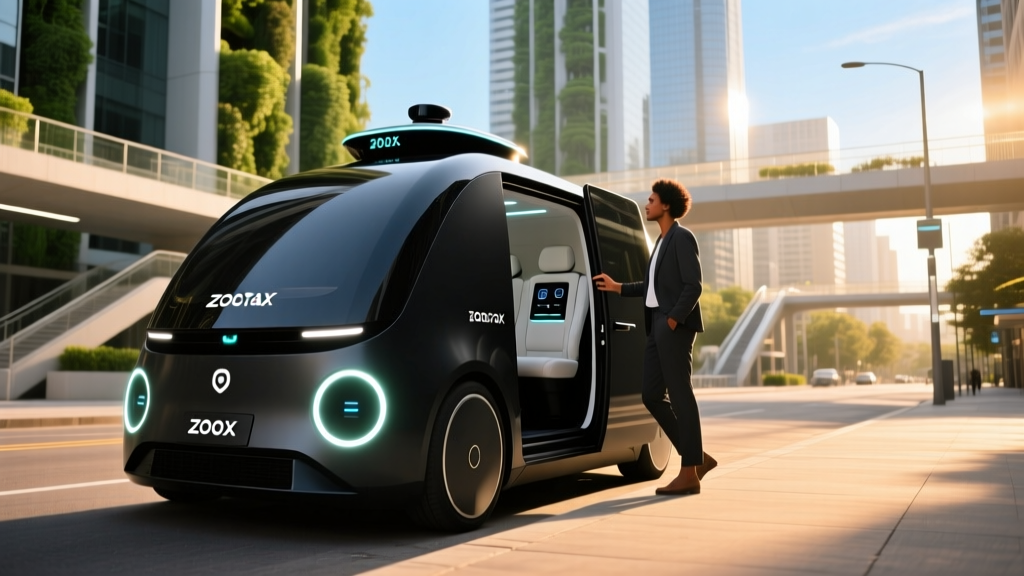
Zoox takes a different physical approach: its purpose-built carriage vehicle is bidirectional (no designated "front"), has four-wheel steering, and places sensors at the corners for maximum coverage. The tradeoff is a top speed around 75 mph and a vehicle that cannot yet be purchased by consumers.
Who Regulates Robotaxis and How Approval Works
Robotaxi regulation in the U.S. is a layered patchwork — there is no single federal license to operate a driverless taxi.
- NHTSA (federal): Regulates vehicle safety standards (FMVSS). NHTSA can grant exemptions to vehicles without steering wheels or mirrors (as it did for Zoox's carriage and GM's Cruise Origin). NHTSA also collects crash data through the Standing General Order and can open defect investigations.
- State DMVs and PUCs: California's DMV issues testing permits and deployment permits. The California Public Utilities Commission (CPUC) issues the actual commercial passenger-service permits — effectively the "taxi license." Arizona takes a lighter-touch approach, with executive orders enabling testing and deployment without the same permit structure. Texas, Nevada, and other states have their own frameworks.
- Local governments: Cities can restrict or negotiate operating terms — San Francisco's Board of Supervisors and the SFMTA have been vocal participants in shaping where and how robotaxis can operate, including speed limits and school-zone restrictions.
The practical result: an operator must clear regulatory hurdles at every level for each new city. This is why expansion is slow. Waymo cannot simply "turn on" Austin the way Uber launches in a new city — it must map the roads, demonstrate safety to state regulators, obtain local operating agreements, and deploy a physical fleet with maintenance infrastructure.
Current Limitations: Where Level 4 Still Falls Short
Level 4 is genuinely autonomous, but it is not universally capable. The limitations are not minor footnotes — they define the entire user experience.
Hard Boundaries of Today's Robotaxis
- Geofencing: The vehicle will not drive outside its mapped service area. If your destination is 200 feet past the geofence boundary, the app will not let you book the ride. You cannot take a Waymo from San Francisco to Sacramento.
- Weather: Heavy rain, fog, and snow degrade LiDAR and camera performance. Waymo operates in light rain in San Francisco but will pause service in severe weather. Phoenix's dry climate is not a coincidence — it is an easier ODD. Snow-belt cities are not on the near-term expansion map.
- Construction zones: Major lane shifts, temporary barriers, and flaggers directing traffic are among the hardest scenarios. The vehicle may slow dramatically, pull over, and request remote guidance — adding minutes to your trip.
- Pickup/drop-off precision: The vehicle uses designated pull-over points, not arbitrary addresses. You may need to walk a half-block to a corner where the car can safely stop. Apartment complexes, parking garages, and drive-throughs are not accessible.
- No highway driving (mostly): Waymo's service includes some highway segments (for example, portions of the I-10 in Phoenix), but the system is primarily optimized for surface streets at 25–45 mph. Long interstate routes are not part of the service model.
- Edge-case conservatism: The vehicle prioritizes safety over assertiveness. In aggressive urban traffic — unprotected left turns across oncoming traffic, four-way stops with ambiguous right-of-way — the robotaxi may wait longer than a human driver would, which can frustrate passengers and other drivers behind it.
- Accessibility: Current Waymo vehicles require passengers to enter a standard SUV. Wheelchair-accessible vehicles are not yet part of the fleet at scale, though Waymo has announced partnerships to address this.
These limitations are not temporary software bugs that a single update will fix. Many — geofencing, weather, accessibility — require hardware changes, physical infrastructure, or regulatory approval to resolve. Anyone projecting Level 4 robotaxis "everywhere" within a few years is not accounting for these compounding constraints.
Frequently Asked Questions
Is Tesla FSD a Level 4 self-driving car?
No. Tesla Full Self-Driving (Supervised) is SAE Level 2. The driver must remain attentive, keep hands available, and is legally responsible for the vehicle at all times. Tesla has not received regulatory approval for driverless operation anywhere. The "Full Self-Driving" name is a product branding choice, not an SAE classification.
Where can I use a self-driving car Level 4 service right now?
As of 2026, Waymo One operates fully driverless commercial rides in Phoenix (East Valley and expanding), San Francisco, Los Angeles (select areas), and Austin (limited). Zoox offers limited pilot rides in Las Vegas and Foster City, CA. Outside these metros, no Level 4 robotaxi service is available to the public.
How much does a robotaxi cost compared to Uber or Lyft?
Waymo One pricing is broadly comparable to UberX and Lyft Standard — typically within $1–$4 on the same route. Waymo does not use surge pricing, which can make it cheaper during peak demand. Short in-geofence rides typically cost $7–$16; airport runs cost $16–$24 depending on distance and city.
How safe are Level 4 robotaxis compared to human drivers?
Waymo's published data, based on over 30 million driverless miles, shows an approximately 85% lower injury-causing crash rate compared to human benchmarks in comparable urban conditions. However, robotaxis operate in constrained environments (good weather, mapped streets, moderate speeds) that are already safer than the national driving average. The Cruise incident of October 2023 demonstrated that edge-case decision-making remains a serious engineering challenge.
Can a robotaxi drive me anywhere I want?
No. Level 4 robotaxis operate only within a pre-mapped geofence — a specific service area measured in tens of square miles. You cannot book a ride that starts or ends outside this boundary. The vehicle also cannot handle severe weather, unmapped construction, or destinations like parking garages and private driveways.
Will Level 4 robotaxis replace Uber and Lyft drivers?
Not in the foreseeable future. Robotaxi fleets are capital-intensive (each vehicle costs well over $100,000 with sensors and compute), limited to favorable geographies, and cannot flex supply the way gig-economy drivers do. They are a complement to rideshare in specific dense urban corridors, not a replacement for the broader market.
What happens if the robotaxi encounters something it cannot handle?
The vehicle will pull over safely and contact a remote assistance advisor. The advisor can confirm a course of action (e.g., proceeding around an obstacle) but does not remotely drive the vehicle. If the situation cannot be resolved, the ride may be ended and you may be asked to exit at a safe location. This is uncommon but does happen, particularly near active construction zones.
Level 4 self-driving cars are real, they are carrying paying passengers today, and the safety data from established operators is encouraging within their defined operating domains. But "self-driving car Level 4" in 2026 means a specific ride in a specific part of a specific city under specific conditions — not a car you can buy, and not a ride you can take anywhere. Understanding that distinction is the difference between being impressed by the technology and being realistic about its reach.