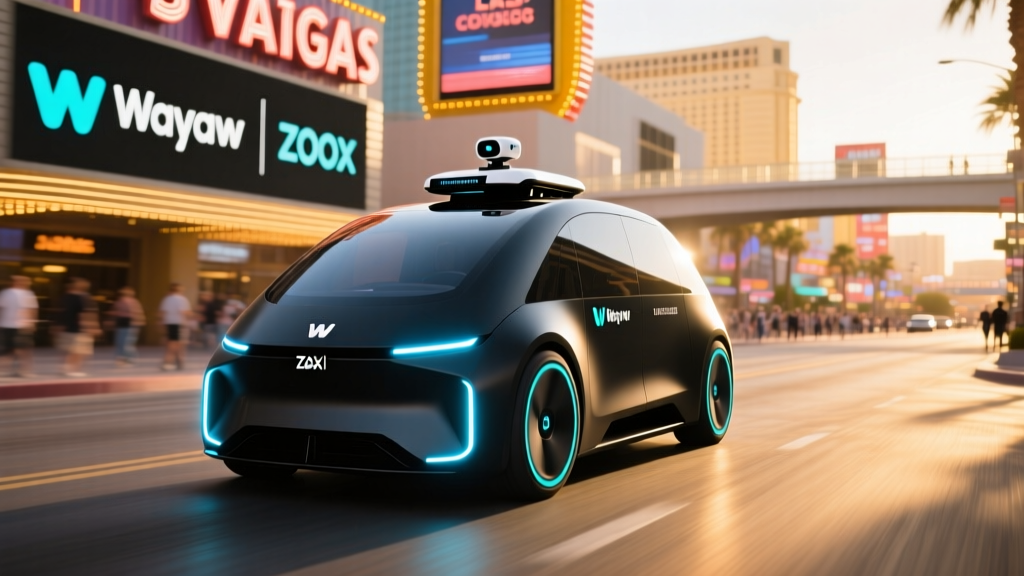
If you have searched for a self-driving car Las Vegas experience, you are not alone. Las Vegas has become one of the most active testing and deployment grounds for autonomous ride-hailing services in the United States. But separating marketing hype from operational reality requires a close look at which services actually pick up passengers without a human behind the wheel, what they cost, how safe they are, and where the geofence boundaries stop.
This guide breaks down the robotaxi landscape in Las Vegas as of 2026 — covering live services, technology differences, pricing, safety records, and the regulatory framework that governs driverless operations in Nevada.
Understanding Autonomy Levels: Robotaxi vs. Driver-Assist
Before evaluating any self-driving car Las Vegas service, it is essential to distinguish between consumer driver-assist systems and true robotaxis. The Society of Automotive Engineers (SAE) defines six levels of driving automation, and the gap between Level 2 and Level 4 is enormous in practice.
| Level | Name | Who Drives | Examples |
|---|---|---|---|
| 0 | No Automation | Human does everything | Traditional vehicles |
| 1 | Driver Assistance | Human + one system (steering OR speed) | Adaptive cruise control |
| 2 | Partial Automation | Human supervises; system handles steering + speed | Tesla Autopilot, GM Super Cruise, Ford BlueCruise |
| 3 | Conditional Automation | System drives in limited conditions; human on standby | Mercedes Drive Pilot (limited markets) |
| 4 | High Automation | System drives fully within geofenced area; no human needed | Waymo, Zoox, Cruise (where operational) |
| 5 | Full Automation | System drives everywhere, all conditions | Does not exist commercially |
Consumer vehicles with Tesla FSD (Supervised), GM Super Cruise, or Ford BlueCruise are Level 2 systems. The driver must remain attentive, hands near or on the wheel (depending on the system), and legally responsible at all times. These are not robotaxis.
The services covered in this guide — Waymo, Zoox, and others operating or testing in Las Vegas — are Level 4. There is no driver. No steering wheel in some vehicles. The company, not the passenger, bears responsibility for the driving task within the approved operational design domain (ODD).
Where Can I Use a Self-Driving Car in Las Vegas Right Now?
Las Vegas is a tier-one robotaxi market, but "available in Las Vegas" requires significant qualification. Each service operates within a defined geofence — a mapped boundary beyond which the vehicle will not travel. Here is the current landscape:
| Service | Status | Geofence Area | Hours | Vehicle |
|---|---|---|---|---|
| Waymo | Live commercial service | Strip corridor, downtown, Convention Center, portions of Summerlin and Henderson (~80+ sq mi expanding) | 24/7 in core zones | Jaguar I-PACE (custom sensor suite), Zeekr RT (newer fleet additions) |
| Zoox | Live limited commercial service | Strip corridor and immediate surrounding area (~15-20 sq mi) | Limited hours, expanding | Zoox purpose-built vehicle (bidirectional, no steering wheel) |
| Cruise (GM) | Testing with safety driver; commercial relaunch in phases | Limited test zones | Restricted | Chevrolet Bolt EV / Origin (pending) |
| Motional (Hyundai/Aptiv) | Testing; limited ride-hail partnerships | Strip and downtown corridor | By invitation/partner app | Hyundai IONIQ 5 robotaxi |
Key takeaway: Waymo is the most accessible option for visitors and residents seeking a truly driverless ride in Las Vegas. Zoox offers a unique experience in its purpose-built vehicle but covers a smaller area. Cruise is rebuilding its operations after its 2023-2024 suspension and has not yet returned to full driverless commercial service in Las Vegas as of early 2026. Motional operates primarily through partnerships (historically Lyft) and remains in a testing/limited-access phase.
To confirm current geofence boundaries, check each provider's app directly — these zones expand incrementally and the in-app map is the authoritative source.
How to Ride a Robotaxi in Las Vegas (and What It Costs)
Booking a Waymo
Download the Waymo One app (available on iOS and Android). Create an account, enter your pickup and drop-off locations, and if both fall within the geofence, you will see a driverless option alongside any human-driven alternatives. The app shows an upfront price, estimated arrival time, and the exact pickup spot (often a specific curb marker or parking-lot corner for precision).
When the vehicle arrives, the app confirms the car's make, color, and license plate. You unlock the doors via the app by tapping a button when you are at the vehicle. Inside, there are rear-seat screens showing your route, and you can start the ride, adjust climate, or add a stop.
Booking a Zoox
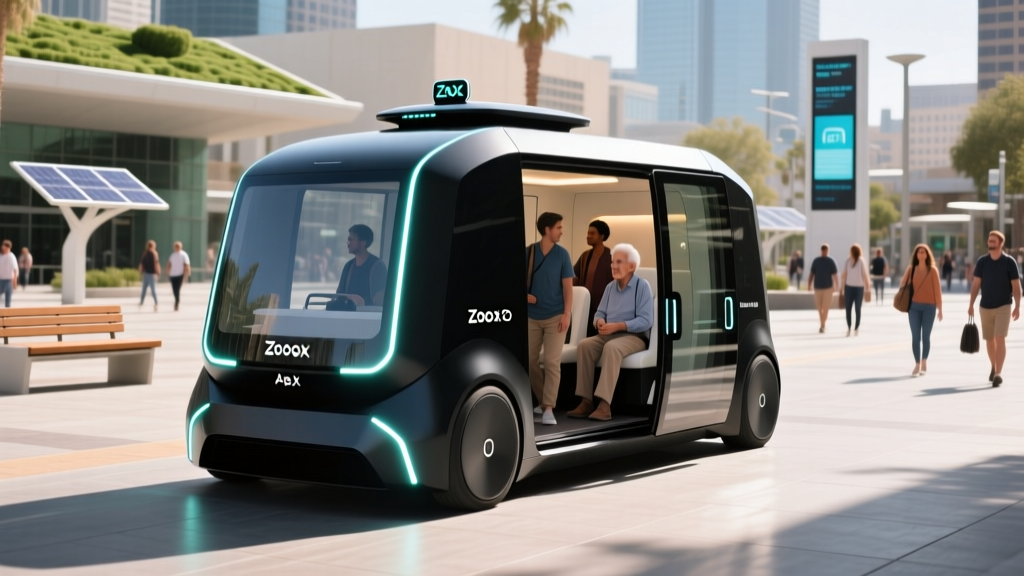
Zoox operates through its own app. Availability is more limited, and you may encounter wait times or zone restrictions. The Zoox vehicle is distinctive — a compact, symmetrical carriage-style design with no steering wheel or pedals, seating four passengers facing each other.
Pricing: Robotaxi vs. Uber and Lyft
| Route | Waymo (driverless) | UberX | Lyft Standard |
|---|---|---|---|
| McCarran Airport (LAS) → Mid-Strip hotel | $18–$26 | $16–$28 | $15–$25 |
| Mid-Strip → Downtown (Fremont St.) | $14–$22 | $12–$22 | $11–$20 |
| Convention Center → Strip hotel (short hop) | $9–$14 | $8–$15 | $8–$14 |
| Strip → Summerlin (suburban) | $22–$35 | $20–$35 | $18–$32 |
Pricing reality check: Robotaxi fares in Las Vegas are generally competitive with UberX and Lyft Standard — sometimes slightly higher during low-demand periods, sometimes lower during surge pricing events when robotaxi pricing remains more stable. Waymo frequently offers promotional credits for first-time riders and periodic discount codes. Neither Waymo nor Zoox currently applies surge multipliers the way Uber and Lyft do, which can make robotaxis the cheaper option during peak convention or event periods. Tipping is not expected (there is no driver), though the app provides the option.
Safety Record: What the Data Actually Shows
Safety is the most scrutinized aspect of robotaxi operations, and Las Vegas is no exception. Here is what the available data tells us, sourced from NHTSA reports, California DMV disengagement data (applicable to companies also operating in CA), and company disclosures.
Robotaxi Safety Data Points
- Waymo cumulative driverless miles (national): Over 10 million fully driverless miles completed across Phoenix, San Francisco, Los Angeles, and other markets as of late 2025, with Las Vegas contributing a growing share.
- Waymo injury-causing crash rate: According to Waymo's published safety data and independent analyses, Waymo driverless vehicles have been involved in injury-causing crashes at a rate approximately 85% lower than human-driven benchmarks in comparable urban environments (per IIHS-cited studies).
- Contact rate: Waymo reports a property-damage contact rate roughly 75% lower than human drivers in the same operating cities.
- Cruise 2023 incident: Cruise's October 2023 San Francisco incident — in which a pedestrian was struck by a human-driven vehicle and then dragged by a Cruise robotaxi that pulled over — led to nationwide suspension of Cruise operations. This remains the most significant robotaxi safety event in the U.S. to date. Cruise has since restructured its safety protocols and is conducting phased, safety-driver-equipped testing before any return to driverless service.
- Zoox: Zoox has accumulated fewer public driverless miles than Waymo. Its NHTSA crash-reporting record shows minor contact incidents consistent with low-speed urban operations; no serious injuries reported in driverless mode as of early 2026.
- NHTSA Standing General Order: All robotaxi operators are required under NHTSA's Standing General Order (since 2021) to report crashes involving ADS-equipped vehicles within 24 hours. This data is publicly accessible and provides ongoing transparency.
Context matters: Robotaxis operate primarily in dense urban environments at moderate speeds (typically under 45 mph). The types of incidents they encounter — low-speed sideswipes, curb contacts, encounters with erratic human drivers and pedestrians — differ from highway-speed collisions. The data consistently shows that Level 4 robotaxis are involved in fewer severe crashes per mile than human drivers in comparable conditions, but they do occasionally cause property damage and draw criticism for overly cautious behavior that can confuse surrounding traffic (e.g., unexpected stops, hesitation at unprotected left turns).
Technology Stack: How Robotaxis See the Road
The sensor and computing systems on Las Vegas robotaxis represent some of the most sophisticated perception stacks in production use. Here is how the major platforms differ:
Waymo (Jaguar I-PACE / Zeekr RT)
- LiDAR: Multiple roof-mounted and body-integrated LiDAR units providing 360-degree 3D point-cloud mapping out to 300+ meters. Waymo's custom 5th-generation LiDAR is a core differentiator.
- Cameras: High-resolution camera array covering all directions, used for lane detection, traffic-light state recognition, sign reading, and object classification.
- Radar: Multiple radar units for velocity detection of moving objects, functioning in conditions where cameras and LiDAR may be degraded.
- Audio sensors: External microphones capable of detecting sirens from emergency vehicles and determining their direction.
- HD Maps: Centimeter-precision pre-mapped routes. The vehicle localizes itself against this map in real time. This means Waymo does not operate outside its mapped geofence.
- Compute: Custom-designed Waymo Driver compute platform handling sensor fusion, prediction, and planning at high frequency.
Zoox (Purpose-Built Vehicle)
- LiDAR: Roof-mounted and corner-integrated LiDAR providing overlapping 360-degree coverage.
- Cameras: Multi-spectrum camera suite for redundancy across lighting conditions.
- Radar: Full-surround radar coverage.
- Vehicle design: Bidirectional driving capability (the vehicle can travel in either direction without turning around), four-wheel steering for tight urban maneuvering, and a symmetric cabin with no driver controls.
Motional (Hyundai IONIQ 5 Robotaxi)
- LiDAR: Roof-mounted LiDAR array (multiple units) plus short-range sensors.
- Cameras: Surround-view camera system integrated into the IONIQ 5's body.
- Radar: Production-grade radar supplemented by Motional's custom long-range units.
- Platform advantage: Built on Hyundai's E-GMP dedicated EV platform, providing a flat floor, 800V architecture, and predictable vehicle dynamics for the motion-planning stack.
LiDAR vs. camera-only: Tesla's consumer FSD system uses a camera-only ("Tesla Vision") approach, arguing that neural networks can extract sufficient depth and velocity data from video. Every major Level 4 robotaxi operator uses LiDAR as a primary sensor, providing direct distance measurement independent of lighting conditions. This redundancy is considered essential for driverless operation where no human is available as a fallback. The Las Vegas environment — bright desert sun, occasional dust storms, nighttime neon glare — tests both approaches severely.
Regulatory Framework: Who Approves Robotaxis in Nevada?
Nevada was the first U.S. state to pass legislation enabling autonomous vehicle testing and deployment (AB 511, signed in 2011). The regulatory structure today involves multiple layers:
- Nevada DMV: Issues autonomous vehicle testing and deployment permits. Companies must demonstrate insurance coverage (minimum $5 million), submit safety plans, and report disengagement and incident data.
- Nevada Legislature: Sets the statutory framework. Nevada law explicitly permits fully driverless operation (no safety driver required) for vehicles meeting deployment-permit requirements.
- Local jurisdictions: Clark County and the City of Las Vegas coordinate on road access, particularly for the Strip corridor (which is technically unincorporated Clark County, not the City of Las Vegas). The Las Vegas Convention and Visitors Authority (LVCVA) has been involved in pilot programs.
- NHTSA (federal): Regulates vehicle safety standards. Current Federal Motor Vehicle Safety Standards (FMVSS) assume a human driver (steering wheel, mirrors, pedals). Zoox received a limited FMVSS exemption for its purpose-built vehicle, which lacks these controls. NHTSA also mandates crash reporting under its Standing General Order.
- Federal Motor Carrier Safety Administration (FMCSA): Relevant if robotaxi services expand to larger vehicles or interstate routes.
Nevada's regulatory posture is generally considered permissive compared to states like California, where the DMV and Public Utilities Commission (CPUC) exercise more granular oversight and have suspended permits (as occurred with Cruise in October 2023). This relative openness is one reason Las Vegas has attracted multiple robotaxi operators.
Current Limitations: What Robotaxis Cannot Do
Even in a robotaxi-friendly market like Las Vegas, Level 4 systems face significant operational constraints. Understanding these limitations prevents unrealistic expectations.
Geofence Boundaries
Robotaxis will not travel outside their pre-mapped, approved zone. If your destination falls outside the geofence, the app will not offer the ride. Geofence boundaries in Las Vegas generally cover the Strip corridor, downtown, the Convention Center, and expanding suburban pockets — but not the entire metro area. Remote suburbs, mountain roads, and rural routes are excluded.
Weather Constraints
Las Vegas is relatively favorable for autonomous operation (dry climate, wide roads, minimal snow). However, monsoon-season dust storms (haboobs), heavy rain causing flash flooding, and dense smoke from regional wildfires can degrade sensor performance and cause service restrictions or temporary suspensions. Waymo's Phoenix operations have occasionally paused during extreme dust events, and the same applies to Las Vegas.
Construction Zones and Road Changes
The Strip and surrounding areas undergo frequent construction. If a mapped route is altered by temporary barriers, lane shifts, or detours, the robotaxi may reroute conservatively, stop and request remote assistance, or decline the route entirely. Expect occasional longer-than-expected routes as the system avoids unmapped construction areas.
Edge Cases
- Unprotected left turns across heavy traffic: Robotaxis may wait longer than a human driver would, or choose a right-turn-only route to avoid the maneuver entirely.
- Emergency vehicles: The system detects sirens and pulls over, but the response timing can occasionally cause brief traffic disruption.
- Unusual road users: Pedestrians behaving unpredictably, animals on the road, or non-standard vehicles (horse-drawn carriages, parade floats) may cause the vehicle to stop and wait.
- Parking garages and valet areas: Most robotaxi services pick up and drop off at street-level designated spots, not inside parking structures or hotel porticos.
No Interstate or Highway-Only Routes
Current Las Vegas robotaxi services do not operate on I-15 between cities (e.g., Las Vegas to Los Angeles). Operations are urban-only within the geofence. Highway-speed autonomous driving is technically feasible and is being tested, but it is not part of the current commercial offering.
Accessibility
Waymo's Jaguar I-PACE fleet can accommodate most passengers but is not wheelchair-accessible in the standard configuration. Waymo has been developing WAV (wheelchair-accessible vehicle) options in select markets. Zoox's purpose-built vehicle features a low floor and wide doors, but full ADA compliance details vary. If you require wheelchair accessibility, check the app for WAV availability before relying on robotaxi service.
Frequently Asked Questions
Is a self-driving car in Las Vegas truly driverless, or is there a safety operator?
Waymo's commercial rides in Las Vegas are fully driverless — no one is in the driver's seat. Zoox's vehicle has no driver controls at all. Cruise's current Las Vegas testing uses a human safety driver behind the wheel. If you book through the Waymo One app and see the "Driverless" label, there is no human operator in the vehicle. Consumer vehicles with Tesla Autopilot or FSD (Supervised) always have a human driver — these are Level 2 systems and are not robotaxis.
How much does a robotaxi ride cost compared to Uber or Lyft in Las Vegas?
Robotaxi fares are broadly comparable to UberX and Lyft Standard for the same route, typically within $2–$5 of rideshare pricing. The key advantage is price stability: robotaxis do not use surge pricing, so during major conventions (CES, SEMA) or holiday weekends when Uber fares spike 2–3x, a Waymo may be significantly cheaper. Short Strip hops typically run $9–$14; airport-to-Strip rides are $18–$26.
Can I get a robotaxi from McCarran (Harry Reid) Airport?
Waymo has expanded its Las Vegas geofence to include Harry Reid International Airport (LAS) as a pickup/drop-off zone. However, airport rides may be subject to specific staging-area rules, and wait times can be longer than a standard rideshare. Check the Waymo One app at the time of your arrival for real-time availability.
What happens if the robotaxi encounters a problem during my ride?
Both Waymo and Zoox vehicles are connected to remote operations centers. If the vehicle encounters a scenario it cannot resolve autonomously (e.g., an unusual construction zone, a disabled vehicle blocking all lanes), it will pull over safely and either wait for the situation to clear or connect with a remote operator who can provide guidance. In-app support is available, and the vehicle can be manually unlocked by remote operations if needed. Emergency services can be contacted through the in-vehicle interface.
Are robotaxis safer than human-driven rideshare?
Available data suggests yes, for the types of driving they perform. Waymo's published analysis indicates its driverless vehicles are involved in injury-causing crashes at roughly 85% lower rates than human benchmarks in comparable urban settings. However, robotaxis operate in geofenced, mapped urban areas at moderate speeds — they do not face highway-speed or rural-road scenarios. They also occasionally cause minor property-damage incidents and can behave overly conservatively in ways that frustrate other road users. No system is incident-free, and NHTSA's Standing General Order ensures all crashes are reported publicly.
Why did Cruise stop operating, and has it returned to Las Vegas?
Cruise suspended all driverless operations nationwide in October 2023 after a serious incident in San Francisco where a robotaxi dragged a pedestrian who had been struck by another vehicle. The company lost its California DMV deployment permit, paused operations in all cities, and underwent a major safety review and leadership restructuring. As of 2026, Cruise has resumed limited testing with human safety drivers in select markets and is pursuing a phased return to commercial service, but it has not yet returned to full driverless operations in Las Vegas.
Will robotaxis eventually replace Uber and Lyft entirely?
Not in the near term. Robotaxis are limited to geofenced urban areas, cannot handle highway intercity routes, face weather constraints, and require enormous capital investment per vehicle (sensor suites on a Waymo-equipped vehicle add significant cost above the base vehicle price). Rideshare with human drivers will remain dominant for suburban, rural, highway, and adverse-weather trips for years. The more likely trajectory is a hybrid model where robotaxis handle high-density urban cores and human drivers cover everything else.
Las Vegas remains one of the best cities in the U.S. to experience a Level 4 robotaxi firsthand. If you are visiting for a convention or vacation, a Waymo ride from your hotel to a downtown restaurant or from the airport to the Strip is a practical, competitively priced option — not a novelty demo. Just understand the geofence, expect conservative driving behavior, and recognize that this technology, while impressive, is bounded by real and specific limitations.