The debate over autonomous vehicle safety often centers on a single, critical question: how does the self-driving car accident rate vs human drivers actually compare? As of early 2026, fully driverless robotaxis from companies like Waymo, Zoox, and a restructured Cruise operation are logging millions of paid passenger miles in select U.S. cities. The data is no longer theoretical — it's measurable, reportable, and increasingly scrutinized by regulators.
This guide breaks down the real safety numbers behind Level 4 robotaxi services, explains how they differ fundamentally from the Level 2 driver-assist systems in consumer EVs, and gives you the practical details on where these services operate, what they cost, and where they still fall short.
Level 2 vs. Level 4: Why the Distinction Matters for Safety Data
Before comparing accident rates, it's essential to separate two categories of automation that are routinely — and incorrectly — conflated in media coverage.
| Level | Name | Who Drives? | Examples |
|---|---|---|---|
| Level 2 | Driver Assistance | Human (must stay engaged) | Tesla Autopilot/FSD Supervised, GM Super Cruise, Ford BlueCruise |
| Level 3 | Conditional Automation | System (human on standby) | Mercedes Drive Pilot (limited conditions) |
| Level 4 | High Automation | System (no driver needed in zone) | Waymo One, Zoox, Cruise (restructured) |
| Level 5 | Full Automation | System (all conditions) | Does not yet exist commercially |
Consumer EVs sold today — even those marketed with terms like "Full Self-Driving" — are SAE Level 2. The human driver is legally and operationally responsible at all times. When we discuss "self-driving car accident rates" in this article, we're referring exclusively to Level 4 robotaxi services that operate without a human driver in the vehicle. Their safety record is a separate data set from Level 2 crash statistics.
Self-Driving Car Accident Rate vs Human: What the Numbers Show
The most comprehensive public safety data for robotaxis comes from California, where the California DMV requires operators to file annual disengagement and collision reports, and from the National Highway Traffic Safety Administration (NHTSA), which mandates crash reporting for all vehicles equipped with SAE Level 2 and above systems.
- Waymo: Over 5 million fully driverless miles completed by mid-2024, with a published study showing a 85% reduction in injury-causing crash rates compared to human benchmarks in comparable urban driving environments.
- Human driver benchmark (U.S.): Approximately 1.35 fatalities per 100 million vehicle miles traveled (NHTSA, 2022 data), with injury-causing crashes occurring roughly 50–80 times per 100 million miles in urban settings.
- Cruise: Following a serious October 2023 incident in San Francisco involving a pedestrian, Cruise suspended all operations, underwent a corporate restructuring, and resumed limited supervised testing in 2024–2025 before phased driverless relaunch.
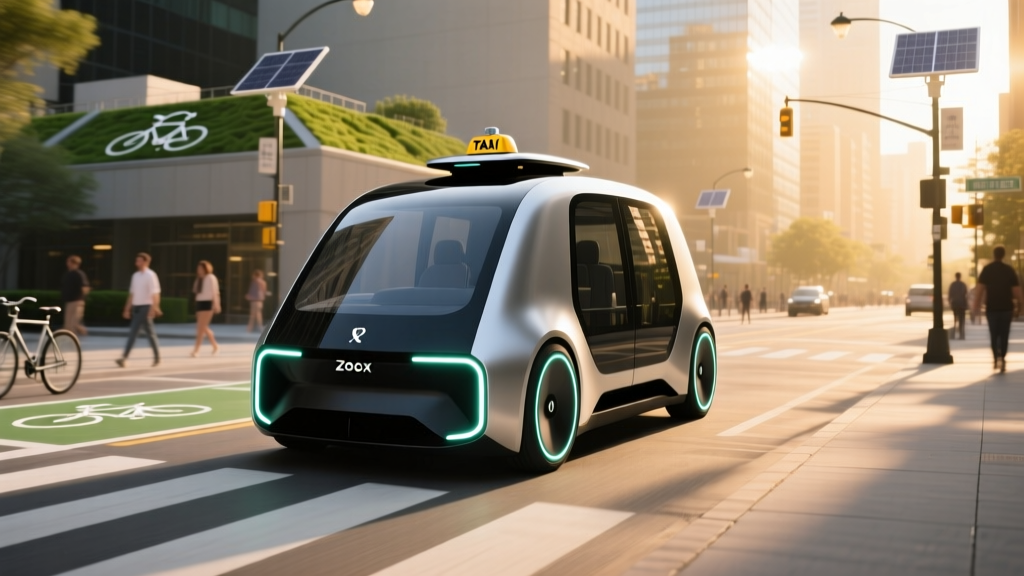
- Zoox: Operating its purpose-built, bidirectional robotaxi in limited paid service in Las Vegas and Foster City, CA, with a smaller cumulative mileage base but zero reported at-fault collisions in paid passenger service through early 2026.
Waymo's peer-reviewed safety study, published in collaboration with Swiss Re, analyzed over 3.8 million autonomous miles and found that Waymo vehicles were involved in 76% fewer property-damage-only crashes and 85% fewer injury-causing crashes per million miles compared to human-driven vehicles in the same operating domains. These are not marketing figures — they were benchmarked against established insurance actuarial data.
However, context matters. Robotaxis currently operate in geofenced urban zones at relatively low speeds (typically under 45 mph), in mapped environments, and predominantly in fair weather. Comparing their crash rate directly to the national average — which includes rural highways, nighttime driving, and severe weather — requires careful normalization. Waymo's own researchers acknowledge this, and the Swiss Re study applied exposure-adjusted comparisons to account for the operating domain.
Where Robotaxis Still Face Challenges
The data also reveals scenarios where robotaxis have struggled:
- Construction zones and temporary lane shifts: Unmapped changes remain a leading cause of disengagements and conservative stops.
- Emergency vehicles: Several incidents have involved robotaxis failing to yield promptly to approaching fire trucks and ambulances, prompting updated protocols.
- Complex multi-point turns: In tight urban streets, robotaxis occasionally execute maneuvers that block traffic or require remote-assistance intervention.
Where Can You Actually Ride a Robotaxi in 2026?
Robotaxi availability remains limited to specific geofenced zones within a handful of U.S. metro areas. Here's the current operational landscape:
| Operator | City/Region | Service Type | Hours |
|---|---|---|---|
| Waymo One | Phoenix, AZ (metro-wide) | Fully driverless, paid | 24/7 |
| Waymo One | San Francisco, CA | Fully driverless, paid | 24/7 |
| Waymo One | Los Angeles, CA | Fully driverless, paid | 24/7 |
| Waymo One | Austin, TX | Fully driverless, paid | Limited hours |
| Zoox | Las Vegas, NV (Strip corridor) | Fully driverless, paid | Select hours |
| Zoox | Foster City, CA | Fully driverless, paid | Select hours |
| Cruise (GM) | Phoenix, AZ / Dallas, TX (phased) | Supervised → driverless relaunch | Limited |
Waymo remains the clear market leader in terms of geographic coverage and ride volume. Expansion to additional cities (including potential 2026 announcements for Miami and Atlanta) has been discussed but is not yet live. Zoox's purpose-built vehicle — which has no steering wheel or pedals — represents a different approach but serves far fewer riders. Cruise, following its 2023 safety incident, has taken a deliberately slower path back to driverless operations under heightened regulatory scrutiny.
Robotaxi Pricing: How Does It Compare to Uber and Lyft?
For riders accustomed to rideshare surge pricing, robotaxi fares can be surprisingly competitive — though the pricing model is still evolving.
| Metric | Waymo One | UberX (Comparable) | Lyft Standard |
|---|---|---|---|
| Base fare | $5–$8 | $3–$6 | $3–$5 |
| Per-mile rate | $1.50–$2.25 | $1.25–$2.00 | $1.20–$1.80 |
| 5-mile trip (typical) | $13–$20 | $10–$17 | $9–$15 |
| Surge pricing | Rare / capped | Common (1.5x–3x) | Common (1.5x–3x) |
| Tipping | Not applicable | Expected ($2–$5) | Expected ($2–$5) |
On a per-ride basis, Waymo fares are generally 10–25% higher than a non-surged UberX or Lyft ride for the same distance. However, the absence of surge pricing and tipping can make robotaxis cheaper during peak demand periods. A Friday-night airport run that might surge to $45 on Uber could be $22 on Waymo — if a vehicle is available.
To use Waymo One, download the Waymo app, set your pickup and dropoff within the service zone, and a vehicle arrives — typically within 3–8 minutes in Phoenix, slightly longer in denser urban areas like San Francisco. The vehicle is a Jaguar I-PACE EV equipped with Waymo's 5th-generation Driver system. You unlock it via the app, buckle up, and the ride begins with no one in the driver's seat.
Under the Hood: Robotaxi Technology Stack Explained
Unlike Tesla's camera-only approach for its consumer FSD system, production robotaxis rely on a multi-sensor fusion stack:
- LiDAR (Light Detection and Ranging): Roof-mounted and fender-mounted units create a real-time 3D point cloud of the environment, accurate to centimeters at ranges up to 200+ meters. This works identically in darkness and daylight.
- Cameras: A surround-view array (typically 8–12 cameras) handles object classification, traffic-light state detection, and signage reading.
- Radar: Forward and corner radars detect velocity and distance of moving objects, particularly useful in rain or fog where LiDAR performance can degrade.
- HD Maps + Localization: Every operational zone is pre-mapped at centimeter-level resolution. The vehicle continuously matches its sensor data against this map for precise localization — it knows exactly where it is within inches.
- Geofencing: The vehicle will only operate within its pre-approved operational design domain (ODD). If a route would take it outside this boundary, the system refuses the ride or reroutes.
This sensor redundancy is the fundamental safety architecture that distinguishes Level 4 robotaxis from consumer Level 2 systems. If one sensor modality degrades (e.g., heavy rain affecting LiDAR), the others compensate. The vehicle also has redundant braking, steering, and computing systems — if the primary compute unit fails, a backup can bring the vehicle to a controlled stop.
The tradeoff is cost. A single Waymo 5th-gen vehicle is estimated to carry $100,000–$150,000+ in sensor and compute hardware on top of the base Jaguar I-PACE (MSRP ~$72,000). This is why robotaxi economics depend on high utilization rates — the vehicle needs to be earning revenue nearly around the clock to amortize that capital cost.
Regulatory Landscape: Who Approves Robotaxi Operations?
Robotaxi deployment in the United States is governed by a patchwork of state and local regulations, with no comprehensive federal framework yet in place.
- California (CPUC + DMV): The California Public Utilities Commission (CPUC) issues permits for commercial passenger service, while the DMV handles testing permits and collects disengagement/collision data. Operators must hold both.
- Arizona: Among the most permissive states. No specific permit is required beyond standard vehicle registration and insurance, which is why Phoenix became Waymo's first commercial market.
- Texas: Austin and Dallas have seen robotaxi activity under relatively light-touch state regulation, though local authorities have some say in operational zones.
- Nevada: Nevada's DMV oversees autonomous vehicle testing and deployment permits, enabling Zoox's Las Vegas operations.
- Federal (NHTSA): NHTSA does not "approve" robotaxi services but mandates crash reporting for all Level 2+ systems and retains authority to investigate safety defects and issue recalls. NHTSA's Standing General Order requires automated driving system operators to report crashes within one day.
This fragmented regulatory environment means that a robotaxi company approved in Phoenix may need an entirely separate approval process — with different safety documentation requirements — to operate in San Francisco. For consumers, this translates to slow geographic expansion regardless of technical readiness.
Current Limitations: What Robotaxis Cannot Do
- Weather restrictions: Heavy rain, fog, and snow degrade LiDAR and camera performance. Waymo and others will suspend service or limit operations in adverse conditions. In Phoenix monsoon season, expect cancellations.
- Geofence boundaries: You cannot hail a robotaxi to a destination outside the pre-mapped zone. In San Francisco, this means no rides across the Golden Gate Bridge to Marin or south past Daly City in most cases.
- No highway driving (mostly): Current robotaxi services primarily operate on surface streets. Limited freeway segments are included in some zones (e.g., Phoenix), but long-distance highway travel is not available.
- Pickup/dropoff precision: Robotaxis may stop a short walk from your exact requested location if the system determines the precise spot is unsafe for stopping.
- No food or open containers: Without a driver to enforce rules, operators use in-cabin cameras and enforce strict policies — violations can result in account suspension.
- Accessibility gaps: Current Waymo vehicles (Jaguar I-PACE) require riders to enter a standard vehicle. Wheelchair-accessible robotaxis are not yet widely deployed, though Zoox's purpose-built design aims to address this.
- Edge cases still cause delays: Construction zones, double-parked delivery trucks, and unusual road configurations can cause the vehicle to stop and wait for remote guidance, adding minutes to your trip.
Frequently Asked Questions
Is this truly self-driving or driver-assist?
Level 4 robotaxis like Waymo and Zoox are genuinely driverless — there is no human in the driver's seat, and no expectation for the passenger to intervene. This is categorically different from Tesla's FSD Supervised, GM's Super Cruise, or Ford's BlueCruise, which are all Level 2 driver-assist systems that require an attentive human driver at all times. When you see "self-driving" in marketing for consumer vehicles, it means Level 2. When you see it for robotaxis, it means Level 4.
How safe are robotaxis compared to human drivers, really?
The most rigorous data available — Waymo's Swiss Re partnership study analyzing 3.8+ million driverless miles — shows an 85% lower injury-causing crash rate and a 57% lower rate of any police-reported crash compared to human benchmarks in the same urban environments. However, this data reflects specific conditions: geofenced, mapped, low-to-moderate speed urban zones. Robotaxis have not been tested at scale in highway-speed, rural, or severe-weather conditions. The safety advantage is real but domain-specific.
Where can I use a robotaxi service right now?
As of early 2026, the largest operational areas are Phoenix, AZ (Waymo, metro-wide 24/7), San Francisco, CA (Waymo, 24/7), Los Angeles, CA (Waymo, 24/7), and Las Vegas, NV (Zoox, limited zone). Austin, TX has Waymo service with more limited hours. Cruise is in a phased relaunch in Phoenix and Dallas. You must be within the geofenced zone to request a ride.
How much does a robotaxi ride cost vs. Uber or Lyft?
Expect to pay roughly 10–25% more than a non-surged UberX or Lyft ride for the same distance, with a typical 5-mile trip costing $13–$20 on Waymo. The advantage is pricing consistency: no surge multipliers, no tipping. During peak demand, a robotaxi can actually be the cheaper option.
What happens if something goes wrong during my ride?
Robotaxis have remote support teams monitoring operations. If the vehicle encounters an unresolvable situation, it will pull over safely and a remote operator can assist. There is also an in-app support button and a physical help button inside the vehicle. In the event of a collision, the vehicle is designed to stop, contact emergency services if needed, and preserve sensor data for investigation.
Will robotaxis replace Uber and Lyft drivers?
Not in the near term. Robotaxi coverage is limited to a handful of cities and specific zones within those cities. The capital cost per vehicle ($170,000–$220,000+ fully equipped), regulatory approval timelines, and operational constraints mean that human-driven rideshare will remain dominant outside robotaxi zones for years. The long-term economic model depends on achieving very high utilization rates to offset hardware costs.
The Bottom Line on Robotaxi Safety in 2026
The self-driving car accident rate vs human driver comparison now has enough real-world data to draw meaningful — if qualified — conclusions. In their current operating domains (mapped, geofenced, urban, fair-weather, low-to-moderate speed), Level 4 robotaxis from Waymo demonstrate a measurably lower crash rate than human drivers, with the most credible data showing a 76–85% reduction in reportable crashes per million miles.
That safety advantage comes with significant operational constraints that riders should understand before booking. Robotaxis are not a universal replacement for rideshare — they're a specialized service available in specific zones, under specific conditions, at a modest price premium. For those within a service area, they represent the first commercially available transportation option that is statistically safer than having a human behind the wheel — a milestone that was theoretical just a few years ago and is now backed by millions of miles of data.