Is a Self-Driving BMW Real — or Just Marketing?
Search for "self driving BMW" and you'll find a tangle of headlines, teaser videos, and forum debates. The reality in 2026 is precise and nuanced: BMW does not sell a driverless car. What BMW does offer is some of the most advanced driver-assist and conditional-automation technology available to retail buyers — specifically Level 2 systems across its lineup and a certified Level 3 system available on select models in limited markets.
Understanding exactly what BMW's autonomous tech can and cannot do is the difference between a confident highway commute and a dangerous misunderstanding. Let's map BMW's current self-driving capabilities against the SAE automation framework, examine real-world availability, and clarify how this compares to true robotaxi services like Waymo.
| Level | Name | Who Drives? | Example |
|---|---|---|---|
| 0–1 | Assistance | Human (car helps steer OR brake) | Cruise control, lane-keep |
| 2 | Partial Automation | Human (car steers AND brakes; you supervise) | BMW Driving Assistant Professional, Tesla Autopilot |
| 3 | Conditional Automation | Car (in strict conditions; human on standby) | BMW Highway Assistant (Germany/Autobahn) |
| 4 | High Automation | Car (geofenced area, no human needed) | Waymo, Zoox robotaxis |
| 5 | Full Automation | Car (anywhere, any condition) | Does not exist in production |
BMW's Current Autonomous Technology Stack
BMW's self-driving technology in 2026 splits into two distinct tiers, each built on different hardware and legal frameworks.
Level 2: Driving Assistant Professional
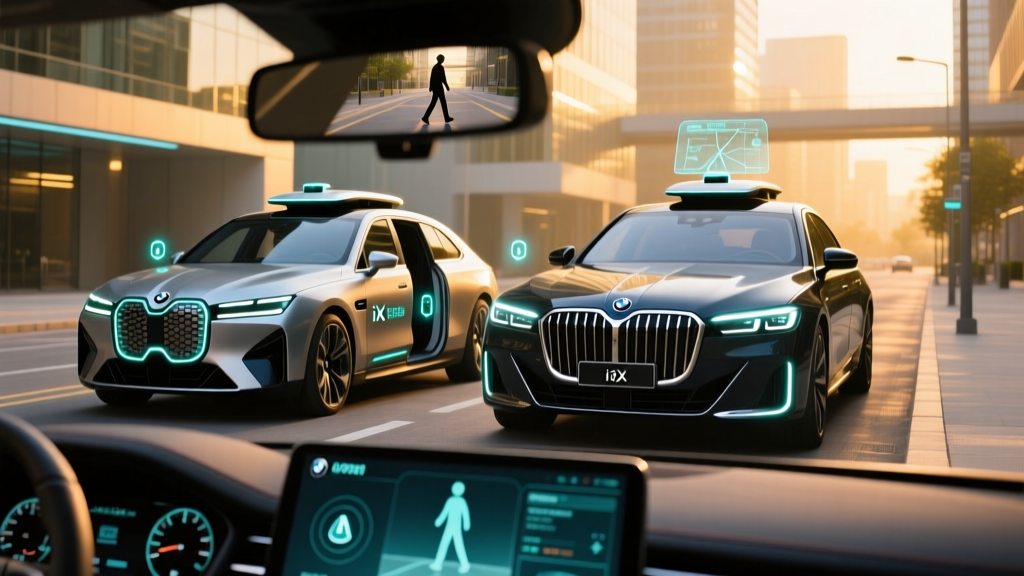
Available on virtually every 2026 BMW model — from the i4 and iX to the 7 Series and X5 — Driving Assistant Professional is BMW's top-tier Level 2 system. It combines adaptive cruise control, lane-centering, automatic lane-change (with turn-signal confirmation), and stop-and-go traffic management. The driver must keep hands on or near the wheel and eyes on the road at all times.
- Cameras: Front-facing trifocal camera cluster (wide, medium, telephoto) behind windshield; 4 surround-view cameras
- Radars: 5 radar units (1 long-range front, 4 corner-mounted mid-range)
- Ultrasonics: 12 parking-distance sensors
- No lidar: Level 2 BMW models do not include lidar sensors
Level 3: Personal Pilot L3 (Highway Assistant)
BMW's Personal Pilot L3 is a certified SAE Level 3 system, meaning the car assumes full driving responsibility under strict conditions. The driver may legally look away from the road (reading, watching a screen) but must be prepared to resume control within approximately 10 seconds when prompted.
As of 2026, BMW's Level 3 Highway Assistant is:
- Approved in Germany for use on suitable Autobahn sections at speeds up to 60 km/h (37 mph) in congested traffic
- Available on the 7 Series (G70) and i7 as an option (approximately €6,000 / ~$6,500)
- Expanded to select new models including the redesigned 5 Series in European markets
- Not available in the United States due to the absence of a federal regulatory framework for Level 3 consumer vehicles
- Cameras: Expanded multi-camera array with redundant front-facing units
- Radars: Long-range front radar + 4 corner radars (upgraded resolution)
- Lidar: Roof-mounted lidar unit (Innoviz or Luminar-sourced, depending on model year) — this is the critical hardware differentiator from Level 2
- Ultrasonics: 12 sensors
- Redundancy: Dual-redundant steering and braking actuators; separate power supply for autonomous-driving compute
Where Can You Actually Use BMW's Self-Driving Tech?
This is where the "self driving BMW" promise meets geographic and legal reality.
| Region | Level 2 (Driving Assistant Pro) | Level 3 (Highway Assistant) | Notes |
|---|---|---|---|
| United States | ✅ All 50 states (model-dependent) | ❌ Not approved | No federal Level 3 framework; BMW has not sought state-by-state approval |
| Germany | ✅ Nationwide | ✅ Approved Autobahn sections, ≤60 km/h | UN Regulation 157 certified; BMW first OEM to offer L3 in Germany |
| Rest of EU | ✅ Nationwide (most countries) | ⚠️ Rolling approval (France, Netherlands expected) | Each country must adopt UN R157 domestically |
| China | ✅ Major cities | ⚠️ Testing with permits; no retail L3 sales yet | BMW holds L3 test licenses in Beijing, Shanghai |
| UK / Japan / South Korea | ✅ Available | ⚠️ Under regulatory review | Japan has separate L3 framework (Honda Legend precedent) |
Key takeaway for US buyers: If you purchase a 2026 BMW iX, i7, or 7 Series in the United States, you are buying a Level 2 vehicle. The hardware may include lidar on higher trims, but the software is legally restricted to driver-supervised operation. There is no "self-driving" BMW you can buy in America today.
BMW vs. Robotaxi Services: How Do They Compare?
BMW's consumer autonomous tech and robotaxi services like Waymo One occupy fundamentally different positions on the SAE scale. Here's a direct comparison:
| Attribute | BMW (Level 2 / Level 3) | Waymo One (Level 4 Robotaxi) |
|---|---|---|
| SAE Level | 2 (US) / 3 (Germany, limited) | 4 (geofenced) |
| Driver required? | Yes (L2) / On standby (L3) | No driver in vehicle |
| Where available | Any road (L2); specific Autobahn sections (L3) | Phoenix, San Francisco, Los Angeles, Austin (geofenced zones) |
| Cost model | Vehicle purchase ($60K–$120K+); you own the car | Per-ride pricing (comparable to Uber/Lyft) |
| Weather limits | L2 works in most conditions; L3 restricted to clear weather | Service suspended in heavy rain, fog, extreme weather |
| Lidar | L3 models only (roof-mounted) | 5+ lidar units, 360° coverage, custom-built |
Robotaxi Pricing vs. Ownership
For context on what true Level 4 autonomy costs per ride, here's how Waymo One pricing compares to conventional rideshare in 2026:
| Service | Estimated Fare | Availability |
|---|---|---|
| Waymo One | $12–$18 | Phoenix, SF, LA, Austin |
| UberX | $10–$16 | Nationwide |
| Lyft Standard | $10–$15 | Nationwide |
| Cruise (GM) | $8–$14 (promotional) | Limited; post-2024 safety review re-launch in select cities |
Robotaxi fares have converged with human-driven rideshare, but availability remains confined to a handful of geofenced metro areas. BMW's Level 2 tech works on any road in America — a fundamentally different value proposition.
Safety Data: What the Numbers Actually Show
BMW does not publish intervention-rate data for its consumer driver-assist systems the way Waymo reports to the California DMV. Here's what we do know from available sources:
- Deployment: Launched on 7 Series in Germany, late 2023; expanded through 2024–2026
- Activation conditions: Suitable Autobahn sections, traffic congestion, speeds ≤60 km/h (37 mph), clear lane markings, good weather
- Liability: BMW assumes legal liability for accidents occurring while L3 is properly engaged — a first for a mass-market OEM
- Reported incidents: No publicly reported L3-at-fault collisions as of early 2026 (source: NHTSA database, German KBA records)
- Limitation: Low deployment volume (limited to congested Autobahn sections) means statistically small sample size
- Miles driven: Over 30 million fully driverless miles as of early 2026 (Waymo Safety Report)
- Collision rate: Waymo reports 85% fewer injury-causing crashes per million miles compared to human benchmarks in Phoenix and SF
- Notable incidents: Recall of ~1,200 vehicles in early 2025 after a pickup-truck collision in Phoenix; software patch applied
- Regulatory status: Active operations in 4+ US cities under state-issued permits
The critical distinction: Waymo's safety data comes from millions of driverless miles in controlled geofenced areas. BMW's Level 3 data comes from a much smaller deployment under extremely constrained conditions (low-speed Autobahn congestion). Neither dataset proves superiority — they measure fundamentally different systems in fundamentally different environments.
Current Limitations of BMW's Autonomous Systems
Every self-driving system has edge cases and hard boundaries. Here are the specific limitations of BMW's 2026 autonomous tech:
- ❌ Does not stop for or recognize all stationary objects (e.g., parked cars, debris)
- ❌ Lane-centering degrades with faded markings, construction zones, or snow-covered roads
- ❌ Driver monitoring system will issue warnings and disengage if eyes leave the road for more than a few seconds
- ❌ Automatic lane changes require driver confirmation via turn signal — not fully autonomous
- ❌ Performance degrades in heavy rain, fog, or direct sun glare affecting cameras
- ❌ Only activates on pre-mapped, suitable highway sections (geofenced at the road-segment level)
- ❌ Maximum speed: 60 km/h (37 mph) — designed for traffic jams, not free-flowing highway driving
- ❌ Requires clear weather — will not engage in rain, snow, fog, or low visibility
- ❌ Requires clear lane markings and intact guardrails
- ❌ 10-second handback window: driver must be capable of resuming control quickly
- ❌ Not available in the United States; no announced US timeline
The Regulatory Landscape: Why BMW Can't Sell Level 3 in America
BMW's Level 3 system is certified under UN Regulation 157, which governs Automated Lane Keeping Systems (ALKS). Germany adopted this regulation domestically, enabling BMW (and Mercedes-Benz, with its Drive Pilot system) to offer Level 3 to retail customers.
The United States has no equivalent federal framework. The National Highway Traffic Safety Administration (NHTSA) regulates vehicle safety standards but has not established certification procedures for Level 3 consumer vehicles. Some states (California, Nevada, Arizona, Texas) have their own autonomous vehicle testing and deployment rules, but these primarily address Level 4 robotaxi operations, not Level 3 consumer sales.
This means BMW would need to either:
- Pursue state-by-state approval (complex, inconsistent, and legally risky given liability implications)
- Wait for a federal framework that does not appear imminent
BMW has publicly stated it is monitoring US regulatory developments but has not announced a timeline for Level 3 availability in North America.
BMW's Autonomous Roadmap: What's Next?
BMW's "Neue Klasse" platform — debuting with the next-generation iX3 in 2025/2026 — features a completely redesigned electrical/electronic architecture with significantly more compute power and an upgraded sensor suite. BMW has indicated that Neue Klasse vehicles will support expanded Level 2+ functionality and will be "Level 3 ready" from a hardware perspective.
However, "hardware ready" does not equal "legally approved." BMW's approach remains conservative: it will not enable Level 3 or higher in any market without explicit regulatory authorization and full OEM liability acceptance. This contrasts with Tesla's approach of selling FSD (Supervised) as a Level 2 system with aspirational naming.
Frequently Asked Questions
Is there a self-driving BMW I can buy in the US in 2026?
No. Every BMW sold in the United States is a Level 2 vehicle requiring active driver supervision. BMW's Level 3 Highway Assistant is only available in Germany (and rolling out to select EU markets) on the 7 Series and i7. There is no announced US launch date.
What's the difference between BMW's Level 2 and Tesla's FSD (Supervised)?
Both are Level 2 systems requiring driver attention. BMW's Driving Assistant Professional uses a camera-and-radar sensor suite without lidar (on L2 trims). Tesla FSD (Supervised) uses a camera-only vision system. Both require hands-on or eyes-on supervision. Neither is "self-driving." BMW takes a more conservative approach to feature naming and capability claims.
Can BMW's Level 3 system handle highway speeds?
No. BMW's Personal Pilot L3 is limited to 60 km/h (37 mph) and is designed specifically for congested traffic on suitable Autobahn sections. It does not function at normal US highway speeds (65–80 mph). Mercedes-Benz's Level 3 Drive Pilot has a similar speed limitation, though newer versions have pushed to 95 km/h (59 mph) in Germany.
Who is liable if a BMW Level 3 system causes an accident?
When BMW's Level 3 Highway Assistant is properly engaged within its operational design domain, BMW assumes legal liability for the vehicle's driving. This is a landmark shift from Level 2, where the driver is always liable. However, if the system issues a handback request and the driver fails to resume control in time, liability may shift back to the driver.
Will BMW ever offer a Level 4 robotaxi?
BMW has not announced a consumer Level 4 vehicle. The company participates in autonomous driving research partnerships and has tested Level 4 prototypes, but its public strategy focuses on incrementally expanding Level 2+ and Level 3 capabilities for privately owned vehicles rather than operating a robotaxi fleet.
How does BMW's autonomous tech compare to Mercedes-Benz?
Mercedes-Benz was the first OEM to sell a certified Level 3 system (Drive Pilot on the S-Class and EQS) in Germany and, notably, received approval for limited Level 3 operation in Nevada — the first such approval in the US. BMW's Level 3 launched slightly later but covers similar functionality. Both are constrained to low-speed, geofenced highway use.
The Bottom Line
A "self-driving BMW" exists in a narrow, precise sense: the Level 3 Highway Assistant on the 7 Series in Germany is genuinely conditional self-driving, with BMW accepting legal liability. For everyone else — especially US buyers — BMW's autonomous technology remains firmly in the Level 2 driver-assist category. It's excellent driver-assist technology, among the best in the industry for smoothness and reliability, but it requires your attention at all times.
If you want a truly driverless ride today, your only option is a Level 4 robotaxi like Waymo in Phoenix, San Francisco, Los Angeles, or Austin. If you want a premium EV with top-tier driver assistance for daily commuting, a 2026 BMW iX or i7 with Driving Assistant Professional is a strong choice — just keep your eyes on the road.