The Achilles Heel of Autonomy: Weather and the ODD
The promise of the robotaxi revolution is a seamless, on-demand transit network that operates with superhuman safety and efficiency. However, Mother Nature remains one of the most formidable adversaries to fully autonomous driving. While human drivers intuitively adjust their speed, following distance, and visual scanning in adverse weather, autonomous vehicles (AVs) must rely on a complex suite of sensors and algorithms to interpret a world that is actively obscuring their vision. Rain, snow, fog, and direct sun glare present massive edge cases for AV perception systems, directly impacting service reliability and network availability.
According to the National Highway Traffic Safety Administration (NHTSA), the safe deployment of Automated Driving Systems (ADS) relies heavily on defining a clear Operational Design Domain (ODD). The ODD dictates the specific conditions under which an AV can safely operate. For current robotaxi fleets, adverse weather frequently pushes the environment outside the ODD, forcing the vehicle to execute a minimal risk condition (MRC)—often meaning pulling over safely and pausing the service until conditions improve or remote human assistance can intervene.
The Physics of Perception: Why Weather Breaks Autonomy
To understand why a sudden downpour in San Francisco or a light snowstorm in Phoenix can ground a multi-million-dollar robotaxi fleet, we must examine the physics of the primary sensors used in autonomous driving: LiDAR, cameras, and radar.
LiDAR Backscatter and Ghost Obstacles
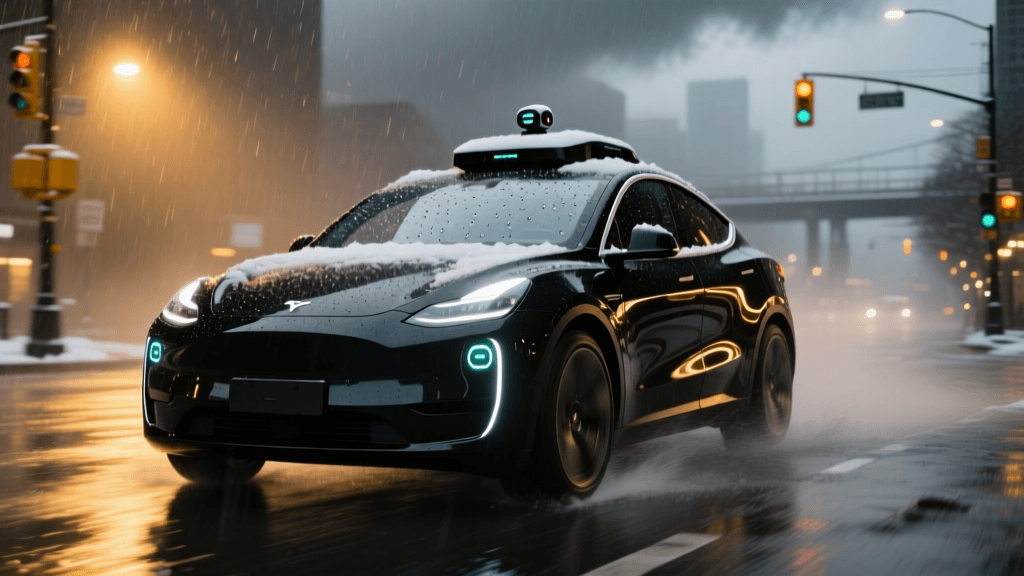
Light Detection and Ranging (LiDAR) is the cornerstone of most robotaxi perception stacks, providing high-resolution, 3D point clouds of the vehicle's surroundings. However, LiDAR operates by firing millions of laser pulses and measuring their return time. In heavy rain or snow, these laser pulses strike water droplets or snowflakes in the air and bounce back to the sensor prematurely. This phenomenon, known as backscatter, creates "ghost" obstacles. The AV's software may interpret a wall of heavy rain as a solid, impenetrable object, triggering emergency braking or causing the vehicle to freeze in its lane to avoid a perceived collision.
Camera Washout and Sensor Occlusion
Cameras are essential for reading traffic lights, interpreting construction signs, and detecting lane markings. Yet, they are highly susceptible to environmental degradation. Heavy rain causes lens occlusion and water distortion, while road spray from other vehicles can completely blind the camera array. Furthermore, fog scatters visible light, drastically reducing contrast and depth perception. Sun glare, particularly during dawn and dusk commutes, can wash out camera sensors, rendering them incapable of distinguishing a red traffic light from the bright sky behind it.
Current Service Reliability: How the Giants Cope
Different robotaxi operators have adopted varying strategies to manage weather-induced reliability issues, prioritizing safety over continuous uptime.
As detailed in Waymo's Official Safety Framework, the company utilizes a conservative, data-driven approach to weather. Waymo's fifth-generation and sixth-generation sensor suites are designed with improved weather resilience, including automated cleaning systems and hydrophobic coatings. However, when localized weather events exceed the system's confidence threshold, Waymo relies on dynamic geofencing. The fleet may be temporarily restricted from operating in specific microclimates, or vehicles will be instructed to safely pull over until the squall passes. This ensures passenger safety but can lead to localized service blackouts and increased wait times during rush hour.
Competitors like Zoox have approached the problem from a hardware-design perspective. The purpose-built Zoox vehicle features a highly redundant sensor layout with overlapping fields of view, ensuring that if road spray blinds one camera cluster, another angle remains clear. Nevertheless, heavy accumulation of snow on roadways—which obscures lane markings and alters the physical geometry of the road—remains a hard limit for almost all current commercial robotaxi services.
Sensor Performance Matrix in Adverse Conditions
Understanding how different sensors degrade in bad weather is crucial for evaluating the future of AV reliability. Below is a comparison of how current and emerging sensor technologies perform under environmental stress.
| Sensor Type | Clear Weather | Heavy Rain | Dense Fog | Snow / Ice | Primary Limitation |
|---|---|---|---|---|---|
| Optical Cameras | Excellent | Poor | Poor | Poor | Lens occlusion, glare, low contrast |
| Traditional LiDAR | Excellent | Fair (Ghosting) | Poor | Poor | Backscatter from precipitation |
| Traditional Radar | Good | Excellent | Excellent | Good | Low spatial resolution, poor object classification |
| 4D Imaging Radar | Excellent | Excellent | Good | Good | Still maturing, lower resolution than LiDAR |
| Thermal Cameras | Good | Good | Fair | Good | Cannot read reflective signs or traffic lights |
The industry is actively shifting toward sensor fusion algorithms that can dynamically weight the importance of each sensor based on real-time weather conditions. For instance, if the system detects heavy rain, it will down-weight the LiDAR point cloud to ignore backscatter noise and rely more heavily on radar data to track the velocity of surrounding vehicles.
Future Trends: Engineering Out the Elements
The future outlook for robotaxi weather reliability hinges on three major technological advancements: 4D imaging radar, AI-driven weather filtering, and Vehicle-to-Everything (V2X) communication.
4D Imaging Radar: Companies like Arbe Robotics and Continental are pioneering 4D imaging radar, which measures distance, velocity, azimuth, and elevation. Unlike traditional radar, 4D radar generates a dense point cloud that rivals LiDAR in resolution but operates on radio waves that easily penetrate rain, fog, and snow. As the cost of 4D radar decreases, it will become a standard redundancy layer in robotaxis, allowing them to maintain highway speeds even when cameras and LiDAR are compromised.
AI Weather Filtering and Sensor Cleaning: Next-generation AV stacks are employing machine learning models specifically trained to "subtract" weather noise from sensor data. By training neural networks on millions of miles of driving in blizzards and monsoons, the AI learns to differentiate between a pedestrian and a dense sheet of rain. Additionally, advanced hardware solutions, such as targeted air-jet nozzles and ultrasonic vibration lenses, are being integrated to physically shake water and snow off sensor housings in real-time.
The Insurance Institute for Highway Safety (IIHS) has consistently noted that while consumer ADAS features struggle in bad weather, commercial robotaxi fleets are investing heavily in redundancy. The eventual integration of V2X infrastructure will further mitigate weather risks. If a robotaxi's cameras are blinded by sun glare, V2X allows the traffic light to broadcast its status directly to the vehicle's computer, ensuring a safe and legal intersection crossing without relying on optical confirmation.
Rider Guide: Navigating Robotaxi Reliability in Bad Weather
For consumers utilizing robotaxi services in cities like Phoenix, San Francisco, or Los Angeles, understanding how weather impacts your ride is essential for effective transit planning. Here is actionable advice for managing expectations and ensuring you reach your destination on time:
- Anticipate Network Pauses: If a sudden microclimate event (like a heavy coastal fog bank or a localized thunderstorm) rolls in, expect the app to notify you of a "Weather Pause." The vehicle will safely pull over to the right lane or a parking lot. Do not attempt to override the system; this is a programmed safety protocol.
- Monitor Surge Pricing on Fallbacks: When robotaxi fleets reduce their operational footprint due to weather, demand shifts to human-driven rideshares (Uber/Lyft) and traditional taxis. This triggers immediate surge pricing. If the forecast predicts rain during your evening commute, pre-schedule a human-driven rideshare or identify public transit alternatives before the weather hits.
- Understand the App's ODD Map: Some advanced robotaxi apps display operational boundaries. If you are trying to book a ride to a higher elevation or an area prone to flooding, the app may block the destination entirely. Have a secondary drop-off point in a known clear zone ready.
- Allow Extra Time for Sensor Calibration: In light rain, robotaxis may drive significantly below the speed limit and increase following distances. The AI is operating in a degraded confidence state. Factor an extra 15 to 20 minutes into your itinerary when booking a robotaxi in damp conditions.
Industry Outlook: When Will Robotaxis Be Truly Weatherproof?
The transition from fair-weather autonomy to all-weather reliability is the final frontier for the robotaxi industry. While current services will remain susceptible to severe weather disruptions through the end of the decade, the rapid commoditization of 4D imaging radar and advancements in AI sensor fusion are narrowing the gap. Within the next five to seven years, we expect to see robotaxis capable of navigating heavy rain and moderate snow with the same confidence as a seasoned human driver. Until then, weather remains the ultimate arbiter of autonomous service reliability, demanding patience and adaptive planning from early-adopter riders.