If you've been searching for how to get on a robotaxi waitlist, you've likely noticed the process isn't as simple as downloading an app and requesting a ride. Access to driverless taxi services in 2026 remains tightly controlled — gated by geography, waitlist queues, and a regulatory patchwork that varies city by city. This guide maps exactly where you can hail a driverless ride today, what it costs, how the safety record actually stacks up against human drivers, and what's keeping full autonomy from your neighborhood.
Is a Robotaxi Actually Self-Driving? Understanding SAE Levels
The single most important distinction in autonomous vehicles is the gap between Level 2 driver-assist and Level 4 driverless operation. Consumer systems like Tesla Autopilot, Ford BlueCruise, and GM Super Cruise are SAE Level 2 — they can steer and manage speed, but the human driver must remain fully engaged and legally responsible at all times. Tesla's FSD (Supervised) is also Level 2 despite its name.
Robotaxis from Waymo, Zoox, and (when operational) Cruise are SAE Level 4 — the vehicle handles all driving tasks within a defined Operational Design Domain (ODD) with no human in the loop. There is no driver's seat intervention required, and in most configurations, no steering wheel within passenger reach.
| Level | Name | Who Drives? | Examples |
|---|---|---|---|
| Level 2 | Partial Automation | Human (monitors, intervenes) | Tesla Autopilot/FSD Supervised, BlueCruise, Super Cruise |
| Level 3 | Conditional Automation | System (in narrow conditions), human on standby | Mercedes DRIVE PILOT (limited markets, <40 mph traffic jams) |
| Level 4 | High Automation | System (within geofenced ODD, no human needed) | Waymo, Zoox, Cruise (when permitted) |
| Level 5 | Full Automation | System (anywhere, any condition) | Does not exist commercially |
Where Can I Use a Robotaxi Right Now?
Robotaxi service in 2026 is live in a handful of metro areas, with each operator holding specific city-level permits. Here's the current operational map:
| Operator | Live Cities (Driverless) | Waitlist Status | Hours |
|---|---|---|---|
| Waymo One | Phoenix (East Valley + downtown), San Francisco, Los Angeles, Austin | Open waitlist; invites rolling weekly | 24/7 in Phoenix/SF; limited hours LA/Austin |
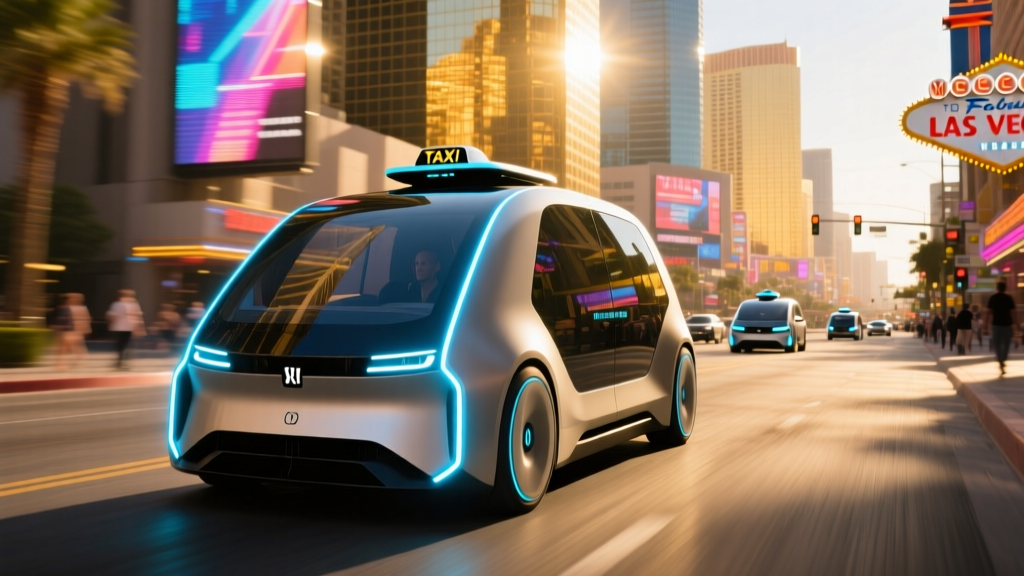
| Zoox | Las Vegas (Strip corridor + downtown), Foster City (employee/invite only) | Invite-only; no public waitlist in Foster City | Daytime/evening hours in LV |
| Cruise | Phoenix (limited, post-relaunch), Dallas (pilot) | Restricted waitlist; phased re-entry | Daylight hours, fair weather only |
| Waymo (expansion) | Announced: Atlanta, Miami (testing with safety driver) | No public access yet | N/A |
How to join the Waymo waitlist: Download the Waymo One app (iOS/Android), create an account, and enter your home address. If you're inside a service area, you'll be placed in a queue. As of early 2026, typical wait times in Phoenix range from 1–3 weeks; San Francisco is 2–6 weeks depending on neighborhood; Los Angeles remains longer due to demand and geofence caps.
How Much Does a Robotaxi Cost vs Uber and Lyft?
Robotaxi pricing is structured to undercut traditional rideshare, at least in current promotional phases. Here's what riders report paying on Waymo One in Phoenix and San Francisco in 2026:
| Service | Base Fare | 3-Mile Trip Avg | Surge Pricing | Tipping |
|---|---|---|---|---|
| Waymo One | $2.50 | $9–$13 | None currently | Optional via app |
| UberX | $2.80 | $12–$18 | Yes, 1.2x–2.5x | Expected (15–20%) |
| Lyft Standard | $2.75 | $11–$17 | Yes, prime-time pricing | Expected (15–20%) |
| Waymo Comfort (larger vehicle) | $3.00 | $14–$19 | None | Optional |
The gap widens during peak hours — Waymo's lack of surge pricing means a Friday night ride that would cost $28 on UberX might run $11 on Waymo One. That said, Waymo's service area is smaller, so trips requiring travel outside the geofence still require a traditional rideshare.
How Safe Are Robotaxis? The Real Data
Safety is the most contested question in autonomous vehicles. Here's what the data actually shows, drawn from operator reports and NHTSA standing general orders requiring crash reporting for Level 2+ systems:
Waymo Safety Record (through Q4 2025)
- 7+ million fully driverless miles completed across Phoenix, SF, and LA.
- Fatalities involving Waymo driverless vehicles: 0 as of early 2026.
- Injury-causing crashes: Waymo's published data shows a 57% lower rate of injury-causing crashes per million miles vs. human benchmarks in comparable urban environments.
- Contact rate (any physical contact): Roughly 1 per 180,000 driverless miles, overwhelmingly minor (scrapes with stationary objects, low-speed sideswipes).
Cruise's record is more complicated. Following a serious October 2023 incident in San Francisco where a pedestrian was struck by a human-driven vehicle and then run over by a Cruise robotaxi, the company lost its California permit, grounded its national fleet, and has been re-entering markets slowly with restricted hours and smaller geofences.
For context, IIHS data shows U.S. drivers experience roughly 1.35 fatalities per 100 million vehicle miles traveled. Robotaxi fleets have not yet accumulated enough driverless miles for a statistically equivalent fatality comparison, but the contact-rate data strongly favors Level 4 systems in low-speed urban environments.
Under the Hood: Robotaxi Technology Stacks
Level 4 robotaxis don't rely on the same hardware as consumer driver-assist. The sensor suite is substantially more robust:
Waymo (6th-generation Driver, 2024+ vehicles)
- 5+ lidar units (roof and fender-mounted) providing 360° 3D point clouds to 500+ meters
- 29 cameras covering all directions with HDR and low-light capability
- 6 imaging radars for weather penetration and velocity detection
- External audio receivers to detect emergency vehicle sirens
- HD pre-mapped routes with centimeter-level localization
Zoox (purpose-built carriage vehicle)
- Bidirectional design — no designated "front," symmetric sensor layout
- Redundant lidar, radar, and camera arrays on all four corners
- Dual-redundant compute, braking, and steering systems
- Designed from the ground up as a passenger carriage, not a modified consumer car
Cruise (Chevrolet Bolt-based Origin, post-relaunch)
- Roof-mounted lidar + camera + radar array
- Restricted to daylight, fair-weather ODD in current markets
This is fundamentally different from Tesla's camera-only FSD approach. Waymo, Zoox, and Cruise all rely on lidar as a primary sensor, arguing that redundant perception modalities are non-negotiable for driverless operation. Tesla maintains that vision + neural nets are sufficient — a claim that remains unproven at Level 4 at scale.
Current Limitations: Where Robotaxis Still Can't Go
Despite years of operation, Level 4 robotaxis face hard constraints that define where and when you can use them:
- Geofencing: Vehicles operate only within pre-mapped, approved zones. Request a ride outside the boundary and the app simply won't let you.
- Weather: Heavy rain, snow, fog, and ice degrade lidar and camera performance. Most operators restrict service to fair-weather conditions; Cruise's post-relaunch ODD explicitly excludes nighttime and precipitation.
- Construction zones: Dynamic lane closures and temporary signage remain a challenge. Vehicles may pull over and request remote assistance rather than proceed.
- Airport and highway access: Most robotaxis cannot serve airport terminals directly or operate on high-speed freeways above 45–55 mph.
- Edge cases: Unusual road configurations, police-directed traffic, and emergency scenes can trigger a vehicle stoppage until remote guidance resolves the scenario.
- Passenger capacity: Waymo's Jaguar I-PACE seats up to 3 passengers; Zoox's carriage seats 4. No wheelchair-accessible configurations are widely deployed yet.
Who Regulates Robotaxis? The Approval Patchwork
There is no single federal license for robotaxi operation. Instead, approvals come from a layered structure:
- NHTSA (federal): Sets vehicle safety standards (FMVSS) and requires crash reporting. Zoox received a specific exemption to deploy its steering-wheel-free carriage.
- State DMVs and PUCs: California's CPUC and DMV issue the permits that actually allow commercial driverless service. Arizona (Waymo's primary market) takes a lighter-touch approach via executive orders and ADOT guidance.
- City governments: Local transportation departments negotiate operating agreements, geofence boundaries, and curb-access rules.
This patchwork is why Waymo can run 24/7 in Phoenix but faces hour restrictions in Los Angeles, and why Cruise's California suspension didn't automatically affect its Phoenix operations.
Frequently Asked Questions
How long is the typical robotaxi waitlist in 2026?
For Waymo One, expect 1–3 weeks in Phoenix, 2–6 weeks in San Francisco, and longer in Los Angeles where demand outpaces fleet size. Zoox Las Vegas access is primarily invite-only or via promotional partnerships. Cruise's waitlist is restricted as it phases back into service.
Can I hail a robotaxi outside the geofenced service area?
No. The app will not allow pickup or drop-off outside the approved ODD. If you need to travel beyond the boundary, you'll need a traditional rideshare.
Is Tesla FSD a robotaxi?
No. Tesla FSD (Supervised) is SAE Level 2 driver-assist. The human driver remains fully responsible. Tesla has announced a robotaxi program, but as of 2026 it is not commercially available as a driverless ride-hail service in any U.S. market.
What happens if a robotaxi gets confused or stuck?
The vehicle will typically pull to a safe stop and request remote assistance from a human operator who can provide guidance (not remote driving). Passengers can also contact support via an in-vehicle button or the app.
Are robotaxis cheaper than owning a car?
For occasional urban trips, yes — a $12 Waymo ride vs. $500+/month car payment plus insurance, fuel, and parking. For daily commuters or suburban users, robotaxi service areas don't yet cover enough territory to replace car ownership.
Can I ride alone, or do I need to share the vehicle?
Waymo One and Zoox rides are private — you book the entire vehicle. No shared/pool options are currently offered.
The Bottom Line on Robotaxi Access
Getting on a robotaxi waitlist in 2026 is straightforward if you live in Phoenix, San Francisco, Los Angeles, Austin, or Las Vegas — download the operator's app, verify your address is inside the geofence, and wait for your invite. For everyone else, driverless taxi service remains a preview of what's coming, not a daily transportation option. The safety data is encouraging, the pricing is competitive, and the technology is real — but the operational footprint is still small, the weather limitations are genuine, and the regulatory path to nationwide coverage is measured in years, not months.