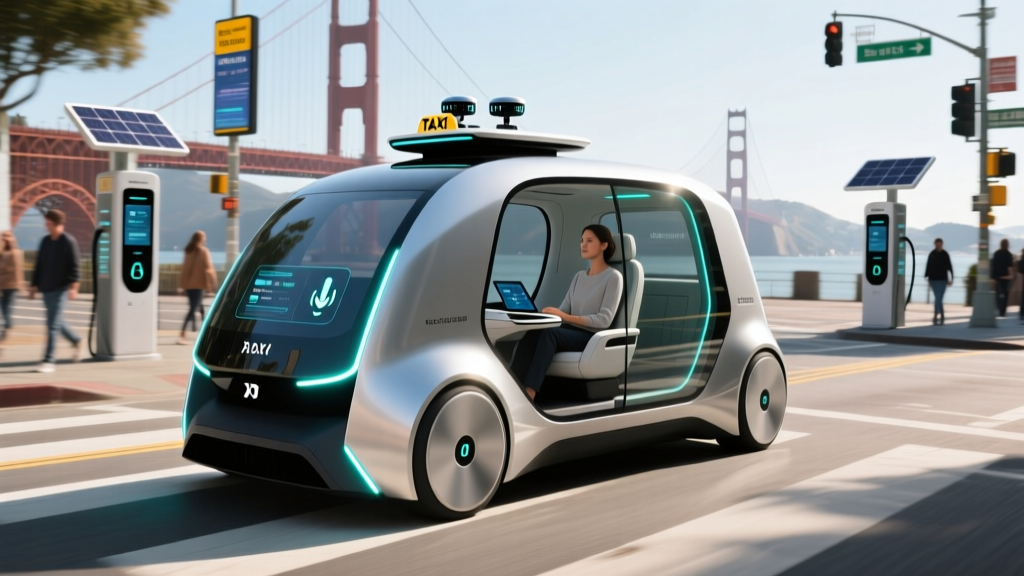
If you've spent any time on the streets of San Francisco in the past two years, you've likely spotted them: white Jaguar I-PACE SUVs with rooftop sensor arrays gliding through traffic without anyone behind the wheel. Robotaxis are no longer a pilot program in the Bay Area — they are a daily transportation option. But with multiple operators, shifting regulations, and frequent headlines about incidents, it's hard to separate reality from hype.
This guide breaks down exactly which robotaxi San Francisco services are live right now in 2026, what they cost compared to Uber and Lyft, what the safety data actually shows, and where the hard limitations remain. We'll also clarify the critical difference between Level 4 robotaxis and the Level 2 driver-assist systems you might have in your own EV.
Level 4 Robotaxis vs. Level 2 Driver-Assist: A Critical Distinction
Before discussing specific services, it's essential to understand what "self-driving" actually means in regulatory terms. The SAE International J3016 standard defines six levels of driving automation, and the gap between what's in your driveway and what's operating as a robotaxi is enormous.
| Level | Name | Who Drives? | Example Systems |
|---|---|---|---|
| Level 0 | No Automation | Human does everything | Standard cars, cruise control |
| Level 1 | Driver Assistance | Human + one assist (steering OR speed) | Adaptive cruise, lane-keep assist |
| Level 2 | Partial Automation | Human supervises; system handles steering AND speed | Tesla Autopilot/FSD Supervised, GM Super Cruise, Ford BlueCruise |
| Level 3 | Conditional Automation | System drives in limited conditions; human on standby | Mercedes Drive Pilot (approved in NV, CA — limited to 40 mph traffic jams) |
| Level 4 | High Automation | System drives fully within its operational domain; no human needed | Waymo, Zoox, Cruise (suspended) |
| Level 5 | Full Automation | System drives everywhere, all conditions | Does not exist yet |
Which Robotaxi Services Are Operating in San Francisco Now?
As of early 2026, the robotaxi San Francisco landscape has consolidated significantly following regulatory actions and corporate restructuring. Here's what's actually available for riders:
| Operator | Status | Service Area | Hours | Vehicle |
|---|---|---|---|---|
| Waymo (Alphabet) | ✅ Fully operational | Most of SF, SFO airport, expanding to Peninsula | 24/7 | Jaguar I-PACE (5th-gen sensor suite), Zeekr RT (newer fleet additions) |
| Zoox (Amazon) | ✅ Operational (limited) | Select zones in SoMa, Mission, Financial District | Limited hours (typically 10am–10pm) | Zoox purpose-built vehicle (bidirectional, no steering wheel) |
| Cruise (GM) | ❌ Suspended | N/A — California DMV permit revoked Oct 2023; limited testing-only with safety drivers as of 2025-26 | N/A | Chevrolet Bolt EV / Origin (Origin program paused) |
Waymo is the dominant operator by a wide margin. After receiving approval from the California Public Utilities Commission (CPUC) for 24/7 commercial service in August 2023, Waymo has steadily expanded its San Francisco geofence to cover most of the city, including routes to and from San Francisco International Airport (SFO). As of 2026, Waymo reports completing over 10 million paid driverless trips across its operational cities (San Francisco, Phoenix, Los Angeles, and Austin).
Zoox, Amazon's autonomous vehicle subsidiary, has taken a different approach with its purpose-built vehicle — a compact, bidirectional pod with no steering wheel or pedals that can travel in either direction. Zoox began limited public rides in San Francisco in mid-2024 and has gradually expanded access, though its service area and hours remain more restricted than Waymo's.
How to Use a Robotaxi in San Francisco (and What It Costs)
Booking a Waymo Ride
- Download the Waymo One app (iOS/Android).
- Create an account — no waitlist as of 2026; the service is open to the public in SF.
- Enter your pickup and drop-off locations. The app will confirm whether both are within the geofenced service area.
- Confirm your ride. A vehicle is dispatched, and you can track its approach in real time.
- At pickup, confirm the vehicle by matching the license plate and the last few digits shown in the app. Open the rear door using the button on the vehicle's exterior (or via the app).
- Buckle up. Tap "Start Ride" on the rear-seat screen. The vehicle drives itself to your destination.
Booking a Zoox Ride
Zoox currently operates via a dedicated app and, in some cases, invitation-only or waitlist access. The experience is distinct: the purpose-built vehicle seats four passengers facing each other, has large windows on all sides, and includes a screen showing the vehicle's perception of surrounding traffic in real time.
Pricing: Robotaxi vs. Uber vs. Lyft
Robotaxi pricing in San Francisco is designed to be competitive with traditional rideshare, though surge dynamics differ. Here's a representative comparison based on typical trips in 2026:
| Trip | Waymo | UberX | Lyft Standard |
|---|---|---|---|
| SoMa to Marina (~4 mi) | $14–$18 | $15–$22 | $14–$20 |
| Financial District to Sunset (~7 mi) | $20–$26 | $22–$32 | $20–$28 |
| Mission to SFO Airport (~15 mi) | $38–$48 | $42–$65 | $40–$58 |
| Peak-hours surge multiplier | None to minimal (1.0–1.2x) | 1.5–3.0x common | 1.3–2.5x common |
Safety Record: What the Data Actually Shows
Safety is the most scrutinized — and most politicized — aspect of robotaxi operations. Let's look at concrete numbers rather than anecdotes.
- Total driverless miles driven: Over 30 million miles across all operational cities (cumulative through 2025).
- Injury-causing crash rate: Waymo's published safety report indicates its vehicles were involved in injury-causing crashes at a rate approximately 85% lower than the human benchmark in comparable urban driving environments.
- Police-reportable crash rate: Approximately 57% lower than human drivers in the same geographies.
- Contactless events (minor scrapes/bumps): Higher than human baseline in early deployment phases; trending downward with successive software updates.
Sources: Waymo safety reports; NHTSA Standing General Order crash data.
For context, the human benchmark in dense urban environments like San Francisco is roughly 5.5 police-reportable crashes per million miles and 1.1 injury-causing crashes per million miles (based on NHTSA and state-reported data). Waymo's reported rates fall below these benchmarks.
However, the data requires nuance:
- Severity vs. frequency: Robotaxi crashes tend to be low-speed (under 15 mph) and low-severity — often rear-end contacts while the vehicle is stopped or near-stopped. Human crashes include a far wider severity range, including high-speed and impaired-driving incidents that don't apply to robotaxis.
- Exposure differences: Robotaxis operate primarily in dense urban cores at moderate speeds. They don't drive on rural highways at 75 mph, which is where many fatal human crashes occur. Comparing crash rates across these different driving environments requires care.
- Reporting bias: Robotaxi operators are required to report all incidents to the California DMV and NHTSA. Human drivers underreport minor crashes extensively. This makes direct comparison imperfect.
The Cruise Incident and Its Regulatory Aftermath
Any honest discussion of robotaxi safety must address the October 2023 Cruise incident in San Francisco, in which a Cruise vehicle struck a pedestrian who had been thrown into its path by a human-driven car, then dragged the pedestrian approximately 20 feet while pulling to the roadside. Cruise's subsequent failure to fully disclose the dragging to regulators led the California DMV to suspend Cruise's deployment permit. GM subsequently restructured Cruise operations, and as of 2026, the company has not resumed driverless commercial service in San Francisco. This incident underscores that the regulatory environment is responsive — and that transparency failures can be as consequential as technical ones.
The Technology Stack: How Robotaxis Actually See the Road
Robotaxi perception systems are substantially more complex than the camera-and-radar setups in consumer Level 2 vehicles. Here's what powers the current generation:
| Component | Waymo (5th Gen / 6th Gen) | Zoox (Purpose-Built Vehicle) |
|---|---|---|
| Lidar | Custom-built 360° lidar (roof-mounted + side units); ~200m range | Multiple lidar units providing full 360° coverage; redundant arrays |
| Cameras | 29+ cameras (high-resolution, varying focal lengths) | Multi-camera arrays covering all directions with overlapping fields |
| Radar | 6+ radar units for velocity and all-weather detection | Multiple radar units for redundancy |
| Audio sensors | External microphones to detect sirens, horns | External audio detection |
| HD Mapping | Pre-built centimeter-precision 3D maps of service area | HD maps + real-time localization |
| Compute | Custom AI inference hardware (in-vehicle) | Custom compute stack |
| Redundancy | Dual-redundant steering, braking, and compute systems | Full system redundancy; vehicle can stop safely on system failure |
The lidar-first approach used by Waymo and Zoox stands in contrast to Tesla's camera-only ("Tesla Vision") approach for its Level 2 FSD system. Lidar provides direct, active depth measurement regardless of lighting conditions — a significant advantage for Level 4 operations where there is no human fallback. Camera-only systems rely on neural-network-derived depth estimation, which can struggle with edge cases like unusual objects, extreme glare, or sensor occlusion.
Geofencing is equally important: both Waymo and Zoox operate within pre-mapped zones. The vehicle's software has detailed prior knowledge of lane geometry, traffic signal locations, speed limits, and construction zones (updated frequently). This is fundamentally different from a consumer vehicle that must handle any road it encounters.
Regulatory Landscape: Who Approves Robotaxi Operations?
Operating a commercial robotaxi in California requires approval from multiple agencies — a layered regulatory framework that doesn't exist for conventional rideshare:
- California DMV: Issues the Autonomous Vehicle Testing and Deployment permits. Operators must submit safety data, disengagement reports, and demonstrate system capability. The DMV can suspend permits (as it did with Cruise in October 2023).
- California Public Utilities Commission (CPUC): Regulates commercial passenger service. Operators must obtain a permit to charge fares for driverless rides. The CPUC evaluates safety, accessibility, and equity plans.
- NHTSA (federal): Sets vehicle safety standards (FMVSS) and investigates crashes through its Standing General Order requiring automated driving system crash reporting. NHTSA can issue recalls for ADS software — it did so with Cruise in 2024.
- San Francisco Municipal Transportation Agency (SFMTA): Manages local street operations, curb access, and can advocate for operational restrictions. SFMTA has been a vocal critic of robotaxi expansion, citing transit lane blockages and emergency vehicle interactions.
This multi-agency oversight means that robotaxi expansion is not unilateral — operators must maintain permits at the state, local, and federal levels simultaneously. Any one of these agencies can impose restrictions or revoke operating authority.
Current Limitations: Where Robotaxis Still Fall Short
For all their sophistication, Level 4 robotaxis in 2026 face concrete limitations that riders should understand before booking:
- Heavy rain and fog: While Waymo operates in light-to-moderate rain, heavy downpours and dense fog can degrade lidar and camera performance. Service may be restricted or paused during severe weather events.
- Leave the geofence: You cannot take a Waymo from San Francisco to Sacramento, Tahoe, or even most of the East Bay. The vehicle will only operate within its pre-mapped, regulator-approved zone.
- Handle all construction zones: Novel or rapidly changing construction configurations can cause the vehicle to stop and wait for remote assistance. This can result in extended travel times or ride cancellations.
- Make judgment calls humans take for granted: Navigating an unmarked parking lot, interpreting a hand signal from a crossing guard, or proceeding past a malfunctioning traffic light in a non-standard way remain challenging edge cases.
- Provide accessibility accommodations: Current robotaxi fleets cannot accommodate wheelchair users without significant advance notice (if at all). Waymo has announced plans for accessible vehicles but widespread availability is limited.
- Carry children unaccompanied: Riders must be 18+. Unaccompanied minors cannot use robotaxi services.
- Handle emergencies: If a passenger has a medical emergency en route, there is no driver to pull over and assist. Riders can contact support via the in-app or in-vehicle interface, but response depends on remote operators and emergency services dispatch.
Additionally, remote assistance is a reality of current operations. When a Waymo encounters a scenario it cannot resolve autonomously (an unusual obstruction, an ambiguous intersection), it may pause and request guidance from a remote human operator. This is not "remote driving" — the human provides high-level guidance (e.g., "it's safe to proceed around the cone"), and the vehicle executes the maneuver autonomously. But it does mean the system is not fully independent in all scenarios.
Frequently Asked Questions
Where can I use a robotaxi in San Francisco right now?
Waymo covers most of San Francisco, including routes to SFO Airport. Zoox operates in more limited zones (primarily SoMa, Mission, and Financial District). Both require pickup and drop-off within their approved geofences — check the respective apps for real-time coverage maps.
How much does a robotaxi cost compared to Uber or Lyft?
Base fares are comparable — typically $14–$26 for most intra-SF trips. The advantage emerges during peak hours: Waymo applies minimal or no surge pricing, while Uber and Lyft can surge 1.5–3x. Airport runs during rush hour can save you 20–40% with Waymo.
Are robotaxis actually safer than human drivers?
Waymo's published data shows injury-causing crash rates approximately 85% below the human benchmark for comparable urban driving. However, robotaxis operate in limited, mapped environments at moderate speeds — they don't face the same exposure as human drivers on highways or rural roads. The data is encouraging but not a blanket "safer than all humans everywhere" claim.
Is a Waymo or Zoox ride truly self-driving, or is someone watching?
These are SAE Level 4 operations — there is no driver in the vehicle, and no human is remotely controlling the car in real time. Remote operators provide high-level guidance during edge cases, but the vehicle drives itself. This is fundamentally different from Level 2 systems like Tesla FSD Supervised, where you must remain alert and ready to take over.
Can I take a robotaxi from San Francisco to another city?
Currently, no. Waymo's geofence covers San Francisco and select surrounding areas (including SFO), plus separate zones in Phoenix, Los Angeles, and Austin. You cannot book a cross-city trip between these zones. Interstate robotaxi travel does not yet exist.
What happens if the robotaxi gets confused or stuck?
The vehicle will typically come to a safe stop and request remote assistance. A human operator reviews the situation and provides guidance. If the issue cannot be resolved, the ride may be canceled, and you'll typically receive a refund or credit. In practice, these pauses add a few minutes to some trips — a tradeoff for the safety-first approach.
Are robotaxis available 24/7?
Waymo operates 24 hours a day, 7 days a week in San Francisco. Zoox has more limited operating hours (typically around 10am–10pm). Availability can be affected by weather, events, or regulatory actions.