If you have ever opened a rideshare app and wondered whether a robotaxi would be cheaper, you are not alone. The question of how much do self-driving cars cost has two very different answers in 2026: what it costs to ride in one today, and what it would cost to own one. This guide focuses on what is actually bookable right now — Level 4 driverless robotaxis from Waymo, Zoox, and the restructured Cruise operation — with exact pricing, service areas, safety data, and the limitations you need to know before you tap "request ride."
Robotaxis like Waymo and Zoox operate at SAE Level 4 — fully driverless within a defined geofenced area, with no human behind the wheel. This is fundamentally different from SAE Level 2 consumer systems like Tesla Autopilot/FSD (Supervised), GM Super Cruise, or Ford BlueCruise, which require continuous driver supervision. If you can buy it at a dealership and sit in the driver's seat, it is Level 2. If there is no one in the driver's seat, it is Level 4. This article covers only Level 4 robotaxi services.
Where Can I Use a Robotaxi Right Now?
Robotaxi availability in 2026 remains geographically concentrated. These services operate within tightly controlled geofences — you cannot hail one from an arbitrary address outside the approved zone. Here is where you can actually book a ride today:
| Service | Live Cities (2026) | Hours | Vehicle |
|---|---|---|---|
| Waymo One | Phoenix (metro), San Francisco, Los Angeles, Austin (limited) | 24/7 in Phoenix & SF | Jaguar I-PACE (6th-gen sensor suite) |
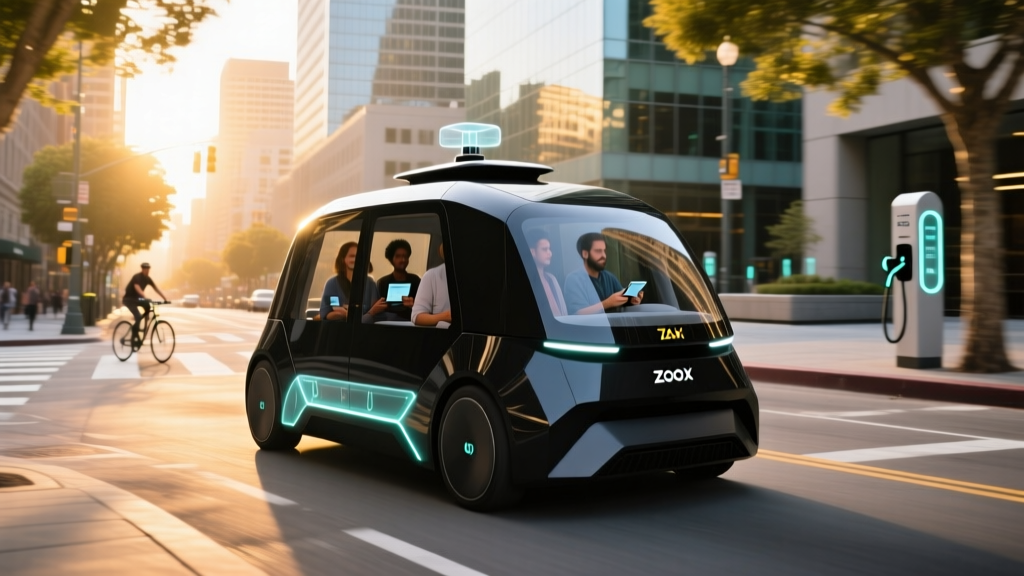
| Zoox | Las Vegas (Strip corridor), San Francisco (SoMa pilot), Foster City | Limited hours, invitation/early-access | Zoox purpose-built carriage (bidirectional) |
| Cruise (GM) | Phoenix (reduced zone), Dallas (limited pilot) | Daytime/evening only | Chevrolet Bolt EV / Origin (announced) |
Key caveat: Announced expansions are not live service. If a company says it plans to launch in a city, that does not mean you can book a ride there. Always check the operator's app for your specific pickup/dropoff pair — geofence boundaries can exclude entire neighborhoods within a city.
How Much Does a Robotaxi Cost vs. Uber and Lyft?
The direct answer to "how much do self-driving cars cost to ride" depends on distance, time of day, and the specific operator. Robotaxi pricing in 2026 generally undercuts traditional rideshare on short urban trips but converges or exceeds it on longer rides. Here is a side-by-side comparison based on published fare structures and aggregated rider reports:
| Trip Scenario | Waymo One | UberX | Lyft Standard |
|---|---|---|---|
| 3-mile urban trip (off-peak) | $8 – $12 | $10 – $16 | $10 – $15 |
| 7-mile urban trip (off-peak) | $16 – $24 | $18 – $30 | $17 – $28 |
| 3-mile trip (peak/surge) | $14 – $20 | $20 – $35 | $18 – $32 |
| 15-mile airport trip | $35 – $50 | $30 – $55 | $28 – $50 |
Why Waymo is often cheaper on short trips: Without a driver to pay, the per-mile cost structure favors short, high-frequency urban hops. However, Waymo does apply dynamic pricing during peak demand, and longer trips can erode the discount because the vehicle's operational cost (electricity, remote-assistance overhead, sensor depreciation) is spread across fewer fare dollars.
How to use the service: Download the Waymo One app (or Zoox app where available), set your pickup and dropoff within the geofenced zone, and confirm the fare estimate before requesting. The vehicle arrives autonomously — you verify the ride by tapping your phone on an exterior reader or entering a PIN on an interior screen. There is no driver to tip, though the app may prompt an optional gratuity that goes to fleet operations staff.
How Safe Are Robotaxis? Real Data, Not Marketing
Safety is the most consequential question in autonomous driving, and it demands concrete numbers rather than corporate assurances. Here is what the data shows as of early 2026:
- 30+ million fully driverless miles completed across Phoenix, SF, and LA
- Fatalities: 0 at-fault fatalities involving a Waymo driverless vehicle
- Injury-causing collisions: Waymo's at-fault rate is approximately 85% lower than the human benchmark for the same urban environments, per the company's peer-reviewed analysis submitted to NHTSA
- Contactless incidents: The majority of reported incidents involve minor contact (e.g., a cyclist brushing the vehicle at low speed) rather than high-energy collisions
Cruise's 2023 suspension and 2025–2026 relaunch: Cruise's original driverless fleet was suspended nationwide in October 2023 after a San Francisco incident in which a pedestrian was dragged beneath a Cruise vehicle. Following a lengthy safety review, NHTSA and California's DMV allowed a phased return with reduced fleet sizes, restricted hours, and enhanced remote-assistance protocols. As of 2026, Cruise operates a limited fleet in Phoenix and Dallas under heightened regulatory scrutiny.
Zoox: Zoox has completed limited driverless miles on public roads in Las Vegas and Foster City, primarily with employees and invited riders. Public safety data is sparse because the fleet's operational scale remains small. The company's purpose-built vehicle includes redundant steering, braking, and sensor systems, but real-world incident data at scale is not yet available.
Context that matters: Robotaxis operate overwhelmingly in dense, low-speed urban environments (under 45 mph). Human crash rates in these conditions are already elevated due to pedestrian, cyclist, and intersection complexity. Comparing robotaxi safety to highway driving statistics is not an apples-to-apples analysis. The relevant benchmark is urban ride-hail collision rates, and by that measure, Waymo's data is strong — though the sample size remains a fraction of total urban VMT.
Technology Stack: Lidar, Cameras, and Geofencing
Understanding what makes these vehicles driverless — and why they are restricted to specific cities — requires a look at the sensor and software stack:
Waymo 6th-Generation System (Jaguar I-PACE)
- Lidar: Custom-built roof-mounted and corner units providing 360° 3D point-cloud mapping up to 500+ meters
- Cameras: 29+ cameras covering 360° with high dynamic range for night and glare conditions
- Radar: 6 imaging radars for velocity detection and adverse-weather penetration
- Audio detection: External microphones to detect sirens from emergency vehicles
- HD Maps: Centimeter-accurate pre-mapped routes — the vehicle "knows" every lane, curb, and signal before it arrives
Zoox Purpose-Built Vehicle
- Symmetric design: No steering wheel; the vehicle can travel in either direction, simplifying maneuvers like three-point turns
- Dual-redundant systems: Independent compute, power, braking, and steering channels — if one fails, the backup takes over without human intervention
- Sensor suite: Lidar, cameras, and radar with overlapping fields of view on all four corners
Cruise (Post-Relaunch Bolt EV)
- Lidar + camera + radar fusion stack, similar in architecture to Waymo but using different supplier hardware
- Enhanced remote-assistance: After the 2023 suspension, Cruise added more robust remote-monitoring protocols where a human operator can confirm a safe path in ambiguous situations (though they do not directly steer the vehicle)
The geofencing constraint: All three operators rely on HD pre-mapping. Before a robotaxi can operate on a street, that street must be surveyed and mapped at centimeter precision. This is why expansion is slow — each new neighborhood requires physical surveying, map validation, and regulatory approval. Geofencing also means the vehicle will refuse a ride request if the route exits the mapped zone.
Regulatory Landscape: Who Approves Robotaxi Operations?
Robotaxi deployment in the United States involves a layered approval process that varies significantly by state:
- California (CPUC + DMV): The most mature regulatory framework. Operators need a DMV driverless testing permit and a California Public Utilities Commission (CPUC) permit to charge fares. After Cruise's 2023 incident, California tightened oversight, requiring incident reporting within shorter windows and granting the DMV authority to suspend permits immediately.
- Arizona: The least restrictive environment. Phoenix has hosted Waymo's commercial service since 2020 with minimal state-level friction. Arizona does not require a separate state permit beyond standard business licensing and federal vehicle compliance.
- Texas: Austin (Waymo) and Dallas (Cruise pilot) operate under a 2023 state law that permits autonomous vehicle operation without a human driver, provided the vehicle meets federal motor-vehicle safety standards and carries minimum insurance.
- Nevada: Zoox's Las Vegas operations fall under Nevada's autonomous vehicle statute, which requires a testing permit and proof of insurance. The state has been receptive to purpose-built autonomous vehicles.
- Federal (NHTSA): The National Highway Traffic Safety Administration sets vehicle safety standards (FMVSS) but does not currently "approve" autonomous driving software. NHTSA's role is reactive — investigating incidents and issuing recalls. Waymo's Jaguar I-PACE and Cruise's Bolt EV are production vehicles that already meet FMVSS. Zoox's purpose-built vehicle required an NHTSA exemption petition because it lacks traditional controls (steering wheel, pedals, mirrors).
The bottom line: there is no single federal "robotaxi license." Approval is a patchwork of state and local permissions, which is why availability remains limited to a handful of cities.
Current Limitations: Where Robotaxis Fall Short
Level 4 autonomy is genuinely impressive within its operational design domain, but that domain has hard edges. Here is what robotaxis cannot do in 2026:
- Heavy rain and fog: Lidar performance degrades in dense precipitation. Waymo will continue operating in light rain but may pause service or refuse rides during heavy downpours. Phoenix's dry climate is a strategic advantage here.
- Snow and ice: No robotaxi currently operates in snow-covered cities. Snow obscures lane markings, degrades sensor returns, and creates road-surface conditions the systems are not validated for.
- Highway driving: Most robotaxi geofences avoid limited-access highways. Waymo does use some highway segments in Phoenix and LA, but only pre-mapped stretches at moderate speeds. You cannot take a robotaxi on a 70-mph interstate corridor between cities.
- Construction zones: Temporary lane shifts, barrel lines, and flaggers create edge cases that often require the vehicle to pull over and request remote assistance. Expect delays or rerouting near active construction.
- Unmapped areas: If your destination falls outside the geofence, the app will not let you book the ride. There is no "manual override" — the service simply is not available.
- Accessibility: Waymo's Jaguar I-PACE requires passengers to enter a standard SUV cabin. Wheelchair-accessible vehicles are not yet part of the fleet, though Waymo has announced plans to add accessible options. Zoox's carriage-style vehicle has a flat floor and wide door opening, which improves accessibility, but it is not yet ADA-certified for wheelchair boarding.
- No food or pets: Most robotaxi operators prohibit eating, open containers, and animals (service animals excepted) because there is no driver to enforce cleanliness.
What Would It Cost to Own a Self-Driving Car?
The other interpretation of "how much do self-driving cars cost" is ownership — and the honest answer is that you cannot buy a Level 4 robotaxi in 2026. The vehicles operated by Waymo, Zoox, and Cruise are fleet-only, not available for consumer purchase.
What you can buy is a consumer EV with Level 2 driver-assistance:
- Tesla Model 3/Y with FSD (Supervised): $8,000 add-on (or $99/month). This remains SAE Level 2 — you must monitor the road at all times. Despite the "Full Self-Driving" branding, the vehicle cannot operate without your attention.
- GM Super Cruise / Ford BlueCruise: Available on select models for hands-free driving on pre-mapped highways. These are Level 2 systems with driver-monitoring cameras. Monthly or annual subscription fees apply after the initial trial period ($25–$75/month depending on the brand).
- Mercedes-Benz Drive Pilot (Level 3): Available on the 2024+ S-Class and EQS in Nevada and California, this is the only SAE Level 3 system sold to US consumers. It allows hands-off, eyes-off driving below 40 mph on approved highways in traffic jams. Cost: approximately $2,500 add-on. The driver must be ready to resume control within ~10 seconds when prompted.
The gap between Level 2/3 consumer systems and Level 4 robotaxis remains vast. Consumer vehicles must handle every road, weather condition, and scenario a human driver might encounter. Robotaxis avoid that problem by limiting their operational domain to a small, pre-mapped, well-understood area.
Frequently Asked Questions
Can I hail a robotaxi anywhere in Phoenix or San Francisco?
No. Even within live cities, robotaxis operate inside a geofenced service area. In Phoenix, Waymo covers roughly 225 square miles of the East Valley (Chandler, Tempe, Mesa, Scottsdale) but does not serve the far West Valley. In San Francisco, the geofence covers most of the city but may exclude certain industrial zones or areas under active construction. Always check the app for your specific origin and destination.
Do I need to sit in a specific seat?
In Waymo's Jaguar I-PACE, passengers typically sit in the rear seats. The front seats are empty — there is no safety driver. The vehicle has interior screens showing the route and a start/stop button. Zoox's purpose-built carriage has four forward-facing seats with no "front" or "back" since the vehicle is symmetrical.
What happens if the robotaxi gets confused or stuck?
The vehicle will pull over safely and contact a remote-assistance operator. This person does not drive the vehicle directly but can confirm a safe path (for example, around a double-parked truck) or authorize a maneuver. In rare cases, the ride may be terminated and you will be asked to exit at a safe location. You are not charged for rides terminated due to system issues.
Are robotaxis cheaper than owning a car?
It depends entirely on your driving volume. If you drive fewer than 5,000 miles per year in a city with robotaxi service, the per-ride cost could be competitive with ownership when you factor in insurance, depreciation, parking, and maintenance. For most suburban drivers covering 12,000+ miles annually, ownership (or a conventional rideshare mix) remains cheaper because robotaxi per-mile costs do not scale down for high mileage.
Will robotaxi prices go down over time?
Likely, yes — but gradually. The sensor hardware in a Waymo vehicle costs tens of thousands of dollars, and fleet operations (charging, cleaning, remote assistance, vehicle redistribution) add significant overhead. As sensor costs decline with volume and next-generation hardware, per-ride prices should decrease. However, operators also need to reach profitability, which may limit how aggressively they cut fares.
Is Waymo's safety data independently verified?
Waymo has published peer-reviewed safety analyses and submitted data to NHTSA, but the company controls the underlying data collection. Independent third-party audits at the scale of millions of miles are not yet standard practice. The IIHS and academic researchers have noted that Waymo's reported collision rates appear favorable compared to human benchmarks, but they caution that direct comparison is complicated by differing exposure conditions (urban vs. mixed driving, low-speed vs. highway).