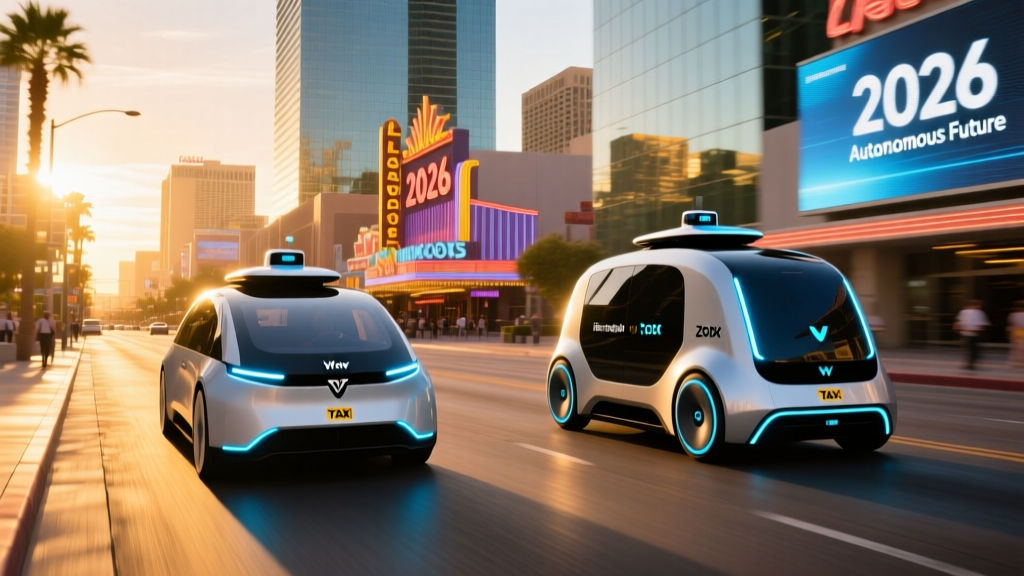
If you have ever opened a rideshare app and wondered whether a car without a human driver would cost more or less, you are not alone. The price for a self-driving car ride is no longer theoretical — millions of paid robotaxi trips happen every quarter in a growing handful of U.S. cities. But the economics are not what most people assume, and the availability map is far smaller than the headlines suggest.
This guide breaks down exactly what robotaxi services charge today, where you can actually hail one, how their safety records compare to human drivers, and what the technology can and cannot do. We focus on the two major Level 4 operators running paid, driverless service in the U.S.: Waymo (Alphabet) and Cruise (GM-backed, relaunched under supervised pilot conditions), plus Amazon's Zoox where its limited public pilots operate.
Robotaxis like Waymo's Jaguar I-PACE fleet and Zoox's purpose-built vehicle operate at SAE Level 4: the vehicle handles all driving tasks within a defined operational design domain (geofenced area, specific weather conditions) with no human driver present. This is fundamentally different from the SAE Level 2 systems sold to consumers — Tesla Autopilot/FSD (Supervised), GM Super Cruise, Ford BlueCruise — which require the driver to remain engaged and ready to take over at all times. Buying a Tesla with FSD does not give you a robotaxi. The two categories share almost nothing in common beyond the word "autonomous."
Where Can I Use a Robotaxi Right Now?
Robotaxi availability in 2026 remains tightly concentrated. Despite years of expansion announcements, the number of U.S. cities where you can hail a fully driverless ride with no human in the front seat is still small. Here is the current operational landscape:
| Operator | City / Region | Service Type | Hours | Vehicle |
|---|---|---|---|---|
| Waymo | Phoenix, AZ (metro-wide) | Fully driverless, paid | 24/7 | Jaguar I-PACE / Zeekr RT |
| Waymo | San Francisco, CA | Fully driverless, paid | 24/7 | Jaguar I-PACE / Zeekr RT |
| Waymo | Los Angeles, CA (core zones) | Fully driverless, paid | Most hours | Jaguar I-PACE / Zeekr RT |
| Waymo | Austin, TX (expanding) | Fully driverless, paid | Limited hours | Jaguar I-PACE |
| Zoox | Las Vegas, NV (Strip corridor + downtown) | Driverless pilot, limited paid | Set hours | Zoox Gen 5 (custom) |
| Zoox | Foster City / Bay Area, CA | Employee + invited-rider pilot | Set hours | Zoox Gen 5 |
| Cruise | Phoenix, Houston (supervised pilot) | Human safety operator onboard | Limited hours | Chevrolet Bolt EV / Origin |
Key reality check: If you live outside these metro areas, no robotaxi is available to you today. Waymo has announced future expansion to additional cities, but announced service is not live service. Always check the operator's app for your exact ZIP code before assuming coverage.
How Much Does a Robotaxi Cost vs. Uber and Lyft?
The price for a self-driving car ride varies by city, time of day, and trip distance — just like conventional rideshare. But the pricing dynamics are different. Waymo does not use traditional surge pricing in the same aggressive way Uber and Lyft do, though it does adjust for demand. Here is a representative comparison based on typical fares in overlapping service areas:
| Trip Scenario | Waymo (Driverless) | UberX | Lyft Standard |
|---|---|---|---|
| Short trip, ~3 miles (off-peak, Phoenix) | $8–$12 | $9–$14 | $8–$13 |
| Medium trip, ~7 miles (off-peak, SF) | $15–$22 | $16–$25 | $15–$24 |
| Medium trip, ~7 miles (peak/evening, SF) | $20–$30 | $28–$45 (surge) | $26–$42 (surge) |
| Airport run, ~15 miles (PHX) | $28–$38 | $30–$50 | $28–$48 |
| Per-mile average (all trips) | ~$1.80–$2.50/mi | ~$1.50–$3.50/mi | ~$1.40–$3.20/mi |
The bottom line on price: For routine off-peak trips, Waymo's fares are roughly on par with UberX and Lyft — sometimes a dollar or two cheaper, sometimes a dollar or two more. The real price advantage appears during peak demand. Because Waymo's pricing model is less surge-dependent, a Friday-night ride in San Francisco can be 30–40% cheaper than a surged Uber. Conversely, during low-demand periods with no surge, Uber and Lyft may undercut Waymo slightly.
Waymo also offers Waymo One membership pricing in some markets, and promotional credits for new riders can bring the effective price for a self-driving car ride down to $1–$3 for the first few trips. Zoox's limited Las Vegas service has offered introductory rides at heavily subsidized rates (sometimes free during pilot phases), making direct price comparison difficult until full commercial pricing launches.
How Safe Are Robotaxis? The Real Data
Safety is the most contentious question in autonomous vehicles, and it deserves concrete numbers rather than marketing claims. Here is what the data shows:
- Total autonomous miles driven: Over 30 million fully driverless miles (Waymo's published figure as of late 2025)
- Injury-causing collision rate: Waymo reported an approximately 85% lower rate of injury-causing crashes per million miles compared to a human-driver benchmark in Phoenix and San Francisco, based on NHTSA-reportable incidents
- Property-damage-only collision rate: Approximately 57% lower than the human benchmark
- Most common incident type: Low-speed contact with stationary objects (parked cars, bollards) — not high-speed collisions
- Cruise's October 2023 incident: A Cruise robotaxi in San Francisco dragged a pedestrian who had been thrown into its path by a human-driven car. This led to Cruise's California permit suspension and a nationwide service pause. Cruise has since relaunched under supervised pilot conditions with human safety operators.
Waymo published a peer-reviewed safety study (available through its safety research page) comparing its driverless operations to human-driver baselines using NHTSA data. The results were compelling but come with important context: Waymo operates primarily in good weather, on mapped roads, at moderate speeds, and in geofenced areas. The human-driver benchmark includes all conditions, including rural highways and severe weather — conditions Waymo does not currently face.
The Cruise incident in San Francisco underscored a critical point: Level 4 autonomy is not infallible. Edge cases — unusual scenarios the AI has not been trained on — remain the central engineering challenge. The Insurance Institute for Highway Safety (IIHS) has noted that comprehensive, standardized robotaxi safety reporting is still evolving, and consumers should interpret operator-published data with that caveat in mind.
The Technology Stack: Lidar, Cameras, and Geofencing
Understanding the price for a self-driving car ride requires understanding what is on the roof. Robotaxis carry sensor suites that cost tens of thousands of dollars per vehicle — a major reason the business model requires high utilization to be profitable.
Waymo (6th-generation Driver)
- LiDAR: Multiple roof-mounted and side-mounted units providing 360° 3D point-cloud mapping; range exceeding 500 meters
- Cameras: High-resolution surround cameras for lane markings, traffic signals, pedestrian detection, and object classification
- Radar: Multiple radar units for velocity detection and operation in reduced visibility
- HD Mapping: Pre-built centimeter-accurate maps of every operational road, updated continuously
- Compute: Custom onboard AI processors handling sensor fusion and real-time path planning
Zoox (Gen 5 Vehicle)
- LiDAR: Roof-mounted array with overlapping fields of view
- Cameras: 360° camera system with redundant coverage
- Radar: Multiple radar sensors
- Vehicle design: Purpose-built, bidirectional (no steering wheel), four-wheel steering, symmetrical cabin with facing seats
Tesla FSD (Supervised) — For Contrast
- Vision only: Camera-only approach (no lidar, no radar on current vehicles)
- No HD maps: Relies on real-time perception, not pre-mapped routes
- Not geofenced: Operates on any road, but requires driver supervision (Level 2)
The sensor-rich approach of Waymo and Zoox provides redundancy — if one sensor type is degraded (e.g., cameras blinded by sun glare), lidar and radar maintain coverage. Tesla's vision-only approach is less expensive per vehicle but remains a Level 2 system requiring human oversight. The cost difference in hardware is a primary reason why robotaxi operators need dense, high-volume urban markets to justify fleet economics.
Regulatory Landscape: Who Approves Robotaxi Operations?
Robotaxi deployment in the U.S. involves a patchwork of state and local approvals — there is no single federal "robotaxi license."
- California (CPUC + DMV): The California Public Utilities Commission issues permits for commercial passenger service. The DMV issues testing and deployment permits. After Cruise's 2023 incident, the DMV suspended Cruise's driverless deployment permit; Cruise has since operated under more restricted supervised permits.
- Arizona: Among the most permissive regulatory environments. Waymo has operated commercially in Phoenix since 2020 with relatively light state-level oversight. No special state permit is required beyond standard business and vehicle-registration requirements.
- Texas: Austin has allowed Waymo to begin commercial operations. Texas has no comprehensive autonomous-vehicle regulatory framework comparable to California's, which gives operators more flexibility but less structured oversight.
- Nevada: Nevada's DMV regulates autonomous vehicle testing and deployment. Zoox operates its Las Vegas pilot under state authorization.
- Federal (NHTSA): The National Highway Traffic Safety Administration sets vehicle safety standards and investigates incidents but does not currently issue permits for robotaxi operations. NHTSA's Standing General Order requires operators to report crashes involving Level 2+ and Level 3–5 systems.
The regulatory fragmentation means that a robotaxi legal in Phoenix may face entirely different approval processes — or be outright prohibited — in a neighboring state. For consumers, this translates to slow, city-by-city expansion rather than a nationwide rollout.
Current Limitations: What Robotaxis Cannot Do
The price for a self-driving car ride buys you a remarkable but bounded experience. These are the hard constraints as of 2026:
- Geofencing: Service is restricted to pre-mapped areas. Request a ride outside the geofence and the app will decline or suggest a pickup within bounds.
- Weather: Heavy rain, fog, snow, and ice degrade sensor performance. Waymo reduces or suspends service during severe weather events. Phoenix's dry climate is a strategic advantage; operations in rainy or snowy cities remain limited.
- Construction zones: Unexpected lane closures, shifted lanes, and temporary signage can cause the vehicle to pull over and request remote-assistance routing, adding delay.
- Unprotected left turns: Complex intersections with no dedicated signal remain challenging. The vehicle may take a conservative, longer route to avoid them.
- No highway driving (mostly): Waymo's Phoenix and SF operations include some freeway segments, but most robotaxi trips are surface-street only. Long-distance highway trips are not available.
- Pickup/dropoff precision: The vehicle may not stop at the exact door you want — it selects a safe, legal stopping point that could be 50–100 feet from your destination.
- Accessibility: Waymo's Jaguar I-PACE fleet requires riders to enter a standard SUV. Wheelchair-accessible vehicles are extremely limited in the robotaxi fleet. Zoox's custom vehicle is designed with level-floor entry, but its fleet size is small.
- No stops mid-trip: Unlike Uber, you cannot ask the robotaxi to stop at a drive-through or wait while you run into a store. The ride is point A to point B.
How to Use a Robotaxi: Step by Step
- Download the app: Waymo One (available on iOS and Android) is the primary consumer app. Zoox uses a separate app for its Las Vegas pilot.
- Check service area: Enter your pickup and dropoff addresses. If both are within the geofence, the app will confirm availability and estimated wait time (typically 3–8 minutes in dense coverage areas).
- Confirm the ride: You will see the vehicle type, license plate, and an estimated fare. Pricing is shown upfront, similar to Uber's upfront pricing model.
- Find your vehicle: The app shows the vehicle's approach on a map. When it arrives, confirm the license plate and use the app to unlock the doors (no driver to wave at).
- Ride: Start the trip via the in-vehicle screen or app. The vehicle drives itself. You can monitor the route on the screen, which displays the vehicle's perception of surrounding objects, pedestrians, and traffic signals.
- Arrival: The vehicle pulls to a designated stop. Exit, and the doors lock automatically. Payment processes through the app.
The experience is striking the first time — the steering wheel turns on its own (in Waymo's Jaguars; Zoox has no steering wheel at all). Most riders report that the driving style is conservative and smooth, with cautious acceleration and early braking. It feels like a careful, experienced driver, not an aggressive one.
Frequently Asked Questions
Is the price for a self-driving car ride going to drop significantly?
Likely yes, over time. Waymo's per-ride cost is subsidized by Alphabet's capital. As fleet utilization increases, sensor costs decline (Waymo's 6th-gen hardware is significantly cheaper than its 4th-gen), and remote-assistance ratios improve, the unit economics improve. But do not expect robotaxi rides to become dramatically cheaper than Uber/Lyft in the near term — the hardware and operational overhead remains substantial.
Can I buy a self-driving car for personal use?
No. The Level 4 vehicles operated by Waymo and Zoox are not available for consumer purchase. They are fleet-only vehicles. The closest consumer product is a vehicle with Level 2 driver-assist (Tesla FSD Supervised, GM Super Cruise, Ford BlueCruise), which still requires you to drive and remain attentive. Mercedes-Benz has offered a limited Level 3 system (DRIVE PILOT) in Germany and Nevada, but it operates only under very specific low-speed highway conditions and does not make the car "self-driving" in the robotaxi sense.
What happens if the robotaxi gets confused or stuck?
Waymo and Zoox vehicles have remote-assistance capabilities. If the vehicle encounters a scenario it cannot resolve (an unusual construction zone, a police officer directing traffic with hand signals), it will pull to a safe stop and connect to a remote operations center. A human specialist reviews the situation and can provide routing guidance. The vehicle does not hand control to the rider — there are no passenger-facing driving controls.
Are robotaxis available at airports?
Waymo serves Phoenix Sky Harbor (PHX) with driverless rides, including airport pickups and dropoffs. San Francisco International (SFO) service has been in testing phases but full commercial airport access varies. Always check the app for your specific airport route.
How does robotaxi insurance work if there's a crash?
When you ride in a Waymo or Zoox vehicle, the operator carries commercial insurance covering passengers and third parties. You are not required to provide your own insurance for the ride. This is one area where robotaxi economics differ from personal EV ownership — the operator bears the liability, and their insurance costs are factored into the fare structure.