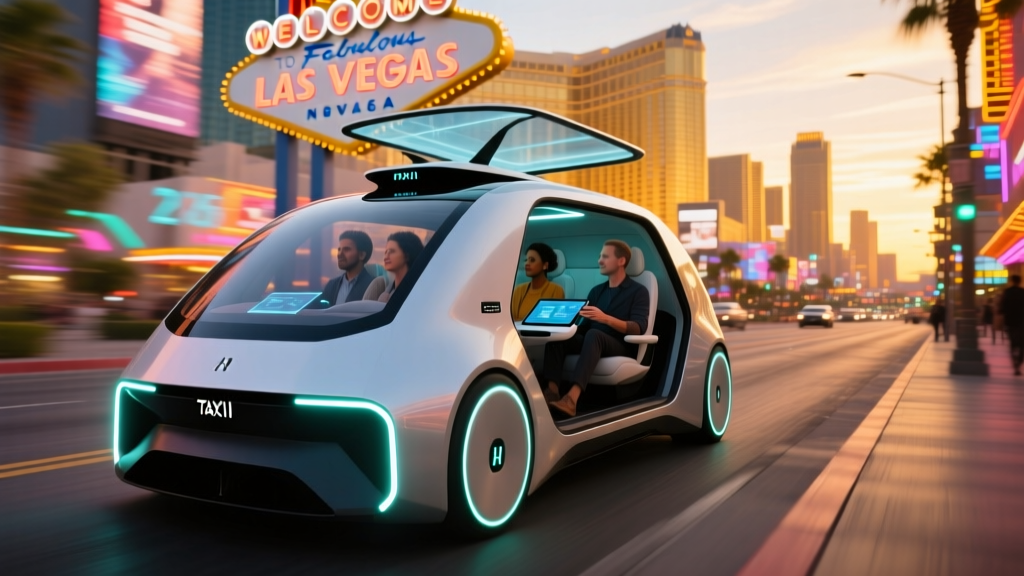
If you have walked the Las Vegas Strip in the past year, you have likely spotted one: a white SUV with a prominent roof-mounted sensor array, no driver behind the wheel, gliding past the Bellagio fountains or navigating the one-way loops around the convention center. The robotaxi in Las Vegas is no longer a pilot program or a tech demo. It is a commercial, fare-charging transportation option available to anyone with a smartphone and the service's app.
But which services actually operate driverless in Las Vegas right now? How do you hail one, what does it cost compared to Uber or Lyft, and — the question we hear most — how safe are they really? This guide breaks down the operational reality of Las Vegas robotaxis with concrete data, pricing, and the limitations you need to know before you tap "Request Ride."
SAE Automation Levels: Why the Robotaxi Distinction Matters
Before mapping out Las Vegas service areas, it is critical to understand what separates a robotaxi from the driver-assist features in your personal EV. The SAE International J3016 standard defines six levels of driving automation, and the difference between Level 2 and Level 4 is not incremental — it is fundamental to who is responsible when something goes wrong.
| Level | Name | Who Drives | Example |
|---|---|---|---|
| 0 | No Automation | Human | Standard car, no assist |
| 1 | Driver Assistance | Human | Adaptive cruise control |
| 2 | Partial Automation | Human (must supervise) | Tesla Autopilot, GM Super Cruise, Ford BlueCruise |
| 3 | Conditional Automation | System (human on standby) | Mercedes Drive Pilot (limited markets) |
| 4 | High Automation | System (no human needed) | Waymo One, Zoox — geofenced areas |
| 5 | Full Automation | System (anywhere, any condition) | Does not exist commercially |
Key distinction: Tesla's Full Self-Driving (Supervised) is a Level 2 system. The driver must remain engaged and is legally responsible. A Waymo or Zoox robotaxi operating in Las Vegas is Level 4 — there is no driver, no steering wheel in the passenger's reach, and the company bears operational responsibility within its approved geofence.
Which Robotaxi Services Operate in Las Vegas Right Now?
As of early 2026, Las Vegas has become one of the most competitive robotaxi markets in the United States, with multiple operators running commercial or late-stage pilot services. Here is where each stands:
| Service | Operator | Status | Service Area | Hours |
|---|---|---|---|---|
| Waymo One | Waymo (Alphabet) | Commercial — driverless | Strip corridor, downtown, airport, ~80 sq mi | 24/7 |
| Zoox | Zoox (Amazon) | Commercial — driverless | Strip and surrounding resort corridor, ~30 sq mi | Limited hours, expanding |
| Motional (Hyundai/Aptiv) | Motional | Late-stage pilot, safety rider present | Strip and downtown test zones | Limited hours |
Waymo One in Las Vegas
Waymo launched commercial driverless service in Las Vegas after an extended mapping and testing period. The Waymo One service area covers the Las Vegas Strip from Mandalay Bay northward to the Strat, extends east to the Las Vegas Convention Center, west to the residential areas near Spring Mountain Road, and includes Harry Reid International Airport (LAS). Riders can hail a ride through the Waymo app — the same way you would request an Uber — and a 5th-generation Waymo Driver-equipped Jaguar I-PACE or the newer custom Zeekr RT vehicle arrives without anyone in the driver's seat.
Zoox in Las Vegas
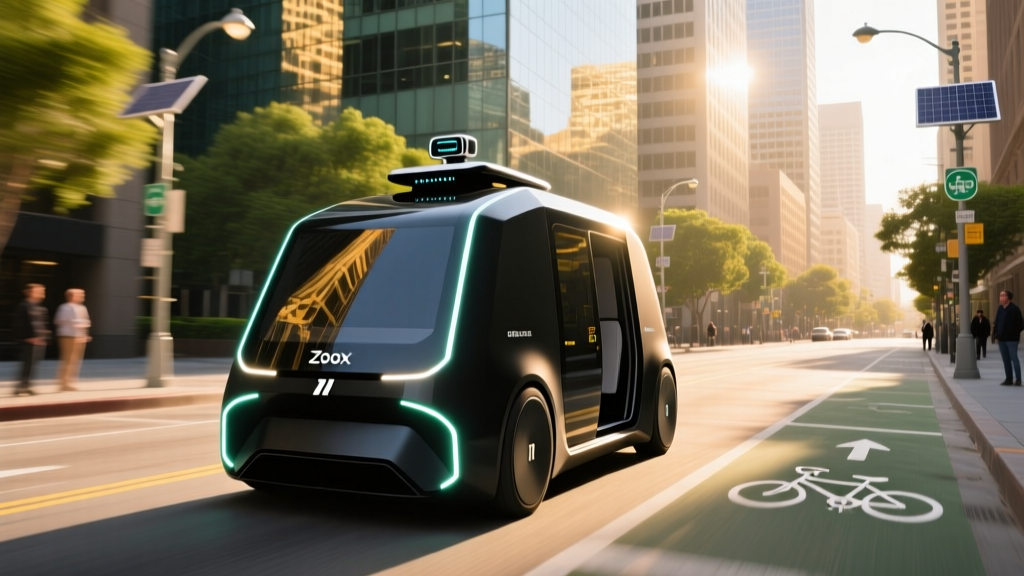
Zoox's purpose-built bidirectional vehicle — the boxy, carriage-style pod with no steering wheel and bench seating facing inward — has been operating on the Strip corridor. Zoox's footprint is smaller than Waymo's but covers the highest-density tourist zone. The Zoox experience is distinct: the vehicle can drive equally well in either direction, which simplifies tight U-turns and dead-end maneuvers common in resort loading areas.
Motional
Motional, the joint venture between Hyundai and Aptiv, has maintained a Las Vegas testing presence using Ioniq 5-based prototypes. As of this writing, Motional's Las Vegas operations still include a safety rider and are not yet open to the general public as a paid, driverless service.
How to Hail a Robotaxi in Las Vegas — and What It Costs
Using a robotaxi in Las Vegas is designed to feel identical to a standard rideshare experience. Here is the step-by-step for Waymo One, the most broadly available option:
- Download the Waymo One app (iOS or Android) and create an account. You will need a valid payment method.
- Enter your pickup and drop-off locations. The app will confirm whether both points fall within the active geofence.
- Request your ride. Wait times typically range from 2 to 8 minutes depending on time of day and location density.
- Find your vehicle. The app shows the car's exact location and license plate. The doors unlock automatically when you arrive.
- Start the ride. Once all passengers are buckled, tap "Start Ride" on the rear-seat screen. There is no driver to interact with.
Robotaxi Pricing vs. Uber and Lyft in Las Vegas
Waymo prices its rides competitively with UberX and Lyft standard fares. During non-surge periods, a Strip-to-airport ride (roughly 4 miles) typically costs between $12 and $18, comparable to an UberX quote for the same route. The key difference: robotaxi fares do not surge in the traditional sense. Waymo may implement higher pricing during peak demand, but the multipliers tend to be less aggressive than Uber's surge pricing during major conventions or New Year's Eve.
| Service | Typical Fare (Off-Peak) | Surge/Peak Fare | Driver in Vehicle |
|---|---|---|---|
| Waymo One | $12–$18 | $18–$25 | No |
| UberX | $12–$17 | $22–$40+ | Yes |
| Lyft Standard | $11–$16 | $20–$38+ | Yes |
| Zoox | Comparable / promotional | Varies | No |
Zoox has been running promotional pricing in Las Vegas, sometimes offering rides at a discount or even free during its initial commercial rollout phase. Check the Zoox app for current fare structures.
Safety Record: What the Data Actually Shows
Safety is the single most important question for anyone considering a robotaxi ride. Let us look at what the data says rather than relying on marketing claims.
Waymo safety data (as reported to NHTSA and in company safety reports):
- Over 30 million fully driverless miles completed across all operational cities (Phoenix, San Francisco, Los Angeles, Las Vegas) as of late 2025.
- Waymo's NHTSA Standing General Order incident reports show that the majority of collisions involving Waymo vehicles were low-speed, rear-end or side-swipe incidents where the other (human-driven) vehicle was the striking party.
- A study published by the Insurance Institute for Highway Safety (IIHS) and partner researchers found that Waymo's driverless vehicles had lower police-reported crash rates per million miles than human-driven benchmarks in comparable urban environments.
- Disengagement rates (where a remote operator must intervene) have decreased significantly with each generation of the Waymo Driver system, though exact per-city figures for Las Vegas are not publicly broken out.
It is important to contextualize these numbers. Robotaxis operate primarily in dense urban environments at relatively low speeds (most Las Vegas Strip-area rides involve travel under 35 mph). This is a different risk profile than highway driving at 75 mph. Within their operational domain, the data suggests robotaxis perform at or above human-driver benchmarks, but the sample is still growing and every incident is scrutinized heavily by regulators and the public.
No robotaxi service has a zero-incident record. What the data does show is that when incidents occur, they are overwhelmingly minor in severity, and the vehicles tend to be more cautious — sometimes to the point of frustrating human drivers behind them — than aggressive.
The Technology Stack: How a Las Vegas Robotaxi Sees the Road
Every Level 4 robotaxi on Las Vegas roads relies on a layered sensor suite. This is not a single-camera setup like Tesla's vision-only approach to FSD. Robotaxi platforms use sensor redundancy as a core safety principle.
Waymo Driver (5th Generation / Current)
- LiDAR: Multiple roof-mounted and body-integrated LiDAR units providing 360-degree, high-resolution 3D point clouds out to 300+ meters. LiDAR works independently of ambient light — critical for nighttime Strip driving where neon, headlights, and shadows create chaotic visual environments.
- Cameras: High-dynamic-range cameras covering all directions, used for lane detection, traffic signal recognition, pedestrian intent classification, and reading temporary signage.
- Radar: Millimeter-wave radar for velocity detection of surrounding objects, performing reliably in rain and dust.
- Audio detection: External microphones that can detect emergency vehicle sirens and adjust behavior (pulling over, yielding) accordingly.
- HD Mapping: Pre-built, centimeter-accurate maps of the entire geofenced area. The vehicle localizes itself against this map in real time, providing a layer of awareness beyond what onboard sensors detect.
Zoox Sensor Suite
- LiDAR, cameras, and radar in a similar redundant configuration, with sensors distributed around the vehicle's symmetrical body.
- Redundant compute: Dual independent computing systems that can each independently execute a safe stop if the other fails.
- Purpose-built vehicle: Unlike Waymo's retrofitted Jaguar I-PACE, Zoox designed its vehicle from the ground up for autonomy — four-wheel steering, bidirectional driving, and a crash structure optimized for passenger-facing seating.
The geofencing approach is central to how these systems achieve Level 4 reliability. Rather than attempting to drive anywhere in any condition (Level 5, which does not exist commercially), the robotaxi operates within a mapped, tested, and regulator-approved zone. If the vehicle approaches the geofence boundary, it will not proceed — it will safely stop or reroute within bounds.
Regulatory Landscape: Who Approves Robotaxi Operations in Nevada?
Nevada was one of the first states to pass legislation enabling autonomous vehicle testing and deployment, and the regulatory framework has evolved as the technology has matured.
- Nevada Department of Motor Vehicles (DMV): Issues autonomous vehicle testing and deployment permits. Operators must demonstrate safety case documentation, insurance coverage, and incident reporting procedures.
- Nevada Legislature: Assembly Bill 511 (passed in 2011 and subsequently updated) established the legal framework for autonomous vehicles on Nevada roads, including the principle that the autonomous system — not a human occupant — is the "driver" when the system is engaged.
- NHTSA (Federal): Requires all robotaxi operators to report crashes involving their automated systems through the Standing General Order. NHTSA can open investigations and issue recalls for autonomous driving systems, just as it does for conventional vehicle defects.
- Local jurisdictions: Clark County and the City of Las Vegas coordinate on road access, particularly for the Strip corridor which involves a mix of state, county, and private (resort) roadways.
The practical result: robotaxi operators in Las Vegas must maintain valid state permits, carry commercial insurance, report all incidents, and limit operations to approved geofenced areas. This is not an unregulated frontier — it is a permitted, monitored commercial transportation service.
Current Limitations: What a Las Vegas Robotaxi Cannot Do
Understanding what these vehicles cannot handle is just as important as knowing what they can. Here are the real-world limitations you will encounter:
- Geofence boundaries: If your destination falls outside the approved zone, the app will not let you book the ride. Suburban Henderson, Summerlin, and distant resort properties may fall outside coverage.
- Extreme weather: While Las Vegas is mostly dry, rare heavy rain or flash-flood conditions can cause service suspensions. The sensor suites handle light rain, but standing water and severely reduced visibility trigger operational pauses.
- Construction zones: Active road construction with shifted lanes, temporary barriers, or flaggers can exceed the system's confidence threshold. The vehicle may reroute or, in some cases, pull over safely and notify remote support.
- Special events: During major events (Formula 1 Las Vegas Grand Prix, New Year's Eve, large conventions), portions of the geofence may be temporarily restricted due to road closures and extreme pedestrian density.
- Accessibility: Current robotaxi vehicles have limitations for wheelchair users and passengers requiring assistance. Waymo has been working on accessible vehicle options, but availability is not universal.
- No route customization: You cannot ask the vehicle to make a stop at a drive-through, wait for you at an intermediate location, or deviate from its planned route. It is point A to point B within the geofence.
- Passenger age restrictions: Unaccompanied minors are generally not permitted. Check each service's terms for minimum age requirements.
The Las Vegas heat is not typically a limiting factor — these vehicles are tested in Phoenix and Death Valley conditions — but the combination of high pedestrian density, aggressive human drivers, and the visual complexity of the Strip (flashing signs, costume characters, jaywalkers) represents one of the most challenging urban environments for any autonomous system. The fact that Level 4 service operates here daily is a meaningful benchmark.
Robotaxi vs. Rideshare: When to Choose Which in Las Vegas
Robotaxis and human-driven rideshare both have a place in Las Vegas transportation. Here is a practical decision framework:
Choose the robotaxi if:
- Your trip is within the geofenced zone (Strip, downtown, airport)
- You want a consistent, predictable fare without surge spikes
- You prefer not to interact with a driver (privacy, late-night comfort)
- You are traveling light — trunk space is available but you load your own bags
Choose Uber/Lyft if:
- Your destination is outside the robotaxi geofence (suburbs, Red Rock Canyon, Hoover Dam)
- You need an XL vehicle for a group of 5+ or heavy luggage
- You need a car seat for a child (robotaxis do not provide these)
- It is a major event night and the robotaxi geofence has been restricted
Frequently Asked Questions About Las Vegas Robotaxis
Is a robotaxi in Las Vegas truly self-driving, or is there a remote driver?
Waymo One and Zoox vehicles in Las Vegas are Level 4 autonomous — there is no driver in the vehicle and no steering wheel accessible to passengers. Remote support operators can assist the vehicle if it encounters an ambiguous situation (for example, an unusual construction zone), but they do not "joystick" the car in real time. The vehicle's onboard system makes all driving decisions within its operational domain.
How much does a robotaxi ride cost compared to Uber in Las Vegas?
For a typical Strip-to-airport trip (~4 miles), Waymo One fares range from $12 to $18 off-peak, closely matching UberX. The advantage emerges during peak demand: robotaxi pricing tends to stay more stable while Uber and Lyft surge multipliers can push the same trip above $35–$40 during major conventions or weekend nights.
Are robotaxis safe? What happens if there is an accident?
Waymo has logged over 30 million driverless miles across its operational cities, with NHTSA-reported incident data showing that most collisions are low-severity events where another vehicle struck the robotaxi. In the event of a collision, the vehicle is designed to pull over safely, contact emergency services if needed, and connect passengers to live support through the in-car screen.
Can I take a robotaxi from the Las Vegas airport to my Strip hotel?
Yes. Harry Reid International Airport (LAS) is within the Waymo One geofence. You can request a pickup at designated rideshare areas. Check the Waymo app upon arrival for exact pickup point instructions, as airport logistics can shift.
What if the robotaxi gets confused or stops mid-route?
If the vehicle encounters a scenario it cannot resolve autonomously, it will come to a safe stop and connect to a remote support agent. The agent can help the system re-plan its route or, in rare cases, guide the vehicle through the ambiguity. An in-car help button connects you to live support at any time.
Do robotaxis operate on the Las Vegas Strip at night?
Waymo One operates 24/7 in Las Vegas, including nighttime Strip driving. The LiDAR-based sensor suite does not depend on visible light, so nighttime operation is well within the system's capabilities. The neon-lit, visually chaotic Strip at night is actually one of the environments where LiDAR's independence from ambient lighting provides a clear advantage over camera-only systems.
Is tipping expected or possible in a robotaxi?
No. There is no driver to tip. The fare you see is the total cost of the ride. Some passengers find this refreshing; others note that it eliminates a service-industry income source. The pricing reflects the absence of a human driver's labor cost.
The robotaxi in Las Vegas has moved from novelty to legitimate transportation infrastructure. The data supports its safety within the operational domain, the pricing competes with rideshare, and the experience — stepping into a car with empty front seats and watching it navigate the Strip autonomously — remains one of the most tangible demonstrations of Level 4 autonomy available to the public today. Just know the geofence, understand the limitations, and let the LiDAR do the driving.