What You Actually See When You Step Into a Robotaxi
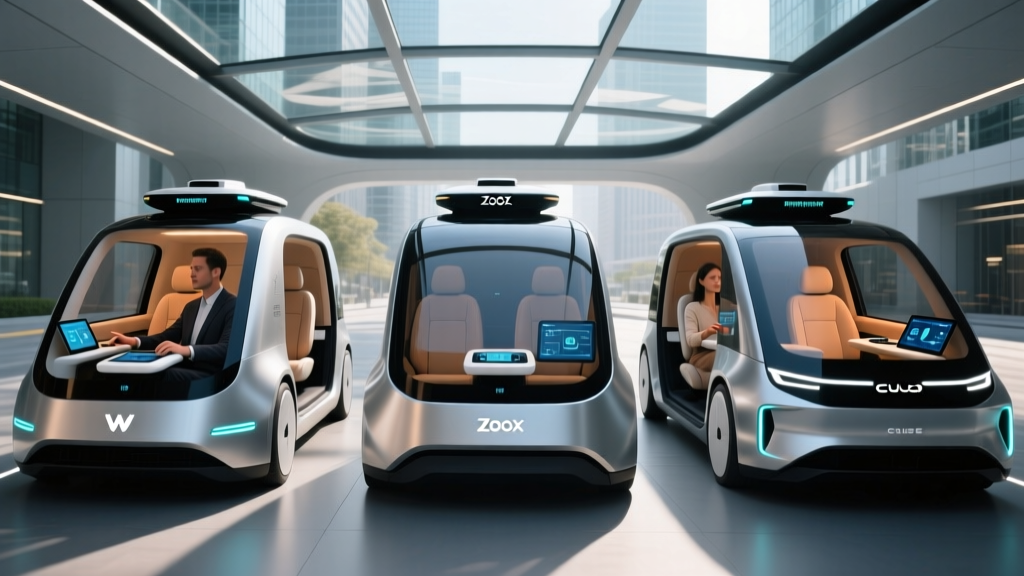
The moment you slide into a robotaxi, the absence of a driver is the first thing that registers — but it's the interior design choices that determine whether the ride feels futuristic or unnerving. As of early 2026, three major operators run commercial driverless services in the United States: Waymo (Alphabet), Zoox (Amazon), and a relaunched Cruise (GM). Each has engineered its robotaxi interior around a fundamentally different philosophy of what a driverless cabin should be.
This guide breaks down what riders actually encounter inside these vehicles — the screens, seating layouts, emergency controls, climate systems, and accessibility features — while grounding the experience in the hard data on safety, availability, and cost that matters to anyone considering hailing one.
Robotaxis operating commercially in the U.S. are classified as SAE Level 4 — high automation within a defined operational design domain (ODD). This means the vehicle handles all driving tasks without human intervention, but only within specific geofenced areas under certain conditions. This is fundamentally different from SAE Level 2 systems like Tesla Autopilot, GM Super Cruise, or Ford BlueCruise, which require continuous driver supervision. In a Level 4 robotaxi, there is no steering wheel, no pedals, and no expectation that you will take over.
The Robotaxi Interior: Vehicle by Vehicle
Waymo — Jaguar I-PACE (5th Generation Driver)
Waymo's current fleet is built on the Jaguar I-PACE electric crossover, a vehicle originally designed with a human driver in mind. The robotaxi interior retains the stock I-PACE cabin forward of the B-pillar — meaning the dashboard, steering column (locked), and center console remain largely intact but deactivated. What changes is the rear cabin:
- Rider screens: Two 10-inch touchscreen displays mounted on the back of the front seats show the route, estimated arrival time, and a real-time visualization of what the car's sensors perceive (pedestrians, other vehicles, traffic signals rendered as a simplified 3D map).
- Climate controls: Rear passengers can adjust fan speed and temperature via the touchscreen — a critical comfort feature since there's no driver to ask.
- Pull-over button: A clearly labeled physical button in the rear cabin allows riders to request an immediate safe stop. Waymo reports the vehicle will pull to the nearest safe location, not stop mid-traffic.
- Accessibility: Waymo has deployed a subset of vehicles with wheelchair-accessible features in Phoenix, though availability remains limited.
- Audio: Riders can pair their phone via Bluetooth to play music through the cabin speakers.
The I-PACE platform gives Waymo a usable 90 kWh battery pack (NMC chemistry), providing an EPA-rated 234 miles of range — though real-world robotaxi operation with constant HVAC, computing loads, and stop-start driving reduces effective range to roughly 150–170 miles before the vehicle must return for charging.
Zoox — Purpose-Built Carriage Vehicle
Zoox's vehicle is the most radical departure from conventional automotive interiors. The Zoox Carriage is a purpose-built, bidirectional electric vehicle with no steering wheel, no pedals, and no designated "front" or "back." The robotaxi interior is configured as a face-to-face four-seat cabin:
- Seating: Two bench seats face each other, similar to a train compartment. This eliminates the "passenger in the driver's seat" anxiety some riders report in retrofitted vehicles.
- Central display: A large shared screen between the two benches shows the route and sensor visualization.
- Individual controls: Each seat position has its own climate vent and USB-C charging port.
- Emergency stop: A prominent red button on the central console allows riders to halt the vehicle.
- Entry/exit: Sliding doors on both sides open wide, and the low floor height (enabled by the skateboard chassis) aids wheelchair and stroller access.
- Powertrain: Dual-motor AWD with a battery pack Zoox has not publicly spec'd in kWh, though the vehicle is designed for all-day operation with opportunity charging.
The face-to-face layout is Zoox's bet that the robotaxi interior should feel like a shared lounge, not a car with a missing driver. Whether riders prefer this over the familiarity of a conventional cabin remains an open question — early rider surveys suggest opinions split along age lines, with younger riders preferring the Zoox layout and older riders finding the I-PACE more comfortable.
Cruise — Chevrolet Origin (Relaunch)
After suspending operations in late 2023 following a serious pedestrian incident in San Francisco, Cruise relaunched limited services in 2025 using the Chevrolet Origin, a purpose-built vehicle similar in concept to Zoox's carriage. The Origin's robotaxi interior features:
- Open cabin: A wide, flat floor with no transmission tunnel or center console divider. Two forward-facing seats and a rear bench accommodate up to four passengers.
- Large central screen: A single 16-inch display mounted on the ceiling folds down to show route and sensor data.
- Accessibility-first design: The Origin was designed with ADA compliance as a priority — wide door openings, low step-in height, and space for a wheelchair without requiring a separate accessible vehicle.
- Simplified controls: Physical buttons for emergency stop, door open, and ride pause — minimizing reliance on touchscreens for critical functions.
GM has not published a battery capacity for the Origin, though the vehicle is built on a dedicated EV platform with Level 2 AC charging capability for depot-based overnight charging and DC fast charging support for mid-shift top-ups.
Where Can You Actually Hail a Robotaxi Right Now?
As of early 2026, commercial driverless robotaxi services are operational in the following U.S. cities. Note that "operational" means you can request a ride through the operator's app without being on a waitlist — but geofencing restricts where you can go.
| Operator | City | Service Area | Hours | Waitlist? |
|---|---|---|---|---|
| Waymo | Phoenix, AZ | ~300 sq mi (metro-wide) | 24/7 | No |
| Waymo | San Francisco, CA | ~150 sq mi (most of SF proper) | 24/7 | No |
| Waymo | Los Angeles, CA | ~80 sq mi (Santa Monica, Hollywood, Downtown) | 6 AM – 2 AM | No |
| Waymo | Austin, TX | ~60 sq mi (Downtown, South Austin) | 6 AM – Midnight | Limited |
| Zoox | Las Vegas, NV | ~12 sq mi (Strip corridor, Downtown) | 10 AM – 2 AM | No |
| Zoox | San Francisco, CA | ~8 sq mi (SoMa, Financial District) | 10 AM – 10 PM | Yes |
| Cruise | Phoenix, AZ | ~40 sq mi (Downtown, Tempe) | 8 AM – Midnight | Yes |
| Cruise | Dallas, TX | ~30 sq mi (Uptown, Downtown) | 8 AM – Midnight | Yes |
The key takeaway: Waymo is the only operator with true city-wide, 24/7 service, and only in Phoenix. Everywhere else, geofencing and hour restrictions apply. If you're visiting Las Vegas, Zoox's Strip corridor service is the most accessible tourist-friendly robotaxi experience available today.
Robotaxi Pricing vs. Uber and Lyft
Pricing is where robotaxi economics get complicated. Operators initially subsidized rides heavily to build rider adoption, but as of 2026, fares have normalized closer to — and sometimes above — conventional rideshare rates.
| Service | Base Fare | 5-Mile Avg | Surge Pricing? | Tip Expected? |
|---|---|---|---|---|
| Waymo | $3.50 | $14–$19 | Yes (peak hours) | No (no driver) |
| Zoox | $2.00 | $10–$14 | No | No |
| Cruise | $3.00 | $12–$17 | Limited | No |
| UberX | $2.50 | $12–$18 | Yes | Yes ($2–$4) |
| Lyft | $2.50 | $11–$17 | Yes | Yes ($2–$4) |
The critical nuance: robotaxi fares don't include tips, which shifts the effective cost comparison. A $16 UberX ride with a $3 tip costs $19 — comparable to a $17 Waymo fare with no tip. Zoox's lower pricing reflects Amazon's strategy of subsidizing adoption to build ridership data.
For airport runs and longer trips (15+ miles), UberX and Lyft still tend to be cheaper because robotaxi per-mile rates don't decrease with distance the way human-driven rideshare sometimes does during off-peak hours. Robotaxis are most cost-competitive on short urban hops of 2–7 miles.
The Technology Stack: What's Powering the Robotaxi Interior Experience
The rider-facing screens inside a robotaxi are just the visible tip of a massive sensor and compute stack. Here's what's actually driving the vehicle while you sit in the back:
Waymo (5th Gen, Jaguar I-PACE)
- LiDAR: 5 roof-mounted units (custom Waymo Laser Bear Honeycomb) providing 360° 3D point-cloud mapping to ~500 meters
- Cameras: 29 cameras covering all directions, including traffic-signal-specific lenses
- Radar: 6 radar units for velocity detection of moving objects in rain/fog
- Audio detection: External microphones detect ambulance sirens and police signals
- Compute: Custom Waymo-designed computing platform (not disclosed in TOPS, but estimated at 500+ TOPS equivalent)
- Approach: LiDAR-first sensor fusion — camera-only is not used for primary perception
Zoox (Carriage Vehicle)
- LiDAR: 8 solid-state units integrated into the roof corners
- Cameras: 36 cameras with overlapping fields of view for redundancy
- Radar: 12 radar units
- Compute: Dual redundant computing systems — if one fails, the backup can execute a safe stop
- Approach: Full sensor fusion with heavy LiDAR reliance; Zoox has been critical of camera-only approaches
Cruise (Chevrolet Origin)
- LiDAR: 5 units (supplier not publicly disclosed post-restructuring)
- Cameras: 16 cameras
- Radar: 21 radar units (Cruise historically used more radar than competitors)
- Compute: GM-developed compute stack, details limited
- Approach: Sensor fusion with emphasis on radar redundancy following the 2023 San Francisco incident review
The industry consensus is clear: no commercial robotaxi operator uses camera-only perception. LiDAR remains a non-negotiable component of Level 4 systems, despite Tesla's camera-only FSD approach at Level 2. The robotaxi interior screens show riders a simplified version of this sensor output — typically rendering pedestrians as colored bounding boxes and vehicles as simplified 3D shapes — which serves as both a trust-building tool and a transparency feature.
Robotaxi Safety: What the Real Data Shows
According to NHTSA Standing General Order data and operator-published safety reports:
- Waymo: Over 10 million fully driverless miles completed. Waymo's published safety data (submitted to NHTSA and peer-reviewed) claims a 76% reduction in police-reported crash involvement per million miles compared to human benchmarks in comparable urban environments. Contactless at-fault incidents (minor scrapes, curb contact): approximately 5.1 per million miles.
- Zoox: Fewer than 1 million driverless miles (smaller fleet, limited service area). No reported serious injuries to riders or pedestrians. Minor property-damage incidents: rate not publicly disclosed due to small sample size.
- Cruise: Operations were suspended October 2023 after a pedestrian was struck and dragged in San Francisco. Relaunched in 2025 with modified software and additional safety protocols. Pre-suspension: approximately 2 million driverless miles. Post-relaunch: fewer than 500,000 miles as of early 2026. The 2023 incident involved the vehicle making initial contact, then pulling over, but a second vehicle struck the pedestrian — Cruise's vehicle then dragged the pedestrian to the roadside. NHTSA and California DMV investigations led to the suspension. Cruise has since implemented more conservative post-collision stop protocols.
The honest assessment: robotaxis have demonstrated they can operate with fewer minor collisions than human drivers in controlled urban environments. However, the Cruise incident exposed a critical edge case — post-collision behavior — that the industry is still working to resolve. Robotaxis are not "safer than humans" in every conceivable scenario; they are safer in the specific scenarios they're geofenced to handle, and they struggle with edge cases involving construction zones, erratic human behavior, and sensor degradation in heavy weather.
For the latest safety data, the NHTSA Automated Vehicles Safety page and California DMV disengagement reports remain the most authoritative public sources.
Current Limitations: Where Robotaxis Fall Short
Before you hail a robotaxi, understand what these vehicles cannot do in 2026:
- Heavy rain and fog: LiDAR performance degrades significantly in heavy precipitation. Waymo and Cruise will pause or restrict service during moderate-to-heavy rain. Phoenix and Los Angeles are chosen partly for their dry climates.
- Construction zones: Temporary lane shifts, orange barrels, and flaggers remain challenging. Robotaxis will often refuse to enter an active construction zone and reroute — sometimes adding significant time to your trip.
- Highway driving: Most robotaxi services avoid limited-access highways. Waymo has begun limited highway segments in Phoenix, but the vast majority of rides are on surface streets under 45 mph.
- Airport pickups: Geofencing rarely extends to airport terminals. You cannot currently take a robotaxi to or from SFO, LAX, or PHX Sky Harbor. This is a major gap compared to Uber/Lyft.
- Suburban and rural areas: Robotaxis are urban-only. If your trip crosses from the geofenced zone into an unmapped suburb, the ride will be declined.
- Large cargo: The robotaxi interior is designed for passengers, not groceries or luggage. Trunk/cargo space in the I-PACE is available but not guaranteed accessible, and the Zoox and Origin vehicles have minimal cargo capacity.
- Unaccompanied minors: All operators require riders to be 18+ with a valid account.
- Pets: Only service animals are permitted. No pets, even in carriers.
- Multi-stop trips: You cannot add a stop along the way. One pickup, one drop-off.
Regulatory Landscape: Who Approves Robotaxi Operations
Robotaxi deployment in the United States requires approval from multiple regulatory bodies, and the patchwork of state-level rules is a major factor in where services are available:
- California (CPUC + DMV): The California Public Utilities Commission issues permits for commercial passenger service, while the DMV issues testing and deployment permits. California has the most stringent reporting requirements, including mandatory collision reporting within 24 hours and annual disengagement reports. Cruise's 2023 suspension was a CPUC action.
- Arizona: The most permissive regulatory environment in the U.S. Arizona has no specific robotaxi permitting process — operators need only comply with general vehicle registration and insurance requirements. This is why Phoenix was Waymo's first commercial market.
- Nevada: Requires a testing permit from the Nevada DMV and an autonomous vehicle certificate for commercial operation. Zoox's Las Vegas service operates under this framework.
- Texas: Allows autonomous vehicle operation with registration through the Texas DMV. Austin and Dallas have seen robotaxi deployments with relatively streamlined local approval.
- Federal (NHTSA): NHTSA does not currently "approve" robotaxi services but has authority to investigate safety defects and issue recalls. The Standing General Order (SGO) requires all operators to report crashes involving Level 2+ systems. NHTSA's nhtsa.gov portal publishes aggregated SGO data periodically.
The regulatory landscape is shifting. Several states are considering legislation that would either expand or restrict robotaxi operations, and a federal framework remains absent. If you live outside the four states listed above, commercial robotaxi service is not available to you in 2026 regardless of what any operator has "announced."
The Robotaxi Interior of the Near Future
The current generation of robotaxi interiors is, in many ways, transitional. Waymo's I-PACE is a retrofit — a human-designed car adapted for driverless use — and Waymo has confirmed it is working with Zeekr (Geely) on a purpose-built vehicle for future fleet deployment. That vehicle, the Zeekr M-Vision concept adapted for Waymo, will feature a flat floor, sliding doors, and a configurable cabin similar to Zoox's approach.
What riders can expect from next-generation robotaxi interiors (2027–2028 timeframe):
- Configurable seating: Seats that rotate or reconfigure based on party size (solo rider gets a lounge seat; group of four gets facing benches)
- AR overlays: Windows with embedded displays showing points of interest or route information
- Improved accessibility: Built-in ramps rather than after-market conversions
- Voice-first interfaces: Reduced reliance on touchscreens, with natural-language voice assistants handling climate, routing, and emergency requests
None of these features are available today. If an operator announces them, they are preliminary and not yet in commercial service.
Frequently Asked Questions
Is a robotaxi truly self-driving, or is there a remote human operator?
Robotaxis are SAE Level 4, meaning they drive themselves without human intervention within their geofenced area. However, remote assistance exists: if the vehicle encounters a scenario it cannot resolve (e.g., a complex construction zone), a remote operator can provide guidance — not by driving the vehicle with a joystick, but by approving a path or confirming it's safe to proceed. This is called teleassistance, and it's used sparingly. Waymo reports that teleassistance interventions occur less than once per 10,000 miles.
How much does a robotaxi cost compared to Uber or Lyft?
For a typical 5-mile urban ride, Waymo costs $14–$19, Zoox $10–$14, and Cruise $12–$17. UberX and Lyft charge $11–$18 but expect a $2–$4 tip. After accounting for tips, robotaxis are cost-competitive on short urban trips but more expensive on longer rides (15+ miles) and airport runs, which are mostly outside robotaxi geofences anyway.
What happens if the robotaxi gets into an accident while I'm inside?
The vehicle is programmed to pull to a safe stop, unlock the doors, and contact emergency services automatically. The rider screen will display instructions. All operators carry commercial liability insurance that covers riders. Waymo carries a $5 million per-incident policy; Cruise and Zoox carry similar coverage. You are not liable for the vehicle's actions as a passenger.
Can I use a robotaxi if I use a wheelchair?
Waymo has a limited number of wheelchair-accessible vehicles (WAVs) in Phoenix, but availability is not guaranteed and wait times are longer. Zoox's purpose-built carriage was designed with accessibility in mind, but the current Las Vegas fleet has limited WAV availability. Cruise's Chevrolet Origin was designed to be ADA-compliant, but the small post-relaunch fleet means accessible vehicles are scarce. If you require wheelchair access, contact the operator directly before relying on the service.
Where can I use a robotaxi service right now?
Commercial driverless robotaxi service is available in Phoenix (Waymo, Cruise), San Francisco (Waymo, Zoox), Los Angeles (Waymo), Las Vegas (Zoox), Austin (Waymo), and Dallas (Cruise). Waymo's Phoenix service is the most comprehensive — 24/7 across a 300-square-mile area. All other services have restricted hours and smaller geofences.
How safe are robotaxis compared to human drivers?
Waymo's published data indicates a 76% reduction in police-reported crash involvement per million miles versus human benchmarks in comparable urban areas. However, this comparison has limitations: robotaxis operate in geofenced, mapped areas, avoid highways, and pause service in bad weather — all of which reduce exposure to high-risk scenarios. The Cruise 2023 incident demonstrated that edge cases (post-collision behavior, interaction with human-driven vehicles) remain unresolved challenges. For comprehensive data, consult NHTSA's automated vehicle safety resources.
What are the current limitations of robotaxi service?
Robotaxis cannot operate in heavy rain or fog, cannot handle most construction zones, generally avoid highways, do not serve airports, cannot carry large cargo or pets, do not allow multi-stop trips, and are restricted to specific geofenced urban areas in six U.S. cities. They are a complement to — not a replacement for — conventional rideshare in 2026.