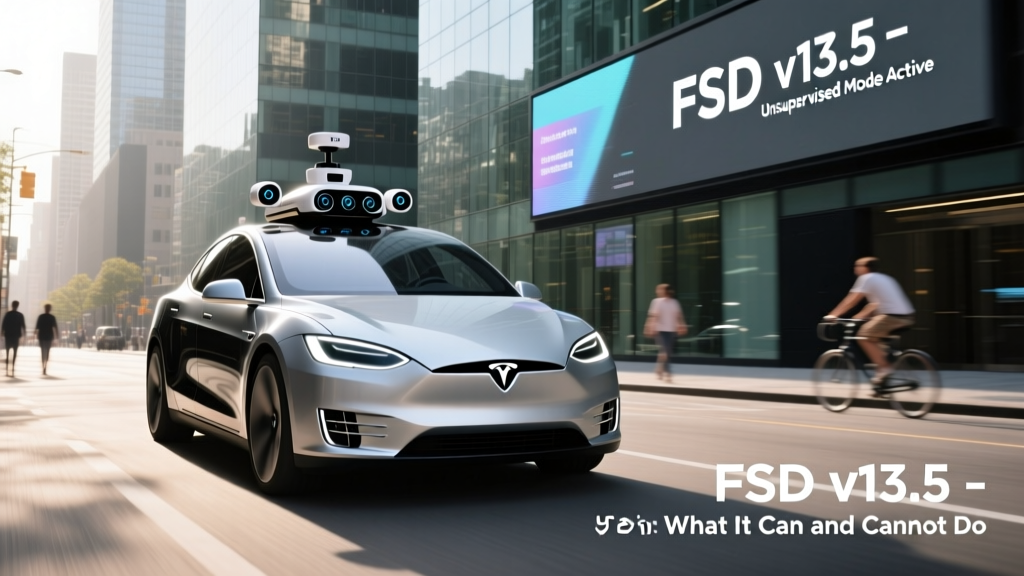
If you've been searching for a robotaxi for sale, you've likely seen headlines about fully autonomous vehicles navigating city streets without a driver. The reality in 2026 is more nuanced: true driverless robotaxis exist and carry paying passengers daily, but they are not consumer products you can purchase. They are fleet-operated, geofenced, and heavily regulated commercial services. This guide breaks down exactly where robotaxis operate, what technology powers them, how safe they are, and why the "robotaxi for sale" market doesn't exist for individual buyers — yet.
SAE Automation Levels: Why Robotaxis Aren't the Same as Autopilot
The single most important distinction in the autonomous vehicle space is the difference between driver-assist systems and true robotaxis. Consumer vehicles with features like Tesla FSD (Supervised), GM Super Cruise, or Ford BlueCruise are SAE Level 2 systems — the driver must remain engaged, monitor the road, and be ready to take over at any moment. Robotaxis operated by companies like Waymo and Zoox are SAE Level 4 — there is no driver, no steering wheel for passenger use, and the system handles all driving within its operational design domain (ODD).
| Level | Name | Who Drives | Examples |
|---|---|---|---|
| Level 0 | No Automation | Human only | Basic cruise control |
| Level 1 | Driver Assistance | Human, with steering OR speed assist | Adaptive cruise, lane-keep |
| Level 2 | Partial Automation | Human (must supervise) | Tesla Autopilot, BlueCruise, Super Cruise |
| Level 3 | Conditional Automation | System in limited conditions; human on standby | Mercedes DRIVE PILOT (limited markets) |
| Level 4 | High Automation | System fully (within geofence/ODD) | Waymo One, Zoox |
| Level 5 | Full Automation | System everywhere, all conditions | Does not yet exist commercially |
Where Can I Use a Robotaxi Service Right Now?
As of early 2026, fully driverless robotaxi services are operational in a handful of U.S. cities. Availability is tightly controlled — each service operates within a defined geofence and requires regulatory approval at both the state and local level. You cannot hail a robotaxi outside these approved zones.
| Operator | City/Region | Service Area | Hours | Vehicle Platform |
|---|---|---|---|---|
| Waymo One | Phoenix, AZ (metro) | ~315 sq mi geofence | 24/7 | Jaguar I-PACE EV, custom Waymo 6th-gen |
| Waymo One | San Francisco, CA | Most of SF proper | 24/7 | Jaguar I-PACE EV, Zeekr RT |
| Waymo One | Los Angeles, CA | Select zones (expanding) | Limited hours | Jaguar I-PACE EV |
| Waymo One | Austin, TX | Central Austin zones | Limited hours | Jaguar I-PACE EV |
| Zoox | Las Vegas, NV | Limited corridor | Limited hours | Zoox purpose-built vehicle (no steering wheel) |
| Zoox | Foster City, CA | Testing/limited rides | Limited | Zoox purpose-built vehicle |
| Cruise | — | Suspended operations (as of late 2024; limited restart in 2025-2026) | — | Chevrolet Bolt EV / Origin |
Waymo, a subsidiary of Alphabet, remains the dominant commercial robotaxi operator in the U.S., completing over 150,000 paid rides per week across its active markets by late 2025. Zoox, owned by Amazon, has taken a different approach with a purpose-built bidirectional vehicle that has no steering wheel or pedals — a true Level 4 design from the ground up. Waymo One service areas and availability continue to expand, but each new city requires separate regulatory approval.
The Technology Stack: Lidar, Cameras, and Why It Matters
Robotaxis rely on a sensor fusion approach that differs fundamentally from consumer driver-assist systems. Understanding the tech stack explains both the capabilities and the limitations of current Level 4 operations.
Waymo 6th-Generation Sensor Suite
- Lidar: Multiple roof-mounted units providing 360° 3D point-cloud mapping up to 500+ meters. Lidar operates independently of ambient light, giving robotaxis a critical edge at night and in glare conditions.
- Cameras: High-resolution surround cameras for object classification, traffic-light recognition, and lane detection. Improved low-light performance over previous generations.
- Radar: Imaging radar for velocity detection and performance in rain/fog where lidar and cameras degrade.
- Audio sensors: External microphones to detect emergency vehicle sirens and adjust behavior accordingly.
- Compute: Custom AI processing hardware running perception, prediction, and planning models in real time.
The lidar-vs-camera-only debate is central to the robotaxi space. Tesla has famously pursued a camera-only ("Tesla Vision") approach for its FSD system, arguing that if humans can drive with eyes alone, so can AI. Waymo, Zoox, Cruise, and nearly every other robotaxi operator disagree — they argue that redundant sensing (lidar + camera + radar) is essential for safety-critical Level 4 operation where there is no human fallback. Current real-world data supports the sensor-fusion approach for driverless operations, as no camera-only system has achieved regulatory approval for unsupervised Level 4 service.
Geofencing is another critical component. Robotaxis don't drive just anywhere — they operate within high-definition mapped areas where the system has detailed knowledge of lane geometry, signal positions, construction zones, and speed limits. When a robotaxi approaches the edge of its geofence, it will not proceed; the ride is either rerouted or terminated. This is a fundamental constraint of current Level 4 technology.
Robotaxi Pricing: How Does It Compare to Uber and Lyft?
One of the most common questions from prospective riders is cost. Robotaxi pricing varies by market and time of day, but here's how it generally compares to traditional rideshare in the same cities:
| Metric | Waymo One | UberX (same city) | Lyft (same city) |
|---|---|---|---|
| Base fare | ~$3.50–$5.00 | ~$2.50–$4.00 | ~$2.50–$4.00 |
| Per-mile rate | ~$1.25–$1.75 | ~$1.00–$1.50 | ~$1.00–$1.50 |
| Per-minute rate | ~$0.30–$0.50 | ~$0.20–$0.40 | ~$0.20–$0.40 |
| Typical 5-mile ride | $12–$18 | $10–$16 | $10–$15 |
| Surge pricing | Limited/rare | Common (1.5x–3x+) | Common (1.5x–3x+) |
| Tipping | Not applicable (no driver) | Expected ($2–$5+) | Expected ($2–$5+) |
The headline takeaway: robotaxi rides are currently priced roughly on par with or slightly above standard UberX/Lyft rides before tip. When you factor in that there's no driver to tip, the total cost is often comparable. Waymo has used promotional pricing and introductory credits in new markets to drive adoption. The long-term economic thesis is that removing the driver (who earns the majority of a rideshare fare) should eventually make robotaxis significantly cheaper — but that scale hasn't been reached yet.
Wait times vary. In Phoenix and San Francisco, Waymo riders typically report 3–8 minute wait times in core service areas during peak hours — competitive with Uber/Lyft. In newer or less dense markets like Austin, wait times can stretch to 10–15 minutes due to smaller fleet sizes.
How Safe Are Robotaxis? The Real Data
Safety is the most scrutinized aspect of robotaxi operations, and for good reason. These vehicles share roads with human drivers, cyclists, and pedestrians. Here's what the data shows:
- Over 50 million fully autonomous miles driven across all markets
- Waymo's own published analysis (peer-reviewed methodology) showed a 85% reduction in injury-causing crash rates compared to human benchmarks in the same geographies
- Contactless "disengagements" (where the vehicle pulls over due to a system uncertainty) occur at a rate of roughly 1 per 5,000–10,000 miles depending on city complexity
- Zero confirmed fatalities in fully autonomous Waymo operations as of early 2026
Source: Waymo Safety Report, NHTSA AV safety data
For context, the U.S. human-driver fatality rate is approximately 1.35 deaths per 100 million vehicle miles traveled (NHTSA). Robotaxi fleets have not yet accumulated enough miles to make direct statistical fatality comparisons definitive, but the injury and contact-rate data is encouraging.
Incidents that have occurred have been scrutinized heavily. Cruise's October 2023 incident in San Francisco — where a pedestrian was struck by a human-driven vehicle and then dragged under a Cruise robotaxi — led to a statewide suspension of Cruise operations in California and a near-total shutdown of the company's commercial service. Cruise has since restructured and restarted limited operations under tighter oversight. This incident underscores that regulatory bodies take robotaxi safety failures seriously, and that operational permits can be revoked swiftly.
The NHTSA Standing General Order requires all AV operators to report crashes involving their systems within one day, providing a level of transparency that doesn't exist for human drivers. This data is publicly accessible and is the best source for ongoing safety monitoring.
The Regulatory Landscape: Who Approves Robotaxi Operations?
Robotaxi operations in the U.S. require a patchwork of approvals — there is no single federal "robotaxi license." Here's how the regulatory structure works:
- Federal (NHTSA): Sets vehicle safety standards (FMVSS). Currently, vehicles without steering wheels or pedals (like the Zoox vehicle) require exemptions from certain FMVSS rules. NHTSA also mandates crash reporting via the Standing General Order.
- State DMV/Regulators: Each state sets its own rules for AV testing and commercial deployment. California's CPUC (Public Utilities Commission) and DMV jointly regulate robotaxi permits. Arizona has taken a permissive approach, which is why Waymo scaled in Phoenix first. Texas, Nevada, and other states have their own frameworks.
- Local/Municipal: Cities often have input on where robotaxis can operate, speed limits, and coordination with local emergency services. San Francisco's Board of Supervisors has held multiple hearings on robotaxi expansion, reflecting local political tension.
This fragmented regulatory environment is a primary reason robotaxi expansion is slow and city-by-city. A company can't simply launch in a new metro — it must navigate state permitting, local negotiations, and often public comment periods before commercial service is approved. As of 2026, only about 8–10 U.S. states have clear frameworks for commercial driverless operations.
Current Limitations: Where Robotaxis Fall Short
Despite impressive capabilities within their operational domains, robotaxis in 2026 have significant constraints that buyers and riders should understand:
- Heavy weather: Torrential rain, heavy snow, dense fog, and ice can degrade sensor performance. Most robotaxi services reduce operations or suspend service during severe weather events.
- Unmapped areas: If a road isn't in the high-definition map, the robotaxi won't enter it. Construction zones, newly built roads, and temporary detours can cause rerouting or ride cancellation.
- Highway merging in complex interchanges: While Waymo handles highways in some markets, complex multi-lane merges and aggressive human-driver behavior remain challenging edge cases.
- Off-road or unpaved roads: Robotaxis are strictly on-road, paved-surface vehicles.
- Unusual scenarios: Police hand signals, accident scenes without clear detours, parade routes, and other non-standard traffic patterns may cause the vehicle to stop and wait for remote guidance.
- Cross-city trips: A robotaxi geofenced to San Francisco cannot drive you to Sacramento. Inter-city travel is not possible.
These limitations explain why Level 4 is described as "high automation within a defined operational design domain" — not universal self-driving. The ODD (operational design domain) is the boundary within which the system is designed to function safely, and it is narrower than most consumers assume.
Why You Can't Buy a Robotaxi (and When You Might)
The search for a "robotaxi for sale" reflects genuine consumer interest in autonomous technology, but the economics and technology simply don't support individual ownership yet. Here's why:
- Cost: A Waymo-equipped Jaguar I-PACE with its full sensor suite (lidar, cameras, radar, compute hardware) is estimated to cost $150,000–$200,000+ per vehicle in hardware alone. The Zoox purpose-built vehicle isn't sold to consumers at all.
- Software licensing: The autonomous driving software is proprietary, cloud-connected, and requires constant updates, HD map data, and remote-assistance infrastructure. It's not a one-time purchase.
- Liability and insurance: Who is liable when a privately owned Level 4 vehicle causes a crash? The legal framework for consumer-owned driverless vehicles doesn't exist in most jurisdictions.
- Maintenance: Sensor calibration, lidar replacement, and compute-hardware servicing require specialized facilities that don't exist in the consumer aftermarket.
The fleet model — where a company owns, maintains, insures, and operates the vehicles — is the only viable structure for Level 4 robotaxis today. This is analogous to commercial aviation: you buy a ticket on a plane, but you don't buy the plane.
When might consumer robotaxis exist? Optimistic projections from industry analysts suggest limited consumer availability of Level 4 vehicles in the early 2030s, likely starting with highway-only autopilot on defined routes (similar to personal aircraft autopilot systems). Full Level 5 — a vehicle that drives itself anywhere, in any condition, without a steering wheel — remains a research goal with no credible commercial timeline. Be wary of any company claiming otherwise.
Consumer Alternatives: What You CAN Buy Today
While you can't purchase a robotaxi, the most advanced consumer driver-assist systems in 2026 offer meaningful autonomy within their Level 2 constraints:
- Tesla FSD (Supervised): The most capable consumer system by feature set, handling city streets, highway interchanges, and parking. However, the driver must remain fully attentive. SAE Level 2.
- GM Super Cruise: Hands-off driving on 750,000+ miles of mapped divided highways in the U.S. and Canada. Driver monitoring via eye-tracking camera. SAE Level 2. Available on Cadillac, Chevrolet, and GMC models.
- Ford BlueCruise: Hands-off on 130,000+ miles of qualified highway sections. SAE Level 2. Available on Ford and Lincoln models.
- Mercedes-Benz DRIVE PILOT: The only certified Level 3 system available in the U.S. (limited to Nevada and California). Allows the driver to fully disengage at speeds up to 40 mph in heavy traffic on approved highways. Mercedes assumes liability when the system is engaged.
These systems represent the practical frontier of what consumers can purchase and use today. They are sophisticated, but they are not robotaxis — the human remains the driver of record.
Frequently Asked Questions
Can I buy a Waymo or Zoox robotaxi for personal use?
No. Waymo and Zoox vehicles are fleet-owned and operated. They are not available for consumer purchase. The sensor hardware, proprietary software, HD mapping infrastructure, and remote-assistance systems are designed for commercial fleet operation, not individual ownership.
Is Tesla FSD a robotaxi?
No. Tesla FSD (Supervised) is an SAE Level 2 driver-assist system. The driver must remain attentive and is legally responsible for the vehicle at all times. Tesla has discussed a future "robotaxi" network, but as of 2026, no Tesla vehicle operates as a driverless commercial service. The anticipated Tesla "Cybercab" has been announced but is not yet in production or commercial operation.
How much does a Waymo ride cost compared to Uber?
Waymo One rides are typically priced within 10–20% of UberX/Lyft fares in the same city for comparable distances. A typical 5-mile ride costs $12–$18. With no driver to tip, the total out-of-pocket cost is often similar to or slightly less than rideshare with a tip included.
Are robotaxis safe in rain or snow?
Light rain is generally handled well by current sensor suites. Heavy rain, snow, fog, and ice significantly degrade lidar and camera performance. Most operators reduce service areas or suspend operations entirely during severe weather. This is a known limitation of Level 4 technology.
What happens if a robotaxi gets confused or encounters an obstacle?
The vehicle will typically come to a controlled stop and contact a remote-assistance operator who can provide guidance or reroute the vehicle. In rare cases, the vehicle may pull over and end the ride. Passengers are never expected to take control of a Level 4 robotaxi.
When will robotaxis be available in my city?
Expansion depends on state regulation, local approval, mapping, and fleet scaling. Waymo has announced plans for additional U.S. cities, but each launch requires 12–24 months of testing, regulatory negotiation, and phased rollout. Check your state DMV or NHTSA's AV resources for the latest information on AV activity in your area.