The Robotaxi App Android Landscape in 2026
If you've searched for a robotaxi app Android download hoping to hail a driverless car, you've likely hit a wall of confusion. Some apps are invite-only, others work in just one city, and a few have been pulled entirely. As of early 2026, the driverless ride-hailing market is real but geographically narrow — dominated by Alphabet's Waymo One, with Amazon's Zoox operating a limited free service and GM's Cruise slowly rebuilding after its 2023 safety crisis.
This guide cuts through the hype. We'll show you exactly which robotaxi apps work on Android today, where they operate, what a ride actually costs compared to Uber or Lyft, and what the safety data really says. No marketing gloss — just operational facts.
Robotaxis like Waymo and Zoox operate at SAE Level 4 — meaning the vehicle handles all driving tasks within a defined operational design domain (geofenced area, certain weather conditions) with no human driver present. This is fundamentally different from SAE Level 2 systems like Tesla Autopilot or Ford BlueCruise, which require continuous driver supervision. If you're in a Waymo, there is no one in the driver's seat. If you're using FSD Supervised, you are the driver. These are not comparable products.
Where Can I Use a Robotaxi App on Android Right Now?
Service availability is the single biggest constraint in the robotaxi market. Unlike Uber or Lyft, which operate in thousands of cities, driverless services are confined to specific metro areas — and often only portions of those areas.
| Service | Android App | Live Cities (2026) | Access Model | Hours |
|---|---|---|---|---|
| Waymo One | Yes — Google Play | Phoenix, San Francisco, Los Angeles, Austin | Open to public (no waitlist in most cities) | 24/7 in Phoenix & SF; limited hours in LA/Austin |
| Zoox | Yes — invite/waitlist | Las Vegas (Strip area), Foster City, CA | Invite-only / waitlist; free rides during beta | Limited daytime hours |
| Cruise | Relaunched in select markets | Phoenix (limited), Dallas (testing) | Phased re-entry; safety driver present in some zones | Restricted hours |
Key takeaway: Waymo One is the only robotaxi app on Android you can download today and use immediately without a waitlist — provided you're physically inside one of its four metro service areas. Zoox remains a novelty experience. Cruise is rebuilding trust gradually.
How to Use Waymo One (and What to Expect)
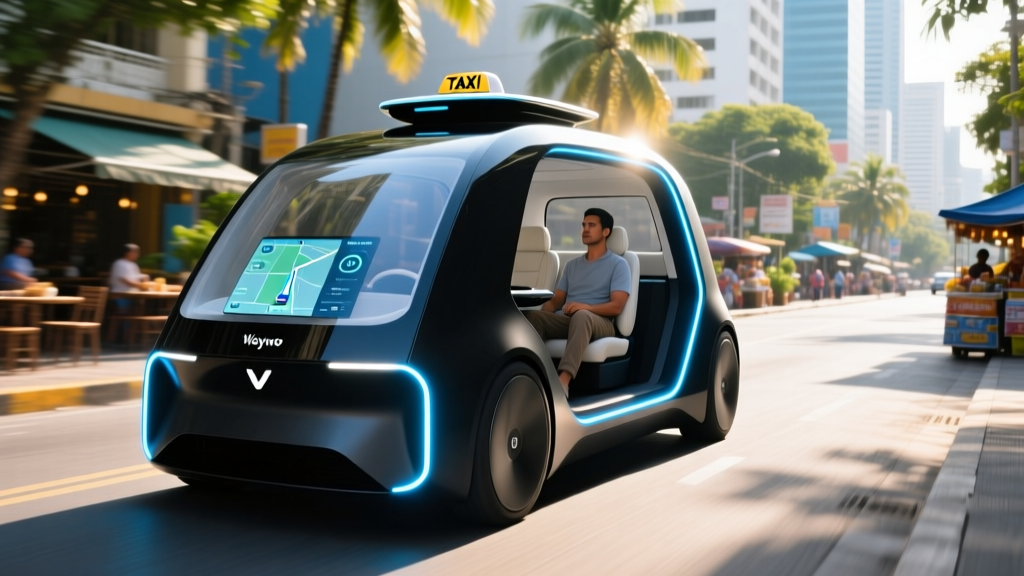
Waymo One is available on the Google Play Store for Android devices running Android 10 or later. The onboarding process mirrors Uber or Lyft: enter your destination, confirm pickup, and track the vehicle's approach on a map. The critical difference is that when the car arrives — currently a Jaguar I-PACE EV with roof-mounted lidar and sensor arrays — there is no driver. The rear doors unlock automatically, you buckle in, and the ride begins via an in-app "Start Ride" button.
Inside the vehicle, a rear-seat screen displays your route, speed, and detected objects (pedestrians, cyclists, other cars rendered in real time). You can adjust climate controls and pull over via the app, but you cannot steer, brake, or override driving decisions. A support line is accessible at all times.
Geofencing: The Invisible Boundary
Robotaxis do not drive everywhere within a city. Waymo's Phoenix service area covers roughly 200+ square miles across the East Valley (Chandler, Tempe, Mesa, Gilbert) and has expanded into central Phoenix and the airport. San Francisco coverage spans most of the city proper but excludes certain highway segments. Los Angeles coverage includes downtown, Hollywood, Santa Monica, and Westside corridors. If your destination falls outside the geofence, the app will not let you book the ride.
Robotaxi Pricing vs. Uber and Lyft
One of the most common questions: does removing the driver make robotaxis cheaper? The honest answer — not always, and not yet at scale.
| Service | Base Fare | Per-Mile Rate | Per-Minute Rate | Typical 5-Mile Ride |
|---|---|---|---|---|
| Waymo One | ~$3.50 | ~$1.25 | ~$0.35 | $12–$16 |
| UberX (same city) | ~$2.50 | ~$1.10 | ~$0.30 | $10–$14 |
| Lyft (same city) | ~$2.50 | ~$1.05 | ~$0.28 | $9–$13 |
| Zoox | Free (beta) | N/A | N/A | $0 |
Waymo's pricing is broadly competitive with UberX and Lyft — sometimes slightly higher, sometimes lower depending on demand and promotions. Waymo has periodically offered discount codes and loyalty pricing to build ridership. The long-term economic thesis is that removing the driver (who typically takes 60–75% of the fare) allows lower prices at scale, but current pricing reflects heavy R&D cost recovery, expensive sensor suites (each Waymo I-PACE carries an estimated $100,000–$150,000 in lidar, cameras, and compute hardware), and fleet operations overhead.
Zoox's free rides are a beta-period anomaly, not a sustainable business model. Expect paid pricing if and when Zoox scales commercially.
Safety Data: What the Numbers Actually Show
Safety is where robotaxi discourse gets polarized — enthusiasts claim the technology is already superhuman, while critics point to every incident as proof it's premature. The data tells a more nuanced story.
- Total autonomous miles driven: Over 30 million fully driverless miles across Phoenix, SF, and LA (Waymo Safety Report)
- Injury-causing crash rate: Approximately 85% lower than human benchmark in comparable urban environments, per Waymo's published insurance-claim data
- Contactless at-fault incidents: Very low rate per million miles; most involve low-speed contact with stationary or unpredictable objects (e.g., illegally parked trucks, jaywalking pedestrians)
- NHTSA Standing General Order: Waymo reports all Level 4 incidents as required; data is publicly searchable via NHTSA's database
For context: The human benchmark in US urban driving is roughly 1.35 fatalities per 100 million vehicle miles (NHTSA). Waymo's fully driverless fleet has logged tens of millions of miles with zero confirmed fatalities as of early 2026. However, 30 million miles, while impressive, is statistically small compared to the ~3 trillion miles Americans drive annually. Drawing definitive "safer than humans" conclusions requires continued data accumulation at larger scale.
Cruise's 2023 incident — in which a pedestrian was struck by a human-driven vehicle and then dragged under a Cruise robotaxi in San Francisco — remains the industry's cautionary tale. The California DMV suspended Cruise's permit, the company halted nationwide operations, and GM wrote down billions in value. Cruise has since restructured its safety protocols and is re-entering markets slowly with human safety drivers before transitioning back to fully driverless operations. Source: NHTSA.
Technology Stack: Lidar, Cameras, and Compute
Understanding how robotaxis "see" the world helps explain both their capabilities and their limitations.
Waymo 6th-Generation Driver (Jaguar I-PACE platform)
- Lidar: Multiple roof-mounted units providing 360° 3D point-cloud mapping up to 500+ meters. Lidar works independently of ambient light — critical for night driving and sun glare scenarios where cameras struggle.
- Cameras: High-resolution surround cameras for lane marking detection, traffic signal state recognition, and object classification (pedestrian vs. cyclist vs. vehicle).
- Radar: Forward and corner-mounted radar for velocity tracking of other vehicles, particularly in rain or fog where lidar return degrades.
- Audio detection: External microphones to detect emergency vehicle sirens and adjust behavior accordingly.
- Compute: Custom AI inference hardware in the trunk processing sensor fusion in real time, running Waymo's "Driver" software stack.
Zoox Purpose-Built Vehicle
- Symmetrical design: No steering wheel, no designated "front" — the vehicle can operate bidirectionally.
- Dual-redundant systems: Independent braking, steering, and compute paths so a single failure doesn't strand the vehicle.
- Sensor suite: Comparable lidar + camera + radar array, optimized for Zoox's lower-speed urban environments (top speed ~75 mph, typically operated at 35–45 mph in city zones).
The camera-only debate: Tesla's approach to autonomy (FSD) relies exclusively on cameras and neural networks, without lidar. No major Level 4 robotaxi operator currently uses a camera-only stack. The industry consensus among Waymo, Zoox, Cruise, and Chinese operators like Baidu Apollo is that lidar provides a necessary safety-redundant depth perception layer that cameras alone cannot reliably supply in all lighting and weather conditions.
Regulatory Landscape: Who Approves Robotaxi Operations?
Robotaxi deployment in the US is governed by a patchwork of state and local authorities — there is no single federal "robotaxi license."
- California (CPUC + DMV): The California Public Utilities Commission issues permits for commercial passenger service, while the DMV regulates testing. Both must approve operations. Cruise's 2023 suspension came from the DMV; reinstatement required demonstrating improved safety processes to both agencies.
- Arizona: The most permissive regulatory environment. Waymo has operated commercially in Phoenix since 2020 with minimal restriction. The state requires a testing permit but imposes fewer operational constraints than California.
- Texas: Austin allows driverless testing and limited commercial operations under a state framework passed in 2017 (SB 2205). Waymo expanded to Austin in 2024–2025.
- Nevada: Zoox operates under a state-issued autonomous vehicle testing and deployment license in Las Vegas.
- Federal (NHTSA): Sets vehicle safety standards (FMVSS) and requires incident reporting under the Standing General Order for ADS-equipped vehicles. NHTSA does not currently "approve" robotaxi services but can investigate and issue recalls for ADS software defects.
The regulatory environment continues to evolve. Several states have introduced or passed legislation requiring specific insurance minimums (typically $5–$10 million per vehicle), data-sharing with local transportation agencies, and accessibility requirements for passengers with disabilities. For the latest state-by-state rules, the National Conference of State Legislatures maintains a comprehensive tracker.
Current Limitations: Where Robotaxis Fall Short
Level 4 autonomy is impressive within its operational design domain — but that domain has hard edges. Here are the real-world limitations you'll encounter today:
- Weather: Heavy rain, fog, and snow degrade lidar and camera performance. Waymo may pause or restrict service during significant precipitation events. None of the major operators currently run in snow-belt cities.
- Geofencing: You cannot hail a robotaxi to a destination outside the mapped service area. Detours, road closures, or construction zones outside the operator's HD map can cause the vehicle to pull over and request remote assistance.
- Highway driving: Most robotaxi services avoid limited-access highways. Waymo has begun limited highway-capable routes (e.g., Phoenix airport runs), but the majority of rides are surface-street only.
- Pickup/dropoff precision: Vehicles pull to the curb at the nearest safe legal stop, not necessarily at the exact pin you dropped. Expect a short walk in complex locations like shopping centers or apartment complexes.
- No intermediate stops: Unlike Uber, you generally cannot add a stop along the route (e.g., pick up a friend, grab coffee). The ride is point A to point B.
- Passenger limits and accessibility: Waymo's I-PACE accommodates up to 3 rear-seat passengers. Wheelchair-accessible vehicles are in pilot stages but not broadly available. Zoox's purpose-built vehicle seats 4 but has limited luggage space.
- Edge cases: Unusual scenarios — a police officer directing traffic with hand signals, a fallen tree across the road, an accident scene with emergency vehicles blocking lanes — may cause the vehicle to stop, wait, or request a remote human operator to guide it through. This can add minutes to your trip.
Is This Truly Self-Driving or Driver-Assist?
This is the most important distinction in the entire autonomous vehicle space, and it bears repeating with absolute clarity:
| SAE Level | Who Drives? | Examples | Available to Consumers? |
|---|---|---|---|
| Level 2 | Human (system assists steering + speed) | Tesla Autopilot/FSD Supervised, Ford BlueCruise, GM Super Cruise | Yes — you buy the car |
| Level 3 | System in specific conditions; human must take over when requested | Mercedes DRIVE PILOT (limited markets, <40 mph, specific highways) | Yes — limited availability |
| Level 4 | System entirely (within geofenced ODD); no human needed | Waymo One, Zoox, Cruise (when operational) | Yes — ride-hail only, not for purchase |
| Level 5 | System everywhere, all conditions | Does not exist commercially | No |
When you download a robotaxi app on Android and book a Waymo One ride, you are experiencing Level 4 autonomy. There is no steering wheel accessible to you, no driver in the front seat, and no expectation that you will intervene. The vehicle is responsible for the entire driving task within its operational domain.
When you engage Tesla FSD Supervised, you are using Level 2 driver-assistance. Despite the "Full Self-Driving" name, Tesla's own owner's manual and the vehicle's interface explicitly require you to keep your hands on the wheel and your eyes on the road. You are legally and operationally the driver. Conflating these two experiences is dangerous and inaccurate.
Android App Practicalities: Downloads, Accounts, and Tips
Waymo One App
- Download: Free on Google Play Store. Requires Android 10+ and Google account.
- Account setup: Phone number verification, payment method (credit/debit card or Google Pay), and agreement to rider terms.
- Ride booking: Enter destination → confirm pickup spot (app suggests nearest legal curb) → see upfront price → confirm → track vehicle approach.
- During ride: In-app screen shows route, speed, and a real-time visualization of what the car's sensors detect. Music via Bluetooth is supported in some vehicles.
- Support: In-app "Help" button connects to a live agent who can also remotely intervene if the vehicle is confused or stuck.
Zoox App
- Download: Available on Google Play but requires an active invite or waitlist clearance to book rides.
- Experience: Zoox's purpose-built carriage-style vehicle offers face-to-face seating and a panoramic interior screen. Currently free during the beta period in Las Vegas and Foster City.
Frequently Asked Questions
Can I use a robotaxi app on Android outside the US?
As of 2026, US-based robotaxi services (Waymo, Zoox, Cruise) operate exclusively in American cities. In China, Baidu's Apollo Go and Pony.ai operate robotaxi services in cities like Beijing, Shanghai, and Wuhan, with their own Android-compatible apps — but these are not available or functional outside China. No global robotaxi network exists.
Do I need a special phone or account to use Waymo One?
No. Any Android phone running Android 10 or later with the Google Play Store can download Waymo One. You need a valid phone number and a payment method. No special hardware, membership, or driver's license is required — you are a passenger, not a driver.
What happens if the robotaxi gets stuck or confused?
The vehicle will pull over safely and contact a remote assistance operator. This human does not "drive" the car remotely but can provide high-level guidance (e.g., "the construction zone is temporary, proceed via the left lane"). Most interventions resolve in under a minute. You can also use the in-app help button to speak to support directly.
Are robotaxis safe at night?
Waymo operates 24/7 in Phoenix and San Francisco, including overnight hours. The lidar-based sensor suite does not depend on ambient light, so nighttime perception capability is comparable to daytime. Safety data has not shown a disproportionate night-time incident rate for Waymo's fleet. However, rider demand is lower at night, so wait times may be longer.
Will robotaxis replace Uber and Lyft?
Not in the near term. Robotaxis are confined to four US cities and cannot operate on most highways, in bad weather, or outside geofenced zones. Uber and Lyft cover thousands of cities, handle complex multi-stop trips, and operate in conditions where Level 4 systems cannot. The more likely trajectory is gradual expansion of robotaxi zones within metro areas, with human-driven rideshare continuing to serve suburbs, highways, and inclement-weather scenarios for years to come.
How much does a robotaxi ride cost compared to owning a car?
A single robotaxi ride at $12–$16 for 5 miles is comparable to UberX. If you replaced all driving with robotaxis, costs would add up quickly — 20 rides per week at $14 average equals roughly $14,500 annually. For comparison, the IRS standard mileage rate for 2026 is approximately $0.70/mile, putting 10,000 annual miles at $7,000 in total vehicle cost. Robotaxis make economic sense for occasional urban trips, not as a full replacement for car ownership in most scenarios today.
The robotaxi app Android ecosystem in 2026 is real, functional, and expanding — but it remains a metro-specific service, not a national transportation network. Waymo One is the clear leader for anyone wanting to experience Level 4 autonomy today. If you're in Phoenix, San Francisco, Los Angeles, or Austin, downloading the app and booking a ride is the most accessible way to experience genuinely driverless transportation. Just know the boundaries — geographic, meteorological, and technological — before you tap "Confirm Ride."