The Robotaxi Accident Question: Separating Data from Headlines
When a self-driving car is involved in a collision, it dominates the news cycle in a way that a human-caused fender-bender never would. This asymmetry makes it difficult for prospective riders to assess the real risk of stepping into a vehicle with no one behind the wheel. In 2026, fully driverless robotaxi services have logged tens of millions of miles across several U.S. cities, generating enough data to move beyond anecdotes. This article examines what the numbers actually say about robotaxi safety, where you can ride one today, what it costs, and where the technology still falls short.
First, a critical distinction that gets blurred in nearly every headline: the vehicles you can hail today without a human driver (Waymo, Zoox) operate at SAE Level 4 — meaning they drive themselves within defined geographic zones without any expectation of human takeover. Consumer vehicles you can buy, including Tesla's FSD Supervised and GM's Super Cruise, remain SAE Level 2 driver-assist systems that require continuous human attention. Conflating the two is the single largest source of public confusion around the phrase "self-driving car accident."
SAE Automation Levels: What They Actually Mean
| Level | Description | Example |
|---|---|---|
| Level 0 | No automation; driver does everything | Basic car with no assist features |
| Level 1 | Single-axis assist (steering OR speed) | Adaptive cruise control only |
| Level 2 | Combined steering + speed assist; driver must supervise at all times | Tesla Autopilot/FSD Supervised, GM Super Cruise, Ford BlueCruise |
| Level 3 | Conditional automation; car drives itself in limited scenarios, human must take over on request | Mercedes DRIVE PILOT (approved in NV and CA, traffic jam only) |
| Level 4 | High automation within a defined operational domain; no human driver required | Waymo One, Zoox |
| Level 5 | Full automation everywhere, all conditions | Does not exist in production |
Source: SAE International J3016. Only Level 4 and Level 5 vehicles are "self-driving" in the sense that no human driver is needed.
Where Can You Actually Use a Robotaxi Right Now?
As of early 2026, fully driverless commercial robotaxi rides — no safety operator in the front seat — are available in a limited set of U.S. metro areas. The footprint has grown, but it remains geographically concentrated.
| Operator | Live Driverless Cities (2026) | Vehicle | Hours of Operation |
|---|---|---|---|
| Waymo One | Phoenix, San Francisco, Los Angeles, Austin (expanding) | Jaguar I-PACE (custom 5th-gen sensor suite), Hyundai Ioniq 5 (6th-gen) | 24/7 in most markets |
| Cruise | Phoenix (limited); gradual re-entry to select cities post-2024 suspension | Chevrolet Bolt EV / Origin (limited) | Daytime/early evening |
| Zoox | Las Vegas (public rides), San Francisco (limited pilot) | Zoox purpose-built bidirectional vehicle | Limited hours |
| Motional | Las Vegas (via Lyft); not fully driverless in all zones | Hyundai Ioniq 5 | Select hours |
Key caveat: "Available in Phoenix" does not mean the entire metro area. Robotaxis operate within geofenced zones — typically 80–200 square miles of mapped urban and suburban roads. If your trip starts or ends outside the fence, the app will not let you book it.
Robotaxi Safety Data: What the Numbers Actually Show
Safety Data Snapshot
- Waymo (through 2025): Over 30 million fully driverless miles completed. Waymo's published data and NHTSA standing general orders show a police-reported crash rate roughly 5–6× lower per million miles than human benchmarks for injury-causing crashes in comparable urban environments.
- Cruise (pre-suspension 2023): Approximately 5 million driverless miles. The October 2023 San Francisco incident — in which a pedestrian thrown into the path of a Cruise vehicle was then dragged — prompted a statewide permit suspension and a nationwide operational pause that reshaped the industry.
- Human benchmark: U.S. fatality rate is approximately 1.35 per 100 million vehicle miles traveled (NHTSA, 2022 data). Injury-causing crash rate is roughly 50–80 per 100 million miles depending on urban/rural mix.
Sources: NHTSA, NHTSA CrashStats, Waymo safety reports.
The data picture is genuinely encouraging but requires careful reading. Waymo's lower crash rate is measured against an urban human-driving baseline, which is the correct comparison since robotaxis operate exclusively in city environments. However, robotaxis drive in fair weather, on mapped roads, at moderate speeds — conditions that are inherently less risky than the full spectrum of human driving (rural highways, ice storms, construction zones at night).
Most robotaxi-involved collisions are low-speed rear-end or side-swipe incidents, often caused by human drivers in other vehicles. This pattern mirrors the broader finding that the majority of multi-vehicle crashes involving any automated system are initiated by the human-driven party. That said, the Cruise incident demonstrated that the consequences of a single edge-case failure can be severe enough to shut down an entire company's operations — a risk profile fundamentally different from human-caused crashes, which are distributed across millions of individual drivers.
How Much Does a Robotaxi Ride Cost vs. Uber or Lyft?
Robotaxi pricing in 2026 is competitive with conventional rideshare but not dramatically cheaper — operators are still subsidizing rides to build market share while covering expensive sensor suites and remote-assistance infrastructure.
| Cost Factor | Waymo One | UberX (same market) | Lyft Standard |
|---|---|---|---|
| 5-mile trip (Phoenix, off-peak) | $10–$14 | $12–$17 | $11–$16 |
| Surge pricing | Moderate demand pricing; less volatile than Uber/Lyft surge | Can 2–3× during peak | Can 2–3× during peak |
| Tipping | No tip expected (no driver) | 15–20% customary | 15–20% customary |
| Wait time | 5–12 min average; fleet-constrained | 3–8 min average | 3–8 min average |
How to book: Waymo One is a standalone app (iOS/Android). You enter pickup and drop-off within the service zone, confirm the fare, and a vehicle arrives. The car unlocks when it arrives at your pin, and the ride begins automatically once you buckle up and confirm. Zoox rides in Las Vegas can be requested via the Zoox app for free during the pilot phase. Motional rides in Las Vegas are bookable through the Lyft app, with the autonomous vehicle option appearing when available.
The Technology Stack: How Robotaxis See the Road
Understanding robotaxi safety requires understanding what these vehicles are sensing. Level 4 robotaxis use a fundamentally different technology approach than the Level 2 driver-assist systems in consumer cars.
Robotaxi Sensor & Compute Stack
Waymo (6th-generation, Hyundai Ioniq 5 platform):
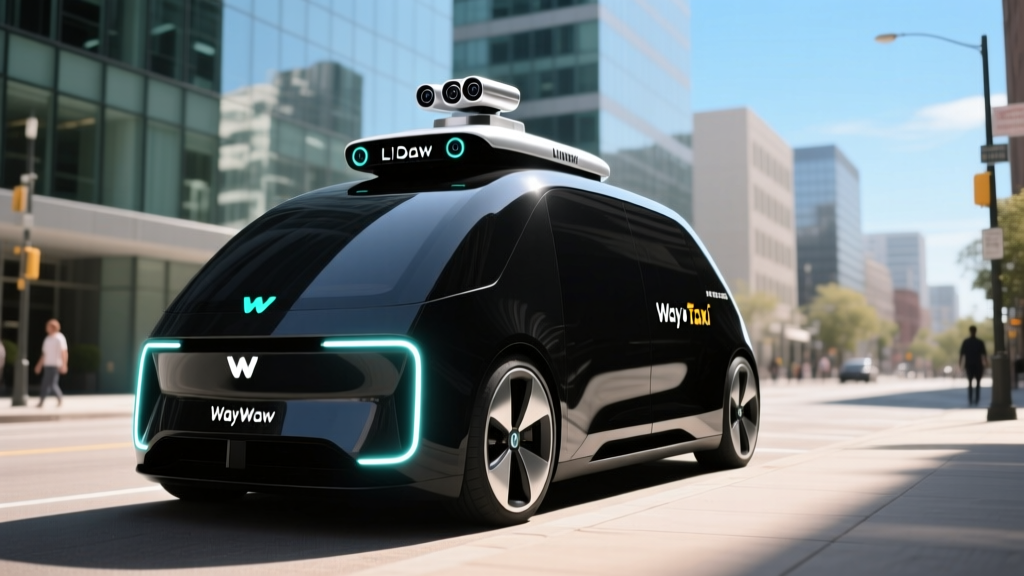
- LiDAR: Multiple roof- and body-mounted units providing 360° 3D point clouds out to 300+ meters. LiDAR works identically in darkness and daylight — a critical advantage over camera-only systems.
- Cameras: High-resolution surround cameras for traffic-light state, sign reading, lane markings, and object classification.
- Radar: Forward and corner radars for velocity measurement of other moving objects, especially in rain or fog where LiDAR performance degrades.
- HD Maps: Centimeter-accurate pre-mapped road geometry. The vehicle localizes itself within this map in real time. This is why robotaxis cannot operate outside their geofence — the map must exist first.
- Compute: Custom AI inference hardware processing sensor fusion at high frame rates, with redundant braking and steering actuators.
Tesla FSD Supervised (Level 2, for contrast): Camera-only (8 cameras), no LiDAR, no radar on current vehicles, no HD map dependency. Relies entirely on neural-network vision processing. Requires driver supervision at all times.
The LiDAR vs. camera-only debate remains the central technical disagreement in the autonomous vehicle industry. Waymo, Zoox, Cruise, and Motional all use LiDAR as a primary sensor, arguing that redundant sensing modalities are essential for safety-critical systems. Tesla's position is that camera-only systems, trained on sufficient data, can match or exceed LiDAR performance at a fraction of the cost. As of 2026, no camera-only system has received regulatory approval for driverless (Level 4) commercial operation in the U.S.
Regulatory Oversight: Who Approves Robotaxi Operations?
Robotaxi deployment in the U.S. involves a layered regulatory framework that varies significantly by state:
- Federal (NHTSA): Sets vehicle safety standards (FMVSS) and requires incident reporting through Standing General Orders. NHTSA does not "approve" autonomous driving software but can investigate and order recalls. The NHTSA AV safety portal tracks all reported incidents.
- California (DMV + CPUC): The most regulated market. The DMV issues testing and deployment permits; the California Public Utilities Commission (CPUC) authorizes commercial passenger service. After the Cruise incident, the DMV suspended Cruise's permit in October 2023, and the CPUC imposed additional requirements before allowing phased re-entry.
- Arizona: The least restrictive major robotaxi market. Waymo launched its first commercial service in Phoenix in 2020 under a permissive regulatory environment. No state-level permit analogous to California's DMV deployment permit is required.
- Texas, Nevada: Moderate frameworks. Austin has become a key Waymo market; Nevada approved Mercedes Level 3 DRIVE PILOT for limited use.
This patchwork means a robotaxi company must navigate different approval processes in each state — a significant barrier to rapid national expansion.
Current Limitations: Where Robotaxis Still Fall Short
Limitations Warning
Level 4 robotaxis are genuinely driverless — but only within tightly constrained conditions. Here is what they cannot do in 2026:
- Heavy rain, snow, or dense fog: LiDAR performance degrades significantly in precipitation. Waymo and others will pause service or refuse rides during heavy rain events. Snow is a hard no — no Level 4 service operates in snowy conditions.
- Unmapped areas: Every road must be pre-mapped at centimeter accuracy. Construction zones that alter lane geometry can confuse the system, though most operators update maps frequently.
- Highway driving (most operators): Waymo's Phoenix service includes some highway segments, but most robotaxi operations are limited to surface streets under 65 mph. Zoox's Las Vegas service is entirely on local roads.
- Complex pickup/drop-off: The vehicle pulls to a designated spot, not to your exact front door if it is on a narrow residential street outside the geofence or in a parking garage.
- Edge cases: Unusual road configurations, emergency-vehicle interactions, and unpredictable pedestrian behavior in non-standard scenarios (jaywalking crowds, parade routes) can cause the vehicle to stop and request remote assistance, adding minutes to your trip.
- Accessibility: Current robotaxi fleets are primarily standard passenger vehicles. Wheelchair-accessible options remain extremely limited.
What Happens When a Robotaxi Is in an Accident?
If a Waymo or Zoox vehicle is involved in a collision, the response protocol differs from a conventional crash:
- The vehicle's onboard system detects the impact and immediately contacts the remote-assistance center.
- A remote operator communicates with passengers through the in-cabin screen and speaker, provides instructions, and dispatches emergency services if needed.
- The vehicle's sensor data (full LiDAR point clouds, camera feeds, decision logs) is preserved for investigation — a level of forensic detail that does not exist in human-caused crashes.
- The incident is reported to NHTSA under the Standing General Order for automated driving systems, and to state regulators where required.
- Insurance is handled by the operator's commercial policy. Passengers are not liable for vehicle damage.
This data-rich post-incident record is one of the strongest safety arguments for robotaxis: every collision is reconstructable in full 3D, enabling systematic fixes rather than relying on eyewitness accounts.
Frequently Asked Questions
Is a robotaxi truly self-driving, or is someone watching remotely?
There is no human driver in the vehicle and no remote "joystick" control. Remote-assistance operators monitor fleets and can provide high-level guidance (e.g., "proceed past the cone"), but they do not steer or brake the vehicle in real time. The vehicle's onboard AI handles all driving decisions. This is SAE Level 4 autonomy within the operational domain.
How safe are robotaxis compared to human drivers?
Based on Waymo's published data through 2025, their driverless vehicles show a police-reported injury crash rate roughly 5–6× lower than human drivers in comparable urban environments. However, robotaxis operate under favorable conditions (mapped roads, fair weather, moderate speeds), so direct comparison to the full spectrum of human driving requires caution. Fatality data is too limited in absolute numbers to draw statistically robust conclusions at this stage.
Where can I ride a robotaxi right now?
Waymo One operates 24/7 driverless service in Phoenix, San Francisco, Los Angeles, and Austin, with geofenced zones within each metro. Zoox offers limited public rides in Las Vegas. Cruise has resumed limited operations in Phoenix following its 2023 suspension. Check each operator's app for current service-area maps, which update as geofences expand.
How much does a robotaxi ride cost compared to Uber or Lyft?
Pricing is broadly comparable. A 5-mile Waymo ride in Phoenix typically costs $10–$14 off-peak, versus $12–$17 for UberX. The main savings come from no tip expectation and less aggressive surge pricing. Wait times can be 2–5 minutes longer due to smaller fleet sizes.
What causes most robotaxi accidents?
The majority of collisions involving robotaxis are initiated by human drivers in other vehicles — typically rear-end or side-swipe incidents at low speeds. Robotaxis tend to drive conservatively (sometimes too conservatively, which itself can cause rear-end incidents when the robotaxi stops unexpectedly). Serious injuries in robotaxi-involved crashes are rare based on available NHTSA data.
Can a robotaxi drive me anywhere, including highways and rural roads?
No. Robotaxis operate within geofenced zones of roughly 80–200 square miles on pre-mapped roads. Most services are limited to surface streets. Some Waymo routes in Phoenix include highway segments, but this is not universal. Snow, heavy rain, and unmapped construction zones are out of bounds.