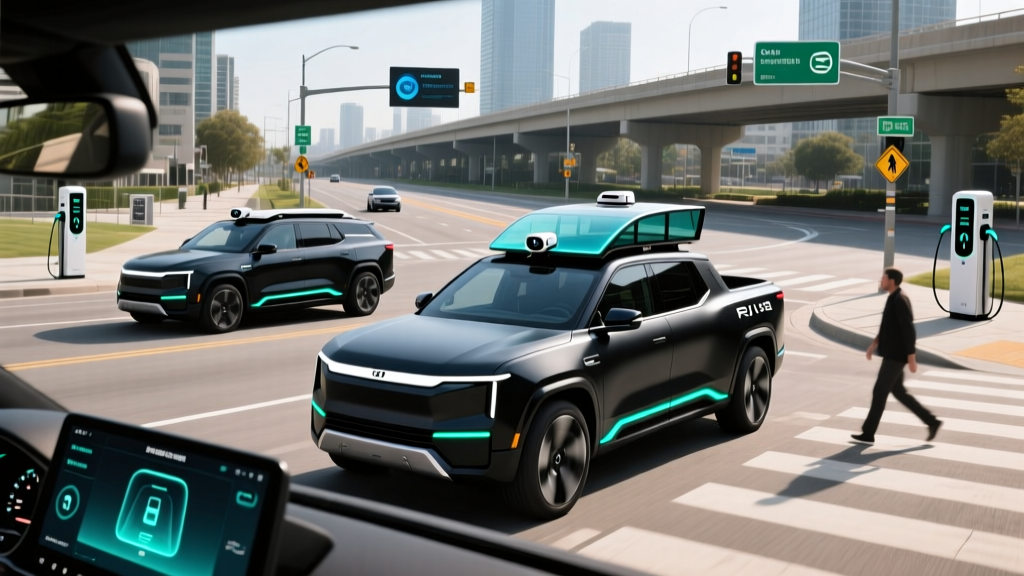
Rivian has steadily upgraded its driver-assistance capabilities across the R1T pickup and R1S SUV, generating significant search interest around the term Rivian self driving. But clarity matters here: Rivian's production vehicles are not autonomous. They are equipped with advanced Level 2 driver-assistance systems that require continuous driver supervision. If you are searching for a robotaxi you can hail without a driver behind the wheel, Rivian does not offer that. What Rivian does offer is a competitive and continuously improving ADAS suite that ranks among the better systems in the electric truck and SUV segment.
This guide cuts through the marketing to explain exactly what Rivian's driver-assist technology can and cannot do in 2026, how its sensor stack compares to rivals, what the real-world limitations are, and where Rivian's autonomy ambitions may be headed.
What Rivian Self-Driving Actually Means: SAE Level 2, Not Level 4
Rivian's Highway Assist and Enhanced Highway Assist are SAE Level 2 systems. This means the vehicle can simultaneously control steering and speed under certain conditions, but the driver must remain fully engaged — eyes on the road, hands available to take over immediately. This is fundamentally different from Level 4 robotaxi services like Waymo, which operate without any human driver in designated geofenced areas.
| Level | Name | Driver Required? | Example |
|---|---|---|---|
| 0 | No Automation | Full-time | Basic cruise control |
| 1 | Driver Assistance | Full-time | Lane-keep OR adaptive cruise |
| 2 | Partial Automation | Full-time, supervised | Rivian Highway Assist, Tesla Autopilot, Ford BlueCruise |
| 3 | Conditional Automation | Fallback-ready | Mercedes Drive Pilot (limited) |
| 4 | High Automation | None (in geofence) | Waymo, Zoox robotaxis |
| 5 | Full Automation | None (anywhere) | Does not yet exist |
The distinction is not semantic — it has legal, safety, and practical implications. With Rivian's Level 2 system, you are the driver at all times. If an accident occurs while Highway Assist is active, liability rests with you, not Rivian.
Rivian's ADAS Feature Suite: What You Get in 2026
Rivian structures its driver-assistance technology in tiers, available across the R1T and R1S (including the updated Gen 2 platform introduced for the 2025 model year and carried forward into 2026).
Standard: Driver Assistance Plus
Every new R1T and R1S ships with a baseline suite that includes:
- Adaptive Cruise Control (ACC) with stop-and-go
- Lane-Keeping Assist (LKA)
- Automatic Emergency Braking (AEB) with pedestrian detection
- Blind-Spot Monitoring with rear cross-traffic alert
- Rearview camera with 360-degree surround view
- Traffic Sign Recognition
Highway Assist (Available via Software Subscription or Purchase)
This is Rivian's core hands-on-wheel Level 2 feature, combining adaptive cruise control with active lane centering on divided highways. Key capabilities:
- Speed range: 0–90+ mph (functional in stop-and-go traffic)
- Lane centering: Active steering on clearly marked divided highways
- Automatic lane changes: Initiated by the driver via turn signal stalk (system executes the maneuver after confirming clear space)
- Hands-on detection: Torque-based steering wheel monitoring — the system requires periodic driver input on the wheel
Enhanced Highway Assist (Available on Gen 2 Vehicles)
Introduced with the Gen 2 R1 platform, this upgraded tier adds:
- Hands-free driving on approved highway segments: Uses a driver-monitoring camera (infrared, mounted on the steering column) to track eye gaze instead of requiring torque on the steering wheel
- Expanded geofenced highway coverage: Operates on mapped divided highways across all 50 US states, though coverage density varies by region
- Improved lane-change logic: Can suggest lane changes to maintain set speed or prepare for upcoming exits (driver confirms)
- Navigate city streets autonomously or handle traffic signals without driver input
- Operate without an attentive, licensed driver in the seat
- Function reliably in heavy rain, snow, fog, or construction zones
- Handle unmapped roads, rural two-lane highways, or complex intersections
- Replace the driver — this is not a robotaxi or autonomous vehicle
The Sensor Stack: How Rivian Sees the Road
Rivian's approach to perception differs meaningfully from some competitors. Here is how the Gen 2 R1T and R1S sensor suite breaks down:
Rivian Gen 2 ADAS Sensor Architecture
| Sensor Type | Count | Function |
|---|---|---|
| Cameras | 11 | 360° surround perception, lane detection, traffic sign reading, object classification |
| Radar (front) | 1 | Long-range object detection, speed/distance measurement, all-weather redundancy |
| Ultrasonic sensors | 8+ | Near-field obstacle detection for parking and low-speed maneuvers |
| Driver-monitoring camera | 1 (IR) | Eye-gaze tracking for hands-free Highway Assist engagement |
| GPS + HD Maps | — | Geofencing approved highway segments, exit/merge anticipation |
Notable omission: LiDAR. Unlike Waymo's Level 4 robotaxis or vehicles like the Volvo EX90, Rivian does not use LiDAR in its production consumer vehicles. Rivian has invested in a camera-and-radar-first approach, relying heavily on neural-network-based perception software rather than LiDAR point clouds. This is similar to Tesla's vision-only approach, though Rivian retains a front radar for redundancy — a choice Tesla abandoned in 2021.
The trade-off is cost and complexity versus all-weather robustness. LiDAR provides precise 3D depth data regardless of lighting conditions, but adds significant hardware cost. Rivian's bet is that camera resolution improvements and software sophistication can close the gap for Level 2 use cases, where a human driver remains the ultimate fallback.
How Rivian ADAS Compares to Competitor Systems
| Feature | Rivian Enhanced HA | Ford BlueCruise 1.4 | GM Super Cruise | Tesla Autopilot/FSD |
|---|---|---|---|---|
| SAE Level | Level 2 | Level 2 | Level 2 | Level 2 |
| Hands-Free | Yes (approved highways, Gen 2) | Yes (130,000+ mi mapped) | Yes (750,000+ mi mapped) | No (hands-on required) |
| Eyes-Free | No | No | No | No |
| Driver Monitoring | IR camera (Gen 2) | IR camera | IR camera | Camera + torque sensor |
| Auto Lane Change | Driver-initiated (signal) | Automatic (w/ confirmation) | Automatic (w/ confirmation) | Automatic (FSD) |
| City Street Assist | No | No | No | Yes (FSD Supervised) |
| LiDAR | No | No | No | No |
| Subscription Cost (est.) | ~$50–75/mo or included w/ purchase | ~$75/mo or $2,500 lifetime | ~$25/mo or $2,500 lifetime | $199/mo or $8,000 (FSD) |
Rivian's system occupies a middle ground. It does not attempt city-street navigation the way Tesla's FSD (Supervised) does, which means fewer edge-case scenarios but also less overall capability. Compared to Super Cruise and BlueCruise, Rivian's mapped highway network is smaller but growing with each over-the-air update. The Gen 2 platform's driver-monitoring camera brings Rivian to parity with Ford and GM on hands-free highway engagement.
Real-World Performance and Safety Data
Rivian does not publish disengagement or intervention-rate data in the same format that California's DMV requires of autonomous vehicle test permit holders (like Waymo and Cruise). This is because Rivian's Level 2 system is a consumer driver-assist product, not a permitted autonomous vehicle testing program.
- NHTSA Standing General Order (SGO): Since July 2021, NHTSA has required manufacturers to report crashes involving Level 2+ ADAS. As of the latest NHTSA SGO reports, Tesla Autopilot/FSD accounts for the majority of reported Level 2 incidents by volume, largely due to fleet size. Rivian's reported incidents are proportionally far fewer, reflecting a smaller fleet.
- IIHS Research: The Insurance Institute for Highway Safety has found that Level 2 systems reduce certain crash types (rear-end, lane-departure) but can introduce new risks related to driver inattention and mode confusion.
- Rivian's AEB Performance: The R1S and R1T have earned strong marks from IIHS for automatic emergency braking, achieving superior ratings in vehicle-to-vehicle and vehicle-to-pedestrian tests.
What real-world Rivian owners consistently report about Highway Assist:
- Highway lane centering: Reliable on well-marked interstates; occasional wandering on faded lane lines or during lane merges
- Stop-and-go traffic: Functional but can be abrupt in braking response compared to a human driver
- Construction zones: System frequently disengages or requests driver takeover — this is expected and appropriate behavior
- Weather sensitivity: Heavy rain, snow, and direct low-angle sunlight can cause camera degradation and system disengagement
- Phantom braking: Some owners report occasional unnecessary deceleration on highways, a known issue across most camera-based ADAS platforms
Where Rivian's System Works — and Where It Doesn't
Unlike robotaxi services that are limited to specific geofenced cities, Rivian's Level 2 ADAS can be used on highways nationwide. However, capability varies significantly by road type and conditions.
| Scenario | Highway Assist | Enhanced HA (Hands-Free) | Notes |
|---|---|---|---|
| Mapped divided interstate | ✅ Full | ✅ Full (hands-off) | Primary use case; best performance |
| Unmapped divided highway | ⚠️ ACC + LKA only | ❌ Hands-free unavailable | Steering assist may be limited |
| Two-lane rural road | ⚠️ ACC only | ❌ | No lane centering without clear markings + divider |
| City streets | ⚠️ ACC only (low speed) | ❌ | No traffic light or stop sign handling |
| Heavy rain / snow | ⚠️ Degraded | ⚠️ Degraded / ❌ | Camera obstruction triggers disengagement |
| Construction zones | ⚠️ Frequent disengagements | ❌ | Driver must take over; barrel/cone detection limited |
The Regulatory Landscape for Consumer ADAS
Rivian's Level 2 system operates under the existing federal framework for driver-assistance technologies. Key regulatory points:
- NHTSA oversight: The National Highway Traffic Safety Administration regulates vehicle safety standards and has issued Standing General Orders requiring crash reporting for Level 2+ systems. NHTSA has also opened investigations into several automakers' ADAS implementations, including Tesla Autopilot and Ford BlueCruise, examining driver monitoring adequacy and crash patterns.
- No federal pre-approval required: Unlike Level 4 robotaxis, which require state-level permits and, in some cases, federal exemptions, Level 2 ADAS can be deployed without specific government approval — manufacturers self-certify compliance with Federal Motor Vehicle Safety Standards (FMVSS).
- State-level variation: Some states have additional requirements or restrictions around hands-free driving features. Drivers should verify local regulations, though in practice, Level 2 systems are legal in all 50 states.
- Liability: With Level 2 systems, the driver retains full legal responsibility. This is a critical distinction from Level 4 services where the operating company assumes liability during autonomous operation.
Rivian's Autonomy Roadmap: What's Next
Rivian has been characteristically measured in its public statements about autonomous driving ambitions. CEO RJ Scaringe has stated that the company's focus is on delivering excellent Level 2+ driver assistance rather than pursuing a Level 4 robotaxi business model.
Key points about Rivian's trajectory:
- Over-the-air (OTA) improvements: Rivian regularly ships software updates that refine Highway Assist behavior — improved lane centering, smoother acceleration/braking profiles, expanded geofenced highway segments, and better driver-monitoring calibration. Gen 2 vehicles receive these updates continuously.
- No announced Level 4 plans: Unlike Tesla's long-promised (and repeatedly delayed) robotaxi ambitions, Rivian has not announced a Level 4 autonomy program for consumer vehicles.
- Commercial fleet potential: Rivian's delivery van partnership with Amazon (the EDV) operates in a last-mile delivery context, but these vehicles are driven by human operators and do not use autonomous technology.
- Sensor hardware headroom: The Gen 2 platform's 11-camera suite and front radar provide a capable foundation for incremental software improvements, but adding Level 4 capability would likely require additional hardware (LiDAR, redundant compute) not present in current production vehicles.
Pricing: How Much Does Rivian's ADAS Cost?
| Feature Tier | Availability | Cost |
|---|---|---|
| Driver Assistance Plus (AEB, ACC, LKA, BSM) | Standard on all R1T/R1S | Included in vehicle price |
| Highway Assist (hands-on) | Available on Gen 1 & Gen 2 | Subscription or one-time purchase (pricing varies by model year) |
| Enhanced Highway Assist (hands-free) | Gen 2 vehicles only | Subscription or one-time purchase |
Rivian's exact subscription pricing has evolved across model years. As of 2026, expect Highway Assist subscriptions to fall in the range of $50–75/month, with lifetime purchase options available. This compares favorably to Tesla's $199/month FSD subscription but is in the same ballpark as Ford BlueCruise's pricing. Check Rivian's current pricing on their website or through the vehicle's infotainment system, as these figures may adjust with OTA updates and feature expansions.
Is Rivian Self-Driving Worth It? A Practical Verdict
Choose Rivian Highway Assist If:
- You commute regularly on divided highways and want to reduce fatigue
- You understand this is a supervisory role — you remain the driver
- You value a system that errs on the side of caution (frequent but appropriate disengagement requests)
- You own or are purchasing a Gen 2 R1T/R1S for the enhanced hands-free capability
Look Elsewhere If:
- You want city-street autonomous navigation (Tesla FSD Supervised covers this, with caveats)
- You expect a true self-driving experience with no driver involvement (no consumer vehicle offers this)
- You primarily drive on rural, unmapped, or poorly marked roads where ADAS provides minimal benefit
- You want a robotaxi experience — consider Waymo in Phoenix, San Francisco, or Los Angeles instead
Frequently Asked Questions
Is Rivian self-driving?
No. Rivian's Highway Assist and Enhanced Highway Assist are SAE Level 2 driver-assistance systems. They can steer and control speed on approved highways, but a licensed, attentive driver must be present and ready to take over at all times. Rivian does not produce autonomous or self-driving vehicles.
Can I take my hands off the wheel in a Rivian?
On Gen 2 R1T and R1S vehicles equipped with Enhanced Highway Assist, yes — but only on mapped, divided highway segments and only while the driver-monitoring camera confirms your eyes are on the road. On Gen 1 vehicles, Highway Assist requires hands-on-wheel contact at all times via torque sensing.
Does Rivian use LiDAR?
No. Rivian uses a camera-and-radar sensor suite (11 cameras, 1 front radar, ultrasonic sensors, and an IR driver-monitoring camera on Gen 2). The company has not announced plans to add LiDAR to consumer vehicles.
How does Rivian's ADAS compare to Tesla Autopilot?
Rivian's Highway Assist is more conservative than Tesla's Autopilot/FSD. It does not attempt city-street navigation, traffic light handling, or stop-sign recognition. However, Rivian's system has generally drawn fewer NHTSA scrutiny headlines, partly due to fleet size and partly due to its more limited operational design domain. Tesla FSD (Supervised) offers broader capability but requires the same Level 2 driver supervision.
Will Rivian ever offer Level 4 autonomy?
Rivian has not announced any Level 4 autonomous driving program for its consumer vehicles. The company's public statements focus on incremental improvement of its Level 2+ ADAS capabilities through over-the-air software updates. Any future Level 4 capability would likely require additional sensor hardware not present in current production vehicles.
What happens if the system disengages while driving?
Rivian's system provides escalating alerts — visual, audible, and haptic (seat vibration) — before disengaging. If the driver does not respond, the system will gradually decelerate the vehicle, activate hazard lights, and eventually bring the vehicle to a stop. This is standard behavior for Level 2 systems and underscores why driver attention is non-negotiable.
Does Rivian ADAS work in winter weather?
Performance degrades in snow, heavy rain, and fog. Camera obstruction from road spray, ice, or snow accumulation will cause the system to alert the driver and disengage. Rivian's front radar provides some all-weather redundancy for adaptive cruise control, but lane-centering depends on camera visibility of lane markings, which may be obscured by snow cover.
Sources: NHTSA Standing General Order Reports, IIHS ADAS Research, Rivian official specifications and software update notes. Pricing and feature availability are subject to change; verify current details with Rivian directly. This article reflects information available as of early 2026.