What Rivian Lidar Actually Does on the R1T and R1S
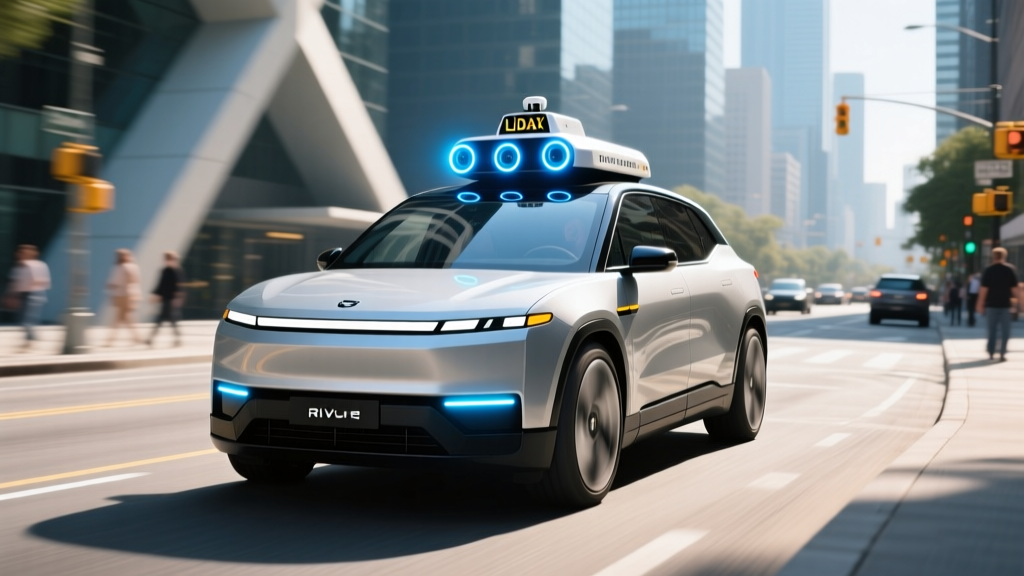
Rivian's advanced driver-assistance suite, marketed as Rivian Driver+, relies on a multi-sensor fusion approach that includes cameras, radar, ultrasonic sensors, and — on select configurations — lidar. The addition of lidar (light detection and ranging) gives the R1T pickup and R1S SUV a depth-sensing advantage that camera-only systems like Tesla's Vision-based Autopilot lack. Lidar emits laser pulses and measures their return time to build a precise, real-time 3D point cloud of the vehicle's surroundings, independent of ambient lighting conditions.
On 2026-model-year R1 vehicles equipped with the full ADAS hardware package, the sensor suite typically includes:
- Multiple exterior cameras — forward-facing, side, and rear for lane detection, traffic sign recognition, and object classification
- Forward-facing lidar unit — roof-mounted or integrated into the windshield header area, providing high-resolution depth mapping up to approximately 200 meters
- Corner radars — for cross-traffic detection, blind-spot monitoring, and lane-change assist
- Ultrasonic sensors — for low-speed proximity detection during parking maneuvers
This sensor fusion allows the system to maintain awareness even when individual sensors are degraded — for example, when camera visibility drops in heavy rain or direct sun glare, lidar and radar can compensate with active sensing that doesn't rely on visible light.
| Feature | Function | Sensor(s) Used |
|---|---|---|
| Highway Assist | Adaptive cruise + lane centering on divided highways | Camera, radar, lidar |
| Lane Change Assist | Semi-automatic lane changes with driver confirmation | Camera, corner radar, lidar |
| Adaptive Cruise Control | Maintains set speed and following distance | Forward radar, camera |
| Blind-Spot Assist | Warns and can apply steering correction | Corner radar, camera |
| Parking Assist | Guided parallel and perpendicular parking | Ultrasonic, camera |
| Traffic Sign Recognition | Displays speed limits, adjusts cruise accordingly | Forward camera |
SAE Level 2: Why Rivian's System Is Not Self-Driving
Rivian Driver+ is classified as SAE Level 2 under the Society of Automotive Engineers' J3016 framework. This means the system can simultaneously control steering and acceleration/braking under specific conditions, but the human driver must remain fully engaged — eyes on the road, hands on or near the wheel, and ready to take over at any moment. The system is not autonomous. Rivian does not claim it is, and no production Rivian vehicle operates at Level 3 or above.
For reference, only driverless robotaxi services like Waymo (operating in geofenced areas of Phoenix, San Francisco, and Los Angeles) function at SAE Level 4. Consumer vehicles sold in the U.S. in 2026 — whether from Rivian, Tesla, Ford, GM, or any other automaker — remain Level 2 at maximum.
Rivian enforces driver engagement through a combination of torque-sensing on the steering wheel and camera-based driver monitoring. If the system detects inattention, it issues escalating warnings — visual, audible, and haptic — before eventually disengaging and bringing the vehicle to a controlled stop with hazard lights activated. This is standard practice across the industry and a critical safety backstop.
Which Rivian Models Include Lidar and Driver+?
Rivian's ADAS hardware is not uniform across all trims. Here is how availability breaks down for the 2026 model year:
| Trim / Package | Lidar Included? | Driver+ Standard? | Driver+ Subscription Required? |
|---|---|---|---|
| R1T / R1S Adventure (base) | No — camera + radar suite | Basic ACC + LKA standard | N/A |
| R1T / R1S Adventure with Driver+ Package | Yes | Yes (trial period) | Yes, after trial — see pricing below |
| R1T / R1S Ascend Edition | Yes | Yes | Subscription after included trial |
The key distinction: lidar is not standard on base Adventure trims. Buyers who want the full sensor fusion stack must either select the Driver+ hardware package at time of order (typically a ~$2,500–$3,500 add-on depending on model year and configuration) or opt for the higher Ascend Edition trim where it is bundled. Rivian has historically included a trial period for the Driver+ software subscription, after which continued access to advanced features like Highway Assist and Lane Change Assist requires an ongoing subscription.
Basic adaptive cruise control and lane-keeping assist — which use camera and radar only — come standard on all R1 vehicles. The lidar-equipped package unlocks the more advanced fusion-based features.
Rivian Driver+ Cost: Purchase, Subscription, and What You Actually Get
| Component | Cost | Notes |
|---|---|---|
| Driver+ hardware package (lidar + sensors) | ~$2,500–$3,500 (one-time at order) | Cannot be retrofitted after delivery; must be selected at build time |
| Driver+ software subscription | ~$49–$59/month or ~$499–$599/year | Required for Highway Assist, Lane Change Assist after trial period expires |
| Included trial | Varies (often 3–6 months) | Check your specific vehicle's terms at delivery |
| Basic ADAS (ACC, LKA, blind-spot) | $0 — included on all trims | No subscription required for base features |
This hybrid model — one-time hardware purchase plus ongoing software subscription — is increasingly common. Ford uses a similar structure for BlueCruise, and GM is transitioning Super Cruise features into its Ultifi subscription platform. Tesla's approach differs: Full Self-Driving (Supervised) is offered as either a $8,000 one-time purchase or a $99/month subscription, but Tesla does not use lidar, relying entirely on its camera-based Tesla Vision system.
For buyers who primarily drive on well-marked divided highways, the subscription cost may be justifiable. For those whose commute is mostly surface streets or rural roads, the basic included ADAS features may be sufficient, and the Driver+ subscription may not deliver enough incremental value to warrant the recurring expense.
Real-World Capabilities and Honest Limitations
In real-world use, Rivian Driver+ with lidar performs well in the scenarios it was designed for: divided, well-marked highways at moderate to high speeds. Highway Assist maintains lane position confidently on interstates with clear striping, handles gentle curves without issue, and modulates speed smoothly in flowing traffic. The lidar contributes meaningfully to object detection confidence, particularly in conditions where cameras struggle — dawn/dusk glare, shadowed overpasses, and light precipitation.
Lane Change Assist requires driver confirmation (typically a tap on the turn signal) before executing a lane change. The system checks blind spots using corner radar and lidar, and will abort the maneuver if it detects a vehicle in the target lane. This is a deliberate design choice that keeps the driver in the decision loop.
- Does NOT drive autonomously. You must keep your eyes on the road and be ready to take over instantly. This is not optional — the system monitors your attention.
- Does NOT handle construction zones reliably. Temporary lane markings, cones, and shifted lanes can confuse camera and lidar interpretation. Take over manually in work zones.
- Does NOT function in severe weather. Heavy rain, snow, fog, and ice accumulation on sensors degrade or disable the system. Lidar is more robust than cameras in low light, but heavy precipitation scatters laser pulses and reduces effective range.
- Does NOT navigate unmapped or poorly marked roads. Rural routes with faded lane lines, no shoulder markings, or non-standard road geometry will cause the system to disengage or request takeover.
- Does NOT handle complex urban intersections. The system is designed for highway use. City driving with pedestrians, cyclists, unprotected turns, and multi-lane intersections requires full manual control.
- Does NOT eliminate liability. In any collision or traffic violation occurring while Driver+ is engaged, the human driver is legally responsible — not Rivian.
Cold-weather performance deserves specific mention. Rivian owners in northern climates report that sensor icing — particularly on the forward-facing camera and lidar unit — can cause system disengagement during winter months. The R1's thermal management system does precondition the battery, but sensor de-icing relies on ambient heat and wiper/washer systems. Keeping sensor surfaces clean and using the vehicle's defrost settings proactively helps maintain ADAS availability in freezing conditions.
How Rivian Lidar Compares to Competing ADAS Systems
| Feature | Rivian Driver+ (w/ Lidar) | Tesla FSD (Supervised) | Ford BlueCruise | GM Super Cruise |
|---|---|---|---|---|
| Lidar | Yes | No (camera-only) | No (camera + radar) | Yes (on select models) |
| Hands-free on approved roads | No — hands-on/torque-sensing | No — hands-on steering wheel | Yes, on pre-mapped divided highways (~130,000 mi) | Yes, on pre-mapped divided highways (~750,000 mi) |
| Driver monitoring | Camera + torque sensor | Camera-based | Camera-based (infrared) | Camera-based (infrared) |
| Automatic lane change | Yes, with confirmation | Yes, with confirmation | Yes, on approved roads | Yes, on approved roads |
| Subscription cost | ~$49–$59/mo | $99/mo or $8,000 one-time | ~$49–$75/mo after trial | ~$25/mo or included for limited period |
| SAE Level | Level 2 | Level 2 | Level 2 | Level 2 |
The most notable competitive distinction: Ford BlueCruise and GM Super Cruise offer true hands-free driving on pre-mapped divided highways, while Rivian Driver+ currently requires hands-on-wheel engagement. This does not make BlueCruise or Super Cruise "self-driving" — both still require eyes-on-road attention and are Level 2 — but they do reduce physical fatigue on long highway stretches. Rivian's lidar advantage, meanwhile, provides a potentially more robust perception layer in edge cases where camera-only or camera-plus-radar systems may falter.
Tesla's FSD (Supervised) is the most widely deployed consumer ADAS system by volume, but its camera-only approach has drawn scrutiny from NHTSA regarding its performance in certain crash scenarios. Tesla's neural-net-based perception is continuously improving through over-the-air updates, but it lacks the physical redundancy that lidar provides for depth estimation.
Should You Pay for Rivian's Lidar-Equipped Driver+?
- You regularly drive 50+ miles per day on divided highways and want reduced mental and physical fatigue
- You value sensor redundancy (lidar + camera + radar) over a camera-only approach
- You plan to keep the vehicle 5+ years, giving Rivian's OTA update pipeline time to expand feature capabilities
- You frequently drive in low-light conditions (dawn, dusk, night) where lidar's active sensing provides an advantage
- Your driving is primarily urban or suburban surface streets where Highway Assist provides minimal benefit
- You object to paying a monthly subscription for features you consider essential safety equipment
- You prefer to stay fully engaged in driving and find ADAS interventions distracting rather than helpful
- You want to minimize upfront vehicle cost — the hardware add-on plus subscription adds meaningfully to total ownership expense
From a total-cost-of-ownership perspective, the Driver+ hardware package (~$3,000) plus five years of subscription (~$3,000) adds roughly $6,000 to your ownership cost. That is not trivial. Compare it to GM's Super Cruise, which on some 2026 Cadillac and Chevrolet models is included for three years at no additional subscription cost, or Ford's BlueCruise, which offers a one-time purchase option alongside its subscription. Rivian's value proposition hinges on the lidar hardware's long-term potential — as Rivian's software team refines the perception stack via OTA updates, the lidar-equipped vehicles may gain capabilities that non-lidar vehicles cannot receive.
For the latest on Rivian's feature availability and pricing, check Rivian's official Driver+ page and the IIHS ratings for the R1T and R1S, which evaluate ADAS performance in standardized crash-avoidance testing.
Frequently Asked Questions
Does every Rivian R1T and R1S have lidar?
No. Lidar is only included on vehicles ordered with the Driver+ hardware package or the Ascend Edition trim. Base Adventure trims use a camera-and-radar-only sensor suite. Lidar cannot be retrofitted after delivery — it must be selected at the time of order.
Is Rivian Driver+ self-driving?
No. Rivian Driver+ is SAE Level 2 partial automation. The driver must keep their eyes on the road and hands on or near the steering wheel at all times. The system assists with steering, acceleration, and braking on qualified highways, but the human driver is always legally and operationally responsible for the vehicle.
How much does Rivian Driver+ cost per month?
As of 2026, the Driver+ software subscription is approximately $49–$59 per month or $499–$599 annually, depending on the plan selected. This is in addition to the one-time hardware package cost (~$2,500–$3,500) paid at vehicle order. Basic adaptive cruise control and lane-keeping assist are included at no extra cost on all R1 vehicles.
Does lidar work in rain and snow?
Lidar performs better than cameras in low-light and some adverse conditions, but heavy rain, dense fog, and snow accumulation on the sensor housing will degrade its range and accuracy. Rivian's system will issue a warning and may disengage ADAS features if sensor data quality falls below safety thresholds. Always clear sensor surfaces of ice and snow before driving in winter.
Can Rivian Driver+ handle city streets?
Rivian Driver+ is primarily designed for divided, well-marked highways. While the basic ADAS features (adaptive cruise, lane-keeping) can function on surface streets, the advanced Highway Assist and Lane Change Assist features are optimized for highway environments. Complex urban driving with intersections, pedestrians, and cyclists requires full manual control.
Will Rivian add more ADAS features via over-the-air updates?
Yes. Rivian regularly deploys OTA software updates that refine existing features and occasionally introduce new capabilities. Vehicles equipped with the lidar hardware package are positioned to receive more advanced perception-dependent updates over time. However, Rivian has not announced a timeline for any features beyond SAE Level 2, and any future capabilities will still require driver supervision.