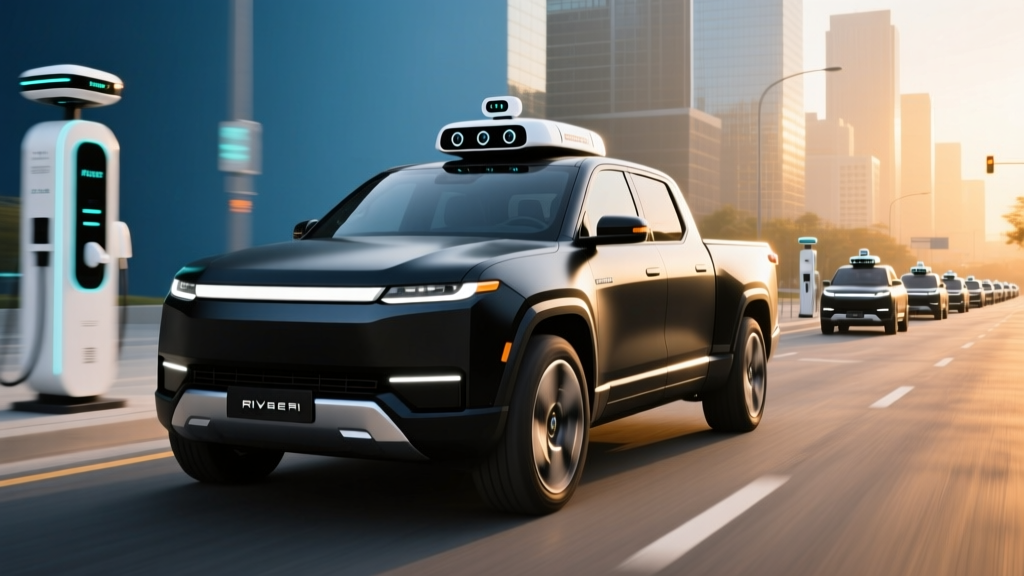
Rivian's advanced driver-assistance suite, marketed under the Driver+ umbrella, equips the R1T pickup and R1S SUV with a robust set of highway and parking aids. But as with every consumer ADAS on the market in 2026, understanding exactly what the system can do — and critically, what it cannot — is the difference between a confident commute and a dangerous misunderstanding. This guide breaks down Rivian ADAS hardware, real-world behavior, pricing, and how it stacks up against Tesla Autopilot, Ford BlueCruise, and GM Super Cruise.
What Rivian Driver+ Actually Does
Rivian's Driver+ package bundles two primary highway-driving features alongside a suite of active-safety systems:
- Highway Assist: Combines adaptive cruise control with lane-centering steering on divided highways. The system manages speed, following distance, and steering input to keep the vehicle centered in its lane.
- Lane Change on Confirm: When Highway Assist is active, the driver can initiate a lane change via the turn signal stalk. The system checks blind spots and, if clear, executes the lane change.
- Active Safety Suite (standard on all trims): Includes automatic emergency braking (AEB), rear cross-traffic alert, blind-spot monitoring, lane-departure warning, and intersection assist.
| Feature | Function | Activation | Driver Requirement |
|---|---|---|---|
| Highway Assist | Adaptive cruise + lane centering | Button on steering wheel; highway roads only | Hands on wheel, eyes on road |
| Lane Change on Confirm | Signal-initiated lane change | Turn signal while Highway Assist active | Driver confirms via stalk |
| Adaptive Cruise Control | Speed + following distance | Steering wheel controls | Hands on wheel |
| AEB / Forward Collision Warning | Auto braking for obstacles | Always active | None (automatic) |
| Blind Spot Monitoring | Rear-quarter vehicle detection | Always active above ~10 mph | None (alert only) |
| Parking Assist | Semi-automated parallel/perpendicular | In-gear selection via touchscreen | Foot on brake, monitor surroundings |
The Hardware Stack: Cameras, Radar, and Ultrasonics
Rivian's ADAS sensor suite is purpose-built and vertically integrated — a rarity among EV startups. The 2026 R1T and R1S carry:
- 11 cameras positioned around the vehicle for 360-degree perception, including forward-facing units with telephoto capability for long-range object detection.
- 5 radar units (one long-range front radar, four corner radars) providing reliable distance and velocity data in rain, fog, and low-light conditions where cameras degrade.
- Ultrasonic sensors for low-speed parking and close-proximity object detection.
This multi-modal sensor approach gives Rivian a redundancy advantage over camera-only systems. Radar maintains object tracking when camera visibility drops — heavy rain, direct sun glare, or snow-covered lane markings. That said, no sensor suite eliminates the physics of poor visibility: if a human driver can't see the road, the system's confidence drops proportionally.
SAE Automation Level: Level 2, Not Self-Driving
SAE Level 2 — Partial Driving Automation
Rivian Driver+ is classified as SAE Level 2 under the SAE J3016 standard. This means the system can simultaneously control steering and acceleration/braking under specific conditions, but the driver must remain fully engaged — hands on the steering wheel, eyes on the road, ready to take over at any moment. The driver is legally and operationally responsible for the vehicle at all times.
Only fully driverless robotaxi services like Waymo One (operating in Phoenix, San Francisco, and Los Angeles) qualify as Level 4. No consumer vehicle sold in the United States in 2026 is self-driving.
Rivian enforces engagement through a torque-sensing steering wheel that detects whether the driver's hands are applying subtle input. Unlike camera-based eye-tracking systems (used by GM's Super Cruise and Ford's BlueCruise), Rivian's approach doesn't monitor gaze direction — it monitors physical contact. This means you cannot look away from the road even momentarily without risking a system alert, but it also means the system works reliably with polarized sunglasses or in low light where cabin cameras can struggle.
Which Rivian Models and Trims Include Driver+?
For the 2026 model year, Rivian structures Driver+ as follows:
| Model | Trim | Driver+ Status | MSRP (Base) |
|---|---|---|---|
| R1T | Adventure / Standard | Included (no subscription) | $69,900 |
| R1T | Ascend / Tri Motor | Included | $99,900 |
| R1S | Adventure / Standard | Included (no subscription) | $75,900 |
| R1S | Ascend / Tri Motor | Included | $104,900 |
| EDV (Commercial Van) | All | Basic ADAS only (no Highway Assist) | Fleet pricing |
A key differentiator for Rivian: Driver+ is included at no additional cost with vehicle purchase. There is no monthly subscription, no one-time unlock fee, and no paywalled tier. Over-the-air (OTA) updates continuously improve the system, and these updates are also free. This contrasts sharply with Tesla's $8,000 FSD purchase or $99/month subscription and BMW's recurring ADAS subscription model in some markets.
| Brand / System | Purchase Price | Subscription | Included Standard? |
|---|---|---|---|
| Rivian Driver+ | $0 (included) | None | Yes, all consumer trims |
| Tesla Autopilot (basic) | $0 (included) | None | Yes |
| Tesla FSD (Supervised) | $8,000 | $99/mo | No |
| GM Super Cruise | $0–$2,500 (trim-dependent) | Free for 3 yrs, then ~$25/mo | Select trims |
| Ford BlueCruise | $0–$2,100 (trim-dependent) | Free trial, then ~$75/yr or $7.99/mo | Select trims |
| Mercedes Drive Pilot | $2,500 (optional) | None | No; limited availability |
Real-World Performance: Where Rivian ADAS Excels and Struggles
After extended highway use in the R1T and R1S, several patterns emerge in how Driver+ behaves in practice:
Strengths
- Lane centering stability: On well-marked interstate highways, Highway Assist holds center-lane position with minimal hunting. The R1T's wide track and air suspension contribute to a planted feel even when crosswinds hit.
- Radar-based ACC in rain: The front long-range radar maintains consistent following distance in moderate to heavy rain where camera-only systems tend to disengage or issue frequent warnings.
- Lane Change on Confirm: The system checks blind spots methodically and waits for a safe gap before executing. It's conservative — which is the right calibration for a 7,000-lb vehicle.
- OTA improvement cadence: Rivian ships meaningful ADAS refinements every few months. Lane-centering smoothness, phantom-braking reduction, and intersection-assist accuracy have all measurably improved since the R1 platform's launch.
Limitations and Edge Cases
What Rivian Driver+ Does NOT Do:
- Does NOT drive autonomously. You must keep hands on the wheel and eyes on the road at all times.
- Does NOT handle construction zones reliably. Temporary lane shifts, cones, and faded/overlapping markings can confuse lane-centering. Disengage and take over in work zones.
- Does NOT navigate unmapped or poorly marked rural roads. Highway Assist requires clear lane markings and typically activates only on divided highways.
- Does NOT perform in heavy snow or ice accumulation. Snow covering lane markings or building up on camera lenses and radar units will cause the system to degrade or disengage entirely.
- Does NOT stop at red lights or stop signs without driver input. This is not a city-streets autonomy system.
- Does NOT monitor driver gaze. Unlike Super Cruise or BlueCruise, there is no eye-tracking camera — so the system cannot detect if you're looking at your phone. The torque sensor only confirms hands-on-wheel. This is a double-edged sword: more lenient on sunglasses, less protective against inattention.
In cold-weather testing (below 25°F), Rivian's cameras can frost over during early-morning drives. The R1T and R1S include camera heaters, but they take several minutes to clear condensation. During that window, Highway Assist may refuse to engage. Preconditioning the vehicle while plugged in — warming the cabin and sensors before departure — mitigates this significantly.
How Rivian ADAS Compares to the Competition
Rivian Driver+ occupies a distinct position in the 2026 ADAS landscape: it's less ambitious than Tesla's FSD (Supervised) in scope, but more reliable and predictable in execution. It lacks the hands-free capability of GM Super Cruise or Ford BlueCruise, but it doesn't charge a subscription after year three.
| Criteria | Rivian Driver+ | Tesla FSD (Supervised) | GM Super Cruise | Ford BlueCruise |
|---|---|---|---|---|
| SAE Level | Level 2 | Level 2 | Level 2 | Level 2 |
| Hands-free highway | No (hands-on) | No (hands-on, despite name) | Yes (approved roads) | Yes (approved roads) |
| Lane change assist | Yes (signal confirm) | Yes (auto + confirm) | Yes (auto) | Yes (signal confirm) |
| Road coverage | Most divided highways | All roads (variable quality) | ~750,000 mi mapped roads | ~130,000+ mi mapped roads |
| Driver monitoring | Torque sensor (hands) | Torque sensor (hands) | Eye-tracking camera | Eye-tracking camera |
| Cost | Included | $8,000 or $99/mo | Included/free 3 yr, then sub | Included trial, then sub |
| Vehicle types | R1T, R1S | All Tesla models | Cadillac, GMC, Chevy EVs | F-150 Lightning, Mach-E, others |
If hands-free highway cruising is your top priority, Super Cruise and BlueCruise have the edge — both use eye-tracking cameras to confirm attention while allowing hands off the wheel on pre-mapped roads. Rivian's torque-sensing approach is simpler and less intrusive but requires constant physical contact with the wheel.
If cost is the deciding factor, Rivian wins outright: full ADAS functionality is bundled into every consumer R1T and R1S with no recurring fees. Over a five-year ownership period, that's a savings of $750–$1,500 compared to BlueCruise or Super Cruise subscriptions, and up to $8,000 compared to Tesla FSD.
Safety Data and NHTSA Context
Rivian's active safety systems (AEB, blind-spot monitoring, lane-departure warning) have contributed to strong crash-avoidance ratings. The Insurance Institute for Highway Safety (IIHS) has evaluated the R1T and R1S, and both models earned top marks in crashworthiness testing. However, IIHS evaluates crash protection and basic AEB — it does not rate the quality of lane-centering or highway-assist systems.
The National Highway Traffic Safety Administration (NHTSA) requires all manufacturers to report crashes involving Level 2 and above ADAS. Rivian, like Tesla and other OEMs, is subject to this Standing General Order. As of early 2026, Rivian's reported ADAS-involved incident rate is low relative to its small fleet size, but the sample remains too small for statistically robust comparison against Tesla's millions of vehicles or GM's Super Cruise fleet.
The honest safety framing: Driver+ reduces fatigue on long highway drives and provides meaningful collision-avoidance backups. It does not replace an attentive driver, and over-reliance on any Level 2 system increases risk during edge-case scenarios where the system disengages suddenly.
Frequently Asked Questions
Is Rivian ADAS self-driving?
No. Rivian Driver+ is an SAE Level 2 driver-assistance system. It controls steering and speed simultaneously on highways, but the driver must keep hands on the wheel, eyes on the road, and remain fully responsible for vehicle operation at all times. No consumer vehicle sold in 2026 is self-driving.
Does Rivian charge a subscription for Driver+?
No. Driver+ is included with the purchase of every 2026 R1T and R1S at no additional cost. There is no monthly fee, no unlock charge, and no paywalled tier. Over-the-air updates that improve the system are also free.
Can I use Highway Assist on any road?
Highway Assist is designed for divided, well-marked highways. It typically will not activate on undivided rural roads, city streets, or roads with faded or missing lane markings. Construction zones with temporary lane configurations may also cause the system to disengage.
How does Rivian's driver monitoring work?
Rivian uses a torque-sensing steering wheel that detects whether the driver's hands are applying input. Unlike GM Super Cruise or Ford BlueCruise, there is no cabin camera monitoring your eye gaze. You must keep hands on the wheel, but the system does not track where you're looking.
Does Rivian ADAS work in snow and rain?
The radar sensors maintain functionality in rain and fog better than camera-only systems. However, heavy snow that covers lane markings or accumulates on camera lenses will cause Highway Assist to degrade or disengage. Camera heaters help but require several minutes to clear frost in sub-freezing temperatures.
Will Rivian add hands-free driving in the future?
Rivian has not announced a hands-free (eyes-on) ADAS feature as of early 2026. The current hardware suite — with its 11 cameras and 5 radars — is technically capable of supporting more advanced features, but any move to hands-free operation would require additional driver-monitoring hardware (likely an eye-tracking camera) and regulatory validation. Rivian has historically been conservative in ADAS rollout, prioritizing reliability over speed-to-market.