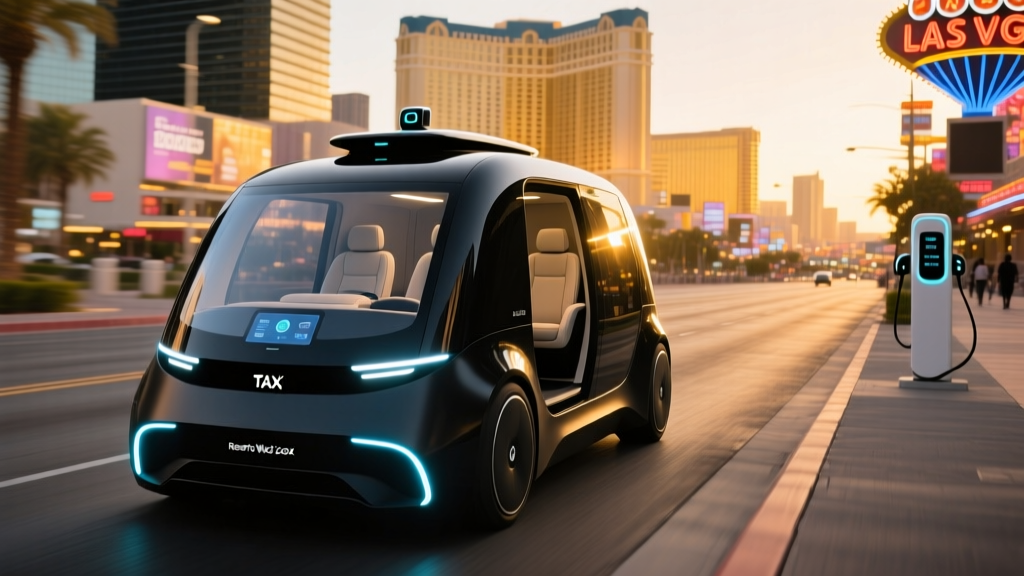
If you've walked the Las Vegas Strip near the Resorts World property, you may have spotted a boxy, steering-wheel-free vehicle gluing itself to the bike lane — that's the Zoox robotaxi. Amazon's autonomous-vehicle subsidiary has been testing and operating its purpose-built carriage on public roads around Resorts World Las Vegas and the broader Strip corridor, making it one of the few places in the United States where you can hail a ride in a vehicle with no driver, no pedals, and no steering wheel.
This guide covers what the Resorts World Zoox service actually offers in 2026: where it runs, how much it costs compared to Uber and Lyft, the SAE Level 4 technology powering it, the publicly available safety record, and the real-world limitations you'll hit as a rider.
Is Zoox Truly Self-Driving or Just Driver-Assist?
The distinction matters enormously in the autonomous-vehicle space, and Zoox sits on the fully autonomous side of the line.
Zoox operates at SAE Level 4 within its geofenced service area. This means the vehicle handles all driving tasks — steering, braking, lane changes, intersection navigation — without any human driver present, and without expecting a human to take over. There is no steering wheel, no brake pedal, and no driver seat inside the Zoox carriage.
This is fundamentally different from SAE Level 2 driver-assist systems like Tesla Autopilot, Ford BlueCruise, or GM Super Cruise, which require an attentive human driver behind the wheel at all times. Zoox is not driver-assist; it is a driverless robotaxi.
| SAE Level | Name | Human Required? | Examples |
|---|---|---|---|
| Level 2 | Partial Automation | Yes — full supervision | Tesla Autopilot/FSD (Supervised), BlueCruise, Super Cruise |
| Level 3 | Conditional Automation | Yes — on request | Mercedes Drive Pilot (limited markets, low speed) |
| Level 4 | High Automation | No — within geofence | Zoox (Resorts World), Waymo One |
| Level 5 | Full Automation | No — anywhere | Does not exist commercially |
Zoox's Level 4 designation is geofence-bound: the vehicle operates autonomously only within its approved service area in Las Vegas (and separately in Foster City, California, and parts of the San Francisco Bay Area). Outside those zones, the system does not operate.
Where Can You Use the Resorts World Zoox Service?
As of early 2026, Zoox's Las Vegas operations are centered on the Strip corridor and the surrounding streets near Resorts World Las Vegas, the property where Zoox established a visible testing and rider hub. The service area has expanded incrementally since Zoox began public road testing in Las Vegas in 2023.
| City | Service Area | Status | Notes |
|---|---|---|---|
| Las Vegas, NV | Strip corridor, Resorts World vicinity, expanding to adjacent streets | Active — testing & limited rider program | Public rides via Zoox app; availability may be restricted to invited users or specific hours |
| Foster City, CA | San Francisco Peninsula service zone | Active — employee & invited rider program | Bay Area headquarters region |
| San Francisco, CA | Select neighborhoods | Limited testing | Regulatory approvals required for commercial service |
Important caveat: Unlike Waymo One in Phoenix and San Francisco, which operates as a fully commercial, open-access rideshare service, Zoox's Las Vegas presence as of 2026 remains in an expanded testing and early-access rider phase. You can request rides through the Zoox mobile app, but availability may be limited to certain hours, specific pickup/dropoff zones near Resorts World, and invited participants. Zoox has not announced a full commercial launch date for unrestricted public access on the Strip.
How to Ride and What It Costs vs Uber/Lyft
Riding in a Zoox robotaxi near Resorts World requires downloading the Zoox app (available on iOS and Android), creating an account, and requesting a ride within the geofenced service area. Pickup and dropoff are limited to designated zones — you can't hail one from an arbitrary street corner the way you might flag a cab.
During its testing phases, Zoox has offered rides free of charge to participants in its rider program, as the company collects operational data and rider feedback. This is a significant difference from Waymo One, which charges fares comparable to UberX.
| Service | Typical Fare (3-mile Strip ride) | Surge Pricing? | Availability |
|---|---|---|---|
| Zoox (Resorts World area) | Free (testing/early-access program) | No | Limited hours, invited riders, designated zones |
| Waymo One | $8–$15 | Yes | Not yet operating on Las Vegas Strip as of early 2026 |
| UberX | $10–$22 | Yes | Wide availability |
| Lyft Standard | $9–$20 | Yes | Wide availability |
When Zoox transitions to a commercial fare model — likely after completing its regulatory and safety validation milestones — pricing is expected to target the UberX/Lyft range, potentially undercutting rideshare on price due to the absence of a human driver's earnings share. Amazon's backing gives Zoox the financial runway to price aggressively on launch.
The Zoox Technology Stack: Lidar, Cameras, and Geofencing
Zoox takes a fundamentally different hardware approach than Tesla's camera-only FSD system. The Zoox carriage is a sensor-dense platform designed for redundancy.
- Lidar: Multiple solid-state and spinning lidar units provide 360-degree 3D point-cloud mapping of the vehicle's surroundings, accurate to centimeter-level resolution at ranges exceeding 150 meters.
- Cameras: A surround camera array (front, rear, side, and corner-mounted) provides visual perception for lane markings, traffic signals, pedestrian detection, and object classification.
- Radar: Forward and corner radar units add velocity detection for moving objects and operate reliably in rain, fog, and glare conditions where cameras and lidar degrade.
- IMU & GPS: Inertial measurement units combined with high-precision GPS and HD map localization keep the vehicle positioned within centimeters on its pre-mapped routes.
Key distinction from Tesla FSD: Tesla relies exclusively on cameras (no lidar, no radar in current hardware) and neural-network-based perception. Zoox fuses lidar, radar, and camera data — a sensor-fusion approach shared by Waymo, Cruise (pre-suspension), and most commercial robotaxi operators. The consensus among robotics engineers is that lidar redundancy provides a safety margin that camera-only systems cannot match in edge cases like direct sun glare, heavy rain, or sensor occlusion.
The Zoox carriage itself is purpose-built for autonomy — not a retrofitted production car. It features bidirectional driving capability (identical front and rear ends, four-wheel steering), a battery-electric powertrain, and a symmetrical interior where all four passengers face each other. The vehicle's top speed is limited to approximately 75 mph, though in urban geofenced service it rarely exceeds 35–45 mph.
Geofencing is central to Zoox's Level 4 operation: the vehicle only operates within pre-mapped, high-definition zones that have been extensively driven and validated. If the vehicle approaches the edge of its geofence, it will not proceed — it will safely pull over and end the ride or await remote guidance.
Safety Record: What the Data Shows
Zoox's safety data is less publicly transparent than Waymo's, which has published extensive disengagement and collision reports. However, several data points are available from NHTSA standing general orders and Zoox's own disclosures.
- Miles driven autonomously: Zoox has accumulated hundreds of thousands of autonomous miles across its test fleet in Las Vegas, Foster City, and the Bay Area. Exact cumulative figures are not publicly disclosed with the same granularity as Waymo's annual reports.
- NHTSA Standing General Order reports: Zoox, like all ADS-equipped vehicle operators, is required to report crashes involving its vehicles to NHTSA. Zoox has reported a small number of minor incidents — predominantly low-speed contacts during testing — with no reported serious injuries or fatalities attributed to Zoox vehicle operation as of early 2026.
- Disengagement rate: Zoox does not publish a public disengagement-per-1,000-miles metric in the same format as California DMV reports (its Nevada operations fall outside that reporting framework). Internal testing data suggests intervention rates have declined significantly year-over-year as the system matures.
- No passenger injuries: Zoox has not reported any rider injuries during its Las Vegas testing program.
For context, IIHS and NHTSA data consistently show that the vast majority of motor vehicle crashes involve human error — distraction, impairment, speeding, and fatigue. Robotaxi operators argue that removing the human driver eliminates these leading crash causes. However, robotaxis introduce their own failure modes: sensor confusion in construction zones, edge-case interactions with erratic human drivers, and software perception errors. The honest assessment is that Level 4 robotaxis have demonstrated strong safety records in geofenced, low-complexity urban environments, but the total miles driven remain a fraction of human-driven fleets, making statistical comparisons imprecise.
Regulatory Landscape: Who Approves Robotaxi Operations?
Robotaxi operations in the United States require a patchwork of state and local approvals — there is no single federal "robotaxi license."
- Nevada: The Nevada Department of Motor Vehicles (DMV) and the National Highway Traffic Safety Administration (NHTSA) provide the regulatory framework for autonomous vehicle testing and deployment. Nevada was one of the first states to pass AV legislation, and Las Vegas has been broadly supportive of robotaxi testing. Zoox operates under Nevada's autonomous vehicle testing permits.
- California: The California DMV issues testing permits, while the California Public Utilities Commission (CPUC) regulates commercial passenger service. Zoox holds a California testing permit and has been progressing through CPUC's phased deployment program for commercial robotaxi service.
- Federal (NHTSA): NHTSA regulates vehicle safety standards. Zoox received a notable exemption from NHTSA in 2022 allowing its purpose-built carriage — which lacks a steering wheel, mirrors, and other human-driver controls — to operate on public roads. This exemption was a significant regulatory milestone, as Federal Motor Vehicle Safety Standards (FMVSS) were originally written assuming a human driver.
The regulatory environment remains dynamic. Following Cruise's license suspension in California in late 2023 (after a serious pedestrian incident in San Francisco), regulators in multiple states increased scrutiny on robotaxi operators. Zoox has not faced a similar suspension, but the industry-wide effect has been slower expansion timelines and more rigorous safety-validation requirements before new markets are opened.
Current Limitations: Weather, Geofence, and Edge Cases
Despite the impressive technology, the Resorts World Zoox service operates under significant real-world constraints that every prospective rider should understand.
- Geofence boundaries: The vehicle will not travel outside its pre-approved service zone. If your destination falls outside the geofence, the ride cannot be completed. Service areas near Resorts World cover a limited portion of the Strip — you cannot currently take a Zoox from Resorts World to the airport or to downtown Fremont Street.
- Weather constraints: Heavy rain, flooding, dust storms (a Las Vegas-specific concern), and extreme heat can degrade sensor performance. Zoox vehicles may suspend operations or reduce speed during adverse weather. The vehicle's lidar and cameras perform best in clear, dry conditions — which Las Vegas provides most of the year.
- Construction zones: Temporary lane closures, detours, and shifted lane markings remain a challenge for all robotaxi systems. If a construction zone falls outside the vehicle's HD map data, the system may route around it or safely stop and await remote assistance.
- No highway driving: Zoox's current Las Vegas operations are limited to surface streets. The vehicle does not merge onto I-15 or US-95 for highway-speed transit.
- Limited operating hours: During the testing and early-access phase, rides may not be available 24/7. Late-night and early-morning availability may be restricted.
- Accessibility: The Zoox carriage is designed with a low floor and wide doors, but wheelchair accommodation details and ADA compliance specifics should be confirmed directly with Zoox before relying on the service for accessible transit.
- No stops en route: Unlike a human-driven Uber, you cannot ask the Zoox to make an unscheduled stop (e.g., at a convenience store or ATM). The route is predetermined and executed autonomously.
These limitations are not unique to Zoox — they apply broadly to all Level 4 robotaxi services, including Waymo. The technology excels in predictable, well-mapped urban environments with moderate traffic and clear weather. It is not yet a replacement for a human driver in complex, unstructured, or rapidly changing scenarios.
Resorts World Zoox vs Waymo: How the Two Robotaxis Compare
| Attribute | Zoox (Resorts World, Las Vegas) | Waymo One (Phoenix, SF, LA) |
|---|---|---|
| SAE Level | Level 4 (geofenced) | Level 4 (geofenced) |
| Vehicle | Purpose-built Zoox carriage (no steering wheel) | Jaguar I-PACE (modified production EV) |
| Sensor approach | Lidar + camera + radar fusion | Lidar + camera + radar fusion (5th-gen Waymo Driver) |
| Las Vegas availability | Active testing / early-access near Resorts World | Not operating in Las Vegas as of early 2026 |
| Commercial fares | Free during testing phase | UberX-comparable pricing in active markets |
| Parent company | Amazon | Alphabet (Google) |
| Cumulative autonomous miles | Hundreds of thousands (estimated) | 30+ million (publicly reported) |
| Passenger capacity | 4 passengers | Up to 4 passengers (I-PACE) |
Waymo is further along in commercial deployment — it operates open, paid robotaxi service in Phoenix, San Francisco, and Los Angeles, with tens of thousands of weekly paid rides. Zoox's advantage lies in its purpose-built vehicle design, which offers a more spacious, purpose-designed rider experience and bidirectional driving capability that simplifies navigation in tight urban spaces. Zoox also benefits from Amazon's logistics infrastructure and deep capital reserves.
Frequently Asked Questions
Can anyone ride the Zoox robotaxi at Resorts World right now?
Access is currently limited. Zoox operates an early-access rider program near Resorts World Las Vegas, and rides are typically requested through the Zoox app. Availability may be restricted to invited participants, specific hours, and designated pickup zones. Check the Zoox app for the latest access status in Las Vegas.
How much does a Zoox ride cost compared to Uber?
During its testing and early-access phase, Zoox rides are free. When commercial service launches, pricing is expected to be competitive with UberX and Lyft Standard — roughly $10–$22 for a typical 3-mile Strip ride, though exact fares have not been announced.
Is the Zoox carriage fully electric?
Yes. The Zoox vehicle is a battery-electric platform designed from the ground up for autonomous operation. Specific battery capacity (kWh) and range figures for the production carriage have not been publicly detailed, but the vehicle is designed for all-day urban operation with depot-based charging.
What happens if the Zoox encounters a situation it can't handle?
Zoox vehicles can contact a remote assistance team — human operators who can provide guidance (such as confirming it's safe to proceed around an obstacle) without directly driving the vehicle. If the system cannot resolve the situation, the vehicle will safely pull over and end the trip.
Is Zoox safer than a human driver?
Zoox's testing data shows no reported passenger injuries and a small number of minor low-speed incidents. Robotaxis eliminate human-error crash causes (distraction, impairment, fatigue), but total autonomous miles remain far below human-driven fleets, making definitive statistical comparisons premature. The safety record is encouraging but still accumulating.
Will Zoox expand beyond the Resorts World area?
Zoox has been incrementally expanding its Las Vegas geofence since beginning operations near the Strip. Expansion to McCarran International Airport, downtown Las Vegas, and broader suburban areas is expected eventually, but timelines depend on regulatory approvals, safety validation, and mapping completion. No specific expansion dates have been announced.