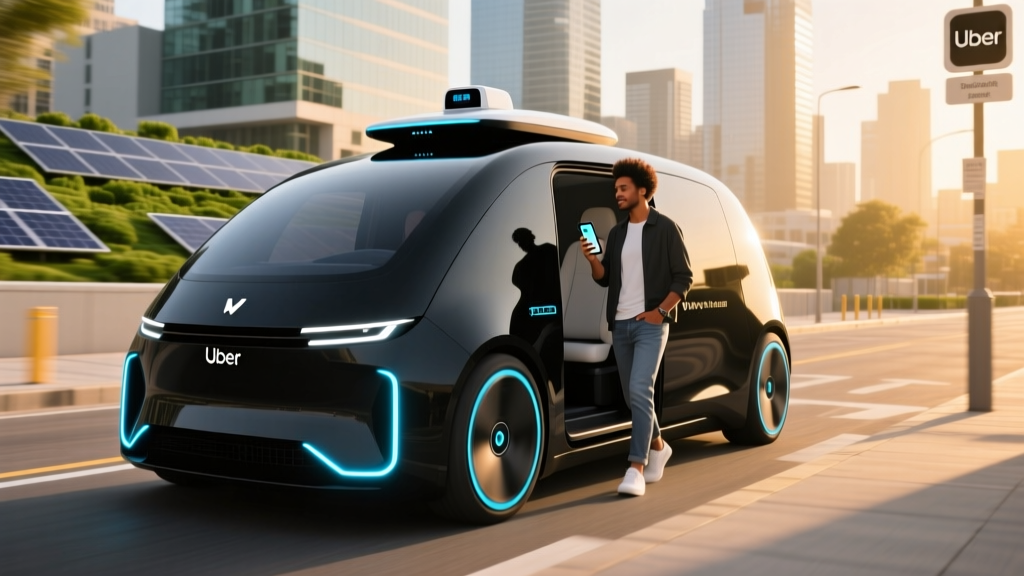
If you have opened the Uber app in Phoenix, San Francisco, or Los Angeles recently, you may have noticed a new ride option alongside UberX and Comfort: Waymo autonomous vehicles. The partnership between Uber and Waymo, which began as a limited pilot and expanded through 2025 into a multi-city integration, means you can now hail a fully driverless Jaguar I-PACE robotaxi without downloading a separate app. Here is exactly how to order a Waymo on Uber, what it costs, where it works, and what the safety and technology data actually shows.
What You Are Actually Ordering: SAE Level 4 Autonomy
Before tapping "confirm ride," it helps to understand what separates a Waymo robotaxi from the driver-assist systems in consumer EVs. Waymo's sixth-generation Waymo Driver operates at SAE Level 4 — meaning the vehicle handles all driving tasks within its defined operational design domain (ODD) with no human intervention required. There is no one in the driver's seat. No one is monitoring a screen from a remote office ready to take over in seconds. The car drives itself.
| Level | Description | Example |
|---|---|---|
| Level 0 | No automation | Conventional vehicle |
| Level 1 | Single-axis assist (steering OR speed) | Adaptive cruise control |
| Level 2 | Combined assist — driver must supervise at all times | Tesla Autopilot, GM Super Cruise, Ford BlueCruise |
| Level 3 | Conditional automation — driver must take over when requested | Mercedes Drive Pilot (limited markets) |
| Level 4 | Full automation within a defined ODD — no human driver needed | Waymo, Zoox (geofenced urban areas) |
| Level 5 | Full automation everywhere, all conditions (does not yet exist commercially) | N/A |
Source: NHTSA / SAE International
This distinction is critical. Consumer systems like Tesla's FSD (Supervised), Ford BlueCruise, and GM Super Cruise are all Level 2 — the driver remains legally responsible and must keep their attention on the road. Waymo's robotaxi carries no such expectation from the rider. You are a passenger, not a backup driver.
Where Can You Order a Waymo on Uber Right Now?
The Waymo–Uber integration is live in select cities where Waymo holds commercial operating permits. As of early 2026, the service operates in the following metro areas:
| City | Service Area Coverage | Hours | Uber Integration Status |
|---|---|---|---|
| Phoenix, AZ | ~225 sq mi (Tempe, Scottsdale, Chandler, downtown Phoenix, Sky Harbor Airport) | 24/7 | Live — fully integrated |
| San Francisco, CA | Most of SF proper (geofence boundaries vary by neighborhood) | 24/7 | Live — fully integrated |
| Los Angeles, CA | Downtown LA, Hollywood, Santa Monica, Westside (~80+ sq mi) | 24/7 | Live — fully integrated |
| Austin, TX | Downtown and select central corridors (limited footprint) | Limited hours | Rolling out — waitlist access |
Important: Waymo vehicles operate inside a geofence — a digitally mapped boundary. If your pickup or drop-off falls outside the geofence, the Uber app will not show Waymo as an option. The Phoenix service area is the largest and most mature; San Francisco and LA are expanding incrementally as California's CPUC and DMV approve new zones.
Step-by-Step: How to Order a Waymo on Uber
The process is nearly identical to requesting any other Uber ride, with a few Waymo-specific differences:
- Open the Uber app and enter your destination as usual.
- Look for "Waymo" in the ride options list. If your trip's origin and destination both fall within the Waymo geofence, the option will appear alongside UberX, Comfort, etc.
- Select Waymo and confirm. The app will show the estimated fare, ETA, and a note that the vehicle is autonomous with no driver.
- Find your Waymo vehicle. The app displays the car's license plate and a unique roof-marker color. The vehicle is a white Jaguar I-PACE with a distinctive sensor array on the roof and fenders.
- Unlock and enter. When the car arrives, tap "Start ride" or "Unlock" in the app. The rear doors unlock automatically. There is no driver to greet you.
- Confirm your ride. An in-seat screen displays your name and destination for verification. Tap to confirm, and the vehicle begins the trip.
- Ride and exit. The in-cabin screen shows your route in real time. When you arrive, the doors unlock and you simply exit. Payment is handled through your Uber account.
Waymo on Uber Pricing: What It Costs vs Standard Rideshare
One of the most common questions is whether robotaxi rides cost more than a human-driven Uber. The answer depends on the city and time of day, but Waymo rides on Uber are generally priced comparably to UberX, with a modest premium in some markets.
| Route Example | Waymo on Uber (est.) | UberX (est.) | Difference |
|---|---|---|---|
| Phoenix Sky Harbor to Scottsdale (~8 mi) | $18–$24 | $16–$22 | ~+10% |
| SF downtown to Mission District (~3 mi) | $12–$16 | $11–$15 | ~+5–8% |
| LA Santa Monica to Hollywood (~16 mi) | $28–$36 | $25–$34 | ~+5–10% |
Estimates based on typical non-surge pricing in early 2026. Actual fares vary by demand, time, and route. Waymo does not currently apply Uber surge multipliers in the same way — pricing tends to be more stable but availability drops during peak demand instead of prices spiking.
Compared to Waymo's standalone app (Waymo One), pricing on Uber is nearly identical. The Uber integration is primarily a convenience play — one app for all your ride needs, including the option of a driverless car when available. No separate tipping is expected or possible, since there is no driver.
Safety Data: What the Numbers Show
Waymo has accumulated over 40 million fully autonomous miles across its commercial fleet as of late 2025, with the vast majority in Phoenix and San Francisco. The company publishes periodic safety reports, and independent analyses from insurance and research groups have generally found favorable results compared to human benchmarks.
- 40+ million fully driverless miles completed commercially (through 2025)
- ~85% fewer injury-causing crash involvement events per million miles compared to human benchmarks in Phoenix, per Waymo's published analysis cross-referenced with NHTSA data
- ~57% fewer property-damage-only police-reported crashes per million miles vs human drivers in comparable urban environments
- Most recorded collisions are low-speed, at-fault-by-other-party incidents (e.g., rear-ended at a stop light, sideswiped in a parking maneuver)
- Waymo vehicles are required to report all collisions to NHTSA under the Standing General Order for ADS-equipped vehicles
Sources: Waymo Safety Reports, NHTSA Standing General Order crash data, IIHS autonomous vehicle research
The safety case for robotaxis rests on elimination of the primary causes of human crashes: distraction, impairment, fatigue, and speeding. A Level 4 system does not text, drink, or get drowsy. That said, robotaxis are not infallible. Documented edge cases include hesitation at complex unprotected left turns, overly conservative behavior that can frustrate human drivers behind them, and rare instances of vehicles stopping unexpectedly in travel lanes during sensor uncertainty.
For context, the US fatality rate is approximately 1.35 deaths per 100 million vehicle miles traveled (NHTSA FARS data). Waymo's commercial fleet has not recorded a rider or pedestrian fatality across its tens of millions of autonomous miles. However, the sample size is still small relative to the national fleet, and the ODD excludes the most challenging driving environments (unpaved roads, extreme weather, unmapped construction zones).
Under the Roof: Waymo's Sensor and Technology Stack
Unlike Tesla's camera-only approach, Waymo's sixth-generation Waymo Driver relies on a redundant, multi-modal sensor suite. This is the fundamental architectural difference between Level 4 robotaxis and Level 2 consumer systems.
| Sensor Type | Function | Count (approx.) |
|---|---|---|
| LiDAR (custom, roof + fenders) | 3D point cloud mapping, object detection at 200m+, works in darkness | 5+ units |
| Cameras (high-res, surround-view) | Traffic light state, signage, lane markings, color/texture recognition | 29 cameras |
| Radar (imaging, 360°) | Velocity detection, performance in rain/fog, redundancy | 6 units |
| External audio receivers | Siren detection (emergency vehicles), horn detection | Multiple |
| HD maps + GPS/IMU | Centimeter-level localization within the geofence | N/A |
The 6th-gen system, which began deploying in 2024 and is now the standard across the commercial fleet, reduced sensor count and cost compared to the 5th-gen while improving range and resolution. The custom-built LiDAR units are a key differentiator — they provide a real-time 3D model of the environment that cameras alone cannot replicate, particularly at night or in high-contrast lighting conditions (tunnel exits, direct sun glare).
Waymo's AI perception stack fuses data from all sensor modalities simultaneously. If one sensor type is degraded (e.g., cameras blinded by sun glare), LiDAR and radar maintain object tracking. This redundancy is what enables the system to operate without a human fallback driver — a requirement that Level 2 systems cannot meet because they depend on a single perception architecture with a human as the final safety net.
Regulatory Landscape: Who Approves Robotaxi Operations
Robotaxi operations in the United States are governed by a patchwork of state and local regulations, not a single federal framework. Here is how approval works in practice:
- Federal (NHTSA): Sets vehicle safety standards (FMVSS) and requires crash reporting via Standing General Order. NHTSA does not currently "approve" autonomous driving systems but can investigate and issue recalls for ADS software defects.
- California (DMV + CPUC): Waymo must hold a DMV Autonomous Vehicle Testing/Deployment permit and a CPUC passenger carrier permit to charge fares. Both agencies track incident reports and can suspend operations.
- Arizona: Takes a permissive regulatory approach. Waymo operates under a general business license and a partnership framework with the state. No specific ADS deployment permit is required, though vehicles must meet standard registration and insurance requirements.
- Texas (Austin): The Texas Department of Licensing and Regulation (TDLR) oversees autonomous vehicle operations. Waymo began limited Austin operations in 2025 under the state's autonomous vehicle framework.
The regulatory environment remains fluid. San Francisco saw significant public debate in 2023–2024 over robotaxi operations after several incidents involving Waymo and Cruise vehicles, including a Cruise vehicle dragging a pedestrian who had been struck by another car. Cruise (GM's robotaxi unit) suspended operations nationally in late 2023 and has been slowly re-entering markets. Waymo, by contrast, maintained continuous operations and expanded, though the CPUC has imposed additional reporting and operational requirements.
Current Limitations: What Waymo Cannot Do
- Geofenced only: Cannot drive outside pre-mapped zones. If your destination is beyond the boundary, the app will not offer Waymo.
- Weather restrictions: Heavy rain, fog, or dust storms can trigger operational pauses. Phoenix monsoon season and SF fog sometimes reduce availability. The vehicles do not operate in snow or ice.
- Construction zones: While Waymo can navigate some temporary lane shifts, major unmapped construction can cause the vehicle to pull over and wait for remote routing assistance (not remote driving — the car remains stationary until a new route is computed).
- No highway driving (most markets): Waymo's current ODD is primarily surface streets. Limited freeway segments are included in some cities, but long highway trips are generally unavailable.
- Passenger limits: Typically 1–3 adult passengers in the rear seat. No car seats, no pets (service animals excepted), no large cargo.
- No multiple stops: You cannot add a mid-trip stop (e.g., pick up a friend or grab coffee). One origin, one destination.
- Accessibility: The Jaguar I-PACE fleet requires passengers to enter a standard SUV-height vehicle. Wheelchair-accessible vehicles are not yet part of the Waymo–Uber fleet, though Waymo has announced partnerships for WAV deployment.
- No trunk access: The trunk/cargo area is reserved for vehicle computing hardware. Luggage must fit on the rear seat or floor.
These limitations are not bugs — they are the boundaries of the Operational Design Domain that keeps the system safe. Waymo's approach is to expand the ODD incrementally (new neighborhoods, more weather conditions) rather than deploy broadly and hope for the best. This is why the service has grown city by city rather than launching nationwide.
Waymo on Uber vs Waymo One App: Which Should You Use?
If you already use Uber regularly, ordering through Uber is the path of least resistance — same payment method, same ride history, same app. However, the standalone Waymo One app offers a few advantages:
- Priority access: In some markets, Waymo One users get slightly faster matching during peak demand.
- Family accounts: Waymo One allows you to order rides for family members (18+) within the service area.
- Direct promotions: Waymo occasionally offers credits and promotions exclusively through Waymo One.
For most riders, the Uber integration is sufficient. If you become a frequent Waymo user in a single city, the standalone app may offer marginal benefits.
Frequently Asked Questions
Is Waymo on Uber truly self-driving, or is there a remote operator?
Waymo is truly self-driving (SAE Level 4) within its geofenced service area. There is no human in the car and no remote operator driving the vehicle in real time. Waymo does have a fleet-response team that can provide high-level routing guidance if a vehicle encounters an unexpected situation (e.g., a fully blocked road), but this team does not steer, brake, or accelerate the vehicle. The AI handles all real-time driving decisions.
How much does a Waymo ride cost compared to UberX?
Waymo rides on Uber are typically priced within 5–10% of UberX for equivalent routes. There is no surge pricing in the traditional sense — instead, availability may decrease during peak demand. A 5-mile trip in Phoenix might cost $14–$18 on Waymo vs $13–$17 on UberX.
Can I order a Waymo on Uber in any city?
No. As of early 2026, Waymo on Uber is available in Phoenix, San Francisco, Los Angeles, and (in limited form) Austin. Even within those cities, both your pickup and drop-off must fall inside Waymo's geofence. If either point is outside the boundary, the Waymo option will not appear.
What happens if the Waymo vehicle encounters an emergency?
The vehicle is programmed to pull over safely, activate hazard lights, and contact Waymo's roadside assistance team. In the event of a collision, emergency services are automatically notified. Riders can also contact support through the in-cabin screen or the Uber app at any time.
Is it safe to ride in a Waymo at night?
Yes. Waymo's LiDAR-based perception system does not rely on visible light, so nighttime operation is a core capability. In fact, some of Waymo's strongest safety data comes from nighttime driving, where human drivers are disproportionately affected by fatigue and impairment. Phoenix and SF both offer 24/7 Waymo service.
Do I need to tip a Waymo driver?
There is no driver to tip. The Uber app does not prompt for a tip on Waymo rides. If you want to show appreciation, Waymo has suggested that positive ratings and feedback help the service improve.
What vehicle will pick me up?
All Waymo rides on Uber currently use the Jaguar I-PACE, a battery-electric SUV with an 84 kWh (usable) NMC battery pack, EPA-estimated 234 miles of range, and 394 horsepower. The vehicle is identifiable by its white paint, roof-mounted LiDAR array, and Waymo branding. Waymo has announced the Zeekr RT (a custom-built robotaxi with no steering wheel) for future deployment, but it is not yet in commercial service as of early 2026.
This article reflects service availability, pricing, and regulatory information as of early 2026. Robotaxi operations expand and change frequently. Always check the Uber app for real-time availability in your area. For tax, legal, or accessibility questions related to autonomous vehicle services, consult relevant local authorities.