The Shift from Robotaxis to Autonomous Delivery
While fully autonomous robotaxis like Waymo and Cruise dominate mainstream headlines, the quiet revolution in autonomous logistics is already generating tangible revenue. Autonomous delivery vehicles (ADVs) bypass many of the complexities of human passenger interaction, focusing instead on predictable routes, middle-mile freight, and last-mile grocery drop-offs. For logistics managers, fleet operators, and automotive tech enthusiasts, understanding the underlying technology stack of these commercial ADVs is critical. This deep dive tracks the sensor architectures, compute platforms, and deployment realities of the leading autonomous delivery platforms operating today.
Core Technology Deep Dive: Sensor Suites and Edge Compute
The operational design domain (ODD) for delivery vehicles varies wildly depending on the use case. A last-mile sidewalk rover faces entirely different edge cases than a Class 8 long-haul freight truck. Consequently, the sensor fusion architectures and edge compute requirements diverge significantly across the industry.
LiDAR vs. Vision-Heavy Approaches in Delivery
Unlike some consumer EV manufacturers pushing pure-vision neural networks, the commercial ADV sector overwhelmingly relies on multi-modal sensor fusion. LiDAR remains the cornerstone for precise depth mapping, especially for high-speed middle-mile and long-haul applications. Companies like Gatik and Kodiak Robotics utilize high-channel-count LiDARs (often from Hesai or Ouster) paired with overlapping radar and camera arrays. This redundancy ensures that a sudden obstacle on a dimly lit highway is detected regardless of ambient lighting conditions.
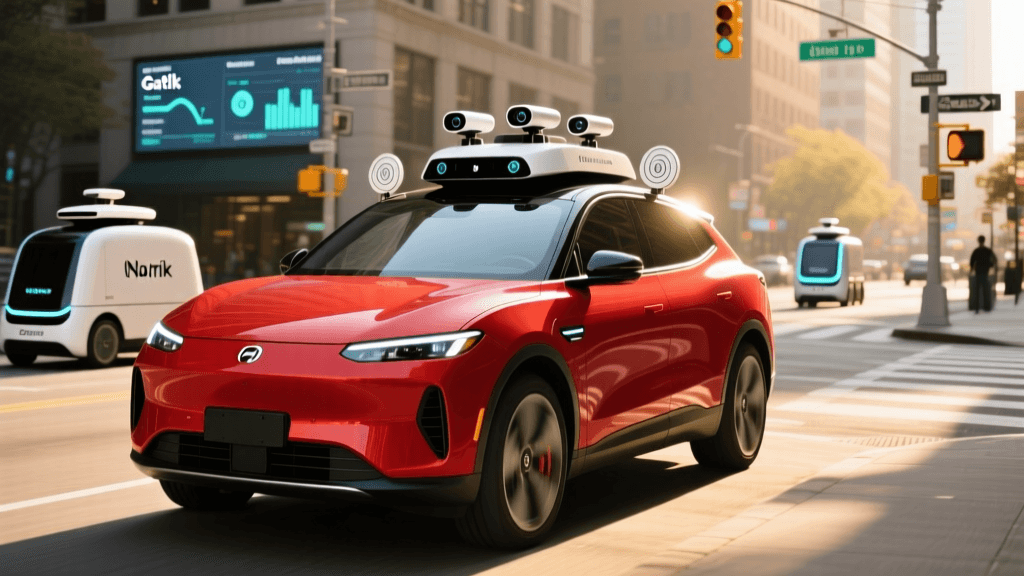
Conversely, last-mile delivery pods like the Nuro R3 operate at lower speeds (typically under 45 mph) in dense urban environments. Nuro utilizes a 360-degree perception system combining solid-state and mechanical LiDAR, high-dynamic-range cameras, and millimeter-wave radar. The emphasis here is on near-field object classification—distinguishing between a pedestrian, a stray dog, and a discarded cardboard box within a 50-meter radius.
Edge Compute and Redundancy Systems
Processing terabytes of sensor data per hour requires automotive-grade edge compute. The NVIDIA DRIVE Orin platform has become the de facto standard for commercial ADVs, offering up to 254 TOPS (Tera Operations Per Second) of performance. However, compute is only half the battle. True SAE Level 4 autonomy requires hardware-level redundancy. According to the frameworks established by SAE International's J3016 standard, a Level 4 system must be capable of performing a minimal risk condition (MRC) maneuver if primary systems fail. ADVs achieve this through dual-redundant steer-by-wire and brake-by-wire systems, powered by independent secondary compute modules that can safely pull the vehicle over if the main Orin SoC encounters a thermal or software fault.
2024 Autonomous Delivery Deployment Tracker
Below is a comprehensive tracker of the primary commercial ADV platforms currently in development or active deployment. This data highlights the divergence in vehicle form factors and technological priorities across the sector.
| Company | Vehicle Platform | Primary Use Case | Sensor Stack Highlight | Compute Platform | Deployment Status |
|---|---|---|---|---|---|
| Nuro | R3 (Custom Pod) | Last-Mile Grocery/Retail | 12 Cameras, 5 Radars, 2 LiDARs | NVIDIA DRIVE Orin | Active (CA, TX, AZ) |
| Gatik | Isuzu / Freightliner Box Trucks | Middle-Mile B2B Logistics | Proprietary Multi-Modal LiDAR/Radar | Custom NVIDIA Architecture | Active (AR, TX, CA) |
| Kodiak Robotics | Class 8 Semi-Trucks | Long-Haul Freight | Hesai AT128 LiDAR, Modular SensorPods | NVIDIA DRIVE Orin | Active (TX, South) |
| Zoox | Bi-directional Carriage | Urban Delivery / Ride-Hail | Duplicated 4-corner Sensor Clusters | Custom Zoox Silicon | Testing / Limited (CA, NV) |
| Udelv | Transporter (Custom) | Last-Mile Pharmacy/Auto Parts | Mobileye EyeQ + LiDAR Fusion | Mobileye Drive | Pilot Programs (Nationwide) |
Regulatory Hurdles and FMVSS Exemptions
One of the most significant bottlenecks for last-mile ADVs is the Federal Motor Vehicle Safety Standards (FMVSS). Traditional vehicles require steering wheels, mirrors, and pedals. Purpose-built delivery pods like the Nuro R2 and R3 do not have human occupants, making these requirements obsolete. Securing exemptions from the National Highway Traffic Safety Administration (NHTSA) is a rigorous process. As detailed by the NHTSA automated vehicle safety guidelines, manufacturers must prove that their occupant-less designs offer an equivalent or superior safety profile compared to traditional vehicles. Nuro successfully secured the first-ever FMVSS exemption for a fully driverless vehicle, setting a massive regulatory precedent that companies like Zoox and Udelv are now leveraging to scale their custom chassis designs.
Teleoperation and Remote Assistance Ratios
A critical, often overlooked metric in the autonomous delivery space is the teleoperation intervention rate. No Level 4 system is perfect; edge cases like complex construction zones or erratic human flaggers require remote human assistance. The industry is moving away from direct remote driving (which suffers from latency issues) toward 'remote guidance,' where a human operator approves a high-level path plan generated by the AV's AI. Fleet managers evaluating ADV vendors must scrutinize the teleop-to-vehicle ratio. Early deployments required one remote operator per 2-3 vehicles. Leading middle-mile operators like Gatik are pushing this ratio past 1:10, which is the mathematical threshold where autonomous logistics becomes cheaper than human-driven freight.
Infrastructure Readiness and V2X Integration
Autonomous delivery vehicles do not operate in a vacuum. The integration of Vehicle-to-Everything (V2X) communication is becoming a priority for municipal planners and logistics hubs. Research conducted by the USDOT's Volpe National Transportation Systems Center highlights how smart infrastructure, such as connected traffic signals and dedicated loading zone beacons, can drastically reduce the dwell time and edge-case confusion for last-mile delivery pods. Fleet operators should prioritize deployment zones where municipal V2X infrastructure aligns with their ADV's communication protocols.
Actionable Advice for Logistics Fleet Managers
If you are a logistics director or fleet manager considering the integration of autonomous delivery vehicles into your supply chain, follow these actionable steps:
- Audit Your ODD: Do not attempt to deploy last-mile pods on high-speed arterial roads. Map your routes and match them strictly to the vendor's approved Operational Design Domain. Middle-mile box trucks (Gatik) are best for distribution center to retail store routes on highways, while pods (Nuro) are strictly for low-speed neighborhood drops.
- Demand Transparency on Disengagement Metrics: Ask vendors for their 'miles per remote intervention' data specific to your geographic region and weather conditions. An AV that performs flawlessly in Phoenix may struggle in Chicago winters due to LiDAR scatter from snow.
- Evaluate Loading/Unloading Automation: The vehicle might drive itself, but if a human still needs to manually load the cargo bay, your labor savings are negated. Look for ADV partners integrating with automated conveyor loading docks or robotic parcel sorters.
- Plan for Facility Upgrades: ADVs require dedicated, geofenced staging areas with high-bandwidth Wi-Fi or 5G coverage for map updates and remote diagnostics. Budget for these facility upgrades prior to vehicle delivery.
Future Outlook: The Path to Class 8 Autonomy
While last-mile pods capture the consumer imagination, the highest ROI in autonomous delivery lies in middle-mile and long-haul freight. The modularization of sensor suites—such as Kodiak's plug-and-play SensorPods—will allow fleet operators to retrofit existing Class 8 trucks rather than waiting for OEMs to release purpose-built autonomous tractors. As compute platforms become more power-efficient and solid-state LiDAR prices drop below the $500 threshold, expect to see autonomous delivery shift from localized pilot programs to a dominant force in the national supply chain by the end of the decade.