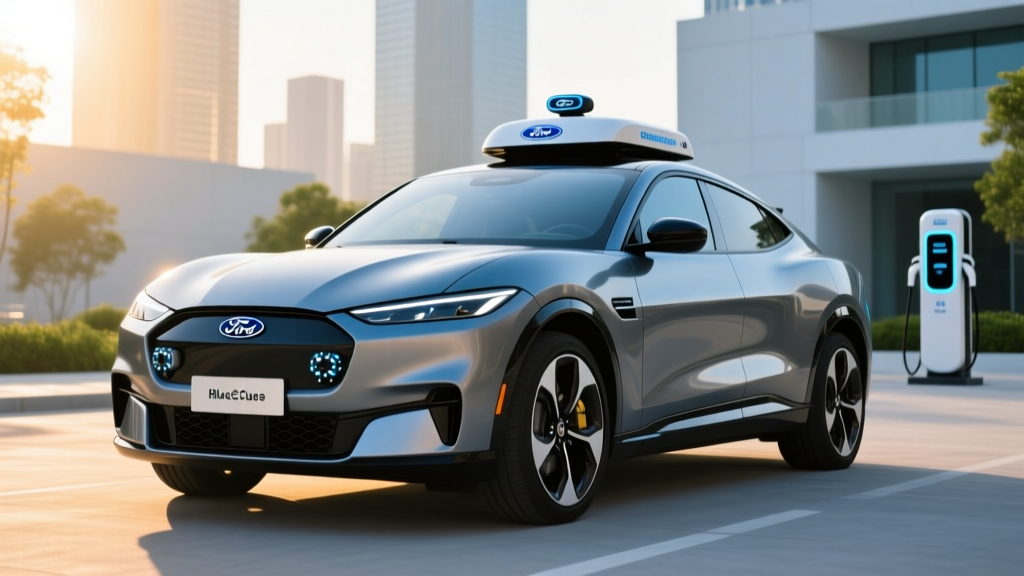
If you've searched for "Mustang Mach-E self-driving," you've likely encountered a tangle of marketing terms, YouTube headlines, and forum debates. Let's cut through it: the Ford Mustang Mach-E is not a self-driving car. It does not operate without a human behind the wheel, and it cannot summon itself from a parking lot or navigate city streets without your constant supervision.
What the Mach-E does offer is Ford BlueCruise — an SAE Level 2 advanced driver-assistance system (ADAS) that enables hands-free driving on pre-mapped divided highways. It's a legitimate convenience feature that reduces fatigue on long road trips, but it demands your attention at all times. Understanding exactly what BlueCruise can and cannot do is essential before you buy into the hype — or the vehicle.
SAE Automation Levels: Where the Mach-E Actually Sits
The Society of Automotive Engineers (SAE) defines six levels of driving automation, from Level 0 (no automation) to Level 5 (full self-driving in all conditions). Marketing language frequently blurs these distinctions, so here's the precise breakdown:
| Level | Name | Who Drives? | Examples |
|---|---|---|---|
| 0 | No Automation | Human does everything | Basic cruise control |
| 1 | Driver Assistance | Human, with one assist | Adaptive cruise OR lane-keeping |
| 2 | Partial Automation | Human supervises | Ford BlueCruise, Tesla Autopilot, GM Super Cruise |
| 3 | Conditional Automation | System drives; human on standby | Mercedes Drive Pilot (limited conditions) |
| 4 | High Automation | System drives; no human needed (geofenced) | Waymo, Zoox robotaxis |
| 5 | Full Automation | System drives everywhere | Does not exist commercially |
The Mustang Mach-E with BlueCruise is firmly SAE Level 2. The system handles steering, acceleration, and braking on qualified highway sections, but you are the driver. You must monitor the road, keep your eyes forward (a driver-facing camera enforces this), and be ready to take over instantly. If you look away from the road for too long, BlueCruise will issue escalating alerts and eventually disengage.
Ford BlueCruise on the Mach-E: How It Works
BlueCruise debuted on the 2021 Mustang Mach-E and has expanded in capability with subsequent model years. As of the 2025–2026 model years, the latest iteration is BlueCruise 1.5 (on equipped trims), which builds on the earlier 1.0, 1.2, and 1.3 versions.
Technology Stack
BlueCruise relies on a sensor suite rather than a camera-only approach:
- Forward-facing camera — lane detection, traffic sign recognition
- Radar sensors (front and corner-mounted) — adaptive cruise, blind-spot monitoring, cross-traffic alert
- Driver-facing infrared camera — monitors eye gaze and head position to ensure attention
- GPS + HD maps — identifies Hands-Free Blue Zones (pre-mapped divided highways)
Unlike Waymo's Level 4 robotaxis, the Mach-E does not use lidar. The system is designed for highway driving in clear conditions, not for navigating unmapped urban environments or construction zones.
Hands-Free Blue Zones
BlueCruise's hands-free mode activates only on pre-qualified sections of divided highways — what Ford calls "Blue Zones." As of early 2026, Ford has mapped over 130,000 miles of Hands-Free Blue Zones across the United States and Canada. These include major interstates like I-5, I-95, I-80, I-10, and I-70, among many others.
When you enter a Blue Zone, the instrument cluster and head-up display (if equipped) indicate that hands-free mode is available. You can then remove your hands from the wheel — but your eyes must stay on the road. When you exit the Blue Zone (e.g., an off-ramp or undivided road), the system prompts you to place your hands back on the steering wheel.
BlueCruise 1.5 Features
Beyond basic hands-free highway driving, BlueCruise 1.5 adds:
- Hands-Free Lane Change — the system can initiate and execute a lane change on the highway when you tap the turn signal
- In-Lane Repositioning — subtle lateral adjustments to give space when passing large trucks
- Predictive Speed Assist — automatically adjusts speed for upcoming curves
- Hands-Free Zone Assist — helps you stay in a Blue Zone by suggesting route adjustments on the navigation system
Is the Mustang Mach-E Self-Driving? The Honest Answer
No. The Mustang Mach-E is not self-driving.
BlueCruise is a Level 2 driver-assistance system. You must remain alert, eyes on the road, and ready to take over at any moment. The vehicle cannot:
- Navigate city streets or intersections autonomously
- Handle construction zones, detours, or unmapped roads hands-free
- Drive in heavy rain, snow, or fog reliably
- Operate without a licensed, attentive driver in the seat
- Park itself without supervision (Active Park Assist 2.0 requires you to remain in or near the vehicle)
If you're looking for a vehicle that drives itself while you sleep, work, or watch a movie, that technology does not exist in any consumer vehicle sold in 2026. Level 4 robotaxis (Waymo, Zoox) operate in limited cities without a human driver, but they are ride-hail services — not personal vehicles you can buy.
BlueCruise Safety Record: What the Data Shows
Ford has published some safety data on BlueCruise, though comprehensive, independently verified crash statistics are more limited than what's available for Level 4 robotaxi operators like Waymo.
Ford BlueCruise Safety Data (as of early 2026)
- Cumulative BlueCruise miles driven: Ford reported over 80 million hands-free miles driven across its BlueCruise-equipped fleet (Mach-E, F-150 Lightning, Lincoln models) by late 2024. The number has continued to grow.
- Ford's internal claim: Ford has stated that BlueCruise-equipped vehicles show a reduction in certain crash types compared to non-equipped vehicles, though the company has not published granular per-million-mile crash rates comparable to NHTSA databases.
- NHTSA Standing General Order: Under NHTSA's reporting requirement for ADAS-equipped vehicles, Ford has reported incidents involving BlueCruise. Individual incident details are available through NHTSA's SGORD database.
- IIHS perspective: The Insurance Institute for Highway Safety has repeatedly emphasized that Level 2 systems like BlueCruise are not proven to reduce crash risk compared to attentive human drivers and has called for stronger driver-monitoring safeguards.
The key takeaway: BlueCruise is a convenience and fatigue-reduction system, not a proven safety net. It works well in its designed conditions (clear weather, divided highways), but it is not a substitute for attentive driving. The driver-facing camera is one of the strongest monitoring systems among Level 2 competitors — a meaningful safety advantage over systems that rely only on steering-wheel torque sensors.
BlueCruise vs. Competitors: How the Mach-E Stacks Up
The Mach-E's BlueCruise competes directly with GM's Super Cruise, Tesla's Autopilot/FSD (Supervised), and other Level 2 systems. Here's how they compare on the attributes that matter:
| Feature | Ford BlueCruise 1.5 | GM Super Cruise | Tesla FSD (Supervised) | Toyota Safety Sense 3.0 |
|---|---|---|---|---|
| SAE Level | Level 2 | Level 2 | Level 2 | Level 2 |
| Hands-Free Highway | Yes (Blue Zones) | Yes (mapped roads) | No (hands-on required) | No |
| Driver Monitoring | IR camera (eye gaze) | IR camera (head/eye) | Camera (steering torque backup) | Steering torque |
| Mapped Road Coverage | ~130,000+ mi | ~750,000+ mi | All roads (no map restriction) | N/A |
| Auto Lane Change | Yes (signal-initiated) | Yes (signal-initiated) | Yes (automatic + signal) | No |
| City Street Assist | No | No | Yes (with supervision) | No |
| Subscription Cost (2026) | ~$75/mo or $800/yr after trial | ~$25/mo after trial | $99/mo or $8,000 one-time | Included (no subscription) |
| Available On | Mach-E, F-150 Lightning, Lincoln | Cadillac, Chevy, GMC, Buick | Tesla S/3/X/Y/Cybertruck | Toyota, Lexus |
Key distinctions: Tesla's FSD (Supervised) works on any road, including city streets, but requires your hands on the wheel and has a more controversial safety record. GM's Super Cruise has the largest mapped-road network. Ford's BlueCruise has one of the most robust driver-monitoring systems. Toyota's approach is hands-on, no-subscription, and focuses on crash prevention rather than convenience.
Mustang Mach-E BlueCruise Pricing and Availability
BlueCruise is available on the 2026 Mustang Mach-E across several trims, though packaging varies:
- Premium trim: BlueCruise is typically included with a complimentary trial period (often 90 days to 1 year, depending on model year and promotion)
- GT trim: BlueCruise is standard, often with a longer trial period
- Rally trim: BlueCruise included
- Select (base) trim: BlueCruise availability depends on option packages — not always standard
After the trial period, BlueCruise requires a paid subscription:
- Monthly: approximately $75/month
- Annual: approximately $800/year
Pricing is subject to change; verify current rates with your Ford dealer or the FordPass app. Without an active subscription, the Mach-E reverts to standard adaptive cruise control and lane-centering — still useful, but not hands-free.
2026 Mustang Mach-E Key Specs (for context)
| Spec | Select (Standard Range) | Premium (Extended Range RWD) | GT (Extended Range AWD) |
|---|---|---|---|
| EPA Range | ~250 mi | ~320 mi | ~290 mi |
| Battery (usable) | ~72 kWh (LFP) | ~91 kWh (NMC) | ~91 kWh (NMC) |
| Horsepower | 266 hp | 290 hp | 480 hp |
| 0–60 mph | ~6.3 sec | ~5.7 sec | ~3.3 sec |
| DC Fast Charge (peak) | ~150 kW | ~150 kW | ~150 kW |
| 10–80% DCFC Time | ~33 min | ~40 min | ~40 min |
| Base MSRP | ~$42,000 | ~$48,000 | ~$58,000 |
| BlueCruise | Optional / package-dependent | Standard | Standard |
| Battery/Powertrain Warranty | 8 years / 100,000 miles | ||
Note: EPA range is a laboratory estimate. Real-world highway range at 70+ mph typically drops 15–25% below the sticker. Cold weather (below 30°F) can reduce range an additional 20–30%. See fueleconomy.gov for official ratings.
Current Limitations: Where BlueCruise Falls Short
BlueCruise is genuinely useful on long highway drives, but it has well-defined limitations you should understand before relying on it:
What BlueCruise Cannot Handle
- Non-divided roads: Blue Zones are limited to divided highways. Two-lane roads, surface streets, and rural routes without physical medians are excluded.
- Construction zones: Shifted lanes, temporary barriers, and lane closures can confuse the system. BlueCruise will disengage and prompt you to take over.
- Severe weather: Heavy rain, snow, fog, and ice can obscure cameras and radar. The system will deactivate and alert you.
- Complex interchanges: Some multi-lane merges, collector-distributor roads, and toll plazas are not Blue Zones, even on mapped interstates.
- City streets: Intersections, traffic lights, stop signs, pedestrians, and cyclists — none of these are handled in hands-free mode.
- Edge cases: Faded lane markings, road debris, emergency vehicles stopped in the travel lane, and erratic human drivers all require human judgment and intervention.
- Towing: BlueCruise hands-free mode is generally disabled when a trailer is connected (verify in your owner's manual).
BlueCruise vs. Actual Robotaxis: A Critical Distinction
Some buyers confuse consumer ADAS like BlueCruise with the Level 4 robotaxi services operated by Waymo (Alphabet) and Zoox (Amazon). These are fundamentally different technologies:
| Attribute | Ford BlueCruise (Mach-E) | Waymo One (Robotaxi) |
|---|---|---|
| SAE Level | Level 2 (driver required) | Level 4 (no driver in vehicle) |
| Where It Operates | Mapped highways across US/Canada | Geofenced city zones (Phoenix, SF, LA, Austin) |
| Who Owns the Vehicle | You (personal ownership/lease) | Waymo (ride-hail service) |
| Can You Buy It? | Yes — at a Ford dealer | No — ride-hail only |
| Sensor Suite | Camera + radar (no lidar) | Lidar + camera + radar |
| City Street Navigation | No | Yes (within geofence) |
| Human Required? | Yes — always | No — fully driverless |
If you're hoping the Mach-E will eventually become a Level 4 vehicle through an over-the-air update, that's extremely unlikely. Level 4 autonomy requires redundant sensor suites (including lidar), redundant computing, and extensive geofenced validation — hardware the Mach-E simply does not have. BlueCruise will continue to improve within Level 2 boundaries, but it will not cross into driverless territory.
Frequently Asked Questions
Can the Mustang Mach-E drive itself on the highway without me touching the wheel?
Yes — but only on pre-mapped divided highways (Blue Zones), and only while you remain attentive with your eyes on the road. The driver-facing camera monitors your gaze and will disengage the system if you look away. This is hands-free driving, not self-driving.
Is BlueCruise included with the Mach-E or do I have to pay extra?
BlueCruise is standard on Premium and GT trims with a trial period (typically 90 days to 1 year). After the trial, it requires a subscription of approximately $75/month or $800/year. On the base Select trim, availability depends on option packages.
How does BlueCruise compare to Tesla's Full Self-Driving?
Tesla's FSD (Supervised) works on more road types, including city streets, but requires your hands on the steering wheel at all times. BlueCruise is hands-free but limited to mapped divided highways. Both are SAE Level 2 — neither is self-driving. Tesla's FSD costs $99/month or $8,000 upfront; BlueCruise is ~$75/month or $800/year after the trial.
Can BlueCruise handle rain and snow?
Light rain is generally fine, but heavy rain, snow, fog, or ice will cause the system to deactivate. The cameras and radar need clear visibility to function. In adverse weather, you are fully responsible for driving.
Will BlueCruise eventually become self-driving through software updates?
No. Level 4 autonomy requires hardware (lidar, redundant computing, redundant steering/braking) that the Mach-E does not have. BlueCruise will receive incremental Level 2 improvements — better lane changes, expanded Blue Zones, smoother operation — but it will not become a driverless system.
Does the Mach-E qualify for the federal EV tax credit?
The §30D federal tax credit eligibility for the Mach-E depends on current-year IRS rules regarding MSRP caps, buyer income limits, and battery component/critical mineral sourcing. The Mach-E's MSRP generally falls under the SUV cap ($80,000), but battery sourcing requirements have narrowed eligibility for many vehicles. Check the latest list at IRS.gov and consult a tax professional before relying on the credit in your purchase decision.
The Bottom Line on Mustang Mach-E Self-Driving
The Mustang Mach-E with BlueCruise is one of the better Level 2 driver-assistance systems available in 2026 — particularly for its robust driver monitoring and growing network of hands-free highway zones. On a 400-mile interstate road trip, it genuinely reduces fatigue and makes the journey more comfortable.
But it is not self-driving. Not even close. You are the driver. You are responsible for every mile. And the system's limitations — no city streets, no construction zones, no bad weather — mean that a significant portion of your actual driving will be fully manual.
If hands-free highway driving is a priority and you understand what you're getting (Level 2 convenience, not Level 4 autonomy), the Mach-E with BlueCruise delivers. If you're waiting for a car that truly drives itself, that vehicle doesn't exist for personal purchase in 2026 — and the Mach-E won't be the one to get there first.