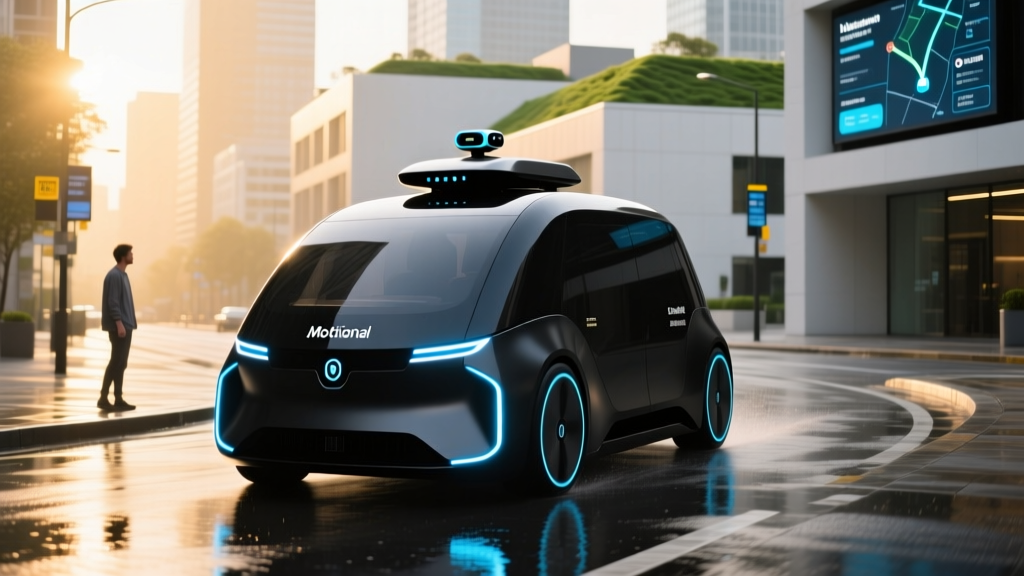
Motional — the autonomous driving joint venture between Hyundai Motor Group and Aptiv — occupies a distinct position in the robotaxi landscape. Unlike Waymo's purpose-built operations or Tesla's camera-only FSD approach, Motional pairs Hyundai's production EV platform (the Ioniq 5) with Aptiv's sensor-fusion architecture to deliver a Level 4 driverless ride-hailing service. If you are researching whether to evaluate the autonomous-vehicles company Motional on robotaxi service viability, this guide covers the technology stack, real-world availability, safety data, pricing economics, and the hard limitations that define what this service can and cannot do in 2026.
What Motional Actually Is — And What SAE Level It Operates At
Motional launched as a joint venture in March 2020, combining Hyundai's vehicle manufacturing and platform integration with Aptiv's autonomous driving software, sensor hardware, and systems engineering. The company's robotaxi service operates at SAE Level 4 — meaning the vehicle handles all driving tasks within a defined operational design domain (ODD) without any human driver present or required. This is a fundamental distinction from consumer driver-assist systems.
SAE Automation Level: Level 4 (High Automation)
What this means: The Motional Ioniq 5 robotaxi performs all dynamic driving tasks — steering, acceleration, braking, lane changes, intersection navigation — without a human driver in the vehicle, but only within its geofenced operational area and under approved conditions (weather, time of day, road type).
What this is NOT: This is not Level 2 driver-assist like Tesla Autopilot, Ford BlueCruise, or GM Super Cruise, which require an attentive human driver at all times. It is also not Level 5 (full automation everywhere). Level 4 means driverless, but geographically and conditionally constrained.
The vehicle platform is the Hyundai Ioniq 5, a battery-electric crossover built on Hyundai's E-GMP architecture. Motional's robotaxi variant uses the long-range AWD configuration with the 77.4 kWh usable NMC battery pack, providing an EPA-estimated 256 miles of range in stock form. The robotaxi sensor suite and compute hardware draw additional power, reducing effective operational range — a factor that influences fleet charging logistics and daily uptime.
Where Can You Use Motional's Robotaxi Service Right Now?
Motional's commercial robotaxi operations have centered on Las Vegas, Nevada, where the company has operated since 2023 through partnerships with Lyft. The Las Vegas deployment covers a geofenced zone that includes the Las Vegas Strip corridor, Harry Reid International Airport, downtown Las Vegas, and surrounding arterials. This is the primary market where riders can hail a driverless Motional vehicle.
| City | Status (2026) | Partner Platform | Geofence Coverage | Operating Hours |
|---|---|---|---|---|
| Las Vegas, NV | Commercial operations active | Lyft | Strip, Airport, Downtown corridor (~55 sq mi) | Daytime and evening hours (weather-permitting) |
| Santa Monica / Los Angeles, CA | Testing / limited pilot | Lyft (selected users) | Restricted test zone | Limited hours |
| Boston, MA | Testing / development | N/A (no public rides) | Development routes only | N/A |
| Pittsburgh, PA | Mapping / validation | N/A | N/A | N/A |
The key takeaway: Las Vegas is the only city where a general rider can request a Motional robotaxi through a standard ride-hailing app. Other cities remain in testing, mapping, or development phases. Motional has announced expansion plans, but announced does not mean live — always check Lyft's autonomous ride options in your city for current availability.
How to Ride and What It Costs vs. Uber/Lyft
Using Motional's robotaxi service is integrated into the Lyft app. When you request a ride within the Las Vegas geofence, the Lyft platform may match you with a Motional autonomous vehicle if one is available and your trip falls within the operational design domain. You'll see an indicator that your ride is autonomous, along with instructions for interacting with the vehicle (e.g., how to unlock doors via the app, where to sit).
There is no human driver in the vehicle. The in-cabin experience includes a rider-facing display showing the vehicle's perception of its surroundings — pedestrians, other vehicles, traffic signals — which serves both as a trust-building interface and a trip-status monitor.
| Service | Typical Base Fare | Per-Mile Rate | Per-Minute Rate | Surge/Dynamic Pricing | Tip Expected |
|---|---|---|---|---|---|
| Motional (via Lyft, Las Vegas) | ~$3.00–$4.50 | ~$1.10–$1.50/mi | ~$0.25–$0.40/min | Yes (Lyft platform surge) | No (no driver) |
| Lyft (human driver, Las Vegas) | ~$3.00–$5.00 | ~$1.20–$1.80/mi | ~$0.30–$0.50/min | Yes | Yes (15–20% typical) |
| Uber (human driver, Las Vegas) | ~$3.50–$5.50 | ~$1.30–$1.90/mi | ~$0.35–$0.55/min | Yes | Yes (15–20% typical) |
| Waymo (Phoenix/SF/LA) | ~$3.00–$4.50 | ~$1.10–$1.50/mi | ~$0.25–$0.40/min | Limited surge | No |
The economics are notable: because there is no driver to tip and no driver wage in the fare structure, Motional robotaxi rides on Lyft tend to be comparable to or slightly cheaper than a standard human-driven Lyft ride — especially once you factor in the eliminated tip (which adds 15–20% to traditional rideshare). For a 6-mile Strip-to-airport trip, expect to pay roughly $10–$16 in a Motional robotaxi versus $14–$22 in a human-driven Lyft with tip. Pricing is dynamic and set by the Lyft platform, so surge conditions during conventions or major events will affect both equally.
Technology Stack: Sensors, Compute, and the Ioniq 5 Platform
Motional's approach to autonomous driving hardware is sensor-fusion heavy — a deliberate contrast to Tesla's camera-only FSD architecture. The Motional Ioniq 5 robotaxi carries a comprehensive suite that provides redundancy across multiple sensing modalities.
Motional Ioniq 5 Robotaxi Sensor Suite
- LiDAR: Multiple solid-state and spinning LiDAR units providing high-resolution 3D point clouds up to 200+ meters. LiDAR is the backbone of Motional's perception, enabling precise distance measurement independent of lighting conditions.
- Cameras: A surround-view array of high-dynamic-range cameras covering 360° for object classification, traffic signal recognition, lane marking detection, and semantic understanding.
- Radars: Forward-facing and corner-mounted millimeter-wave radars for velocity detection of moving objects (vehicles, cyclists) at range, and for operation in rain or fog where camera and LiDAR performance degrades.
- Ultrasonic sensors: Short-range proximity detection for low-speed maneuvering, curb detection, and parking.
- HD Maps: Pre-mapped, centimeter-accurate HD maps of the geofenced operational area, continuously updated. The vehicle localizes against these maps in real time.
- Compute: Aptiv's Smart Vehicle Architecture with redundant compute platforms running Motional's AI perception, prediction, and planning stack. Redundancy ensures the vehicle can execute a safe stop if a primary system fails.
This sensor diversity is a critical differentiator. LiDAR provides ground-truth distance data that cameras must estimate, and radar penetrates precipitation that blinds optical sensors. The trade-off is cost and complexity: the sensor suite on a Motional robotaxi adds tens of thousands of dollars in hardware to each vehicle, which is why the Level 4 model requires fleet-scale economics rather than consumer purchase.
The underlying vehicle — the Hyundai Ioniq 5 — brings advantages for fleet operations. Its 800V E-GMP architecture supports DC fast charging at up to 240 kW peak, enabling 10–80% charges in approximately 18 minutes at compatible chargers. For a robotaxi fleet, this means shorter downtime between shifts. The 77.4 kWh NMC battery provides sufficient range for a full shift of city driving, though the sensor and compute load reduces effective range below the stock EPA estimate of 256 miles.
Safety Record: What the Data Shows
Safety is the single most scrutinized dimension of any robotaxi service, and Motional's record must be evaluated against both human-driver baselines and competitor data. As of early 2026, Motional has accumulated millions of autonomous miles across testing and commercial operations, primarily in Las Vegas.
Motional Safety Data Summary
- Autonomous miles driven: Multi-million cumulative miles (testing + commercial, all cities combined)
- At-fault collisions: Motional has reported a lower at-fault collision rate per million miles than the human-driver baseline for urban environments, per company disclosures and California DMV disengagement reports
- Disengagement rate: California DMV autonomous vehicle disengagement reports track how often a safety driver (in test vehicles) must take over. Motional's rate has trended downward year-over-year, indicating improving system capability
- Fatalities: As of early 2026, no fatalities have been reported in Motional's commercial robotaxi operations
- Incident context: Most reported incidents in the broader robotaxi industry involve low-speed contact with stationary objects, unexpected construction zones, or interactions with human drivers who behave unpredictably around driverless vehicles
Sources: California DMV AV Disengagement Reports, NHTSA Automated Vehicle Safety
For context, the National Highway Traffic Safety Administration (NHTSA) reports that human drivers in the U.S. experience approximately 1.3 fatalities per 100 million vehicle miles traveled, with urban environments significantly higher. Robotaxi operators, including Motional, operate under Standing General Orders requiring crash reporting to NHTSA for any incident involving an ADS-equipped vehicle.
It is important to note that direct safety comparisons between robotaxis and human drivers are methodologically challenging: robotaxi fleets operate in geofenced, mapped areas during favorable conditions, while human drivers face all conditions everywhere. Motional's safety record is strong within its ODD, but it does not yet represent the full spectrum of driving scenarios.
Regulatory Landscape: Who Approves Robotaxi Operations?
Robotaxi deployment in the United States is governed by a patchwork of state and local regulations — there is no single federal approval process for commercial autonomous ride-hailing. Motional's operations must satisfy requirements at multiple levels:
- State level: In Nevada, the Department of Motor Vehicles and the Public Utilities Commission regulate autonomous vehicle testing and commercial deployment. Motional holds the necessary state permits for driverless commercial operations in Las Vegas. In California, the DMV issues testing permits and the California Public Utilities Commission (CPUC) issues commercial deployment permits.
- Federal level: NHTSA sets vehicle safety standards and requires crash reporting under Standing General Orders for ADS-equipped vehicles. The Federal Motor Vehicle Safety Standards (FMVSS) apply, though NHTSA has granted limited exemptions for vehicles without traditional controls (steering wheel, pedals) in some cases.
- Local/municipal: City governments and local transportation authorities influence road access, curb management, and geofence boundaries. Las Vegas's municipal government and Clark County have been cooperative with Motional's deployment.
- Insurance and liability: Commercial robotaxi operators carry substantial liability insurance. In a Level 4 operation, the operator (Motional) — not the rider — bears liability for vehicle operation.
The regulatory environment is evolving. Some states (Arizona, Nevada, Texas) have been permissive, while others maintain restrictive testing-only frameworks. Any expansion by Motional to a new city requires navigating that jurisdiction's specific approval process, which contributes to the slow pace of geographic expansion.
Current Limitations: What Motional's Robotaxi Cannot Do
Level 4 autonomy is powerful but bounded. Understanding the limitations is essential for anyone evaluating whether to use the service.
Operational Design Domain Constraints
- Geofence boundary: The vehicle will only operate within its pre-mapped geofence. Requesting a ride to a destination outside this zone will not be fulfilled by an autonomous vehicle — the Lyft app will match you with a human driver instead.
- Weather restrictions: Heavy rain, dense fog, snow, or dust storms can degrade LiDAR, camera, and radar performance. Motional's service will suspend operations or limit routing during severe weather events. Las Vegas's dry climate is a strategic advantage here.
- Construction zones: Unmapped, active construction zones with shifted lanes, temporary signals, or flaggers present edge cases that may require the vehicle to pull over and request remote assistance. The system handles many construction scenarios but not all.
- Complex unprompted interactions: Scenarios requiring human-to-human communication — such as a police officer directing traffic with hand signals, a crossing guard, or negotiation with a double-parked delivery truck in a narrow lane — remain challenging.
- No highway operation (in most deployments): Motional's Las Vegas operations focus on surface streets and arterials. High-speed freeway driving is generally outside the current commercial ODD, though the technology is being developed for future inclusion.
- Limited hours: Operations are not 24/7. Nighttime driving adds complexity (reduced camera performance, increased impaired-driver encounters), and service hours are set by Motional in coordination with Lyft.
- Accessibility: While the Ioniq 5 is a standard crossover, wheelchair-accessible robotaxi variants are not yet part of Motional's commercial fleet, limiting service for riders with mobility devices.
These limitations are not unique to Motional — they apply broadly to every Level 4 robotaxi operator, including Waymo and Cruise. The technology is genuinely driverless, but it is not yet universally capable.
Motional vs. Competitors: Where It Fits in the Robotaxi Market
Evaluating Motional requires comparison to the other major Level 4 operators:
| Attribute | Motional | Waymo (Alphabet) | Cruise (GM) | Zoox (Amazon) |
|---|---|---|---|---|
| Vehicle Platform | Hyundai Ioniq 5 (EV) | Jaguar I-PACE / Zeekr (EV) | Chevrolet Bolt EV / Origin (EV) | Zoox purpose-built (EV) |
| SAE Level | Level 4 | Level 4 | Level 4 | Level 4 |
| Primary Sensor | LiDAR + Camera + Radar | LiDAR + Camera + Radar | LiDAR + Camera + Radar | LiDAR + Camera + Radar |
| Commercial Cities (2026) | Las Vegas | Phoenix, San Francisco, Los Angeles, Austin | Phoenix (limited post-restart) | Limited pilot (Las Vegas, Foster City) |
| Ride-Hailing Partner | Lyft | Waymo One (proprietary app) | Cruise app | Zoox app (limited) |
| Backing | Hyundai + Aptiv | Alphabet (Google) | General Motors | Amazon |
Motional's competitive position rests on three factors: its partnership with Hyundai gives it access to a high-volume, cost-efficient EV platform (the Ioniq 5); the Aptiv relationship provides deep sensor-fusion and systems-integration expertise; and the Lyft partnership provides immediate access to an existing ride-hailing user base without building a standalone consumer app. However, Waymo's geographic footprint and operational maturity are substantially larger as of 2026, and Cruise is rebuilding after its 2023–2024 safety incidents and operational pause.
Frequently Asked Questions
Is Motional truly self-driving or is it driver-assist?
Motional's commercial robotaxi service operates at SAE Level 4 — meaning there is no human driver in the vehicle during operation. This is genuinely driverless within the geofenced area and approved conditions. It is fundamentally different from Level 2 driver-assist systems like Tesla Autopilot or Ford BlueCruise, which require a fully attentive human driver behind the wheel at all times.
How much does a Motional robotaxi ride cost compared to Uber or Lyft?
Fares are set through the Lyft platform and are generally comparable to or slightly less than a human-driven Lyft ride — primarily because there is no driver tip (saving 15–20%). A typical 6-mile ride in Las Vegas costs approximately $10–$16 in a Motional robotaxi versus $14–$22 with a human driver including tip. Surge pricing applies during peak demand.
Where can I ride a Motional robotaxi right now?
Las Vegas is the only city with active commercial Motional robotaxi service as of 2026, accessible through the Lyft app. The geofenced zone covers the Las Vegas Strip, Harry Reid International Airport, and downtown. Other cities (Los Angeles, Boston, Pittsburgh) are in testing or development stages.
How safe are Motional's robotaxis?
Motional has accumulated millions of autonomous miles with no reported fatalities in commercial operations. The company's at-fault collision rate per million miles is reported below the human-driver urban baseline. All incidents are reported to NHTSA under Standing General Orders. California DMV disengagement reports show year-over-year improvement. However, robotaxi operations are geofenced and weather-restricted, making direct comparison to unrestricted human driving methodologically complex.
What happens if something goes wrong during my ride?
Motional vehicles are equipped with remote assistance capabilities. If the vehicle encounters a scenario it cannot resolve autonomously (e.g., an unmapped construction zone), it will pull over safely and connect with a remote operations team for guidance. In-cabin displays and the Lyft app provide status updates. Emergency services can be contacted through the vehicle's systems or your phone.
Does Motional use Tesla-style cameras only or LiDAR?
Motional uses a multi-sensor fusion approach combining LiDAR, cameras, radar, and ultrasonic sensors. This is fundamentally different from Tesla's camera-only FSD approach. LiDAR provides direct 3D distance measurement, radar provides velocity data in poor visibility, and cameras provide semantic understanding. The redundancy improves safety but increases per-vehicle hardware cost.
Can I use Motional if I need a wheelchair-accessible vehicle?
As of 2026, Motional's commercial fleet uses the standard Hyundai Ioniq 5, which is not configured for wheelchair accessibility. Riders requiring wheelchair-accessible vehicles will need to use traditional rideshare or taxi services. Accessibility in robotaxi fleets remains an industry-wide gap.