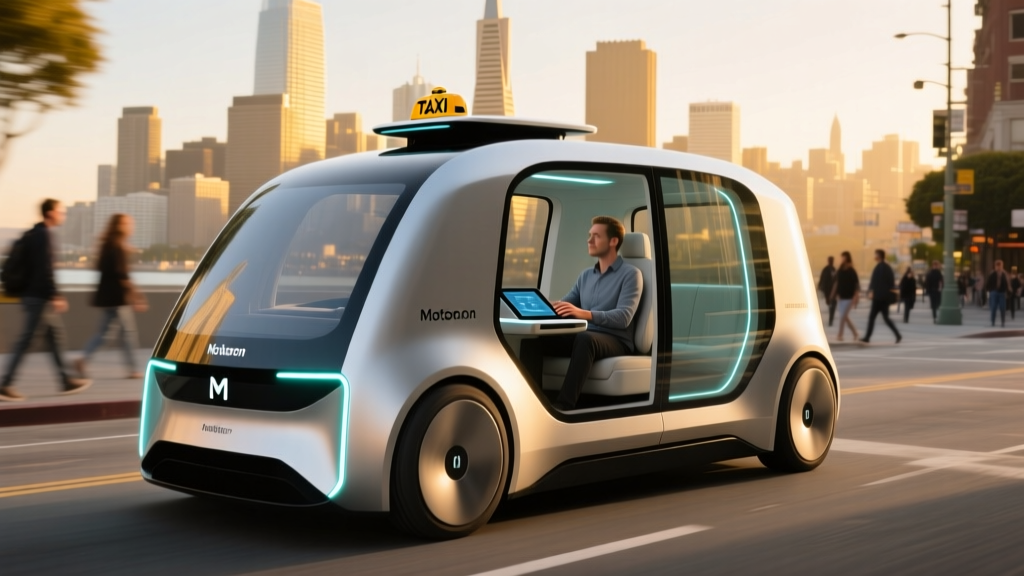
Motional — the autonomous vehicle joint venture between Hyundai Motor Group and Aptiv — has been one of the quieter players in the robotaxi space compared to Waymo and Cruise. But the company's Ioniq 5-based autonomous test fleet has logged significant miles in several U.S. cities, including San Francisco. If you've been searching for an honest assessment of how to evaluate the autonomous-vehicles company Motional on robotaxi San Francisco operations, this guide breaks down exactly where the service stands in 2026: autonomy level, service availability, safety data, technology stack, pricing, and the limitations you need to know before hailing a ride.
What Is Motional and What Autonomy Level Does It Operate At?
Motional was formed in 2020 as a 50/50 joint venture between Hyundai and Aptiv (formerly Delphi). The company develops Level 4 autonomous driving systems — meaning the vehicle handles all driving tasks within a defined operational design domain (ODD) without any human driver behind the wheel. This is a critical distinction from consumer systems like Tesla's FSD (Supervised) or GM's Super Cruise, which remain SAE Level 2 and require active driver engagement at all times.
| Level | Description | Example |
|---|---|---|
| Level 2 | Driver assist — human must monitor and intervene | Tesla Autopilot/FSD Supervised, BlueCruise, Super Cruise |
| Level 3 | Conditional automation — human on standby | Mercedes Drive Pilot (limited markets, low speed) |
| Level 4 | High automation — no driver needed within geofenced ODD | Waymo, Motional, Zoox (robotaxi services) |
| Level 5 | Full automation — any road, any condition | Does not exist commercially |
Motional's robotaxi fleet operates at SAE Level 4 within mapped, geofenced urban corridors. A remote safety operator monitors the fleet but is not physically in the vehicle during driverless operations.
Where Can You Use Motional's Robotaxi in San Francisco?
Motional's commercial footprint has evolved considerably. As of early 2026, the company's driverless robotaxi service availability is limited and has shifted through several partnership models — most notably a prior integration with Lyft in select markets. Here is where Motional has operated or announced operations:
| City | Status (2026) | Service Model | Notes |
|---|---|---|---|
| San Francisco, CA | Testing / Limited pilot | Invite-only / partner app | Geofenced to specific neighborhoods; not open public hail |
| Las Vegas, NV | Most mature market | Lyft integration (previously) | Longest-running test operations; Strip and downtown corridors |
| Boston, MA | Testing | Closed testing fleet | Historical test market since early development |
| Pittsburgh, PA | Testing | Closed testing fleet | Expanded operations area in recent years |
| Santa Monica, CA | Testing | Limited pilot | Part of LA-area validation |
The honest answer for San Francisco: Motional is not operating an open, public robotaxi service in San Francisco as of 2026. Unlike Waymo, which has open commercial robotaxi service across large portions of SF, Motional's SF presence remains limited to testing and invite-only pilot programs. You cannot currently open an app and hail a Motional robotaxi the way you would a Waymo in SF or Phoenix. For the latest on California robotaxi permits, the California Public Utilities Commission (CPUC) maintains the official list of approved driverless deployment permits.
Technology Stack: What Powers Motional's Ioniq 5 Robotaxi?
Motional's current-generation robotaxi is built on the Hyundai Ioniq 5 platform — a battery-electric crossover with an 800V architecture and a ~77.4 kWh usable battery (NMC chemistry). The autonomous sensor suite is significantly more complex than anything in a consumer vehicle:
Motional Sensor and Compute Stack
- LiDAR: Multiple solid-state and spinning LiDAR units providing 360° 3D point-cloud mapping — this is a lidar-first approach, unlike Tesla's camera-only FSD architecture.
- Cameras: A surround-view array of high-resolution cameras for object classification, traffic-light recognition, and lane detection.
- Radar: Forward and corner radar units for velocity detection and redundancy in low-visibility conditions (rain, fog).
- Ultrasonic sensors: Short-range proximity detection for low-speed maneuvers and docking.
- HD Mapping: Pre-built centimeter-accurate maps of the geofenced operational area, updated regularly. The vehicle localizes within this map in real time.
- Compute: Custom high-performance computing platform running Motional's proprietary perception, prediction, and planning stack, with redundant systems for fail-safe operation.
- Remote Assistance: Fleet-level remote operators who can provide high-level guidance (not direct driving) when the system encounters an ambiguous scenario.
The reliance on lidar + HD maps is a philosophical divergence from Tesla's vision-only approach. The trade-off: Motional's system is more robust in edge cases involving unusual objects or poor lighting, but it is also more expensive per vehicle and requires extensive pre-mapping of every operational zone. This is why Level 4 robotaxis scale city by city, not overnight nationwide.
Safety Record: What the Data Shows
Evaluating robotaxi safety requires looking at concrete metrics — not marketing claims. Motional has published some data through its safety framework reports, and California DMV disengagement reports provide additional transparency for operations within the state.
Motional Safety Data Points (as available through 2025-2026)
- Autonomous miles driven (all markets): Motional has reported over 2 million autonomous miles across its test fleet cumulatively, though this is substantially less than Waymo's 30+ million driverless miles.
- At-fault collisions: Motional has reported zero at-fault collisions during driverless operations in its published safety reports. However, the smaller fleet size and more limited operational area mean the statistical sample is far smaller than competitors.
- California DMV disengagement reports: Manufacturers operating autonomous test vehicles in California must report miles driven and the number of disengagements (instances where a safety driver had to take control). Motional's disengagement rate has improved over successive reporting periods but remains higher per-mile than Waymo's, reflecting a smaller operational scale and more conservative thresholds for handoff.
- No passenger injuries reported in Motional robotaxi operations as of available public records.
Sources: California DMV Autonomous Vehicle Disengagement Reports, Motional Safety Framework publications.
Context matters: Waymo has operated millions of driverless miles with a documented safety record that the National Highway Traffic Safety Administration (NHTSA) and independent researchers have analyzed. Motional's smaller dataset makes definitive safety comparisons premature. A smaller fleet with fewer miles doesn't mean less safe — but it does mean less statistically proven.
Pricing: Motional vs. Uber, Lyft, and Waymo
Because Motional does not currently operate a public commercial robotaxi service in San Francisco, there is no standard consumer pricing to compare. However, we can contextualize how robotaxi pricing generally compares to traditional rideshare in SF:
| Service | Estimated Cost (3-mile SF trip) | Availability | Notes |
|---|---|---|---|
| UberX | $12–$18 | Citywide | Surge pricing during peak hours |
| Lyft Standard | $11–$17 | Citywide | Wait times vary by neighborhood |
| Waymo (SF) | $10–$16 | Large SF geofence | Comparable to rideshare; no tipping |
| Motional (SF) | N/A — no public service | Invite-only pilot | Pilot rides have been offered free or heavily subsidized |
In markets where Motional previously offered rides through Lyft (Las Vegas), the pricing was typically subsidized or comparable to standard Lyft rates to encourage adoption. Robotaxi companies universally subsidize early commercial operations — the true long-term unit economics (vehicle cost, sensor depreciation, remote operator overhead, charging) are still being worked out industry-wide.
Regulatory Landscape: Who Approves Robotaxi Operations?
Operating a driverless robotaxi in San Francisco requires navigating a multi-layer regulatory framework:
- California DMV: Issues testing permits and requires annual disengagement reports. A separate "Driverless Testing" permit is required before removing the safety driver.
- California Public Utilities Commission (CPUC): Regulates commercial passenger service. Companies must obtain a Deployment Permit to charge fares for driverless rides. The CPUC has granted such permits to Waymo and previously to Cruise (suspended after the October 2023 incident, later reinstated with conditions).
- San Francisco Municipal Transportation Agency (SFMTA): Manages local street access, pick-up/drop-off zones, and coordination with city services.
- NHTSA (Federal): Sets vehicle safety standards and investigates incidents. Currently, there is no federal framework specifically for robotaxi licensing — it remains largely a state-by-state patchwork.
Motional, as of 2026, has not received a CPUC Deployment Permit for open commercial service in San Francisco. This is the single biggest regulatory gap between Motional and Waymo in the SF market. For current permit status, the CPUC Autonomous Vehicle Programs page is the authoritative source.
Current Limitations: What Motional's Robotaxi Cannot Do
Honest Limitations of Motional's Level 4 System
- Geofenced only: The vehicle operates exclusively within pre-mapped corridors. Request a destination outside the geofence and the ride simply cannot be fulfilled.
- Weather constraints: Heavy rain, fog, or unusual road conditions (construction reroutes, emergency vehicle interactions) can cause the system to pull over safely and request remote assistance or end the trip.
- No highway operations (in most areas): Level 4 robotaxis in urban SF and Las Vegas operate primarily on surface streets at speeds under 45 mph. Highway merging and high-speed lane changes remain outside the typical ODD.
- Edge-case conservatism: Unusual scenarios — a person in a costume, an overturned truck, a parade route — may cause the vehicle to stop and wait rather than navigate creatively. This is a safety feature, not a bug, but it means trips can take longer than a human driver would.
- Limited fleet size: Even in its most mature market (Las Vegas), Motional's fleet is measured in dozens of vehicles, not hundreds. Wait times and availability are correspondingly limited.
- Not available for public hail in SF: As noted, San Francisco remains a testing market — there is no consumer app integration for open robotaxi rides.
How Does Motional Compare to Waymo and Other Robotaxi Operators?
If you're evaluating robotaxi options in San Francisco specifically, the competitive landscape looks like this:
| Factor | Waymo | Motional | Zoox (Amazon) |
|---|---|---|---|
| SF Public Service | Yes — open commercial | No — testing/pilot only | Limited testing; no public SF service |
| Vehicle Platform | Jaguar I-PACE (custom 6th-gen) | Hyundai Ioniq 5 (BEV) | Custom Zoox purpose-built vehicle |
| Sensor Approach | LiDAR + cameras + radar | LiDAR + cameras + radar | LiDAR + cameras + radar (symmetrical) |
| Cumulative Driverless Miles | 30+ million | ~2+ million (all modes) | Not publicly disclosed at scale |
| CPUC Deployment Permit | Yes | No | No |
| Expansion Cities | Phoenix, LA, Austin, expanding | Las Vegas (primary) | Las Vegas, Foster City (testing) |
The gap between Waymo and Motional in San Francisco is significant. Waymo has a multi-year head start on commercial driverless operations, CPUC approval, and a fleet that serves thousands of rides per week across the city. Motional's strengths lie in its Hyundai manufacturing partnership (potential for lower per-unit vehicle cost at scale) and its Aptiv integration expertise — but these advantages have not yet translated to an open SF service.
Frequently Asked Questions
Is Motional's robotaxi truly self-driving or is there a driver?
In its driverless pilot operations, Motional's Ioniq 5 robotaxi operates at SAE Level 4 — no human driver is behind the wheel within the geofenced operational area. A remote fleet operator monitors the vehicle and can provide high-level guidance if the system encounters an unusual scenario, but they do not directly steer or brake the vehicle in real time. This is fundamentally different from Level 2 consumer systems (Tesla FSD, BlueCruise) where a human driver must remain attentive and ready to take over at any moment.
Where can I ride a Motional robotaxi right now?
As of 2026, there is no open public Motional robotaxi service in any city. Motional's most advanced operations are in Las Vegas, where previous Lyft-integrated rides were available to select users. San Francisco, Boston, and Pittsburgh remain testing markets. If you're in SF and want a robotaxi today, Waymo is the only service with open commercial availability.
How much does a Motional robotaxi ride cost vs. Uber or Lyft?
Because Motional does not offer public commercial rides, there is no published consumer fare. In prior Lyft-integrated pilots, rides were typically subsidized — often matching or undercutting standard Lyft pricing. Industry-wide, robotaxi fares aim to match rideshare rates (roughly $1.50–$3.00 per mile in SF) while eliminating the driver's share of the fare. Long-term, the economics depend on reducing per-vehicle sensor and compute costs.
How safe are Motional robotaxis compared to human drivers?
Motional has reported zero at-fault collisions in driverless operations, but the total driverless mileage is significantly lower than Waymo's, making statistical comparison difficult. The California DMV disengagement data shows Motional's intervention rate has improved but remains higher per-mile than the most mature operators. Robotaxis eliminate human risks like distraction, impairment, and fatigue, but they can struggle with edge cases that a human driver would handle intuitively.
What are the biggest limitations of Motional's system today?
The key limitations are: (1) no open commercial service in San Francisco or any city; (2) strict geofencing — the vehicle cannot travel outside pre-mapped corridors; (3) weather sensitivity — heavy rain or fog can limit operations; (4) conservative edge-case handling that may cause unexpected stops; and (5) a small fleet size that limits availability even in test markets.
Will Motional launch a public robotaxi service in San Francisco?
Motional has signaled intent to expand commercial operations, but no firm timeline for open SF service has been announced. The company would need to obtain a CPUC Deployment Permit and scale its fleet substantially. Hyundai's manufacturing backing gives Motional a potential advantage in fleet scaling, but regulatory approval and proven safety data at scale are prerequisites. Any announced timelines should be treated as targets, not guarantees.
Bottom Line: Should You Count on Motional in San Francisco?
If you're researching robotaxi options in San Francisco in 2026, Motional is a legitimate Level 4 autonomous vehicle developer with real technology, a credible Hyundai-Aptiv backing, and a growing test dataset. But it is not an available consumer service in SF. For riders who want a driverless experience today, Waymo remains the only proven, commercially available option in the city. Motional's path to open SF service requires CPUC permitting, fleet scaling, and significantly more public driverless miles to build the statistical safety case that regulators and consumers demand. We'll update this evaluation as Motional's operational status evolves.