If you've searched for a Mercedes-Benz self-driving car, you've likely found a tangle of marketing terms, YouTube demos, and conflicting headlines. The reality in 2026 is nuanced: Mercedes-Benz is one of the few automakers to legally certify a Level 3 automated driving system for public roads, but it operates under strict conditions that look nothing like a Waymo robotaxi pulling up to your curb without a driver.
This guide separates what Mercedes-Benz actually sells today — the DRIVE PILOT system available on the EQS and S-Class — from what remains in development, what the regulations allow, and how the technology stacks up against Level 4 robotaxi services and Level 2 driver-assist competitors.
Where Mercedes-Benz Autonomy Actually Stands: The SAE Level Breakdown
Understanding any "self-driving" claim requires grounding in the SAE International J3016 framework, which defines six levels of driving automation. Mercedes-Benz currently offers systems at two distinct levels, and confusing them is the single most common mistake in coverage of the brand.
| Level | Name | Who Drives? | Mercedes-Benz Product |
|---|---|---|---|
| Level 2 | Partial Automation | Driver must monitor at all times | DRIVE PILOT (standard adaptive cruise + lane centering), Active Lane Change |
| Level 3 | Conditional Automation | System drives; driver must take over when requested (with ~10 sec warning) | DRIVE PILOT Level 3 (certified; EQS & S-Class) |
| Level 4 | High Automation | No driver needed within operational design domain | Not available in consumer Mercedes-Benz vehicles |
| Level 5 | Full Automation | No driver, no steering wheel needed, anywhere | Does not exist in production anywhere |
DRIVE PILOT Level 3: The System You Can Actually Buy
Mercedes-Benz DRIVE PILOT (Level 3) is the company's certified conditional-automation system. It is not a robotaxi. It is a feature you purchase as an option on a personal vehicle, and its operational design domain (ODD) — the specific conditions under which it can engage — is narrow.
Where You Can Use DRIVE PILOT Level 3 Today
As of 2026, DRIVE PILOT Level 3 is legally approved for use in the following regions, on suitable divided highways:
- Germany: Approved since 2022 on Autobahn sections with physical median separation, up to 60 km/h (37 mph). Expanded routes added through 2025.
- United States — Nevada: Approved in late 2023 for specific Interstate corridors (primarily I-15 between Las Vegas and the California border, and sections of I-215) at speeds up to 40 mph in congested traffic.
- United States — California: Regulatory approval granted in late 2024; deployment on designated freeways in the Bay Area and Los Angeles metro began in 2025, also limited to 40 mph in traffic.
Outside these approved corridors, the car defaults to its Level 2 DRIVE PILOT system, which requires full driver attention.
Conditions Required for Level 3 Engagement
The system will not engage — and will disengage — if any of the following are not met:
- Vehicle speed must be 40 mph (60 km/h) or below
- Road must be a divided highway with physical median barrier (mapped and verified via HD maps)
- Daytime only; no engagement at night or in tunnels without sufficient lighting
- Weather must be clear to light rain — no heavy rain, snow, fog, or ice
- Driver must be detected in the driver's seat, belted, eyes open (even though they need not watch the road)
- Preceding vehicle must be detected (system is designed for traffic-jam assist, not free-flow driving)
How DRIVE PILOT Compares to Robotaxi Services and Competing Level 2 Systems
Buyers researching a Mercedes-Benz self-driving car often conflate three very different products. Here's how they stack up:
| Attribute | Mercedes DRIVE PILOT (Level 3) | Tesla FSD Supervised (Level 2) | Waymo One (Level 4 Robotaxi) |
|---|---|---|---|
| SAE Level | Level 3 (certified) | Level 2 (driver must supervise) | Level 4 (no driver in geofenced area) |
| Eyes off road allowed? | Yes, under ODD conditions | No — driver must monitor | N/A — no driver seat |
| Liability in a crash | Mercedes-Benz accepts liability when Level 3 is properly engaged | Driver is liable | Waymo/Alphabet is liable |
| Operational speed | Up to 40 mph (traffic jams) | Any speed, any road (driver supervision) | Up to ~65 mph within geofence |
| Availability | NV, CA (US); Germany — personal vehicle option | Nationwide — personal vehicle option | Phoenix, SF, LA, Austin (rideshare model) |
| Cost to consumer | ~$2,500 option + $2,500/year subscription (US pricing) | $8,000 one-time or $99/month | Per-ride pricing (comparable to Uber/Lyft) |
The Technology Stack: Lidar, Cameras, and HD Maps
Mercedes-Benz DRIVE PILOT Level 3 uses a sensor-fusion approach — fundamentally different from Tesla's camera-only ("Tesla Vision") strategy and closer to Waymo's multi-sensor stack, though at a different scale.
DRIVE PILOT Level 3 Sensor Suite
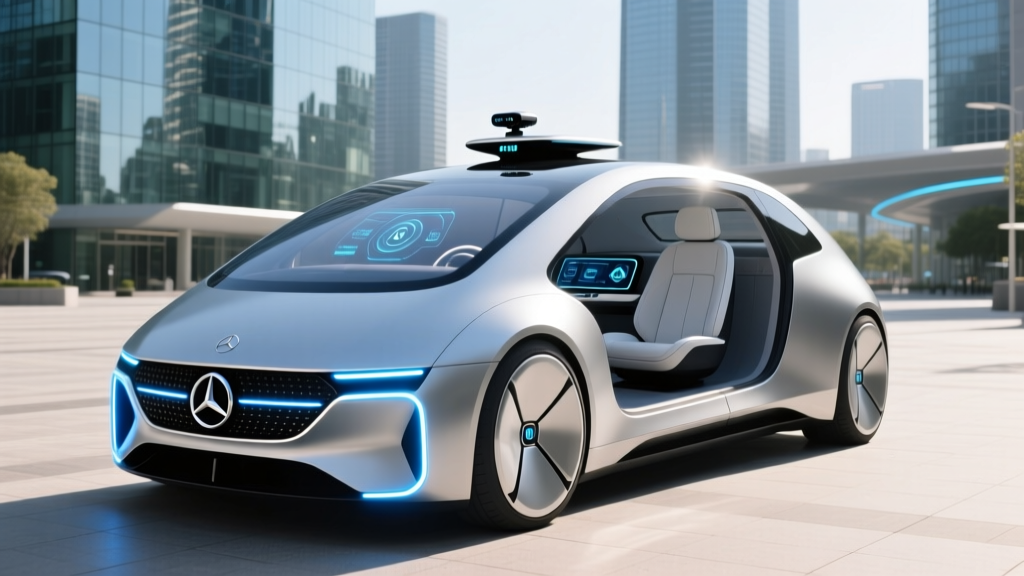
- Lidar: One long-range lidar unit (roof-mounted, behind windshield) providing 3D point-cloud mapping up to ~200 meters
- Cameras: Multiple surround-view cameras (front stereo pair, side, rear) for lane detection, sign recognition, and object classification
- Radar: Front and rear millimeter-wave radar for vehicle tracking and blind-spot monitoring
- Ultrasonic sensors: Short-range proximity detection (parking, low-speed cut-ins)
- Rear-window camera: Dedicated sensor monitoring the driver's state (head position, eye state)
- HD Maps: Pre-scanned centimeter-accurate maps of approved routes, continuously updated via cellular connection
- Redundant actuators: Dual steering and braking systems — if one fails, the other maintains control until the car can safely stop
The reliance on HD maps is both the system's strength and its constraint. Maps allow the car to "know" the road geometry, lane counts, and merge points ahead of time — enabling the legal liability transfer to Mercedes-Benz. But maps also mean the system literally cannot operate on unmapped roads, which is why expansion is measured in specific Interstate corridors, not entire states.
Safety Record: What the Data Shows
Evaluating the safety of the Mercedes-Benz self-driving car requires separating Level 3 DRIVE PILOT data from the broader fleet data of Level 2 systems.
DRIVE PILOT Level 3 Safety Data (through 2025)
- At-fault collisions while Level 3 engaged: Zero reported incidents (per Mercedes-Benz and NHTSA filings)
- Total miles driven under Level 3: Estimated low millions (exact fleet-wide figure not publicly disclosed; Mercedes-Benz reports internal validation of 15+ million test miles pre-certification)
- System-requested takeovers: Average 1–3 per hour of Level 3 operation, typically due to ODD exit (speed increasing above 40 mph, weather change, road construction)
- NHTSA Standing General Order compliance: Mercedes-Benz files incident reports for any ADS-involved crash; no Level 3-specific incidents reported in public NHTSA data as of early 2026
Sources: NHTSA Standing General Order, Mercedes-Benz Group press releases
For context, Waymo's Level 4 fleet has logged over 50 million fully driverless miles (as of late 2025) with a documented at-fault crash rate significantly below the human average per Waymo's published safety reports. DRIVE PILOT's much smaller deployment footprint makes direct statistical comparison premature, but the zero-incident record to date is consistent with the narrow ODD and conservative engagement rules.
Regulatory Landscape: Who Approves a Self-Driving Mercedes?
The path from "Mercedes built it" to "you can legally use it on I-15" involves multiple regulatory bodies:
- Germany (KBA — Kraftfahrt-Bundesamt): Federal Motor Transport Authority certifies Level 3 systems under UN Regulation 157 (ALKS — Automated Lane Keeping System), amended in 2022 to allow up to 60 km/h. Mercedes-Benz was the first OEM to receive KBA certification.
- United States — Federal (NHTSA): Does not "approve" ADS features pre-market but requires reporting via Standing General Order and retains recall authority. Mercedes-Benz self-certifies compliance with FMVSS standards.
- United States — State (Nevada DMV, California DMV/CPUC): State-level approval is the practical gate. Nevada's autonomous vehicle testing framework allowed DRIVE PILOT deployment in 2023. California required separate DMV deployment permit (granted 2024) and coordination with the CPUC for any commercial service model.
The patchwork nature of US state regulation is why a feature certified in Germany in 2022 took until 2025 to reach meaningful US roads. Each state requires separate testing documentation, incident-reporting agreements, and in some cases insurance minimums beyond personal auto policies.
Current Limitations: What the Mercedes-Benz Self-Driving Car Cannot Do
The gap between marketing language and operational reality is where buyer disappointment happens. Here is an honest inventory of what DRIVE PILOT Level 3 cannot do in 2026:
- No highway-speed autonomy: 40 mph cap means the system is traffic-jam assist, not a highway chauffeur. Above 40 mph, the car reverts to Level 2 and you must watch the road.
- No night driving: System will not engage after dark in the US (Germany has begun limited nighttime testing on select routes, but US deployment remains daytime-only).
- No adverse weather: Heavy rain, snow, fog, and icy road conditions all prevent engagement. In practice, this means DRIVE PILOT Level 3 is a fair-weather, daytime, rush-hour feature.
- No unmapped roads: If the HD map doesn't cover the corridor — including many Interstate rest areas, construction-zone reroutes, and newly built freeways — Level 3 will not engage.
- No lane changes: Level 3 DRIVE PILOT maintains the current lane. It does not change lanes, exit, or merge. Active Lane Change is a Level 2 feature requiring driver confirmation.
- No point-to-point navigation: This is not a robotaxi. You cannot set a destination and nap. You remain in the driver's seat and must resume control when asked.
- Vehicle price barrier: The feature requires an EQS ($105,000+ MSRP) or S-Class ($115,000+ MSRP), plus the ~$2,500 hardware option and annual subscription fee.
If your use case is "I want a car that drives me from my house to the airport while I sleep," neither DRIVE PILOT nor any production Mercedes-Benz vehicle offers this in 2026. That capability remains the domain of Level 4 robotaxi services in their limited geofenced cities.
Is Mercedes-Benz Developing a True Level 4 Robotaxi?
Mercedes-Benz has invested in Level 4 partnerships rather than building a consumer robotaxi in-house. The company previously partnered with Bosch on a Level 4 pilot in San Jose (concluded in 2022 without commercial launch) and has collaborated with Motional (the Hyundai/Aptiv joint venture) on Level 4 fleet testing using Mercedes vehicles.
As of 2026, Mercedes-Benz's stated strategy is to expand the Level 3 DRIVE PILOT ODD — higher speeds (targeting 130 km/h / 80 mph on Autobahn), broader weather tolerance, and more mapped corridors — rather than launch a consumer Level 4 vehicle. The company has not announced a production Level 4 Mercedes for personal ownership.
Should You Buy a Mercedes-Benz for Its Self-Driving Tech?
The decision framework depends on what you actually want from the vehicle:
Choose the EQS or S-Class with DRIVE PILOT Level 3 if:
- You commute daily on approved Interstate corridors in Nevada or California (or live in Germany)
- Your commute includes predictable stop-and-go traffic under 40 mph
- You value the legal liability transfer — Mercedes-Benz accepts responsibility when Level 3 is properly engaged
- You want a luxury EV (EQS) or flagship sedan (S-Class) regardless of autonomy features
Look elsewhere if:
- You want a car that drives itself on surface streets, at night, or in rain — no production vehicle offers this
- You want a robotaxi experience without ownership — Waymo One (in Phoenix, SF, LA, Austin) is the only scaled option
- Your budget is under $100,000 — the DRIVE PILOT Level 3 hardware is not available on Mercedes-Benz's more affordable EQE or GLB EV lines
- You live outside NV, CA, or Germany — the Level 3 feature will be dormant in your state, and you'll effectively have a Level 2 vehicle
Frequently Asked Questions
Where can I use the Mercedes-Benz self-driving car right now?
DRIVE PILOT Level 3 is legally usable on designated divided highways in Nevada (I-15, I-215 corridors), California (approved Bay Area and LA freeways, expanding), and Germany (select Autobahn sections). Outside these zones, the car operates as a Level 2 driver-assist vehicle requiring full driver attention.
How much does DRIVE PILOT Level 3 cost?
In the US, the Level 3 hardware package is approximately $2,500 as a vehicle option, with an ongoing subscription of roughly $2,500 per year. This is in addition to the vehicle's base MSRP ($105,000+ for EQS, $115,000+ for S-Class). By comparison, a Waymo robotaxi ride costs roughly $1.10–$1.40 per mile with no ownership commitment.
How safe is the Mercedes-Benz DRIVE PILOT system?
Through early 2026, Mercedes-Benz and NHTSA data show zero at-fault collisions while DRIVE PILOT Level 3 was engaged. The system has accumulated millions of real-world miles, though far fewer than Waymo's 50+ million driverless miles. The narrow operating conditions (low speed, mapped roads, daytime, clear weather) contribute significantly to this record.
Is DRIVE PILOT truly self-driving, or is it driver-assist?
It is Level 3 conditional automation — a middle ground. The system drives the car and accepts liability when engaged, and you may legally look away from the road. But you must remain in the driver's seat and be ready to take over within ~10 seconds. It is not "self-driving" in the Level 4/5 sense of a driverless vehicle.
What are the biggest limitations of the system?
The 40 mph speed cap, daytime-only operation, no adverse-weather use, and dependency on pre-mapped highways are the most significant. The system also cannot change lanes or exit the highway autonomously. It is best understood as a traffic-jam chauffeur, not a replacement for an attentive driver in all conditions.
Can I get DRIVE PILOT Level 3 on the EQE, GLC, or other Mercedes models?
No. As of 2026, Level 3 DRIVE PILOT is available only on the EQS sedan and S-Class. The hardware (including the roof-mounted lidar) and software certification are specific to these platforms. Other Mercedes models receive Level 2 DRIVE PILOT (adaptive cruise + lane centering), which requires continuous driver supervision.
Specifications and regulatory status reflect model-year 2026 and current state/federal approvals as of publication. Always verify DRIVE PILOT availability and corridor maps via your local Mercedes-Benz dealer and state DMV before purchase. SAE level definitions per SAE International J3016.