Mercedes-Benz has taken a different path to autonomous driving than Tesla or Waymo. Instead of chasing a fully driverless robotaxi fleet, the German automaker has focused on certifying production vehicles where the driver can legally take their hands off the wheel, eyes off the road, under specific conditions. That system, called Drive Pilot, is the world's first internationally certified Level 3 conditional driving system. But as of 2026, Mercedes is also deepening its robotaxi ambitions through partnerships and testing of Level 4 platforms.
This guide breaks down exactly what the Mercedes-Benz driverless car lineup looks like today — what's available to buy, what's in testing, where you can use it, and what the safety and technology data actually shows.
SAE Automation Levels: Where Mercedes-Benz Sits
Before evaluating any autonomous system, you need the SAE International framework. Most consumer confusion stems from conflating Level 2 driver-assist with genuine self-driving capability. Mercedes operates at multiple levels simultaneously.
| SAE Level | Name | Driver Role | Mercedes System | Availability |
|---|---|---|---|---|
| Level 1 | Driver Assistance | Hands on, eyes on | Active Distance Assist DISTRONIC | All current models |
| Level 2 | Partial Automation | Hands on (briefly off), eyes on | Drive Pilot (Level 2 variant, US) | EQS, S-Class, EQE |
| Level 3 | Conditional Automation | Hands off, eyes off (system's request to resume) | Drive Pilot 60 / Drive Pilot 95 | Germany, Nevada, California (limited) |
| Level 4 | High Automation | No driver needed in geofenced area | Robotaxi test fleet (with partners) | Testing only — not public |
| Level 5 | Full Automation | No driver, any condition | None (industry-wide) | Not available anywhere |
Drive Pilot 60 and Drive Pilot 95: The Level 3 Systems You Can Buy
Mercedes-Benz Drive Pilot is not a single product — it's an evolving platform. Here's what's shipping in 2026:
Drive Pilot 60 (Level 3)
Originally launched on the 2024 S-Class and EQS in Germany and later approved in Nevada and California, Drive Pilot 60 allows the driver to fully disengage from driving at speeds up to 60 km/h (37 mph) on suitable divided highways during heavy traffic. When engaged, the driver can watch streaming video on the central display — a first for a production vehicle sold in the US.
- Max operational speed: 37 mph (60 km/h)
- Road type: Divided highways with mapped routes
- Conditions: Daytime, clear weather, dry roads
- Driver requirement: Must be seated, awake, ready to resume within ~10 seconds of system prompt
- Liability: Mercedes-Benz assumes liability for accidents caused by the system while engaged
Drive Pilot 95 (Level 3 — Expanded)
Announced for the 2025 model year and expanding into 2026 models, Drive Pilot 95 raises the operational speed to 95 km/h (59 mph), covering a far broader range of highway scenarios. Initially available in Germany on the S-Class and EQS, Mercedes has indicated US regulatory submissions are underway, though approval timelines vary by state.
- Max operational speed: 59 mph (95 km/h)
- Expanded scenarios: Higher-speed highway cruising, not just stop-and-go
- Same liability model: Mercedes accepts responsibility when system is active
Technology Stack: Sensors, Lidar, and HD Mapping
Unlike Tesla's camera-only approach, Mercedes-Benz Drive Pilot uses a redundant, multi-sensor architecture. This is a deliberate engineering choice: Level 3 certification requires the system to handle all driving tasks within its operational design domain (ODD) without relying on the driver as a fallback.
Mercedes Drive Pilot Tech Stack
- Lidar: Long-range lidar sensor (roof-mounted, integrated into the windshield area) for 3D environment mapping up to ~200 meters
- Cameras: Multiple surround-view cameras for lane detection, traffic sign recognition, and object classification
- Radar: Front and rear radar units for distance measurement and object tracking in poor visibility
- Ultrasonic sensors: Short-range proximity detection
- Rear-window camera: Monitors vehicles approaching from behind
- Moisture sensors: Detect road surface wetness to assess condition suitability
- HD Map: Pre-scanned centimeter-precision 3D maps of approved highway segments — the system will not engage outside mapped zones
- Driver monitoring: Interior camera tracks head position and eye state to confirm readiness
- Redundant computing: Dual independent processing units; if one fails, the other maintains safe operation
- Redundant braking & steering: Backup actuators ensure the vehicle can stop safely even in partial system failure
This sensor-fusion approach is more expensive than camera-only systems but provides the redundancy needed for regulatory certification. Mercedes has stated publicly that the hardware cost for Drive Pilot adds several thousand dollars to the vehicle price, which is reflected in the option package pricing.
Where Can You Use Drive Pilot Right Now?
| Region | Status | System Version | Approved Roads |
|---|---|---|---|
| Germany | Live — purchasable | Drive Pilot 60 & 95 | ~13,191 km of Autobahn (mapped, divided highways) |
| Nevada, USA | Live — purchasable | Drive Pilot 60 | Designated divided highways (I-15, US-93 segments) |
| California, USA | Live — purchasable (limited) | Drive Pilot 60 | Select divided highways; DMV-approved routes |
| Other US States | Not approved | Level 2 fallback only | N/A — hands-on supervision required |
| China | Testing / regulatory review | Drive Pilot 60 | Beijing, Shanghai test zones |
The geofencing is strict. Drive Pilot will not engage unless the vehicle is on a pre-mapped highway segment, conditions are suitable (daytime, no heavy rain or snow, dry surface), and traffic is flowing within the speed threshold. If any parameter falls outside the operational design domain, the system prompts the driver to resume control with approximately 10 seconds of warning.
Mercedes-Benz Robotaxi Plans: Level 4 Testing and Partnerships
Beyond consumer Drive Pilot vehicles, Mercedes-Benz is pursuing Level 4 robotaxi development primarily through partnerships:
- Waymo partnership: Mercedes-Benz and Waymo have been integrating Waymo's Driver platform into Mercedes-Benz Sprinter vans for autonomous delivery and logistics, with passenger robotaxi testing on Mercedes chassis also underway.
- BMW collaboration: Mercedes and BMW previously explored joint autonomous driving development. While the formal partnership scaled back, both companies share insights on regulatory frameworks.
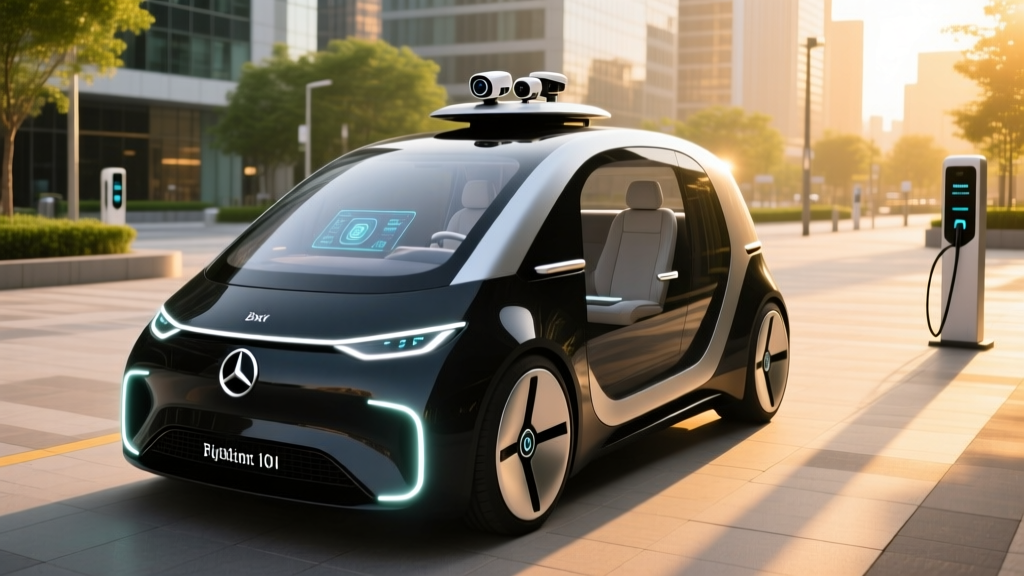
- In-house Level 4 testing: Mercedes operates test fleets in Germany, China, and the US using modified EQS and next-generation EVA2-platform vehicles equipped with enhanced sensor suites. These are not available for public rides.
As of 2026, there is no Mercedes-branded robotaxi service that consumers can hail in any city. If you want a driverless ride today, Waymo One (in Phoenix, San Francisco, Los Angeles, and Austin) remains the primary option in the US.
Safety Record and Regulatory Data
Because Drive Pilot Level 3 transfers liability to Mercedes-Benz, the company has been exceptionally cautious about operational boundaries. Here's what the data shows:
Drive Pilot Safety Data (2024–2026)
- Reported at-fault incidents with Drive Pilot Level 3 engaged: Zero public reports as of early 2026 (per Mercedes-Benz public statements and German KBA records)
- Operational miles: Mercedes has not published cumulative Level 3 engagement miles; independent estimates suggest tens of thousands of hours of real-world operation across German and US fleets
- Liability model: Mercedes-Benz accepts legal responsibility for system-caused accidents during Level 3 engagement — a first among production automakers
- NHTSA Standing General Order: Mercedes reports all Level 2+ and above incidents per NHTSA requirements; no Drive Pilot Level 3-specific crash reports have been flagged in public NHTSA databases as of early 2026
The clean safety record is partly a function of extreme conservatism: the system operates only in narrow, well-mapped, low-speed scenarios. This is not comparable to Waymo's millions of miles in complex urban environments, but it reflects a fundamentally different philosophy — certify a narrow ODD perfectly rather than attempt broad coverage prematurely.
Cost and Ownership: Drive Pilot Pricing
Drive Pilot is not a ride-hailing service — it's a vehicle feature. Here's what it costs:
| Item | Cost | Notes |
|---|---|---|
| Drive Pilot 60 option package | ~$5,000–$6,000 (US est.) | Available on EQS and S-Class; price varies by market |
| Drive Pilot 95 (Germany) | €5,000–€7,000 | Higher-speed version; US availability TBD |
| Subscription / ongoing fee | None announced | Unlike Tesla FSD, no recurring subscription as of 2026 |
| Vehicle base MSRP (EQS 450+) | ~$105,000 | Drive Pilot is an add-on, not standard |
| Vehicle base MSRP (S-Class S 500) | ~$118,000 | Drive Pilot available on select trims |
Compared to a robotaxi cost-per-ride model, Drive Pilot is an ownership feature. If you're comparing the economics of owning a Mercedes with Drive Pilot versus using Waymo robotaxis, the break-even depends entirely on your commute patterns and whether your route falls within the geofenced, low-speed highway corridors where Level 3 operates.
Current Limitations: What Drive Pilot Cannot Do
Hard Limitations of Mercedes-Benz Drive Pilot (Level 3)
- Speed ceiling: 37 mph (Drive Pilot 60) or 59 mph (Drive Pilot 95) — no highway cruising at 70+ mph
- Geofencing: Only pre-mapped divided highways; no surface streets, no rural roads, no unmapped highway segments
- Weather: Will not engage in heavy rain, snow, ice, fog, or nighttime conditions (Drive Pilot 60)
- Construction zones: System disengages and prompts driver takeover in active construction areas
- No lane changes: Drive Pilot maintains lane position; it does not perform autonomous lane changes on its own
- Driver monitoring: Interior camera tracks your face — if you look down for extended periods or close your eyes, the system issues escalating warnings and eventually performs an emergency stop
- No city driving: Intersections, traffic lights, pedestrians, and cyclists are outside the ODD
- State-by-state approval: Even in the US, only Nevada and California have approved Level 3 — crossing into Arizona means immediate downgrade to Level 2
These limitations are not bugs — they're the regulatory and engineering boundaries that make Level 3 certification possible. Mercedes has chosen to deliver a narrow but legally certified autonomous experience rather than a broad but uncertified one.
Frequently Asked Questions
Is the Mercedes-Benz driverless car actually self-driving?
Not in the Waymo sense. Mercedes Drive Pilot is Level 3 — the car drives itself under specific conditions (mapped highways, low speeds, clear weather), and the driver can legally disengage. But a human must be present, seated, and ready to resume. There is no Mercedes vehicle you can buy or ride in that operates without a driver at Level 4 in 2026.
How is Mercedes Drive Pilot different from Tesla Autopilot or FSD Supervised?
Tesla's Autopilot and FSD (Supervised) are Level 2 systems. The driver is always responsible, must monitor the road, and Tesla does not accept liability. Mercedes Drive Pilot at Level 3 means Mercedes accepts liability when the system is engaged, and the driver is legally permitted to look away from the road. The trade-off: Drive Pilot works in far fewer scenarios than FSD attempts to cover.
Can I buy a Mercedes with Drive Pilot in any US state?
You can purchase the vehicle with Drive Pilot hardware in any state, but Level 3 functionality only activates in Nevada and California where regulatory approval exists. In all other states, the system operates as Level 2 — requiring hands-on-wheel supervision at all times.
How much does a ride in a Mercedes robotaxi cost?
There is no Mercedes-branded robotaxi ride service available to the public in 2026. Drive Pilot is a feature you purchase as part of a vehicle, not a per-ride service. For driverless robotaxi rides, Waymo One charges rates comparable to Uber/Lyft (typically $0.90–$1.50/mile depending on city and demand).
What happens if Drive Pilot gets into an accident?
When Drive Pilot Level 3 is properly engaged within its ODD, Mercedes-Benz assumes legal liability for accidents caused by the system. This is a landmark shift from Level 2 systems, where the driver always bears responsibility. However, if the system prompted the driver to resume control and the driver failed to respond, liability may shift back to the driver.
Will Mercedes launch a full Level 4 robotaxi service?
Mercedes is testing Level 4 vehicles and partnering with Waymo, but has not announced a consumer-facing robotaxi service under the Mercedes brand. The company's stated strategy prioritizes certified Level 3 in production vehicles over speculative Level 4 timelines. Any Level 4 expansion will likely come through partnerships rather than a Mercedes-branded ride-hailing app.