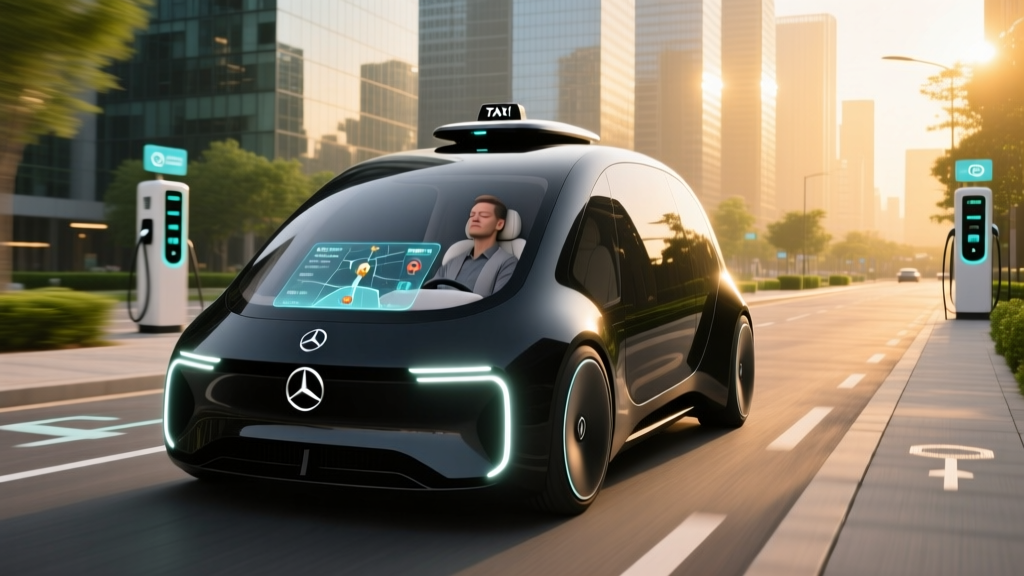
Mercedes-Benz is the first automaker to sell a certified Level 3 autonomous driving system to consumers in the United States. The company's Drive Pilot system, available on the 2026 S-Class and EQS sedans, allows drivers to legally hand over control of the vehicle under specific highway conditions — no hands on the wheel, no eyes on the road. This is a fundamentally different proposition than the Level 2 driver-assist systems sold by Tesla, Ford, and GM, where the driver remains legally responsible at all times.
But "autonomous" requires careful definition. Mercedes-Benz autonomous cars with Drive Pilot are not robotaxis. They cannot navigate city streets, handle construction zones, or operate in heavy rain. The system works within a tightly defined operational design domain (ODD), and understanding those boundaries is essential before spending six figures on the privilege.
What SAE Level Is Mercedes-Benz Drive Pilot?
Under SAE J3016, Level 3 means the vehicle performs all driving tasks — steering, acceleration, braking, and environmental monitoring — within its approved operational design domain. The driver may disengage from driving (no hands, no eyes) but must be prepared to resume control when the system issues a take-over request, typically with 10 seconds of warning. The manufacturer assumes liability for accidents that occur while Level 3 is actively engaged and operating within its ODD.
This is the critical distinction from Level 2 systems like Tesla Autopilot, GM Super Cruise, or Ford BlueCruise. Those are driver-assist features: the car helps, but you are driving. With Mercedes Drive Pilot at Level 3, the car is driving — and Mercedes accepts responsibility during valid engagement.
| Level | Name | Who Drives | Eyes Required | Examples |
|---|---|---|---|---|
| 0 | No Automation | Human | Yes | Standard vehicles |
| 1 | Driver Assistance | Human | Yes | Adaptive cruise control |
| 2 | Partial Automation | Human | Yes | Tesla Autopilot, Super Cruise, BlueCruise |
| 3 | Conditional Automation | System (limited) | No (within ODD) | Mercedes Drive Pilot |
| 4 | High Automation | System | No | Waymo, Zoox (geofenced robotaxis) |
| 5 | Full Automation | System | No | Not yet commercially available |
Where Can You Use Mercedes-Benz Autonomous Cars Today?
As of early 2026, Mercedes-Benz Drive Pilot is approved for use on approximately 1,300 miles of suitable divided highways in Nevada and California. Nevada was the first state to grant regulatory approval in January 2023, followed by California in late 2023 after the state DMV completed its autonomous vehicle testing certification.
| State | Status | Approved Road Miles | Regulatory Body |
|---|---|---|---|
| Nevada | Approved & Active | ~600 miles of divided highway | Nevada DMV |
| California | Approved & Active | ~700 miles of divided highway | CA DMV + CPUC |
| Germany | Approved (since 2022) | ~8,000 miles Autobahn | KBA (Federal Motor Transport Authority) |
| Other U.S. states | Pending / Under Review | — | Various |
The system activates only on pre-mapped, divided highways with physical median barriers, at speeds up to 40 mph (65 km/h). This makes it primarily a heavy-traffic commuting tool, not a high-speed cruiser. On the German Autobahn, Mercedes has tested at higher speeds, but U.S.-spec Drive Pilot remains capped at 40 mph pending further regulatory validation.
Drive Pilot is not a ride-hailing or robotaxi service. You purchase or lease the vehicle and use the system as the owner. There is no per-ride fee for Level 3 engagement, though Mercedes requires an annual subscription to maintain connectivity and HD map updates after the initial included period.
The Technology Stack Behind Drive Pilot
- LiDAR: 1 roof-mounted Valeo SCALA 3 long-range LiDAR (up to 200m range, 360° coverage) — Mercedes uses LiDAR as a core sensor, unlike Tesla's camera-only approach
- Cameras: Multiple stereo and surround cameras for lane detection, traffic-sign recognition, and object classification
- Radar: Front and rear long-range radar units for vehicle tracking and blind-spot monitoring
- Ultrasonic sensors: Close-proximity object detection for low-speed scenarios
- Rear-window camera: Monitors traffic approaching from behind
- HD Maps: Centimeter-precision pre-scanned maps of every approved highway segment, continuously updated via OTA
- Redundant computing: Dual NVIDIA DRIVE Orin SoCs running parallel perception stacks for fail-operational safety
- Redundant steering & braking: Duplicate actuators so the vehicle can safely stop itself even if one system fails
- Driver monitoring: Interior camera tracks head position and eye state; system issues take-over request if driver appears asleep or incapacitated
The reliance on LiDAR and HD maps is a deliberate engineering choice. Mercedes has stated publicly that camera-only systems cannot yet meet the safety validation requirements for Level 3 liability transfer. The pre-mapped approach means the vehicle "knows" the road geometry, lane configurations, and exit locations in advance — it is not discovering them in real time.
The trade-off is inflexibility. Any road segment not pre-mapped to Mercedes' precision standards cannot support Drive Pilot, and map updates require Mercedes to physically re-scan routes with specialized survey vehicles.
Pricing: What Does Drive Pilot Cost the Buyer?
Mercedes-Benz does not sell Drive Pilot as a standalone option on base trims. It is bundled into a premium package on the S-Class and EQS, which already carry premium MSRPs.
| Model | Base MSRP | Drive Pilot Package | Total with Drive Pilot | Annual Subscription (after Year 1) |
|---|---|---|---|---|
| S 580 Sedan | $120,500 | $2,500 | ~$123,000+ | $250/year |
| EQS 450+ Sedan | $105,550 | $2,500 | ~$108,050+ | $250/year |
| EQS 580 4MATIC | $120,300 | $2,500 | ~$122,800+ | $250/year |
Because these vehicles exceed the IRS §30D MSRP cap of $55,000 for sedans, the federal EV tax credit does not apply to any Drive Pilot-equipped Mercedes, regardless of buyer income or battery sourcing. This is purely a premium ownership proposition.
Unlike Waymo or Cruise robotaxi rides, there is no per-mile or per-trip charge. Once you own the car and maintain the subscription, you can engage Drive Pilot as often as conditions allow at no additional cost.
Safety Record: What the Data Shows
- U.S. customer fleet size: Estimated ~2,000–3,000 Drive Pilot-equipped vehicles on American roads (Nevada + California)
- Reported at-fault incidents while Level 3 engaged: Zero publicly documented collisions attributed to Drive Pilot system failure in the U.S. as of early 2026
- German operations (since 2022): Mercedes has reported no Level 3 at-fault incidents across approximately 2+ years of customer use on approved Autobahn segments
- Take-over request frequency: Mercedes has not published aggregate intervention-rate data; the company states the system is designed for "millions of miles" of validation before public deployment
- NHTSA oversight: All Level 3 and above systems are subject to NHTSA's Standing General Order requiring crash reporting within 24 hours for incidents involving ADS-equipped vehicles
The safety data is limited by the small deployment scale. With only a few thousand vehicles operating under narrow conditions (under 40 mph, divided highways, clear weather), the exposure is low compared to Waymo's millions of urban robotaxi miles. Mercedes' approach minimizes risk by minimizing the operational design domain — but it also means the system has not been stress-tested in the chaotic environments where most collisions occur.
Mercedes' liability commitment is significant: the company has publicly stated it will accept legal responsibility for accidents caused by Drive Pilot system failure while the system is properly engaged within its ODD. No U.S. court has yet tested this commitment in litigation.
Current Limitations: What Drive Pilot Cannot Do
- Speed above 40 mph: System will not activate; if traffic accelerates past 40 mph, it issues a 10-second take-over warning
- Rain: Moderate to heavy rain disables LiDAR reliability; system requires clear or lightly overcast conditions
- Snow and ice: Any snow accumulation on roads or sensors prevents engagement
- Fog: Reduced visibility below system threshold blocks activation
- Night driving: As of the 2026 U.S. spec, Drive Pilot operates only during daylight hours (sunrise to sunset)
- Construction zones: Pre-mapped HD data may be invalidated by lane shifts; system detects and disengages
- Non-divided roads: No oncoming traffic separation = no Level 3 engagement
- Tunnels longer than system threshold: GPS loss and LiDAR geometry issues cause disengagement
- Unmapped road segments: Any highway stretch not in Mercedes' HD map database is off-limits
- Driver not buckled: Seatbelt must be fastened for engagement
- Driver incapacitation detected: Interior camera monitors alertness; failure to respond to take-over request triggers hazard lights and controlled stop
These limitations are not bugs — they are the engineering boundary that makes Level 3 liability transfer possible. Mercedes is explicitly choosing to guarantee safety within a narrow domain rather than attempt broad capability with uncertain outcomes. For comparison, Waymo's Level 4 robotaxis handle city streets, rain, and night driving — but only within geofenced urban zones and with no human in the loop to fall back on.
Mercedes Drive Pilot vs. Level 2 Competitors
| Feature | Mercedes Drive Pilot (L3) | Tesla FSD Supervised (L2) | GM Super Cruise (L2) | Ford BlueCruise (L2) |
|---|---|---|---|---|
| SAE Level | Level 3 | Level 2 | Level 2 | Level 2 |
| Eyes off road | Yes (within ODD) | No | Yes (on approved roads) | Yes (on approved roads) |
| Hands off wheel | Yes | Yes | Yes | Yes |
| Driver liable | No (Mercedes liable) | Yes | Yes | Yes |
| Max speed | 40 mph | Posted limit | Posted limit | Posted limit |
| Road coverage | ~1,300 mi (2 states) | Any road | ~750,000 mi mapped | ~130,000 mi mapped |
| Weather limits | Strict (no rain/night) | Driver judgment | Moderate limits | Moderate limits |
| LiDAR | Yes | No (camera-only) | Yes (some models) | No |
| Cost | $2,500 + $250/yr | $8,000 or $99/mo | Included on trims | $2,100 + $75/yr |
The table makes the trade-off clear: Drive Pilot offers genuine legal autonomy transfer but in an extremely narrow envelope. Tesla FSD and GM Super Cruise cover vastly more roads at higher speeds, but the driver is always responsible. Which approach is "better" depends entirely on your commute pattern and risk tolerance.
The Regulatory Landscape for Autonomous Mercedes Vehicles
Level 3 autonomous driving in the United States exists in a patchwork regulatory environment. There is no single federal approval process for consumer Level 3 systems. Instead, manufacturers must seek approval state by state:
- Nevada: Requires manufacturer certification, proof of insurance, and compliance with Nevada Administrative Code Chapter 482A. The Nevada DMV issues autonomous vehicle testing and deployment licenses.
- California: Requires a DMV Autonomous Vehicle Deployment Permit plus separate CPUC authorization if operating any form of passenger service. Manufacturers must report disengagement data annually.
- NHTSA (Federal): Does not "approve" autonomous systems but enforces safety standards and mandates crash reporting through its Standing General Order for ADS-equipped vehicles.
Mercedes has indicated plans to expand Drive Pilot to additional states, but each expansion requires new regulatory filings, HD map validation, and in-state testing. There is no announced timeline for nationwide availability.
Is Drive Pilot the Future of Autonomous Driving?
Mercedes-Benz's approach represents one of two competing philosophies for bringing autonomy to consumers. The first — exemplified by Drive Pilot — starts with a tightly limited Level 3 system and gradually expands the operational design domain through additional sensor capabilities, higher speed approvals, and broader geographic mapping. Mercedes has previewed a future version capable of up to 65 mph on suitable highways, though no timeline has been confirmed.
The second philosophy — exemplified by Waymo and Tesla — pursues broad capability from the outset, either through geofenced Level 4 robotaxi zones (Waymo) or through iterative neural-network training on billions of real-world miles (Tesla). Each approach has distinct risk profiles and regulatory challenges.
For the 2026 buyer, Drive Pilot is a real, purchasable, certified Level 3 system — not a beta test, not a promise. But it is also a $120,000+ vehicle with a 40 mph speed ceiling and daylight-only, dry-weather-only operation. It solves a specific problem: stop-and-go highway commuting in Nevada and California. If that is your daily reality and the price is acceptable, no other production car offers the same legal autonomy transfer today.
Frequently Asked Questions
Is Mercedes-Benz Drive Pilot truly self-driving?
It is conditionally self-driving — SAE Level 3. Within its approved operational domain (divided highways, under 40 mph, clear weather, daytime, mapped routes in Nevada and California), the car handles all driving tasks and Mercedes assumes liability. Outside that domain, it is a conventional vehicle with Level 2 driver-assist features. It is not a robotaxi and cannot drive itself door-to-door.
Where can I use Mercedes-Benz autonomous cars right now?
In the United States, Drive Pilot is approved for use on approximately 1,300 miles of divided highways in Nevada and California as of 2026. The system is also available in Germany on approved Autobahn segments. Expansion to other U.S. states is under review but has no confirmed timeline.
How much does Drive Pilot cost compared to Uber or Waymo?
Drive Pilot is not a per-ride service. It is a $2,500 option on vehicles starting above $105,000, plus a ~$250/year connectivity subscription. There is no per-trip charge. A Waymo ride in Phoenix or San Francisco typically costs $1–$3 per mile, comparable to Uber/Lyft pricing. Drive Pilot makes financial sense only for owners who regularly commute in qualifying conditions on approved roads.
How safe is Mercedes Drive Pilot?
As of early 2026, there are zero publicly reported at-fault collisions attributed to Drive Pilot system failure in either U.S. or German customer use. However, the deployment scale is small (estimated 2,000–3,000 U.S. vehicles) and operating conditions are extremely narrow, making direct statistical comparison with Waymo's millions of urban robotaxi miles or human driver baselines premature. Mercedes' liability commitment and redundant sensor/actuator architecture provide structural safety assurance that Level 2 systems cannot match.
What are the biggest limitations of Mercedes-Benz autonomous driving?
The 40 mph speed cap, daylight-only operation, inability to function in rain or snow, restriction to pre-mapped divided highways in two U.S. states, and the requirement that the driver remain awake and ready to take over within 10 seconds. Construction zones, tunnels, and unmapped road segments all trigger disengagement.
Can I get the federal EV tax credit on a Drive Pilot-equipped Mercedes?
No. The IRS §30D credit caps sedan eligibility at $55,000 MSRP. Every Drive Pilot-equipped Mercedes exceeds $100,000, making it ineligible regardless of buyer income or battery sourcing. Consult a tax professional for your specific situation.
Will Drive Pilot work in heavy traffic above 40 mph?
No. If traffic flow exceeds 40 mph, the system will not engage. If traffic accelerates past 40 mph while Drive Pilot is active, the system issues a take-over request with approximately 10 seconds of warning. The driver must resume full control. This is the single most significant practical limitation for highway commuters whose routes flow freely above 40 mph.