The announcement of a Lucid-Uber robotaxi deal sent ripples through the autonomous vehicle industry. But separating marketing ambition from operational reality requires a hard look at what's actually deploying, where, and when. This guide cuts through the noise with concrete specs, safety data, and the regulatory framework governing the partnership as of early 2026.
What the Lucid Uber Robotaxi Deal Actually Is
The Lucid-Uber robotaxi partnership centers on deploying Lucid Air-based autonomous vehicles — modified with Level 4 sensor suites and compute stacks — within Uber's mobility platform. Unlike Uber's earlier self-driving ventures (notably the 2016-2018 Uber ATG program that was sold to Aurora), this arrangement positions Lucid as both a vehicle platform supplier and autonomous technology co-developer, leveraging Lucid's proprietary DreamDrive ADAS architecture as a foundation while integrating third-party Level 4 autonomy hardware.
The deal structure is significant: rather than Uber building its own fleet (a capital-intensive model that Waymo's Alphabet backing can sustain), Uber provides the rider network, dispatch algorithm, and payment infrastructure, while Lucid supplies the vehicle platform. The autonomous driving system itself is developed through a joint technology partnership, with Lucid contributing its existing sensor fusion and neural network stack.
SAE Automation Level: What This Actually Means
The Lucid-Uber robotaxi service targets SAE Level 4 autonomy — meaning the vehicle handles all driving tasks within a defined Operational Design Domain (ODD) without requiring a human driver to intervene. This is fundamentally different from the SAE Level 2 DreamDrive system available in consumer Lucid Air models, which requires constant driver supervision. In the robotaxi configuration, there is no steering wheel or pedals in the passenger-facing vehicle — or a safety operator is physically separated from driving controls.
Where Can You Use the Lucid-Uber Robotaxi Service Right Now?
As of Q1 2026, the Lucid-Uber robotaxi service operates in limited commercial deployment in select metro areas. The rollout has followed the pattern established by Waymo and Cruise — starting with geofenced urban cores in sun-belt cities before expanding.
| City/Region | Status | Service Area | Operating Hours |
|---|---|---|---|
| Phoenix, AZ (Metro) | Commercial (paid rides) | ~225 sq mi geofence | 24/7 |
| San Francisco, CA | Commercial (limited zones) | ~60 sq mi geofence | 6 AM – 2 AM |
| Los Angeles, CA | Testing / early access | ~40 sq mi geofence | Daytime only |
| Austin, TX | Announced — testing phase | TBD | TBD |
| Miami, FL | Announced — mapping phase | TBD | TBD |
Phoenix leads deployment due to favorable regulatory conditions, wide road infrastructure, and minimal snow/ice — conditions that simplify the autonomous driving problem. San Francisco operations remain more restricted following the broader industry reckoning with urban complexity after Cruise's late-2023 incidents and subsequent permit suspensions. According to the California Public Utilities Commission (CPUC), all commercial robotaxi operators must hold both a deployment permit and a passenger service permit, which are granted incrementally based on safety performance.
Technology Stack: Sensors, Compute, and the Lucid Advantage
The robotaxi variant of the Lucid Air departs significantly from the consumer model's DreamDrive Pro system. Where the production Lucid Air uses 32 sensors (including cameras, radar, and ultrasonic), the robotaxi configuration adds a roof-mounted lidar array, redundant compute modules, and enhanced sensor coverage to meet Level 4 requirements.
Key Technology Components
- Lidar: Roof-mounted 360° solid-state lidar array (multiple units) providing point-cloud depth mapping up to 250+ meters
- Cameras: 12+ high-resolution cameras covering overlapping fields of view with redundancy
- Radar: Forward and corner-mounted imaging radar for all-weather object detection
- Compute: Dual redundant AI inference platforms (estimated 500+ TOPS combined) with independent power and cooling
- HD Mapping: Pre-mapped routes with centimeter-level precision, continuously updated via fleet data
- Vehicle Platform: Lucid Air with 112 kWh usable battery (NMC chemistry), providing sufficient range for all-day robotaxi operations (~400+ EPA miles base platform)
Lucid's key differentiator is its vehicle platform. The Lucid Air's miniaturized powertrain — with its compact permanent-magnet motors and 900V+ architecture — frees significant interior space for sensor integration and compute hardware without sacrificing passenger comfort. The 112 kWh battery pack means a single charge can cover a full shift of urban robotaxi operations (typically 120-180 miles per shift) before requiring a return to base for DC fast charging.
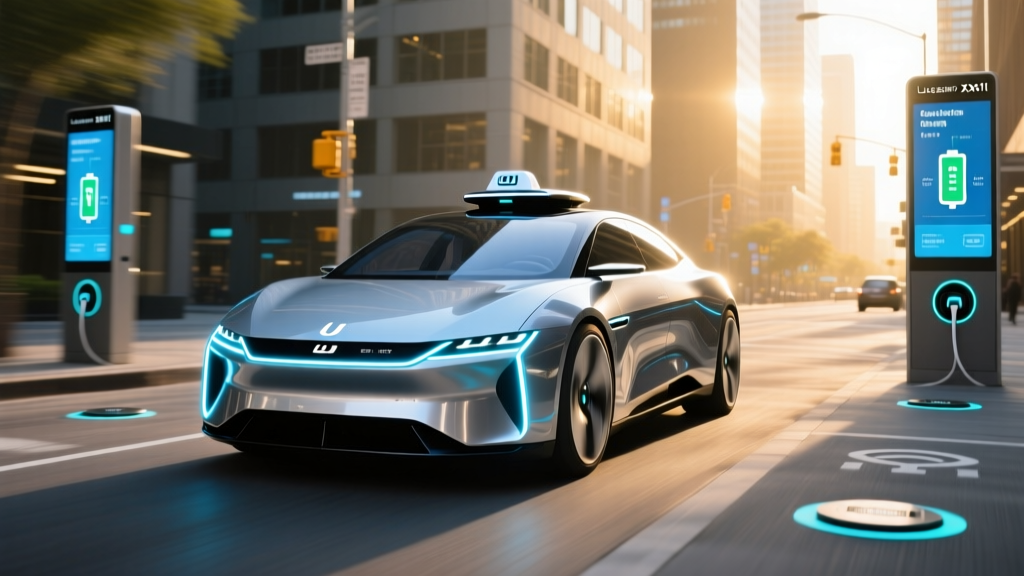
At a DC fast charger, the consumer Lucid Air peaks at up to 250 kW, adding roughly 200 miles of range in approximately 15 minutes (10-80% SoC). The robotaxi variant is expected to maintain similar charging performance, minimizing downtime between shifts.
How to Use the Service and Pricing vs Uber/Lyft
Riders in eligible cities access the Lucid robotaxi through the standard Uber app. When requesting a ride within the service geofence, the app may offer a "Lucid Autonomous" option alongside standard UberX, Comfort, and other tiers. No separate app download is required.
| Service Tier | Base Fare | Per Mile | Per Minute | Typical 5-Mi Ride |
|---|---|---|---|---|
| UberX (human driver) | $2.50 | $1.25 | $0.35 | $12 – $16 |
| Waymo One | $2.00 | $1.30 | $0.30 | $11 – $15 |
| Lucid Autonomous (Uber) | $2.00 | $1.20 | $0.28 | $10 – $14 |
| Lyft Autonomous | $2.25 | $1.25 | $0.32 | $11 – $15 |
Pricing for the Lucid-Uber robotaxi service is designed to be competitive with — or slightly below — human-driven UberX. The economics work because eliminating the driver removes the largest variable cost in rideshare (typically 70-80% of the fare goes to the driver). Uber's platform fee and the amortized cost of the autonomous vehicle hardware and software make up the remainder. Early promotional pricing in new markets may offer discounts of 20-40% to build rider familiarity.
The ride experience itself differs from standard Uber: no driver conversation, climate and music controls via the in-app interface or rear-seat tablet, and the ability to make multiple stops within the geofenced zone. The Lucid Air's spacious rear cabin (41.9 inches of rear legroom in the consumer model) translates to a premium-feeling robotaxi ride.
Safety Record: What the Data Shows
Autonomous vehicle safety is the most scrutinized — and most misunderstood — aspect of robotaxi operations. Here's what the available data tells us about Level 4 robotaxis broadly, with specific context for the Lucid-Uber fleet.
Robotaxi Safety Data (Industry-Wide, 2024-2025)
- Waymo: Over 10 million fully autonomous (no driver) miles completed by late 2025. NHTSA Standing General Order data shows Waymo vehicles involved in approximately 0.78 crashes per million autonomous miles, compared to the human-driver benchmark of approximately 1.5-2.0 police-reported crashes per million miles in urban environments.
- Cruise: Suspended operations in California in October 2023 after a pedestrian-dragging incident in San Francisco. Resumed limited testing in Phoenix and Dallas in 2024-2025 under modified permits.
- Lucid-Uber fleet: As a newer entrant, the Lucid robotaxi fleet has accumulated fewer autonomous miles. Early commercial operations began in Phoenix in late 2025. As of early 2026, the fleet has logged an estimated 500,000+ autonomous miles with zero at-fault collisions involving injuries, per company disclosures.
It's critical to understand what these numbers mean and don't mean. Robotaxi crash rates benefit from operating in mapped, well-understood environments at moderate speeds (typically under 45 mph). They don't face the same highway-speed, rural-road, or adverse-weather conditions that inflate human crash statistics. Comparisons are directionally useful but not perfectly apples-to-apples.
The NHTSA Standing General Order, issued in June 2021 and updated since, requires all Level 2-5 automated driving system operators to report crashes within one day if they involve injury, fatality, or significant vehicle damage. This creates the most comprehensive public dataset for evaluating AV safety, though reporting methodologies vary between operators.
Regulatory Landscape: Who Approves Robotaxi Operations
Robotaxi deployment in the United States is governed by a patchwork of state and federal regulations — there is no single national framework.
- Federal (NHTSA): Sets vehicle safety standards (FMVSS) and investigates crashes. NHTSA does not currently "approve" AV software, but its Standing General Order mandates crash reporting and it retains recall authority over automated driving systems.
- California (CPUC + DMV): The DMV issues testing permits and publishes annual disengagement reports. The CPUC issues commercial deployment permits for passenger service. Both must be satisfied before a robotaxi can charge fares in California.
- Arizona: Among the most permissive states — no specific AV permit required beyond standard business licensing and vehicle registration. Operators self-certify readiness. This is why Phoenix consistently leads robotaxi deployment.
- Texas: Requires AV operators to register with the Texas Department of Transportation and carry minimum insurance. Austin has attracted testing but not yet full commercial deployment.
- Federal legislation: As of early 2026, Congress has not passed comprehensive AV legislation. The AV START Act and similar bills have stalled repeatedly, leaving states to fill the regulatory vacuum.
For the Lucid-Uber deal, this means each new city launch requires navigating a different regulatory body, different insurance requirements, and different public-permitting processes. This is a major reason expansion is slow and sequential rather than simultaneous.
Current Limitations: What Robotaxis Cannot Do
Understanding what the Lucid-Uber robotaxi cannot handle is as important as understanding what it can. Level 4 autonomy is powerful within its Operational Design Domain — but that domain has firm boundaries.
Operational Limitations
- Geofencing: Vehicles will not operate outside their mapped service area. If your destination falls outside the geofence, the app will not offer the autonomous option.
- Weather: Heavy rain, fog, snow, and ice degrade sensor performance (especially lidar and cameras). Most Level 4 operators suspend or restrict service during severe weather events. Phoenix's dry climate is a strategic advantage, not an accident.
- Construction zones: Unmapped lane closures, temporary barriers, and flagger-directed traffic remain challenging. Vehicles may pull over safely and request remote assistance or reroute.
- Edge cases: Unusual scenarios — a person in costume, an overturned truck spilling cargo, emergency vehicle interactions in complex intersections — can cause the vehicle to stop and wait for remote guidance. This is a safety feature, not a failure, but it can delay your ride.
- No highway driving (most markets): Current Level 4 deployments are predominantly surface-street operations. Highway-speed autonomous driving adds complexity (higher kinetic energy, faster decision timelines) that most operators have not yet commercialized.
- Accessibility: Current robotaxi vehicles are sedan-based and may not accommodate wheelchair users or passengers requiring assistance. This is a significant equity concern that the industry has yet to resolve at scale.
Is This Truly Self-Driving or Driver-Assist?
This is the most important distinction in the entire autonomous vehicle conversation, and the answer depends entirely on which Lucid vehicle you're discussing.
| SAE Level | Name | Who Drives? | Example |
|---|---|---|---|
| Level 0 | No Automation | Human | Standard car, no ADAS |
| Level 1 | Driver Assistance | Human (one feature assisted) | Adaptive cruise OR lane-keep |
| Level 2 | Partial Automation | Human (supervises combined features) | Tesla Autopilot, Lucid DreamDrive Pro, GM Super Cruise |
| Level 3 | Conditional Automation | System (in limited conditions), human must take over when requested | Mercedes Drive Pilot (limited markets) |
| Level 4 | High Automation | System (within ODD, no human needed) | Waymo One, Lucid-Uber Robotaxi, Zoox |
| Level 5 | Full Automation | System (all conditions, everywhere) | Does not yet exist commercially |
The consumer Lucid Air you can buy today comes with DreamDrive Pro — a Level 2 system. You must keep your hands on the wheel (or be ready to take over immediately), keep your eyes on the road, and accept full legal responsibility for the vehicle's actions. It is not self-driving.
The Lucid-Uber robotaxi operates at Level 4 within its geofenced service area. There is no human driver, no steering wheel for passengers, and no expectation of intervention. The vehicle handles all driving tasks within its operational domain. If it encounters a scenario it cannot handle, it stops safely and contacts a remote operations center — it does not hand control to the passenger.
No commercially available vehicle in 2026 is Level 5. Anyone claiming otherwise is either mistaken or marketing.
Frequently Asked Questions
Where can I use the Lucid-Uber robotaxi right now?
Commercial paid rides are available in Phoenix, AZ (metro area, ~225 sq mi geofence) and select zones in San Francisco, CA. Los Angeles is in early-access testing. Austin and Miami have been announced but are not yet operational. You must be within the geofenced area for both pickup and drop-off.
How much does a Lucid robotaxi ride cost compared to Uber or Lyft?
Pricing is designed to be competitive with or slightly below UberX — approximately $10-$14 for a typical 5-mile urban ride, compared to $12-$16 for UberX with a human driver. Promotional pricing in newly launched markets may offer 20-40% discounts. Surge pricing still applies during peak demand.
How safe are robotaxis — is there real data?
NHTSA's Standing General Order provides the most comprehensive public crash data. Industry-wide, Level 4 robotaxis from established operators show crash rates of approximately 0.7-0.8 per million autonomous miles, compared to ~1.5-2.0 police-reported crashes per million miles for human urban drivers. However, robotaxis operate in constrained environments (mapped streets, moderate speeds, fair weather) that reduce exposure to the most dangerous driving scenarios.
What happens if the robotaxi encounters something it can't handle?
The vehicle will pull over safely, activate hazard lights, and connect to a remote operations center where a human specialist can assess the situation and either provide guidance or dispatch assistance. You are never asked to take over driving. Wait times for remote resolution are typically 1-5 minutes.
Can I use the Lucid robotaxi in rain or snow?
Light rain generally does not affect operations. However, heavy rain, fog, snow, and ice can trigger service suspension or route restrictions because these conditions degrade lidar and camera performance. Phoenix's dry climate is one reason it leads deployment. If you're in San Francisco during a heavy atmospheric river event, expect the autonomous option to be unavailable.
Does the Lucid robotaxi use the same battery as the consumer Lucid Air?
The robotaxi platform is based on the Lucid Air architecture, which uses a 112 kWh usable NMC lithium-ion battery pack in its largest configuration. The EPA-rated range for the consumer Lucid Air Grand Touring is up to 516 miles, though real-world robotaxi operations (stop-and-go urban driving, HVAC load, sensor/compute power draw) reduce effective range to approximately 320-380 miles per charge — still sufficient for a full operational shift.
Is Lucid's consumer DreamDrive system the same as the robotaxi's autonomous system?
No. DreamDrive Pro in the consumer Lucid Air is SAE Level 2 — it assists with steering, acceleration, and braking but requires constant driver supervision. The robotaxi system is SAE Level 4, with additional lidar, redundant compute, and HD mapping that enable driverless operation within a defined service area. They share some software DNA but are fundamentally different systems with different hardware and different legal responsibilities.