The Lucid-Uber Gravity Robotaxi Deal: Separating Signal from Noise
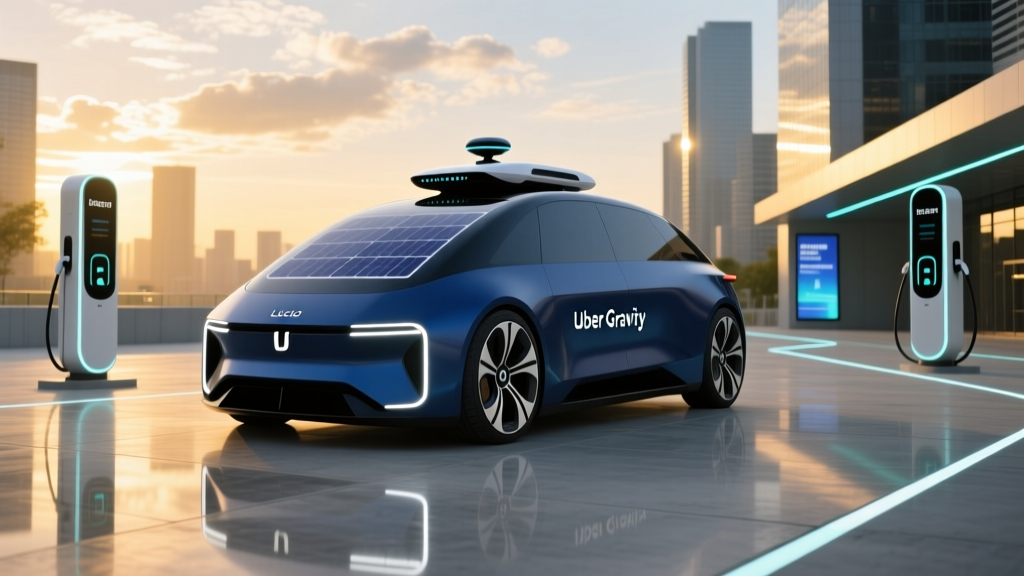
In late 2024, Lucid Motors and Uber Technologies announced a multi-year partnership to deploy Lucid Gravity SUVs on Uber's autonomous ride-hailing network starting in 2026. The headline was irresistible: a luxury electric SUV purpose-built for premium robotaxi service, backed by one of the world's largest mobility platforms. But for riders wondering when they can actually hail a driverless Gravity — and for investors parsing the revenue implications — the details matter enormously.
This analysis examines the Lucid Uber Gravity robotaxi deal as it stands in 2026: what's operational, what's still in testing, the autonomy level involved, the technology stack, safety data, regulatory status, and the real limitations that define where and when this service can run.
What the Deal Actually Covers
The Lucid-Uber agreement, first disclosed in October 2024, outlines a phased deployment of Lucid Gravity vehicles integrated with Uber's autonomous vehicle (AV) platform. Under the terms, Lucid supplies Gravity SUVs equipped with a sensor suite and AV hardware package, while Uber handles fleet integration, rider matching, and the consumer-facing app experience. A third-party autonomous driving technology provider — the specific partner has been a moving target — supplies the self-driving software stack that enables driverless operation.
Critically, this is not a simple vehicle purchase agreement. Lucid is positioning the Gravity as an "autonomous-ready" platform, meaning the vehicle architecture supports the compute, power, and sensor requirements of Level 4 operation. Uber, meanwhile, is pursuing a platform strategy: rather than building its own robotaxi fleet (as Google's Waymo does), Uber wants to be the network layer connecting multiple AV operators and vehicle OEMs to riders.
SAE Automation Level: What This Actually Is
The Lucid Gravity robotaxi, when deployed for driverless service, targets SAE Level 4 — high automation within a defined operational design domain (ODD). This means no human driver is required behind the wheel, but the vehicle can only operate in pre-mapped, geofenced areas under specific conditions (good weather, mapped roads, limited speeds).
This is fundamentally different from the Lucid Gravity you can buy today at a dealership, which ships with DreamDrive Pro — an SAE Level 2 driver-assistance system that requires the human driver to remain fully engaged at all times. Do not conflate the two: consumer DreamDrive Pro is not self-driving, and the robotaxi Gravity uses a different sensor and compute stack.
Where Can You Use This Robotaxi Service Right Now?
As of mid-2026, Lucid Gravity robotaxis are not yet available for public rides. The partnership is in a testing and validation phase, with pilot programs expected to launch in select markets later in 2026 or into 2027. Uber has indicated that initial deployments will target cities where it already has AV partnerships and favorable regulatory environments.
Based on Uber's existing autonomous partnerships and public filings, the most likely early-launch markets include:
| City/Region | Status (2026) | Regulatory Environment | Notes |
|---|---|---|---|
| Phoenix, AZ | Testing/Pilot | Permissive (AZ DOT) | Uber's AV hub; Waymo also operates here |
| Dallas-Fort Worth, TX | Planned Pilot | Moderate (TX DOT framework) | Uber AV expansion market |
| Los Angeles, CA | Pre-Pilot | Complex (CPUC + city permits) | Large addressable market; regulatory friction |
| Miami, FL | Under Evaluation | Permissive (FL statute) | Florida allows driverless testing and deployment |
| San Francisco, CA | Not Announced | Restrictive (CPUC + SFMTA) | Post-Cruise suspension; cautious regulatory posture |
For comparison, Waymo currently operates commercial driverless service in Phoenix, San Francisco, Los Angeles, and Austin — a head start of several years. The Lucid-Uber Gravity deployment is chasing that benchmark, not matching it yet.
Technology Stack: How the Autonomous Gravity Sees the World
The production Lucid Gravity available to consumers uses Lucid's DreamDrive Pro ADAS suite: a camera-forward system with radar and ultrasonic sensors, running on Lucid's proprietary compute platform. It's a capable Level 2 system, competitive with Tesla Autopilot and Ford BlueCruise in highway scenarios, but it is not the stack used in the robotaxi variant.
The robotaxi-spec Gravity is expected to carry a significantly expanded sensor and compute package:
Expected Robotaxi Gravity Sensor Suite
- LiDAR: Multiple solid-state or semi-solid-state LiDAR units providing 360° high-resolution point clouds. This is the key differentiator from consumer DreamDrive Pro and from Tesla's camera-only FSD approach. LiDAR provides precise depth perception independent of lighting conditions.
- Cameras: 12+ cameras covering 360° field of view, including long-range forward-facing units for highway-speed object detection and near-field cameras for pedestrian and curb detection.
- Radar: 4D imaging radar for velocity detection and operation in rain, fog, and dust where LiDAR and cameras degrade.
- Ultrasonic Sensors: Short-range proximity detection for low-speed maneuvering and parking.
- Compute: High-performance redundant compute platform (likely NVIDIA DRIVE Orin or successor) capable of 500+ TOPS, with full system redundancy for steering, braking, and power.
- HD Mapping: Pre-built centimeter-accurate maps of the operational geofence, updated continuously.
The LiDAR-inclusive approach aligns the Gravity robotaxi with Waymo, Zoox, and Cruise's sensor philosophy — a direct rejection of Tesla's camera-only bet. In practice, LiDAR provides a redundant depth channel that improves safety margins in edge cases like nighttime construction zones, faded lane markings, and partially occluded pedestrians.
How Safe Are Robotaxis? The Real Data
Safety is the single most important variable for the Lucid-Uber Gravity robotaxi deployment. Public trust in autonomous vehicles was severely tested in 2023-2024 when Cruise (GM's robotaxi subsidiary) was pulled from California roads after a series of incidents, including a pedestrian being dragged by a Cruise vehicle that failed to properly detect the person post-collision.
Here's what the available safety data shows for the robotaxi industry broadly — keeping in mind that Lucid Gravity robotaxis have not yet accumulated public operational miles:
Robotaxi Safety Data (Industry Benchmarks)
- Waymo: Over 20 million driverless miles completed as of early 2025. Waymo's published data (peer-reviewed, reported to NHTSA) shows a fatal crash rate roughly 85% lower than human benchmarks and a serious-injury rate ~60% lower when comparing like-for-like urban driving. However, Waymo vehicles are involved in more minor contact incidents per mile than human drivers, partly because they drive conservatively and sometimes stop unexpectedly in traffic.
- Cruise: Accumulated millions of driverless miles before its October 2023 suspension. Cruise's disengagement rate (human interventions per 1,000 miles) was reported to California DMV at approximately 0.3-0.5 per 1,000 miles in its final reporting period — but the DMV data has known limitations in how companies self-report.
- Human Benchmark: U.S. fatal crash rate is approximately 1.35 per 100 million vehicle miles traveled (NHTSA FARS data).
Context for Lucid Gravity: Until Gravity robotaxis accumulate millions of real-world driverless miles, their safety profile is theoretical. Lucid and Uber will need to publish disengagement data, incident reports, and eventually peer-reviewed safety studies to build public confidence.
Pricing: Robotaxi vs. UberX vs. Owning a Gravity
One of the core economic promises of robotaxis is lower per-mile cost compared to human-driven rideshare. The logic: remove the driver (who takes 20-30% of the fare), and the platform can charge less while maintaining margins. In practice, the economics are more complicated.
| Option | Cost Per Mile (Est.) | Typical 5-Mile Trip | Notes |
|---|---|---|---|
| Waymo (current robotaxi) | $1.50–$2.50 | $8–$14 | Often subsidized; surge pricing applies |
| UberX (human driver) | $1.80–$3.00 | $10–$17 | Varies by city, time, demand |
| Uber Autonomous (projected, Gravity) | $1.20–$2.20 | $7–$13 | Target pricing; early subsidies likely |
| Personal Lucid Gravity (ownership) | $0.15–$0.25 | $0.75–$1.25 | Electricity + depreciation + insurance per mile |
The personal-ownership column makes clear that robotaxis — even at aggressive pricing — are not cheaper than owning and charging your own EV. The value proposition of a robotaxi is convenience and access, not cost parity with ownership. For a Lucid Gravity owner who pays $79,900+ (base MSRP for the 2025/2026 Gravity, before destination), the per-mile cost of home charging at ~$0.13/kWh with its 112 kWh usable battery is roughly $0.04/mile in energy alone.
For riders, the Lucid-Uber Gravity robotaxi will likely launch with promotional pricing to build adoption, similar to how Waymo offered heavily discounted rides during its Phoenix and San Francisco expansion phases. Expect initial fares to be competitive with UberX, with a premium "Lucid Luxury" tier priced 15-30% higher for the Gravity's upscale interior and quiet ride.
Regulatory Landscape: Who Approves Robotaxi Operations?
Deploying a driverless vehicle for commercial passenger service in the United States requires navigating a patchwork of federal, state, and local regulations. There is no single "robotaxi license." Instead, operators must satisfy multiple authorities:
- Federal (NHTSA): The National Highway Traffic Safety Administration sets vehicle safety standards (FMVSS). Current FMVSS rules assume a human driver (steering wheel, pedals, mirrors). Vehicles like the Zoox robotaxi have required NHTSS exemptions for elements like the absence of a steering wheel. The Lucid Gravity, which retains conventional driver controls, avoids this particular hurdle.
- State DMVs/DOTs: Each state controls whether driverless testing and commercial deployment are permitted. Arizona, California, Texas, Florida, and Nevada are among the most active AV-regulating states. California requires both a DMV testing permit and a CPUC (California Public Utilities Commission) permit for commercial passenger service.
- Local/Municipal: Cities often have their own permitting requirements, particularly regarding curb access, parking, and coordination with emergency services. San Francisco's Board of Supervisors has pushed back against robotaxi expansion, demonstrating that local politics can override state-level permissiveness.
- Insurance: States require minimum liability coverage for AV operators. The question of who is liable in a crash — the OEM (Lucid), the AV software provider, the fleet operator, or the platform (Uber) — remains partially unresolved in case law.
For the Lucid-Uber Gravity deal, Uber's existing relationships with state regulators give the partnership a significant advantage. Uber has been navigating AV regulation since its ATG (Advanced Technologies Group) days in Pittsburgh. However, each new city launch will require fresh permitting, and the post-Cruise regulatory environment has made authorities more cautious, not less.
Current Limitations: What the Gravity Robotaxi Cannot Do
Understanding the boundaries of Level 4 operation is essential for setting realistic expectations. The Lucid Gravity robotaxi, like all current and near-term robotaxis, operates within a tightly defined Operational Design Domain (ODD). Outside that domain, the vehicle cannot function autonomously.
Known and Expected Limitations
- Geofencing: The Gravity robotaxi can only operate within pre-mapped areas. Drive outside the geofence and the system cannot function. This means no spontaneous road trips, no rural routes, and no service in unmapped suburbs.
- Weather Restrictions: Heavy rain, snow, ice, and dense fog degrade LiDAR and camera performance. Most Level 4 systems today suspend operation or reduce speed significantly in moderate-to-heavy precipitation. Phoenix's dry climate is not an accident — it's the easiest ODD to operate in.
- Construction Zones: Temporary lane shifts, barrel placements, and flaggers present some of the hardest edge cases for AV perception systems. While improving, most robotaxis still struggle with complex, unannounced construction zones.
- Speed Limits: Current Level 4 deployments typically operate on roads with speed limits up to 45-50 mph. Highway-speed operation (65-75 mph) adds enormous complexity in perception range requirements and decision latency.
- Night Operations: While LiDAR is lighting-independent, camera-based classification degrades at night. Some operators restrict nighttime service or operate at reduced speeds after dark.
- Emergency Vehicles: Detecting and properly responding to approaching emergency vehicles (pulling over, yielding right-of-way) remains a challenging scenario, though Waymo and others have made significant progress here.
- Unprotected Left Turns: Crossing oncoming traffic without a protected signal is a high-difficulty maneuver. Robotaxis sometimes take conservative approaches that frustrate human drivers behind them.
The Lucid Gravity as a Vehicle: What Riders Get
If and when you step into a Lucid Gravity robotaxi, you're entering one of the most spacious and technologically advanced EVs on the road. The consumer-spec Gravity offers:
| Specification | Gravity Grand Touring | Gravity Touring |
|---|---|---|
| EPA Range | ~440 miles | ~390 miles |
| Battery (Usable) | 112 kWh (NMC) | 112 kWh (NMC) |
| DC Fast Charging (Peak) | ~300 kW | ~300 kW |
| 10-80% DC Charge Time | ~15-18 min (est.) | ~15-18 min (est.) |
| Level 2 Charging | 19.2 kW (onboard) | 19.2 kW (onboard) |
| Horsepower | ~800+ hp (AWD) | ~600+ hp (AWD) |
| 0-60 mph | ~3.5 sec | ~4.5 sec |
| Base MSRP | ~$94,900 | ~$79,900 |
| Battery/Powertrain Warranty | 8 yr / 100,000 mi | 8 yr / 100,000 mi |
| Seating | Up to 7 passengers | Up to 7 passengers |
Real-World Range Note: The EPA-rated ~440 miles for the Grand Touring is exceptional, but robotaxi duty cycles are different from personal use. Expect fleet operators to keep SoC between 20-80% for battery longevity, effectively giving ~260 usable miles between charges. Highway-speed driving, HVAC use in extreme heat (Phoenix summers regularly exceed 110°F), and stop-start urban patterns will further reduce effective range to approximately 200-240 miles per charge cycle in real-world robotaxi service.
For riders, the Gravity's appeal is its interior: a massive 34-inch curved glass cockpit display (which in robotaxi mode could show route information or entertainment), available reclining rear seats, and a flat floor enabled by Lucid's miniaturized powertrain. The ride quality, aided by available air suspension, is among the best in any SUV. As a robotaxi, the Gravity would compete in the premium tier — think of it as the "business class" of autonomous rideshare.
What This Means for Buyers, Riders, and Investors
The Lucid Uber Gravity robotaxi deal represents a credible but early-stage bet on premium autonomous mobility. For different audiences, the implications differ:
For riders: Don't expect to hail a driverless Gravity on Uber in 2026. Pilot programs may begin in one or two markets (Phoenix is the most likely candidate), with meaningful scale not arriving until 2027-2028 at the earliest. When it does launch, expect premium pricing and a geofenced service area.
For Lucid buyers: The consumer Gravity you purchase at a dealership is not a robotaxi and cannot become one through an over-the-air update. The robotaxi variant uses different hardware. Your DreamDrive Pro system remains Level 2 driver-assist — you are the driver, always.
For investors: The deal validates Lucid's strategy of monetizing its platform beyond direct consumer sales and gives Uber a luxury AV option without the capital expenditure of building vehicles. But revenue from robotaxi fleet sales will be modest for Lucid until deployments reach thousands of vehicles, which is years away.
Where can I use the Lucid Gravity robotaxi right now?
Nowhere yet. As of 2026, the Lucid-Uber Gravity robotaxi is in the testing and pilot phase. Commercial rider access is expected to begin in limited geofenced areas (most likely Phoenix, AZ) in late 2026 or 2027, with broader availability in 2028+.
How much will a Gravity robotaxi ride cost compared to UberX?
Projected pricing is $1.20-$2.20 per mile, roughly competitive with UberX ($1.80-$3.00/mile). A premium "luxury" tier may cost 15-30% more. Early promotional pricing is likely during launch phases.
Is the Lucid Gravity robotaxi truly self-driving?
The robotaxi-spec Gravity targets SAE Level 4 — genuinely driverless within its geofenced operational area. However, the consumer Gravity with DreamDrive Pro is SAE Level 2, which requires full driver engagement. These are different systems in differently equipped vehicles.
How safe are robotaxis compared to human drivers?
Waymo's published data shows fatal crash rates approximately 85% lower than human benchmarks across 20+ million driverless miles. However, robotaxis still struggle with edge cases (construction zones, severe weather, complex intersections), and the Lucid Gravity robotaxi has not yet accumulated public operational miles to establish its own safety record.
What are the biggest limitations of the Gravity robotaxi?
Geofencing (only works in pre-mapped areas), weather restrictions (reduced or suspended service in heavy rain/snow), construction zone handling, speed limit constraints (typically ≤50 mph), and limited city availability. These are industry-wide Level 4 constraints, not unique to Lucid.
Can I buy a Lucid Gravity and use it as a robotaxi on Uber?
No. The consumer-spec Gravity does not include the robotaxi sensor suite, compute hardware, or software stack. The autonomous variant is a purpose-built fleet vehicle. Uber's AV platform is also not open to individual owner-operators adding their personal vehicles.