Quick Answer: No, Lucid Is Not Self-Driving — Here's What It Actually Offers
If you're asking "does Lucid have self-driving," the short answer is no. No Lucid vehicle sold today — whether the Air sedan or the Gravity SUV — can drive itself without human supervision. Lucid's driver-assistance suite, branded DreamDrive Pro, is an SAE Level 2 system. That means the car can simultaneously manage steering, acceleration, and braking under certain conditions, but you must remain fully engaged, eyes on the road, hands available to take over at any moment.
This is a critical distinction. Level 2 driver-assist — the same category as Tesla's Autopilot, Ford's BlueCruise, and GM's Super Cruise — is fundamentally different from Level 4 robotaxi services like Waymo, where no human driver is needed. Lucid does not currently offer a Level 3, 4, or 5 system in any production vehicle, nor has it announced a driverless ride-hail service.
| Level | Description | Example |
|---|---|---|
| Level 0 | No automation — warnings only | Backup camera, blind-spot alert |
| Level 1 | Single-axis assist (steering OR speed) | Adaptive cruise control alone |
| Level 2 | Combined steering + speed; driver must supervise | Lucid DreamDrive Pro, Tesla Autopilot, BlueCruise |
| Level 3 | Conditional self-driving; driver on standby | Mercedes Drive Pilot (limited markets) |
| Level 4 | Self-driving in defined areas; no driver needed | Waymo, Zoox robotaxis |
| Level 5 | Full self-driving everywhere, all conditions | Does not yet exist in production |
Source: SAE International J3016
Lucid DreamDrive Pro: What the System Actually Does
DreamDrive Pro is Lucid's advanced driver-assistance system (ADAS), standard on the Air Grand Touring and above, and available as part of the Dream package on lower trims. It bundles a comprehensive sensor suite with software that enables hands-on, eyes-on highway and traffic driving assistance.
Core DreamDrive Pro Features (2025–2026 Models)
- Highway Assist: Combines adaptive cruise control with lane-centering steering on divided highways. Maintains a set speed, following distance, and lane position.
- Advanced Adaptive Cruise: Stop-and-go capability in traffic; works down to 0 mph and resumes automatically in short stops.
- Lane-Keeping Assist: Active steering input to keep the vehicle centered in marked lanes.
- Automatic Emergency Braking (AEB): Forward collision mitigation with pedestrian and cyclist detection.
- Blind-Spot Assist: Active intervention if you attempt a lane change into an occupied blind spot.
- Rear Cross-Traffic Alert with Braking: Automated braking when reversing into cross-traffic.
- Surround-View Monitoring: 360-degree camera system for parking and low-speed maneuvering.
What DreamDrive Pro does not do: navigate on-ramps to off-ramps autonomously, change lanes without driver confirmation, stop at traffic lights without driver input, or operate without a fully attentive human behind the wheel. Every steering and speed intervention can be overridden instantly, and the system will issue escalating warnings — visual, audible, then haptic — if it detects driver inattention.
The Sensor Stack: Cameras, Radar, and Lidar
Lucid takes a multi-sensor approach with DreamDrive Pro, which sets it apart from Tesla's camera-only Tesla Vision architecture. Here's what's on board:
| Sensor Type | Count | Function |
|---|---|---|
| Cameras | Up to 14 (exterior + interior) | Object detection, lane reading, traffic signs, driver monitoring |
| Radar (long-range front) | 1 | Distance/speed measurement of vehicles ahead, works in fog/rain |
| Radar (corner/side) | 4 | Blind-spot detection, cross-traffic, lane-change support |
| Lidar (Luminar) | 1 (roof-mounted, standard on Air Dream Edition) | High-resolution 3D point cloud for object classification at distance |
| Ultrasonic sensors | 12 | Near-field obstacle detection for parking and low-speed maneuvers |
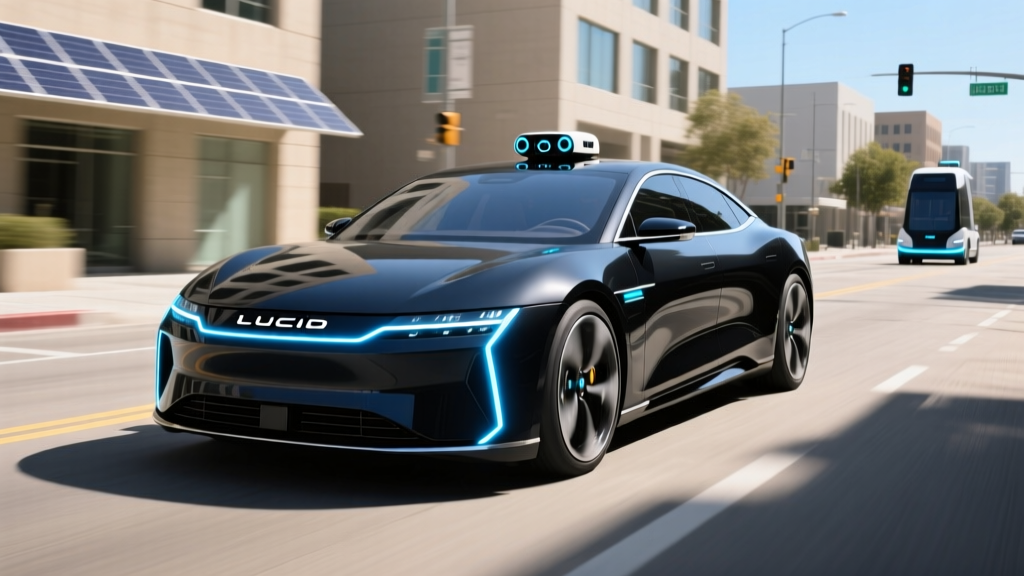
The inclusion of a Luminar lidar unit (on Air Dream Edition and certain Grand Touring configurations) is a notable differentiator. Lidar provides precise depth mapping independent of lighting conditions, which is valuable for edge-case object detection. However, Lucid has not yet leveraged this hardware to deliver anything beyond Level 2 functionality. The lidar's presence is forward-looking — it provides a data-collection and development platform for future higher-level autonomy features, pending software advancement and regulatory approval.
For comparison, Tesla removed all radar and ultrasonic sensors from its vehicles in favor of a pure camera approach, while Mercedes-Benz's Level 3 Drive Pilot system uses a similar multi-sensor stack (cameras, radar, lidar, rear-facing camera) but only activates under very narrow conditions (pre-mapped highways, under 40 mph, clear weather).
DreamDrive Pro vs. Competitor ADAS Systems
To understand where Lucid stands, it helps to compare DreamDrive Pro against the best-known driver-assistance systems from other EV manufacturers. All of these are Level 2 systems — none are self-driving.
| Feature | Lucid DreamDrive Pro | Tesla Autopilot / FSD (Supervised) | GM Super Cruise | Ford BlueCruise |
|---|---|---|---|---|
| SAE Level | Level 2 | Level 2 | Level 2 | Level 2 |
| Hands-free on approved roads? | No (hands-on required) | No (hands-on required) | Yes (~750,000 mi of mapped highways) | Yes (~130,000+ mi of divided highways) |
| Eyes-free? | No | No | No (driver monitoring camera) | No (driver monitoring camera) |
| Automatic lane change? | No (driver-initiated only) | Yes (with confirmation in FSD) | Yes (on newer versions) | Yes (BlueCruise 1.0+) |
| Lidar equipped? | Yes (Dream Edition) | No | Yes (map-based lidar scanning) | No |
| Included / Extra cost | Standard on upper trims | Basic Autopilot standard; FSD $8,000 or $99/mo | Included on qualified trims; 3-yr subscription then ~$25/mo | Included trial; ~$75/yr renewal |
Lucid's most significant gap relative to Super Cruise and BlueCruise is the lack of hands-free driving on pre-mapped highways. GM and Ford have invested heavily in HD mapping of divided highways across North America, enabling true hands-off (but eyes-on) cruising on those specific roads. Lucid's DreamDrive Pro currently requires the driver to keep hands on the steering wheel at all times, with torque-sensing to verify engagement.
Lucid's Autonomous Driving Roadmap: What's Next?
Lucid has been relatively cautious about autonomy timelines compared to some competitors. CEO Marc Winterhoff and former CEO Peter Rawlinson have both emphasized a safety-first approach, and the company has not announced a specific date for Level 3 or higher functionality in consumer vehicles.
What we know about Lucid's trajectory:
- Lidar hardware is already deployed on certain Air trims, providing a sensor foundation that most Level 2-only competitors lack.
- Over-the-air (OTA) updates have progressively improved DreamDrive Pro's lane-centering accuracy, adaptive cruise responsiveness, and driver-monitoring sensitivity since the Air's 2021 launch.
- Lucid has not announced a robotaxi service, a driverless ride-hail partnership, or a Level 3 "eyes-off" highway pilot for any specific model year.
- The company's software and AI development team has grown, but Lucid's engineering bandwidth has been focused primarily on launching the Gravity SUV and scaling production.
If Lucid does eventually introduce a Level 3 system, it would likely debut on pre-mapped, divided highways under specific conditions — similar to Mercedes-Benz's Drive Pilot, which is currently limited to certain German autobahn sections at speeds under 40 mph. U.S. regulatory approval for Level 3 remains fragmented, with Nevada being one of the few states to have certified a Level 3 system (Mercedes, in early 2024).
Current Limitations of DreamDrive Pro
- Drive without supervision: You must remain alert, eyes on the road, and ready to take over instantly.
- Handle construction zones: Cones, lane shifts, and temporary barriers can confuse the system. Always take over in work zones.
- Navigate city streets autonomously: Traffic lights, stop signs, crosswalks, and complex intersections require full driver control.
- Perform in severe weather: Heavy rain, snow, fog, and ice can degrade camera and lidar performance. The system will alert you and may disengage.
- Manage unmapped or poorly marked roads: Rural roads without clear lane markings will reduce or disable lane-centering functionality.
- Execute hands-free driving: Unlike Super Cruise or BlueCruise, Lucid requires torque on the steering wheel at all times.
- Change lanes automatically: Lane changes are driver-initiated only — DreamDrive Pro will not steer into an adjacent lane on its own.
These limitations are not unique to Lucid. Every Level 2 system on the market today has similar constraints. The difference is in degree: Tesla's FSD (Supervised) attempts city-street navigation with driver oversight, while GM's Super Cruise limits its operational domain to pre-mapped highways but offers a more relaxed hands-free experience within that domain. Lucid's approach is conservative — it does less autonomously, but what it does, it does with a high degree of refinement and predictability.
Lucid Air and Gravity: Key Specs for 2026 Buyers
Since DreamDrive Pro is bundled with Lucid's vehicles rather than sold as a separate autonomy package, here are the key specs for current Lucid models with the system:
| Spec | 2026 Lucid Air Pure | 2026 Lucid Air Grand Touring | 2026 Lucid Gravity Grand Touring |
|---|---|---|---|
| Base MSRP | ~$69,900 | ~$109,900 | ~$94,900 |
| EPA Range | 419 mi | 516 mi | 440 mi |
| Battery (usable) | 88 kWh (NMC) | 112 kWh (NMC) | 120 kWh (NMC) |
| Peak DC Charge Rate | 200 kW | 300+ kW | 300+ kW |
| 10–80% DC Fast Charge | ~25 min | ~20 min | ~22 min |
| 0–60 mph | 5.0 sec | 3.0 sec | 3.5 sec |
| Horsepower | 430 hp | 819 hp | 800+ hp |
| DreamDrive Pro | Standard | Standard | Standard |
| Battery/Powertrain Warranty | 8 yr / 100,000 mi | 8 yr / 100,000 mi | 8 yr / 100,000 mi |
Regarding the federal EV tax credit (§30D): as of 2026, the Air Pure may qualify for up to $7,500 depending on battery component sourcing and critical minerals requirements, buyer income caps ($150,000 single / $300,000 joint AGI), and the vehicle's MSRP falling within the sedan cap of $55,000. However, the Air Pure's ~$69,900 MSRP exceeds the $55,000 sedan cap, meaning it does not qualify for the new-vehicle §30D credit. The Air Grand Touring and Gravity also exceed their respective MSRP caps. Buyers should consult the IRS clean vehicle credit page and a tax professional for current eligibility.
The Bottom Line: Driver-Assist, Not Self-Driving
Lucid's DreamDrive Pro is a well-executed Level 2 driver-assistance system that complements the Air and Gravity's class-leading range and efficiency. It is not self-driving, and Lucid has not indicated that a Level 3 or Level 4 system is imminent. The lidar hardware on higher trims provides a foundation for future upgrades, but software capability and regulatory approval remain the gating factors.
If hands-free highway driving is a priority for your next EV purchase, GM's Super Cruise and Ford's BlueCruise currently offer a more permissive experience within their mapped domains. If you value a conservative, predictable system paired with the longest EPA-rated range in any production EV, Lucid's DreamDrive Pro delivers — as long as you understand that you are still the driver.
Frequently Asked Questions
Does Lucid have self-driving capabilities in 2026?
No. Lucid's DreamDrive Pro is an SAE Level 2 driver-assistance system. It provides steering, acceleration, and braking support, but requires full driver attention and engagement at all times. It cannot drive itself on any road type.
Does Lucid use lidar?
Yes. The Lucid Air Dream Edition and certain Grand Touring configurations include a roof-mounted Luminar lidar sensor. However, this hardware currently supports Level 2 functionality only and has not been activated for any Level 3 or higher feature.
Is Lucid DreamDrive Pro better than Tesla Autopilot?
They have different strengths. Tesla's FSD (Supervised) attempts more ambitious scenarios like city-street navigation and automatic lane changes, but has drawn scrutiny from NHTSA for safety incidents. Lucid's DreamDrive Pro is more conservative — fewer autonomous actions, but highly refined lane-centering and adaptive cruise on highways. Neither is self-driving.
Will Lucid ever offer hands-free driving like Super Cruise?
Lucid has not announced a hands-free highway driving feature with a specific timeline. The sensor hardware (including lidar) could theoretically support it, but the company has prioritized production scaling and vehicle launches over autonomy feature expansion to date.
What happens if I take my hands off the wheel in a Lucid?
DreamDrive Pro uses torque sensing on the steering wheel. If it detects no driver input for a set period, it issues a visual warning, followed by an audible alert, then haptic feedback. If the driver remains unresponsive, the system will gradually decelerate the vehicle, activate hazard lights, and eventually bring the car to a controlled stop.
Can I get DreamDrive Pro on the Lucid Air Pure?
Yes. DreamDrive Pro comes standard across all 2026 Lucid Air trims, including the Air Pure. However, the lidar sensor is only included on Dream Edition and select Grand Touring configurations — the Pure relies on the camera and radar suite without lidar.