If you have been searching for "Lucid FSD," you are not alone — but you are also looking for something that does not exist under that name. Lucid Motors does not sell a feature called Full Self-Driving. What Lucid offers is DreamDrive and DreamDrive Pro, the brand's proprietary advanced driver-assistance system (ADAS). Confusion is understandable: Tesla's marketing dominance has turned "FSD" into a generic search term for any premium driver-assist suite. This guide cuts through that confusion with exact specs, sensor counts, pricing, and real-world capability data for Lucid's system as it stands for the 2025–2026 Air and Gravity lineups.
What DreamDrive and DreamDrive Pro Actually Do
DreamDrive is Lucid's baseline ADAS suite. It bundles adaptive cruise control (ACC), lane-centering assist, automatic emergency braking (AEB), blind-spot monitoring, rear cross-traffic alert, and traffic-sign recognition. Every new Lucid Air and Lucid Gravity ships with DreamDrive as standard equipment at no additional cost.
DreamDrive Pro is the upgraded tier. It adds highway lane-change assist, intersection collision avoidance, enhanced surround-view monitoring, and a more sophisticated sensor fusion stack that leverages Lucid's full camera and lidar array. Pro is designed for sustained highway use and complex urban intersections, though — and this cannot be stressed enough — the driver must remain engaged at all times.
Both DreamDrive and DreamDrive Pro operate at SAE Level 2 — partial driving automation. The system can control steering, acceleration, and braking simultaneously, but the human driver is the responsible operator. You must keep your hands on or near the wheel, monitor the road, and be ready to take over instantly. This is not Level 4 autonomy (like Waymo's driverless robotaxi service). No production Lucid vehicle is self-driving.
The Sensor Suite: Cameras, Lidar, and Radar
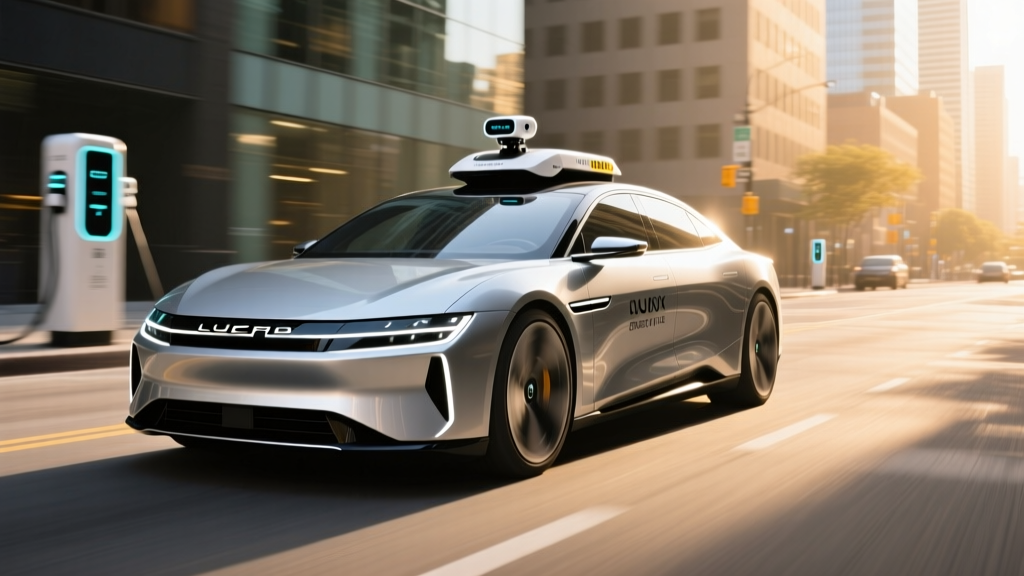
Lucid equips the Air and Gravity with one of the most sensor-dense ADAS platforms on the market. The hardware stack includes:
- 32 sensors total across the vehicle
- 14 cameras — providing a 360-degree surround view with forward telephoto capability
- 5 radar units — including a long-range forward radar and four corner radars for blind-spot and cross-traffic coverage
- 1 solid-state lidar (roof-mounted) — exclusive to DreamDrive Pro trims, providing high-resolution 3D mapping of the environment up to several hundred meters ahead
- Ultrasonic sensors for close-range parking and low-speed maneuvering
The lidar unit is the key differentiator between DreamDrive and DreamDrive Pro. Lidar provides precise depth perception independent of lighting conditions, giving Pro an advantage in low-visibility scenarios such as dusk, dawn, and tunnel transitions. Tesla's FSD (Supervised), by contrast, relies on a camera-only (vision-only) architecture with no lidar or radar — a philosophical choice that has drawn scrutiny from NHTSA in various investigation contexts.
| Feature | DreamDrive (Standard) | DreamDrive Pro |
|---|---|---|
| Adaptive Cruise Control | ✓ | ✓ |
| Lane-Centering Assist | ✓ | ✓ |
| Automatic Emergency Braking | ✓ | ✓ |
| Blind-Spot Monitoring | ✓ | ✓ |
| Highway Lane-Change Assist | ✗ | ✓ |
| Lidar Sensor | ✗ | ✓ |
| Intersection Collision Avoidance | ✗ | ✓ |
| Surround-View Enhanced Monitoring | ✗ | ✓ |
| Traffic-Sign Recognition | ✓ | ✓ |
Which Lucid Models and Trims Include DreamDrive Pro?
For the 2025 and 2026 model years, Lucid structures DreamDrive Pro availability as follows:
- Lucid Air Pure — DreamDrive standard; DreamDrive Pro available as part of the DreamDrive Pro Package (add-on).
- Lucid Air Touring — DreamDrive Pro included standard.
- Lucid Air Grand Touring — DreamDrive Pro included standard.
- Lucid Air Sapphire — DreamDrive Pro included standard.
- Lucid Gravity Touring / Grand Touring — DreamDrive Pro expected standard (Gravity began deliveries in late 2024; confirm trim-level ADAS inclusion with Lucid at order time).
The Pure trim is the entry point where buyers must actively choose and pay for the Pro upgrade. On higher trims, the hardware and software are bundled into the vehicle MSRP at no incremental charge.
Pricing: How Much Does DreamDrive Pro Cost?
Unlike Tesla's FSD (Supervised), which can be purchased for a one-time fee of $8,000 or subscribed at $99/month, Lucid has kept its ADAS pricing simpler — and generally more favorable for buyers who select higher trims.
| Item | Cost | Notes |
|---|---|---|
| DreamDrive (base ADAS) | Included | Standard on all trims |
| DreamDrive Pro Package (Air Pure add-on) | ~$3,000–$4,000 | One-time; bundled with other comfort features in some packages |
| DreamDrive Pro (Air Touring and above) | Included in MSRP | No separate charge |
| Monthly subscription | Not currently offered | Lucid has not introduced a recurring ADAS subscription as of early 2026 |
Check Lucid's official configurator for the latest package pricing, as bundling with wheel upgrades, interior packages, or color options can shift effective cost.
Real-World Capabilities and Driving Impressions
On well-marked divided highways — interstates like I-5, I-95, or I-80 — DreamDrive Pro performs confidently. Adaptive cruise control maintains consistent following distances, and lane-centering is stable through gentle curves at speeds up to 85 mph. The lane-change assist function initiates moves smoothly when the driver confirms via the turn signal stalk, checking blind-spot radar and camera feeds before executing.
The lidar sensor earns its keep in transitional lighting. Entering and exiting tunnels, driving at dusk with sun glare on the windshield, or navigating construction zones with shifted lane markings are scenarios where lidar's depth-mapping supplements cameras that might otherwise struggle. In our experience, DreamDrive Pro disengages less frequently in these edge cases compared to camera-only competitors.
City driving is where the system shows its Level 2 boundaries. Intersection collision avoidance provides alerts and can apply braking if a cross-traffic threat is detected, but the system does not autonomously navigate complex multi-lane intersections, unprotected left turns, or roundabouts. The driver must handle these scenarios entirely.
- Drive without an attentive, hands-on driver — this is not autonomous operation
- Navigate to a destination autonomously (no point-A-to-point-B self-driving)
- Handle construction zones with missing or contradictory lane markings reliably
- Operate safely in heavy snow, fog, or conditions that obscure sensors
- Recognize and stop for all traffic lights and stop signs without driver confirmation
- Replace sober, alert human judgment — impairment or fatigue invalidates all safety systems
How DreamDrive Pro Compares to Tesla FSD, Super Cruise, and BlueCruise
The premium ADAS landscape has four major contenders in the US market. Here is how they stack up on architecture, capability, and cost:
| System | Brand | SAE Level | Lidar | Hands-Free? | Cost |
|---|---|---|---|---|---|
| DreamDrive Pro | Lucid | Level 2 | Yes | No | Included (Touring+) / ~$3–4K add-on (Pure) |
| FSD (Supervised) | Tesla | Level 2 | No | No | $8,000 or $99/mo |
| Super Cruise | GM (Cadillac/Chev) | Level 2 | No (LiDAR-mapped roads) | Yes (mapped highways) | Included or $2,500 pkg; $25/mo after trial |
| BlueCruise | Ford / Lincoln | Level 2 | No | Yes (mapped highways) | $2,100 pkg or $75/mo |
The critical distinction: GM's Super Cruise and Ford's BlueCruise permit hands-free driving on pre-mapped divided highways (over 750,000 and 130,000 miles of road, respectively), using driver-facing cameras to confirm eye attention. Lucid's DreamDrive Pro, like Tesla's FSD (Supervised), requires hands on or near the steering wheel at all times — though it works on virtually any road, not just pre-mapped corridors.
Lucid's lidar gives it a sensor-hardware advantage over Tesla's vision-only approach. According to IIHS research, multi-sensor redundancy (combining cameras, radar, and lidar) generally provides more robust environmental perception than any single sensor modality alone, particularly in adverse conditions.
Safety Data and Regulatory Context
As of early 2026, Lucid's DreamDrive system has not been the subject of a major standalone NHTSA defect investigation, though all ADAS-equipped vehicles are subject to NHTSA's Standing General Order requiring manufacturers to report crashes involving Level 2+ systems. The Lucid Air earned strong crash-test ratings, and the ADAS suite is designed as a collision-avoidance layer on top of the vehicle's passive safety structure.
Lucid's approach to driver monitoring uses a combination of steering-wheel torque sensing and cabin-facing camera attention detection. If the system determines the driver is not paying attention, it issues escalating alerts — visual, audible, and haptic — before initiating a controlled deceleration and stop if no response is received.
Frequently Asked Questions
Does Lucid have a feature called "FSD"?
No. "FSD" (Full Self-Driving) is a Tesla brand name. Lucid's advanced driver-assistance system is called DreamDrive (standard) and DreamDrive Pro (upgraded). Searching for "Lucid FSD" will not find a matching product, but DreamDrive Pro is Lucid's equivalent premium ADAS offering.
Is Lucid DreamDrive Pro self-driving?
No. DreamDrive Pro is an SAE Level 2 system. The driver must remain fully engaged, hands on or near the wheel, and eyes on the road at all times. The system assists with steering, acceleration, and braking but does not replace the driver. Only Level 4 services like Waymo operate without a human driver, and those are not available in consumer vehicles.
How much does DreamDrive Pro cost?
On the Lucid Air Touring, Grand Touring, and Sapphire, DreamDrive Pro is included in the vehicle MSRP at no extra charge. On the Air Pure, it is available as part of an option package estimated at $3,000–$4,000. Lucid does not currently offer a monthly subscription for DreamDrive Pro, unlike Tesla's $99/month FSD plan or Ford's $75/month BlueCruise plan.
Does DreamDrive Pro work on all roads?
DreamDrive Pro's adaptive cruise and lane-centering functions work on most well-marked roads, including highways and surface streets. However, performance degrades on roads with faded or missing lane markings, in heavy precipitation, and in construction zones. Lane-change assist is optimized for divided highways.
Does the Lucid Air have lidar?
Yes — but only on trims equipped with DreamDrive Pro. The lidar sensor is roof-mounted and solid-state, providing high-resolution depth mapping that supplements the 14-camera, 5-radar sensor array. The base DreamDrive system on the Air Pure (without the Pro package) does not include lidar.
Will Lucid add hands-free driving in the future?
Lucid has indicated that its sensor hardware — particularly the lidar unit — is provisioned for future capability expansions via over-the-air software updates. However, as of early 2026, no hands-free driving feature has been announced or released. Any future functionality will still operate within SAE Level 2 supervision requirements unless regulatory frameworks change.