If you're shopping for a luxury electric sedan and wondering does Lucid have FSD, the short answer is no. Lucid Motors does not offer Tesla's Full Self-Driving system. Instead, Lucid equips its vehicles with its own advanced driver-assistance suite called DreamDrive — and in the 2026 Air lineup, the top-tier version is branded DreamDrive Pro.
While DreamDrive Pro competes in the same space as Tesla FSD, Ford BlueCruise, and GM Super Cruise, it has a fundamentally different hardware philosophy and capability ceiling. Here's exactly what Lucid's ADAS can do, what it cannot, and how it stacks up against the systems buyers cross-shop.
What Is Lucid DreamDrive and How Does It Work?
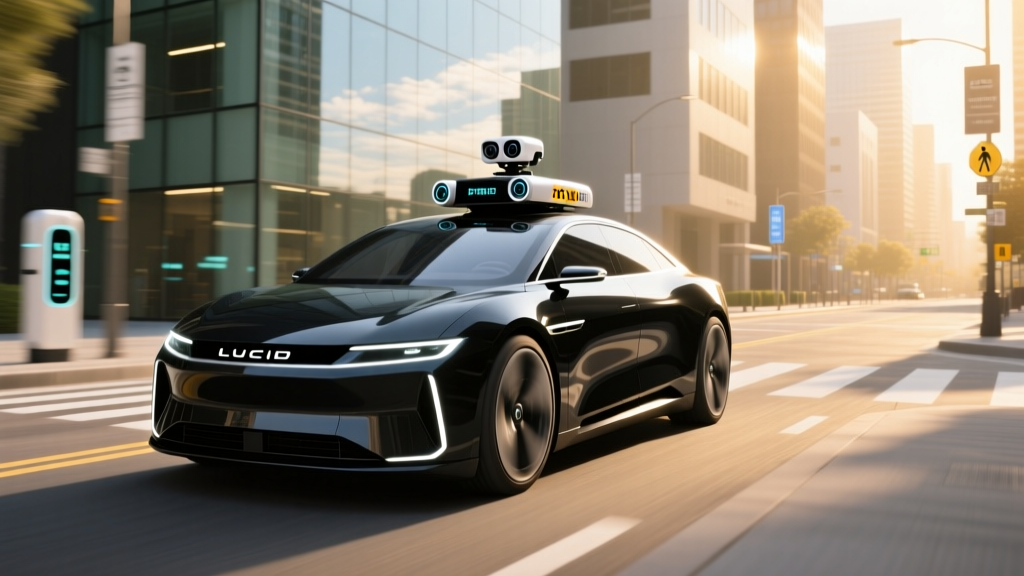
DreamDrive is Lucid's proprietary ADAS platform, engineered in-house at the company's Newark, California headquarters. Unlike Tesla's camera-only vision approach, DreamDrive uses a multi-sensor fusion architecture combining cameras, radar, ultrasonic sensors, and — critically — a lidar unit on equipped trims.
| Sensor Type | Count | Purpose |
|---|---|---|
| High-definition cameras | 13 | Lane detection, traffic sign recognition, object classification |
| Forward-facing lidar | 1 | Precise 3D depth mapping, low-light object detection |
| Long-range radar | 1 | Adaptive cruise control, high-speed object tracking |
| Short-range radar | 4 | Blind-spot monitoring, cross-traffic alert, lane-change assist |
| Ultrasonic sensors | 12 | Low-speed parking, near-field obstacle detection |
The lidar unit — roof-mounted and integrated into the glass canopy — gives DreamDrive a hardware advantage in low-visibility scenarios where cameras struggle, such as direct sun glare, heavy rain, or unlit construction zones at night. This is a deliberate engineering choice: Lucid prioritizes sensor redundancy over a purely vision-based approach.
Under the hood, sensor data feeds into Lucid's onboard compute platform, which processes environmental mapping in real time. The system handles adaptive cruise control with stop-and-go, lane-centering assist, lane-keeping, automatic emergency braking, and highway lane-change assist on mapped roads.
Is Lucid DreamDrive Self-Driving? The SAE Level Reality
DreamDrive and DreamDrive Pro are SAE Level 2 driver-assistance systems. This means the vehicle can simultaneously control steering and acceleration/braking under certain conditions, but the driver must remain fully attentive, keep hands on the wheel (or demonstrate engagement when prompted), and be prepared to take over instantly. No consumer ADAS on sale in 2026 — including Tesla FSD Supervised, Ford BlueCruise, or GM Super Cruise — qualifies as self-driving. True driverless operation (SAE Level 4) currently exists only in geofenced robotaxi services like Waymo.
This distinction matters because marketing language often blurs the line. "Full Self-Driving" is Tesla's product name, not a technical classification. Lucid avoids this ambiguity: DreamDrive is marketed transparently as a driver-assist system, not an autonomous one.
Which Lucid Models Include DreamDrive — and What Does It Cost?
For the 2026 model year, Lucid structures DreamDrive availability across its Air sedan and the newly launched Gravity SUV. Here's the breakdown by trim:
| Model / Trim | ADAS Package | Included or Add-On | Cost |
|---|---|---|---|
| Air Pure | DreamDrive (base) | Standard | Included in $69,900 MSRP |
| Air Touring | DreamDrive Pro | Standard | Included in $87,400 MSRP |
| Air Grand Touring | DreamDrive Pro | Standard | Included in $110,900 MSRP |
| Air Sapphire | DreamDrive Pro | Standard | Included in $250,500 MSRP |
| Gravity Touring | DreamDrive Pro | Standard | Included in $84,900 MSRP |
| Gravity Grand Touring | DreamDrive Pro | Standard | Included in $99,900 MSRP |
Unlike Tesla, which charges $8,000 upfront or $99/month for FSD Supervised, Lucid bundles DreamDrive Pro into the vehicle price at Touring and above trims. There is no separate subscription fee as of the 2026 model year. The base Air Pure includes the standard DreamDrive suite (adaptive cruise, lane-keeping, AEB) but omits lidar and some advanced lane-change features reserved for Pro.
This pricing model means DreamDrive Pro ownership cost is effectively amortized into the vehicle purchase — no recurring monthly charge. For buyers who dislike Tesla's subscription model, this is a tangible advantage.
Real-World Capabilities: What DreamDrive Pro Does Well
In real-world highway driving, DreamDrive Pro delivers confident lane-centering, smooth adaptive cruise modulation, and reliable lane-change assist on well-marked interstates. The system's lidar sensor shines in scenarios where camera-only competitors falter:
- Construction zones with shifted lanes: Lidar detects physical barriers and temporary lane configurations earlier than vision-only systems.
- Night driving on unlit roads: Depth perception remains strong without relying on ambient light or headlamp illumination.
- Direct sun glare: Camera washout at dawn/dusk is supplemented by radar and lidar data, reducing phantom braking events.
- Stop-and-go traffic: The system handles low-speed creep smoothly, reducing driver fatigue in congestion.
The lane-change assist feature requires driver confirmation via the turn signal stalk — DreamDrive Pro will not initiate lane changes autonomously without input. This is a deliberate design choice prioritizing driver authority over automation aggressiveness.
Limitations and Edge Cases You Need to Know
- Not a self-driving system. You must monitor the road, keep hands available, and remain prepared to intervene at any moment.
- Hands-on-wheel monitoring: The system uses a torque-based steering sensor. If you remove your hands for more than a few seconds, visual and audible alerts escalate, eventually bringing the car to a controlled stop.
- Lane-change assist is highway-only: It does not function on surface streets or in complex urban intersections.
- Weather degradation: Heavy snow, ice accumulation on sensors, or dense fog can reduce system confidence. The lidar unit, while robust in low light, is still affected by precipitation on the sensor housing.
- No point-to-point navigation routing: Unlike Tesla FSD's city-street navigation mode, DreamDrive Pro does not execute turns at intersections or navigate unmapped surface roads autonomously.
- Geofencing: Some advanced features require GPS-mapped highway segments and may disengage on unmapped roads.
The most significant capability gap versus Tesla FSD Supervised is urban navigation. Tesla's system can (with heavy supervision) handle traffic lights, stop signs, and left turns on city streets. DreamDrive Pro does not attempt this. Lucid has indicated that future over-the-air updates may expand capabilities, but as of 2026, the system is highway-focused.
DreamDrive Pro vs. Tesla FSD vs. BlueCruise vs. Super Cruise
For buyers cross-shopping luxury EVs with advanced ADAS, here's how the major systems compare on the metrics that matter:
| Feature | Lucid DreamDrive Pro | Tesla FSD (Supervised) | Ford BlueCruise 1.4 | GM Super Cruise |
|---|---|---|---|---|
| SAE Level | Level 2 | Level 2 | Level 2 | Level 2 |
| Lidar | Yes (1 unit) | No (vision-only) | No (camera + radar) | Yes (1 unit, select trims) |
| Hands-free on mapped highways | No (hands-on torque monitoring) | No (hands-on wheel torque) | Yes (on pre-mapped divided highways) | Yes (on 750,000+ mi of mapped roads) |
| City-street navigation | No | Yes (with supervision) | No | Limited (expanding) |
| Automated lane change | Yes (driver-confirmed) | Yes (driver-confirmed) | Yes (driver-confirmed) | Yes (driver-confirmed) |
| Upfront cost | Included (Touring+) | $8,000 or $99/mo | $2,100–$2,950 depending on model | $2,500 or included on select trims |
| Subscription required | No | Optional ($99/mo) | Some plans post-trial | $25/mo after trial on some models |
| Driver monitoring | Torque-based steering | Torque-based steering | Infrared camera (eye tracking) | Infrared camera (eye tracking) |
The standout differentiators: BlueCruise and Super Cruise offer true hands-free driving on mapped highways with camera-based eye monitoring, while Lucid and Tesla still require physical steering-wheel contact. However, Lucid's lidar gives it a hardware edge in adverse conditions. Tesla's city-street capability is the most ambitious, but it also generates the most NHTSA scrutiny and requires the most vigilant supervision.
Safety Context: What the Data Shows
Lucid's ADAS has not been the subject of major NHTSA defect investigations as of early 2026, though the broader ADAS industry faces ongoing regulatory attention. The Insurance Institute for Highway Safety (IIHS) evaluates ADAS systems under its crash-prevention ratings, and partial-automation features like AEB and lane-keeping factor into vehicle safety scores.
Lucid's standard DreamDrive suite includes automatic emergency braking with pedestrian detection, rear cross-traffic alert, and blind-spot intervention — features that perform independently of the driver-assist mode and contribute to crash-avoidance ratings regardless of whether you use DreamDrive Pro's highway features.
One practical safety note: DreamDrive Pro's torque-based driver monitoring is less sophisticated than the infrared eye-tracking cameras used by Ford and GM. This means the system cannot verify that you're actually looking at the road — only that your hands are applying torque to the wheel. Buyers should self-police their attention levels accordingly.
Frequently Asked Questions
Does Lucid have Tesla FSD?
No. Tesla's Full Self-Driving software is exclusive to Tesla vehicles. Lucid uses its own system called DreamDrive (or DreamDrive Pro on higher trims), which is independently developed and operates on different hardware — including lidar, which Tesla does not use.
Can DreamDrive Pro drive the car without me touching the wheel?
No. DreamDrive Pro requires continuous hands-on-wheel contact, monitored via steering torque. It is an SAE Level 2 driver-assist system, not a self-driving system. You must remain fully attentive and ready to take control at all times.
How much does Lucid DreamDrive cost?
DreamDrive (base) is standard on the 2026 Air Pure at $69,900. DreamDrive Pro is standard on Air Touring ($87,400), Air Grand Touring ($110,900), Air Sapphire ($250,500), and all Gravity trims. There is no separate subscription or add-on fee for DreamDrive Pro — it's included in the vehicle MSRP.
Will Lucid add city-street self-driving in the future?
Lucid has stated it is developing expanded ADAS capabilities via over-the-air updates, but as of the 2026 model year, DreamDrive Pro does not support autonomous navigation on city streets, through intersections, or at traffic signals. Any future expansion has not been dated or guaranteed.
Is DreamDrive Pro better than Tesla FSD?
It depends on what you prioritize. DreamDrive Pro's lidar hardware provides superior depth perception in low-visibility conditions. Tesla FSD Supervised offers broader capability, including city-street navigation (with heavy supervision). Neither system is self-driving, and both require constant driver attention. If highway comfort and adverse-weather reliability are your priorities, DreamDrive Pro's sensor fusion is a strong choice. If you want the most ambitious feature set and accept the supervision burden, FSD offers more scope.
Does the Lucid Air qualify for the federal EV tax credit?
Federal §30D tax credit eligibility depends on MSRP caps, buyer income limits, and battery-component/critical-mineral sourcing requirements set by the IRS. The Air Pure ($69,900) falls under the $55,000 sedan cap and does not qualify. The Air Touring and above exceed the MSRP cap. Always verify current-year eligibility at irs.gov and consult a tax professional, as rules are subject to change.
For buyers researching whether Lucid has FSD, the answer is clear: Lucid offers a competitive, lidar-equipped Level 2 ADAS in DreamDrive Pro, bundled at no extra cost on most trims. It's a highway-focused system with genuine hardware advantages in challenging conditions — but it is not, and should not be mistaken for, a self-driving platform. Understand what it does, respect its limitations, and it's one of the most refined driver-assist suites in the luxury EV segment.