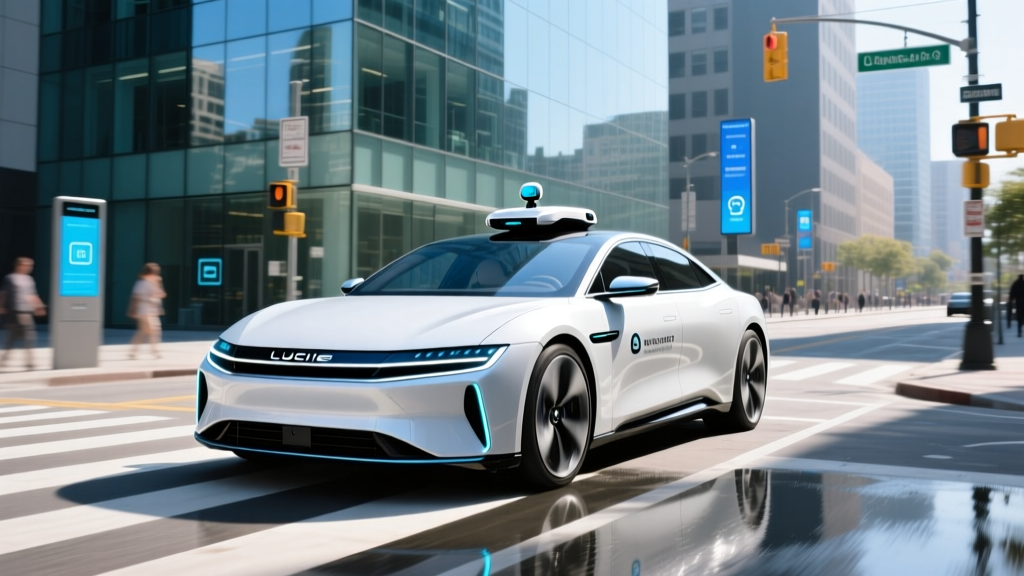
If you've been searching for Lucid Autopilot, you're likely trying to understand the advanced driver-assistance system (ADAS) in the Lucid Air sedan. Here's the first thing to know: Lucid doesn't actually use the name "Autopilot." That's Tesla's branding. Lucid's in-house driver-assistance suite is called DreamDrive, with an upgraded tier named DreamDrive Pro. In this guide, we break down exactly what DreamDrive does, what it doesn't do, the sensor hardware behind it, which trims include it, and how it stacks up against Tesla Autopilot, Ford BlueCruise, and GM Super Cruise.
What Is Lucid DreamDrive and How Does It Work?
DreamDrive is Lucid Motors' proprietary ADAS platform, designed in-house and introduced with the Lucid Air's launch. It bundles adaptive cruise control, lane-centering assist, automated emergency braking, blind-spot monitoring, and a surround-view camera system into a unified software stack that runs on Lucid's custom silicon.
The hardware foundation is one of the most sensor-rich suites in the luxury EV segment:
- 32 sensors total, including cameras, radar, and ultrasonic units
- High-resolution camera array covering forward, side, and rear fields of view
- Long-range forward radar for vehicle and obstacle detection at highway speeds
- LiDAR (on DreamDrive Pro–equipped trims) — a solid-state unit that provides precise 3D depth mapping, giving Lucid a hardware advantage over camera-only systems like Tesla's
- Ultrasonic sensors for low-speed proximity detection and parking assist
The LiDAR inclusion is a meaningful differentiator. It allows DreamDrive Pro to build a real-time 3D model of the vehicle's surroundings independent of camera visibility, which improves performance in low-light conditions and provides redundancy that camera-only systems lack.
| Sensor Type | Quantity | Primary Function |
|---|---|---|
| Cameras (surround-view) | Multiple (front, side, rear) | Lane detection, traffic sign recognition, object classification |
| Long-range radar | 1 (forward) | Vehicle distance/speed measurement at highway speeds |
| LiDAR (solid-state) | 1 (DreamDrive Pro) | 3D depth mapping, low-light redundancy |
| Ultrasonic | Multiple (bumper-mounted) | Near-field obstacle detection, parking assist |
SAE Automation Level: DreamDrive Is Level 2, Not Self-Driving
Lucid DreamDrive and DreamDrive Pro are classified as SAE Level 2 driver-assistance systems under the SAE J3016 framework. This means the system can simultaneously control steering and acceleration/braking under certain conditions, but the driver must remain fully engaged — hands on or near the wheel, eyes on the road, ready to take over at any moment. DreamDrive is not a self-driving system. Only Level 4 services like Waymo One operate without a human driver in defined geographic zones.
This distinction is critical because marketing language around ADAS often blurs the line. Lucid's DreamDrive can maintain your lane, adjust speed to traffic, and even execute certain lane changes with driver confirmation — but at no point can you legally or safely disengage from the driving task. The system monitors driver attention and will issue escalating warnings (visual, audible, then haptic) if it detects inattention, eventually bringing the vehicle to a controlled stop if the driver does not respond.
DreamDrive vs. DreamDrive Pro: What's the Difference?
Lucid splits its ADAS into two tiers, and availability depends on the trim level of the Lucid Air you choose:
| Feature | DreamDrive (Standard) | DreamDrive Pro |
|---|---|---|
| Adaptive Cruise Control (ACC) | ✓ | ✓ |
| Lane-Centering Assist | ✓ | ✓ |
| Automated Emergency Braking | ✓ | ✓ |
| Blind-Spot Monitoring | ✓ | ✓ |
| Surround-View Camera | ✓ | ✓ |
| LiDAR sensor | ✗ | ✓ |
| Hands-free highway driving (eyes-on) | ✗ | ✓ (on supported divided highways) |
| Automatic Lane Change | ✗ | ✓ (driver-confirmed) |
| Intersection Assist | Limited | Enhanced |
DreamDrive Pro is the tier most shoppers compare to Tesla's Full Self-Driving (Supervised), GM's Super Cruise, or Ford's BlueCruise. Its headline capability is hands-free driving on pre-mapped divided highways, though the driver's eyes must remain on the road — a camera-based driver-monitoring system enforces this.
Which Lucid Air Trims Include DreamDrive?
For the 2025–2026 model years, Lucid has structured DreamDrive availability as follows (based on the Lucid Air lineup):
- Lucid Air Pure: DreamDrive standard. DreamDrive Pro not available.
- Lucid Air Touring: DreamDrive standard; DreamDrive Pro available as an option or included depending on model year and package.
- Lucid Air Grand Touring: DreamDrive Pro included.
- Lucid Air Sapphire: DreamDrive Pro included.
Lucid has historically bundled DreamDrive Pro into the higher trims rather than offering it as a standalone subscription, though packaging can shift by model year. Always confirm with your dealer or the Lucid configurator at the time of purchase.
Real-World Capabilities: Where DreamDrive Pro Excels
In highway driving on well-marked, divided interstates, DreamDrive Pro delivers a confident Level 2 experience. The combination of LiDAR, radar, and cameras gives the system strong situational awareness, and lane-centering is notably smooth — less "ping-ponging" between lane lines than some competitors exhibit.
Key real-world strengths:
- Smooth longitudinal control: ACC braking and acceleration feel natural, not abrupt, even in moderate stop-and-go traffic.
- Lane-centering precision: The LiDAR depth map supplements camera lane-detection, which helps on faded lane markings and in construction zones where temporary markings exist.
- Low-light performance: LiDAR doesn't rely on visible light, giving DreamDrive Pro a tangible edge over camera-only systems at night or during heavy glare.
- Driver-monitoring responsiveness: The infrared driver camera accurately tracks eye gaze, allowing genuine hands-free operation on supported roads while maintaining safety guardrails.
- City streets and intersections: DreamDrive Pro is designed for divided highways. It does not handle complex urban intersections, unprotected left turns, or pedestrian-heavy environments autonomously.
- Severe weather: Heavy rain, snow, fog, or ice can degrade camera and LiDAR performance. The system will alert the driver and may disengage, requiring full manual control.
- Construction zones: While LiDAR helps, temporary lane shifts, missing lane markings, and cone layouts still require the driver to take over promptly.
- Unmapped roads: Hands-free operation requires pre-mapped highway segments. On unmapped or newly built roads, the system falls back to hands-on lane-centering.
- No traffic-light or stop-sign recognition for automated stopping: The driver must handle all intersection controls.
Lucid DreamDrive vs. Tesla Autopilot, BlueCruise & Super Cruise
| Feature | Lucid DreamDrive Pro | Tesla Autopilot / FSD (Supervised) | Ford BlueCruise | GM Super Cruise |
|---|---|---|---|---|
| SAE Level | Level 2 | Level 2 | Level 2 | Level 2 |
| LiDAR | Yes (solid-state) | No (camera-only) | No | Yes (on select models) |
| Hands-free highway (eyes-on) | Yes (mapped roads) | No (FSD still requires hands-on wheel torque) | Yes (Hands-Free Blue Zones) | Yes (pre-mapped highways) |
| Automatic lane change | Yes (driver-confirmed) | Yes (FSD, driver-confirmed) | Limited | Yes (driver-confirmed) |
| Driver monitoring | Camera (eye-tracking) | Steering-wheel torque | Camera (eye-tracking) | Camera (eye-tracking) |
| Sensor count | 32 | 8 cameras, no radar (current HW4) | Camera + radar | Camera + radar + LiDAR (select) |
Key takeaway: Lucid's LiDAR-equipped DreamDrive Pro occupies a middle ground. It has richer hardware than Tesla's camera-only approach, comparable hands-free capability to BlueCruise and Super Cruise, but a smaller mapped-road network than GM's Super Cruise (which covers over 750,000 miles of North American highways as of 2025). Lucid has been expanding its mapped-road coverage via over-the-air updates, but if you frequently drive rural or less-traveled interstates, verify that your routes are supported.
Cost: Is DreamDrive a Subscription or One-Time Purchase?
| Item | Cost | Notes |
|---|---|---|
| DreamDrive (base) | Included (no extra charge) | Standard on all Lucid Air trims |
| DreamDrive Pro | Included on Grand Touring & Sapphire; optional on Touring | Not available on Pure trim |
| Subscription fee | None currently | Lucid does not charge a recurring subscription for DreamDrive Pro as of 2026 |
| OTA updates | Included | Feature improvements delivered via over-the-air software updates |
This is a significant advantage over Tesla's approach. Tesla charges approximately $8,000 one-time or $99/month for FSD (Supervised) as of 2026. Ford's BlueCruise offers a complimentary trial period followed by a subscription (roughly $75/month or $800/year after the trial). GM's Super Cruise typically includes a 3-year complimentary period, after which a subscription applies (approximately $25/month).
Lucid's decision to bundle DreamDrive Pro into the vehicle price — with no subscription — simplifies ownership cost. You're paying for it in the MSRP of the Grand Touring ($125,000+) or Sapphire ($249,000), but there are no surprise recurring charges.
Safety Context and NHTSA Considerations
The National Highway Traffic Safety Administration (NHTSA) has increased scrutiny of all Level 2 ADAS systems, including standing orders requiring manufacturers to report crashes involving automated driving features. Lucid, like all automakers offering Level 2 systems, is subject to these reporting requirements.
DreamDrive includes several safety layers:
- Automated Emergency Braking (AEB) with pedestrian detection
- Rear cross-traffic alert with automatic braking
- Driver incapacitation protocol: If the driver fails to respond to escalating attention warnings, the system will activate hazard lights, gradually decelerate, and bring the vehicle to a stop in its lane
- Intersection collision warning (DreamDrive Pro)
The Lucid Air has earned strong safety ratings. Check the latest IIHS and NHTSA scores for the specific model year, as ratings are updated annually.
Frequently Asked Questions
Is Lucid DreamDrive the same as Tesla Autopilot?
No. "Lucid Autopilot" is a common search term, but Lucid's system is branded DreamDrive (and DreamDrive Pro for the higher tier). It uses a different sensor suite — notably including LiDAR, which Tesla does not use — and is developed entirely in-house by Lucid Motors.
Can DreamDrive Pro drive the car by itself?
No. DreamDrive Pro is an SAE Level 2 system. It can control steering and speed simultaneously on supported divided highways with your eyes on the road, but you must remain alert and ready to take over immediately. It is not autonomous or self-driving.
Does DreamDrive work in rain or snow?
DreamDrive functions in light rain, but heavy precipitation, snow, fog, or ice on sensors can cause degradation or disengagement. The system will notify you and revert to manual driving. LiDAR provides some advantage over camera-only systems in low-visibility conditions, but it is not immune to weather interference.
Do I have to pay a monthly subscription for DreamDrive Pro?
As of 2026, no. Lucid includes DreamDrive Pro in the purchase price of eligible trims (Grand Touring, Sapphire) and does not charge a recurring subscription. This differs from Tesla FSD, Ford BlueCruise (post-trial), and GM Super Cruise (post-complimentary period).
Will DreamDrive Pro get better over time?
Yes. Lucid delivers over-the-air (OTA) software updates that can improve ADAS performance, expand mapped-road coverage, and add new features. However, hardware capabilities (sensor count, LiDAR resolution) are fixed at the time of manufacture.
Which Lucid models offer DreamDrive Pro?
As of the 2025–2026 model years, DreamDrive Pro is available on the Lucid Air Touring (optional), and included on the Lucid Air Grand Touring and Lucid Air Sapphire. The Air Pure includes base DreamDrive only. The upcoming Lucid Gravity SUV is expected to offer DreamDrive Pro, but final packaging should be confirmed at launch.