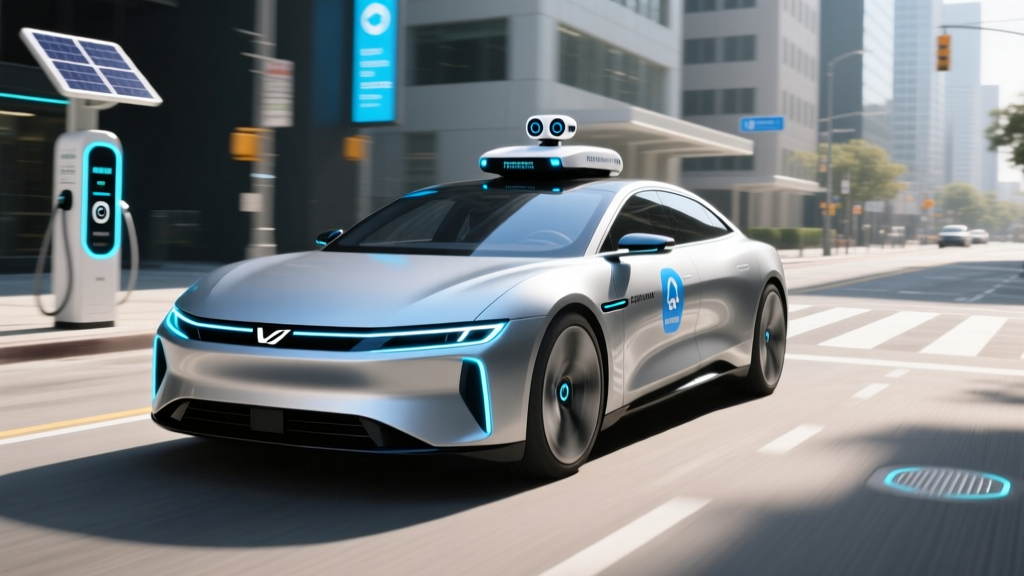
If you've searched for "Lucid Air self driving," you've likely encountered a tangle of marketing language, YouTube thumbnails, and forum debates. The short answer: the Lucid Air is not a self-driving car. It offers one of the most sophisticated driver-assistance systems on the market — called DreamDrive Pro — but it remains an SAE Level 2 system that requires your full attention at all times.
That distinction matters enormously, both legally and practically. Below, we break down exactly what the Lucid Air's ADAS can and cannot do, how its sensor stack compares to competitors, where it sits in the broader autonomous-vehicle landscape, and what real owners should expect on the highway in 2026.
SAE Automation Levels: Where the Lucid Air Actually Sits
The Society of Automotive Engineers (SAE) defines six levels of driving automation, from Level 0 (no automation) to Level 5 (full automation everywhere, no steering wheel needed). Understanding these levels is essential before evaluating any "self-driving" claim.
| Level | Name | Who Drives? | Example |
|---|---|---|---|
| 0 | No Automation | Human | Basic cruise control |
| 1 | Driver Assistance | Human | Adaptive cruise OR lane-keep |
| 2 | Partial Automation | Human (must supervise) | Tesla Autopilot, Lucid DreamDrive Pro, GM Super Cruise, Ford BlueCruise |
| 3 | Conditional Automation | System (in limited conditions) | Mercedes Drive Pilot (approved in NV/CA, <40 mph) |
| 4 | High Automation | System (geofenced, no driver needed) | Waymo One, Zoox |
| 5 | Full Automation | System (everywhere) | Does not yet exist commercially |
DreamDrive Pro: Lucid's Sensor Stack and Technology
Lucid equips the Air (Pure, Touring, Grand Touring, and Sapphire trims) with its DreamDrive Pro ADAS suite. Unlike Tesla's camera-only approach, Lucid uses a multi-modal sensor array that includes lidar — a meaningful hardware advantage in certain scenarios.
Lucid Air DreamDrive Pro — Sensor Inventory
- 1x Solid-state lidar (roof-mounted, forward-facing; provides precise 3D depth mapping up to ~250 meters)
- 5x Radar units (1 forward long-range, 4 corner radars for blind-spot and cross-traffic)
- 14x Cameras (surround-view, forward telephoto, cabin-monitoring)
- 12x Ultrasonic sensors (close-range parking and low-speed obstacle detection)
- High-definition GPS + IMU (inertial measurement unit for precise localization)
This 32-sensor suite gives the Air redundancy that camera-only systems lack. Lidar, in particular, provides reliable distance measurement regardless of lighting conditions — a critical advantage at night, in glare, or when encountering stationary objects on the roadway.
What DreamDrive Pro Actually Does
The DreamDrive Pro package enables the following Level 2 features:
- Adaptive Cruise Control (ACC): Maintains set speed and following distance, including stop-and-go traffic
- Lane Centering Assist: Actively keeps the vehicle centered in marked lanes
- Highway Assist: Combines ACC and lane centering for sustained highway driving on divided roads
- Automatic Lane Change: Executes lane changes when the driver confirms via turn signal (not hands-free)
- Emergency Steering Assist: Can apply corrective steering to avoid imminent collisions
- 3D Surround View + Parking Assist: Bird's-eye camera view and semi-automated parking maneuvers
Lucid has discussed a future "DreamDrive" hardware upgrade path that could support hands-free driving on mapped highways, similar to GM's Super Cruise or Ford's BlueCruise. However, as of the 2026 model year, Lucid Air requires hands on the steering wheel at all times when using these features. The cabin-monitoring camera tracks driver attention, and the system will issue escalating warnings — eventually bringing the car to a controlled stop — if it detects disengagement.
Lucid Air Self-Driving vs. Tesla FSD, Mercedes Drive Pilot, and Robotaxis
To understand where the Lucid Air fits, it helps to compare it directly against other systems that buyers frequently confuse with full autonomy.
| System | SAE Level | Hands-Free? | Eyes-Free? | Sensor Approach | Operational Domain |
|---|---|---|---|---|---|
| Lucid DreamDrive Pro | Level 2 | No | No | Lidar + radar + cameras | Highways, surface streets |
| Tesla FSD (Supervised) | Level 2 | No | No | Cameras only | Most roads (driver supervises) |
| GM Super Cruise | Level 2 | Yes (mapped roads) | No | Lidar-mapped HD maps + cameras + radar | ~750,000+ miles of compatible roads |
| Ford BlueCruise 1.4 | Level 2 | Yes (mapped roads) | No | Cameras + radar + HD maps | ~130,000+ miles of divided highways |
| Mercedes Drive Pilot | Level 3 | Yes | Yes (conditional) | Lidar + cameras + radar + HD maps | Approved highways, <40 mph, good weather (NV, CA) |
| Waymo One | Level 4 | N/A (no driver) | N/A | Lidar + cameras + radar | Geofenced metro areas (Phoenix, SF, LA, Austin) |
The Lucid Air's hardware stack is arguably more robust than Tesla's camera-only system and competitive with GM and Ford. But Lucid has been more conservative in software deployment, choosing not to enable hands-free driving until it can validate the system more extensively. This is a defensible engineering decision — it also means the Air currently offers less hands-off convenience than a Cadillac Lyriq or Ford Mustang Mach-E equipped with their respective hands-free systems.
Current Limitations: What DreamDrive Pro Cannot Do
Every Level 2 system has operational boundaries. Here are the specific scenarios where Lucid DreamDrive Pro will disengage, limit functionality, or require immediate human takeover:
⚠️ Limitations Warning — Lucid DreamDrive Pro
- No hands-free operation: Torque must be detected on the steering wheel at all times
- Construction zones: Cone detection and temporary lane reconfigurations can confuse the system; expect to take over
- Unmarked or poorly marked roads: Lane centering requires visible, well-maintained lane markings
- Heavy precipitation: Rain, snow, or fog can degrade camera and lidar performance; the system may restrict or disable Highway Assist
- Low-speed urban navigation: The system does not handle traffic lights, stop signs, or complex intersections autonomously
- Unmapped roads: While less dependent on HD maps than Super Cruise, the system performs best on well-documented divided highways
- Edge cases: Merging from on-ramps, navigating toll plazas, and encountering emergency vehicles still require driver judgment
In real-world testing on Interstate highways in dry conditions, DreamDrive Pro performs admirably — smooth lane-keeping, confident following-distance management, and reliable curve handling. But push into a work zone with shifted lanes and faded markings, and you'll immediately understand why this is Level 2, not Level 4.
Safety Data: What We Know About Lucid ADAS Incidents
Unlike Tesla, which publishes periodic safety reports, or Waymo, which shares detailed incident data with NHTSA, Lucid has not released granular ADAS performance statistics as of early 2026. Here is what is publicly available:
Lucid Air Safety Context
- NHTSA Standing General Order: All manufacturers of Level 2+ ADAS must report crashes involving their systems. Lucid is subject to this requirement, but individual incident data is aggregated at the industry level by NHTSA rather than published per-manufacturer in real time.
- IIHS Ratings: The Lucid Air has earned strong marks in IIHS crashworthiness testing. However, IIHS has noted that no current Level 2 system — including DreamDrive Pro — qualifies for their "good" rating in driver-monitoring adequacy, as all still permit extended periods of inattention before intervention.
- Recall history: Lucid has issued software-related recalls for early Air models (notably a 2023 recall affecting approximately 5,700 vehicles related to a loss-of-propulsion risk, unrelated to DreamDrive). Check NHTSA's recall database for the latest on your specific VIN.
- Industry context: Across all Level 2 systems, NHTSA data shows that the majority of reported ADAS-involved crashes occur in rear-end scenarios at low speeds on surface streets — not highway scenarios where these systems perform best.
The honest assessment: without Lucid publishing its own disengagement-rate data or miles-driven-without-intervention statistics, buyers cannot quantitatively compare DreamDrive Pro's safety record against Tesla's FSD or GM's Super Cruise. The multi-sensor approach with lidar provides theoretical redundancy advantages, but software maturity and edge-case handling matter just as much as hardware.
The Regulatory Landscape for ADAS in 2026
Understanding who regulates what helps explain why the Lucid Air is Level 2 and not more:
- Federal (NHTSA): Regulates vehicle safety standards and post-market defect/recall authority. Does not "approve" ADAS features before sale but can investigate and mandate recalls.
- State level: States control driver licensing, traffic laws, and — critically — whether hands-free or eyes-off driving is legal. Mercedes Drive Pilot's Level 3 status is only valid in Nevada and California because those states specifically passed legislation enabling conditional automation. In most states, hands-off-wheel Level 2 features (like Super Cruise) operate in a gray area that's generally tolerated but not explicitly authorized.
- Lucid's approach: By keeping DreamDrive Pro as a hands-on Level 2 system, Lucid avoids the regulatory complexity of Level 3 certification and the liability shift that comes with the manufacturer accepting responsibility for driving (as Mercedes does with Drive Pilot under 40 mph in approved zones).
Is Lucid Working on Higher Autonomy or a Robotaxi Platform?
Lucid has made public statements about the long-term potential of its sensor-rich platform to support higher levels of autonomy. The lidar-equipped hardware in the Air is, in principle, closer to a robotaxi-grade sensor suite than Tesla's camera-only approach. However:
- Lucid has not announced a specific timeline for hands-free Level 2+ capability (comparable to Super Cruise or BlueCruise).
- Lucid has not announced any robotaxi or Level 4 service plans.
- Lucid's current business focus remains on scaling vehicle production (Air, Gravity SUV, and the upcoming midsize platform) rather than autonomous-ride-hail services.
If you're evaluating the Lucid Air with the hope that a future over-the-air update will transform it into a self-driving car, there is no public evidence to support that expectation within the next several model years. Buy the Air for its class-leading efficiency, 500+ mile EPA range, and premium driving dynamics — not for an autonomy roadmap that hasn't been announced.
Lucid Air DreamDrive Pro: Ownership Practicalities
For current and prospective Air owners, here's what matters about living with DreamDrive Pro day to day:
| Trim | Base MSRP | EPA Range | Battery (usable) | 0-60 mph | DreamDrive Pro |
|---|---|---|---|---|---|
| Pure RWD | $69,900 | 419 mi | 88 kWh (NMC) | 5.0 sec | Standard |
| Touring AWD | $77,900 | 406 mi | 92 kWh (NMC) | 3.4 sec | Standard |
| Grand Touring AWD | $109,900 | 516 mi | 112 kWh (NMC) | 3.0 sec | Standard |
| Sapphire | $249,000 | 427 mi | 118 kWh (NMC) | 1.89 sec | Standard |
Note: EPA range is a laboratory estimate. Real-world highway driving at 75+ mph typically yields 80-90% of EPA figures. Cold weather (below freezing) can reduce range by 20-35% depending on cabin heating load and whether the Air's heat pump is active. The Grand Touring's 516-mile EPA rating is among the highest of any production EV, but expect roughly 410-440 miles on a long highway trip in moderate temperatures.
DreamDrive Pro comes standard on all 2026 Air trims — there is no separate subscription fee (unlike Tesla's FSD, which costs $8,000 upfront or $99/month). This is a significant value differentiator: you're getting a lidar-equipped ADAS suite bundled into the vehicle price.
Frequently Asked Questions
Is the Lucid Air self-driving?
No. The Lucid Air is an SAE Level 2 vehicle. Its DreamDrive Pro system can control steering and acceleration simultaneously on highways, but the driver must keep hands on the wheel, eyes on the road, and remain responsible for all driving decisions at all times.
Does the Lucid Air have lidar?
Yes. All Lucid Air trims include a roof-mounted solid-state lidar unit as part of the DreamDrive Pro 32-sensor suite. This gives the Air a hardware advantage over camera-only systems like Tesla's, particularly for depth perception in low-light or high-glare conditions.
Can the Lucid Air change lanes by itself?
DreamDrive Pro supports automatic lane changes, but only when the driver initiates the command via the turn signal stalk. The system then checks for safe gaps and executes the lane change. It does not make autonomous lane-change decisions without driver confirmation.
Will Lucid add hands-free driving via an OTA update?
Lucid has discussed the potential for hands-free capability in future software updates, but as of the 2026 model year, no hands-free feature has been announced or deployed. The hardware is theoretically capable, but software validation and regulatory approval are separate challenges.
How does DreamDrive Pro compare to Tesla's Full Self-Driving?
Both are Level 2 systems requiring full driver supervision. Tesla FSD (Supervised) covers a broader range of scenarios including city streets, stop lights, and parking lots, but relies solely on cameras. DreamDrive Pro is more limited in scope (primarily highway-focused) but benefits from lidar and radar redundancy. Neither is "self-driving" — both require you to pay attention and take over at any time.
Is there a subscription fee for Lucid DreamDrive Pro?
No. DreamDrive Pro is included as standard equipment on all 2026 Lucid Air trims with no additional purchase cost or monthly subscription.
Where can I use DreamDrive Pro?
DreamDrive Pro works on most well-marked divided highways and surface streets across the United States. It is not geofenced to specific regions like Mercedes Drive Pilot or Waymo's robotaxi service. However, performance degrades in construction zones, poor weather, and roads with faded or absent lane markings.