What Lidar Self-Driving Actually Means for Robotaxis
When you hear "lidar self-driving," you're hearing about the sensor backbone that enables true driverless vehicles — cars that navigate city streets, handle intersections, and drop passengers off without anyone behind the wheel. Lidar (Light Detection and Ranging) fires millions of laser pulses per second to build a real-time, centimeter-accurate 3D map of the vehicle's surroundings. Unlike cameras, lidar works in total darkness, sees through glare, and measures distance directly rather than inferring it from pixels.
As of 2026, every major commercial robotaxi service operating in the United States — Waymo, Zoox, and the restructured Cruise operation — relies on lidar as a core sensor. This stands in sharp contrast to Tesla's camera-only approach for its supervised Full Self-Driving system. The distinction matters enormously: lidar-equipped robotaxis operate at SAE Level 4, meaning no human driver is present or needed within their operational domain. Camera-only FSD remains a Level 2 driver-assist system that requires constant human supervision.
| Level | Who Drives | Example |
|---|---|---|
| Level 2 | Human (hands on or eyes on) | Tesla Autopilot/FSD Supervised, GM Super Cruise, Ford BlueCruise |
| Level 3 | System (human must take over on request) | Mercedes Drive Pilot (limited markets, ≤40 mph) |
| Level 4 | System (no human needed in defined area) | Waymo One, Zoox, Cruise (geofenced cities) |
| Level 5 | System (everywhere, all conditions) | Does not exist commercially |
Understanding this hierarchy is essential. When Waymo pulls up to your curb with an empty driver's seat, that's Level 4 lidar self-driving. When your Tesla navigates a highway on-ramp with FSD, that's Level 2 driver-assist — impressive, but legally and technically not self-driving.
The Lidar Self-Driving Tech Stack: Sensors, Compute, and Geofencing
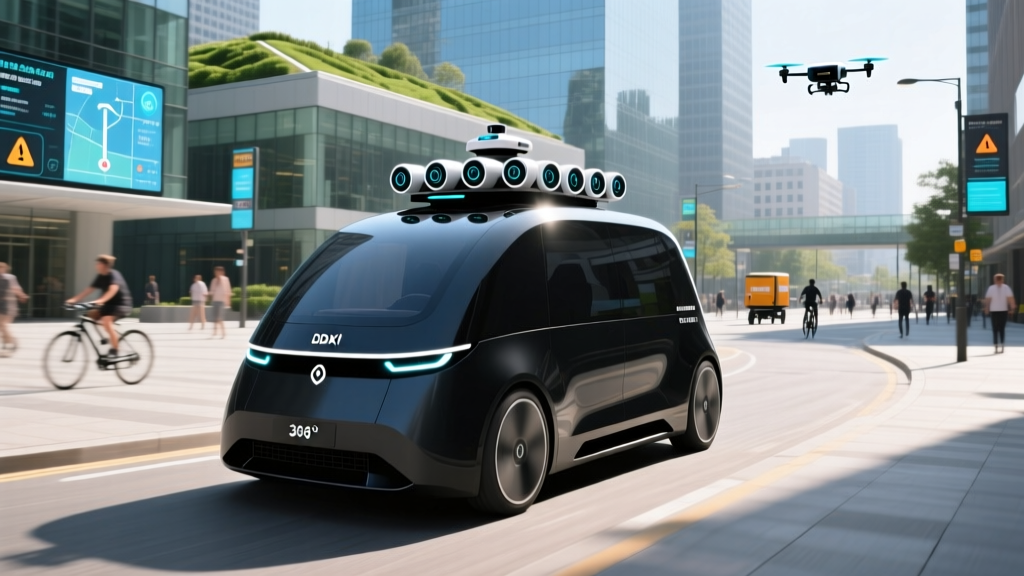
Modern robotaxi sensor suites are redundant by design. No single sensor type handles every scenario, so lidar is fused with cameras, radar, and sometimes ultrasonic sensors to create a layered perception system.
| Sensor | Role | Strength | Limitation |
|---|---|---|---|
| Lidar (roof + sides) | 3D point-cloud mapping, object detection | Precise depth, works in dark | Heavy rain/snow scattering |
| Cameras (8-20+ units) | Color, text/sign reading, lane markings | High resolution, semantic detail | Glare, darkness, fog |
| Radar (4-6 units) | Velocity measurement, long-range detection | Weather-penetrating, speed data | Low angular resolution |
| Ultrasonic (short-range) | Nearby obstacles, parking | Cheap, reliable at <5 m | Very short range only |
| HD Maps + GNSS/IMU | Localization, route planning | Centimeter-level positioning | Requires pre-mapped areas |
Waymo's 6th-generation hardware, deployed across its Jaguar I-Pace fleet and newer Zeekr RT vehicles, uses roof-mounted lidar units with a 360° field of view and detection range exceeding 500 meters. The system processes sensor data through custom-designed AI accelerators mounted in the trunk, capable of hundreds of trillions of operations per second.
Zoox, owned by Amazon, takes a different vehicle approach: its purpose-built carriage has no steering wheel or pedals, with symmetrical design allowing it to drive in either direction. Zoox uses a dense lidar array covering the full 360° environment with overlapping fields of view for redundancy.
Geofencing is what keeps Level 4 practical. Each robotaxi service maps its operational area down to the lane level — every curb, signal, crosswalk, and construction zone is pre-cataloged. The vehicle will not operate outside this geofenced boundary. If you request a ride to an unmapped address, the app simply won't let you set that destination.
Where Can I Use a Robotaxi Service Right Now?
Robotaxi availability expanded significantly through 2025 and into 2026, but service remains confined to specific metro areas and, within those areas, to geofenced zones. Here's the current operational landscape:
| Service | Live Cities (2026) | Hours | Access |
|---|---|---|---|
| Waymo One | Phoenix (metro-wide), San Francisco, Los Angeles, Austin | 24/7 in most zones | Open to public via Waymo app |
| Zoox | Las Vegas (Strip corridor + downtown), San Francisco (limited zones), Foster City | Limited hours | Invite-only / expanding public access |
| Cruise | Phoenix, Dallas, Houston (phased relaunch with safety drivers first) | Daytime initially | Limited beta; driverless TBD |
Waymo is the clear leader in commercial scale. In Phoenix, the service covers over 200 square miles — essentially the entire East Valley from Scottsdale to Chandler. San Francisco service covers most of the city, and Los Angeles expanded from downtown to cover a corridor stretching from Santa Monica through Hollywood to Pasadena. Austin launched commercially in late 2025.
If you're in one of these cities, download the Waymo One app, enter your destination, and the app will confirm whether both pickup and dropoff fall within the geofence. If they do, you'll see an estimated price and wait time — typically 3-8 minutes in dense zones.
How Much Does a Robotaxi Cost vs Uber and Lyft?
Robotaxi pricing is designed to compete directly with rideshare, and in many scenarios it undercuts Uber and Lyft — especially during surge pricing periods when human-driver supply is thin.
| Route Example | Waymo One | UberX | Lyft Standard |
|---|---|---|---|
| SFO Airport → Downtown SF (~14 mi) | $35–$45 | $38–$55 | $36–$52 |
| Scottsdale → Phoenix Sky Harbor (~12 mi) | $25–$35 | $28–$42 | $26–$40 |
| Hollywood → Santa Monica (~16 mi) | $30–$42 | $32–$50+ | $30–$48 |
| Short downtown trip (~3 mi) | $10–$15 | $12–$18 | $11–$17 |
Key pricing dynamics:
- No surge pricing: Waymo does not currently implement surge multipliers the way Uber and Lyft do during peak demand. Instead, wait times may increase when fleet capacity is strained.
- Tips not expected: There's no driver to tip. Some riders report the app doesn't even surface a tipping option.
- Promotional credits: New users in expansion cities often receive $5–$15 in ride credits.
- Per-mile economics: Waymo's pricing works out to roughly $1.50–$2.50/mile depending on the market, competitive with rideshare's off-peak rates.
The long-term economic thesis for robotaxi operators is that removing the driver — who typically takes 60-75% of the fare — allows pricing below rideshare while still achieving profitability at scale. That scale hasn't been reached yet; Waymo's parent Alphabet continues to subsidize operations, though the unit economics are improving as fleet utilization rises.
Robotaxi Safety: What the Real Data Shows
Safety is the most scrutinized — and most misunderstood — aspect of lidar self-driving. Let's look at what the data actually says rather than relying on anecdotes or marketing.
- Over 50 million fully driverless miles completed across Phoenix, San Francisco, Los Angeles, and Austin as of early 2026.
- Injury-relevant crash rate: 85% lower than human benchmarks in comparable urban environments, per a NHTSA-reviewed study published by Waymo and Swiss Re.
- Property-damage-only crash rate: 76% lower than human benchmarks.
- Most contact incidents: Low-speed (<15 mph), typically involving another human driver violating right-of-way. The robotaxi is rarely the at-fault party.
- Disengagement metric is misleading: Waymo does not publish traditional "miles per disengagement" because the vehicles are driverless — there's no human to "disengage" from. Instead, they report "remote assistance" events, where a teleoperations specialist provides guidance (not direct steering). These occur roughly once per several thousand miles and usually involve construction zones or unusual road configurations.
The Cruise incident in San Francisco in late 2023 — where a pedestrian was struck by a human-driven vehicle and then dragged under a Cruise robotaxi — prompted a statewide suspension and a fundamental restructuring of Cruise's operations. The National Highway Traffic Safety Administration and California DMV both investigated. Cruise has since relaunched with safety drivers in select cities and is working back toward driverless operations under stricter oversight.
For context on exposure: Waymo operates roughly 1,000+ vehicles across its markets and completes over 150,000 paid rides per week. The fleet is on the road 24/7 in most markets, including overnight hours when human crash rates spike due to impairment and fatigue.
It's worth noting that IIHS has begun evaluating robotaxi safety systems, though formal crash-test ratings for purpose-built robotaxi vehicles (like the Zoox carriage) remain a developing area. The regulatory framework for testing autonomous vehicle safety is still maturing.
Regulatory Landscape: Who Approves Robotaxi Operations?
Robotaxi deployment in the United States involves a layered approval process that varies significantly by state:
- California (DMV + CPUC): The DMV issues testing and deployment permits. The California Public Utilities Commission (CPUC) authorizes commercial paid service. After the Cruise suspension, California tightened reporting requirements and now mandates real-time incident disclosure within specified timeframes.
- Arizona: The most permissive major market. No special state permit is required beyond standard vehicle registration and insurance. Phoenix's regulatory environment is why Waymo launched commercially there first.
- Texas: Austin and other cities have welcomed robotaxi testing. Texas passed legislation in 2023 creating a framework for autonomous vehicle operation, with oversight through the Texas Department of Licensing and Regulation.
- Nevada: Has an established autonomous vehicle testing framework. Zoox operates in Las Vegas under state authorization.
- Federal (NHTSA): NHTSA sets vehicle safety standards (FMVSS) but has been slow to update them for vehicles without steering wheels. Zoox received a special exemption to deploy its steering-wheel-free carriage, but the exemption process is lengthy and case-by-case. Congress has not passed comprehensive federal autonomous vehicle legislation as of 2026.
The patchwork regulatory environment means that a robotaxi service legal in Phoenix may face years of approval processes before operating in, say, Miami or Chicago. State and city-level political dynamics — including concerns from taxi unions, pedestrian safety advocates, and first responders — heavily influence expansion timelines.
Current Limitations of Lidar Self-Driving Robotaxis
- Heavy snow and ice: Lidar pulses scatter off dense precipitation. Waymo suspends service in Phoenix monsoon downpours and does not operate in snow-belt cities. No commercial robotaxi service operates in Minneapolis, Chicago winter, or similar conditions.
- Unmapped roads: If the street isn't in the HD map, the car won't go there. New construction, recently modified intersections, and rural roads are all off-limits.
- Airport pickups (most): Many airport authorities have not yet authorized driverless curb pickups. Waymo can drop off at SFO and PHX but airport pickup availability varies by terminal and agreement.
- Highway driving at full speed: Most robotaxi geofences prioritize surface streets. Waymo does operate on some freeways (e.g., Phoenix's Loop 101, sections of I-10), but highway expansion is gradual and carefully validated.
- Complex construction zones: While the system handles basic lane shifts and temporary signals, major multi-phase construction may trigger remote assistance or route rerouting.
- Off-road or unpaved roads: Strictly paved, mapped surfaces only.
- Passenger emergencies: There is no driver to assist with a medical emergency, child seat installation, or loading heavy luggage. An in-app support line connects to remote operators, but physical assistance requires calling 911.
Weather is the most consequential limitation. Lidar self-driving works superbly in the clear, dry conditions of Phoenix and Los Angeles. It degrades in fog (San Francisco's summer marine layer causes occasional service adjustments), heavy rain, and snow. This is a physics problem, not a software problem — laser light scatters off water droplets and ice crystals, reducing the effective range and fidelity of the point cloud.
The industry is addressing this through sensor fusion improvements (leaning more on radar in poor visibility) and next-generation lidar with longer wavelengths that penetrate precipitation better. But as of 2026, no robotaxi operates in a city with regular snowfall.
Is This Truly Self-Driving or Just Advanced Driver-Assist?
This question cuts to the core of public confusion about autonomous vehicles, and the answer depends entirely on which system you're discussing:
Waymo One, Zoox, and driverless Cruise operations are genuinely self-driving within their geofence. There is no human in the driver's seat. No one is monitoring the road. The vehicle handles all driving tasks — lane changes, left turns across traffic, four-way stops, pedestrian detection, signal compliance — without human input. A remote teleoperations team monitors fleet health and can provide high-level guidance (e.g., "proceed past the cone"), but they do not steer or brake the vehicle in real time.
Tesla FSD Supervised, GM Super Cruise, Ford BlueCruise, and all consumer ADAS features are not self-driving. These are SAE Level 2 systems. The human driver is legally and operationally responsible for the vehicle at all times. You must keep your eyes on the road (or hands on the wheel, depending on the system). If you disengage mentally and a scenario exceeds the system's capability, you are at fault for whatever happens.
The conflation of these two categories — Level 4 robotaxi and Level 2 driver-assist — is the single biggest source of misinformation in the autonomous driving space. When a news headline says "self-driving car crash," always check: was there a driver present? If yes, it was Level 2 driver-assist, and the human was responsible. If no, it was Level 4, and the operating company bears responsibility.
Frequently Asked Questions
Can I hail a robotaxi in any city?
No. As of 2026, commercial driverless robotaxi service is available in Phoenix, San Francisco, Los Angeles, Austin, and Las Vegas (limited). Expansion to new cities requires regulatory approval, HD mapping, and fleet deployment that takes 12-24 months per market. Cities like Miami, Atlanta, and Nashville are in various stages of testing or approval but do not yet have open commercial service.
What happens if the robotaxi gets confused or stuck?
The vehicle will pull over safely and contact a remote assistance specialist. The specialist reviews the situation through the vehicle's cameras and sensors, then provides guidance — such as confirming it's safe to proceed around a double-parked car. The specialist does not remotely drive the car. If the situation cannot be resolved, the ride is canceled and support arranges alternative transportation.
Are robotaxis wheelchair accessible?
Waymo's current fleet (Jaguar I-Pace) is not wheelchair-accessible. The company has announced a partnership with Stellantis to develop an accessible vehicle based on the Pacifica platform, but widespread accessible robotaxi service is not yet available. This remains a significant equity and ADA-compliance concern that regulators are pressing.
How do robotaxis handle emergency vehicles?
The sensor suite detects emergency vehicle lights and sirens. The system is programmed to pull to the right and stop, consistent with traffic law. Waymo publishes data showing that emergency-vehicle interaction is one of the most extensively validated scenarios in their testing. First responder agencies in operating cities have direct communication channels with robotaxi fleet operations centers.
Will lidar self-driving eventually replace all human driving?
Not in any foreseeable timeframe. Level 4 robotaxis will expand to more cities and handle more scenarios over the next decade, but Level 5 autonomy (any road, any weather, any condition) remains a research challenge with no proven solution. Personal car ownership, human-driven rideshare, and conventional transit will coexist with robotaxis for decades. The realistic near-term outcome is robotaxis handling a meaningful share of urban point-to-point trips in favorable-weather cities.
What's the environmental impact of robotaxi fleets?
Waymo's fleet is fully electric (Jaguar I-Pace, transitioning to Zeekr RT). Zoox's purpose-built vehicle is also battery-electric. The environmental benefit depends on fleet utilization — an electric robotaxi driving empty between rides ("deadheading") still consumes energy. Studies suggest that at high utilization rates, shared electric robotaxis produce lower per-passenger-mile emissions than personal vehicles, but comprehensive lifecycle analyses are still developing.
Sources: Safety data referenced from NHTSA filings and Waymo's published safety case; regulatory information from California DMV and CPUC public records; operational details from Waymo and Zoox official channels. Pricing estimates based on observed fares in operating markets and may vary by demand and route.