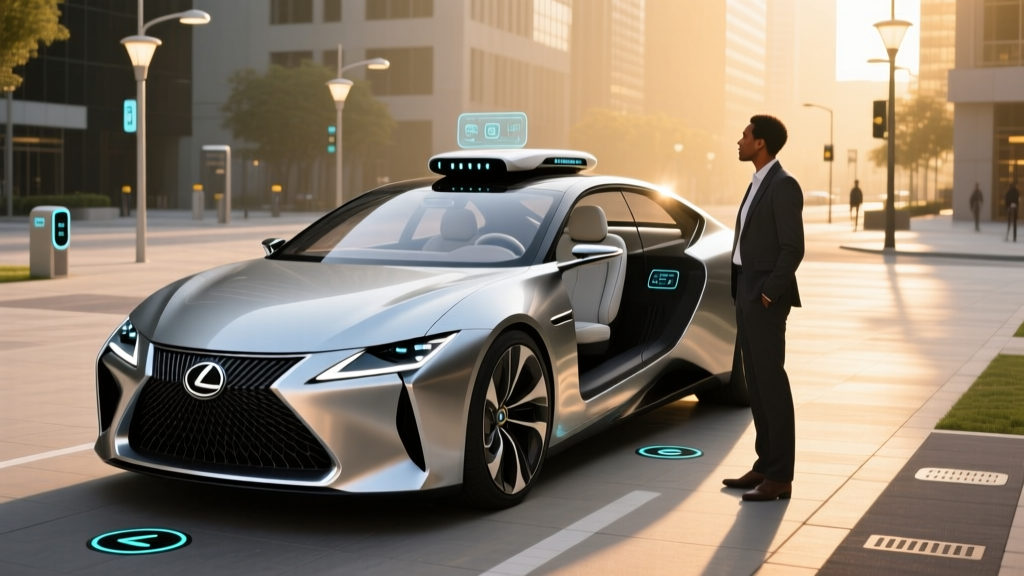
If you've searched for a "Lexus self driving car" lately, you've likely hit a wall of conflicting headlines. Some articles suggest Toyota's luxury brand is on the verge of launching a driverless fleet. Others point to the Lexus RX and LS sedans gliding through highway traffic hands-free. The truth sits somewhere specific and measurable: Lexus offers one of the most capable Level 2 driver-assistance systems on the market under the Teammate and Advanced Drive banners, and Toyota's research arm is testing Level 4 robotaxi prototypes on public roads. But a commercially available, driverless Lexus you can hail today? That doesn't exist yet.
This guide cuts through the noise. We'll map exactly what Lexus autonomy looks like in 2026, where the technology stands on the SAE automation scale, what the safety data actually says, and how Lexus's trajectory compares to live robotaxi services like Waymo and Cruise.
What Lexus Self-Driving Tech Actually Is in 2026
Lexus does not sell a self-driving car. What it does sell is Lexus Teammate — a suite of driver-assistance features bundled under the broader Lexus Safety System+ 3.0 platform. On select 2026 models (notably the RX, LS, and LX), Teammate includes a feature called Advanced Drive, which provides hands-off, eyes-on highway driving under specific conditions.
Here's the critical distinction: Advanced Drive requires the driver to remain attentive and ready to take over at any moment. The system monitors driver engagement through a cabin-facing camera and will issue escalating warnings — and eventually bring the vehicle to a controlled stop — if the driver looks away or fails to respond.
Lexus Teammate / Advanced Drive is classified as SAE Level 2 — partial automation. The vehicle can control steering, acceleration, and braking simultaneously, but the human driver must supervise at all times. This is the same automation tier as Tesla Autopilot, GM Super Cruise, and Ford BlueCruise. It is not self-driving. Only Level 4 systems (like Waymo's robotaxi fleet) operate without a human driver in the loop.
| Level | Name | Who Drives? | Example |
|---|---|---|---|
| 0 | No Automation | Human | Basic cruise control |
| 1 | Driver Assistance | Human | Adaptive cruise OR lane-keeping |
| 2 | Partial Automation | Human (supervising) | Lexus Teammate, Tesla Autopilot, Super Cruise |
| 3 | Conditional Automation | System (in limited conditions) | Mercedes Drive Pilot (limited markets) |
| 4 | High Automation | System (geofenced) | Waymo One, Zoox |
| 5 | Full Automation | System (everywhere) | None commercially available |
Lexus Teammate and Advanced Drive: What You Get
The 2026 Lexus Teammate suite, available on the RX (from $52,900), LS (from $80,650), and LX (from $93,550), includes these core functions:
- Advanced Drive (hands-off highway assist): Maintains lane position, manages speed relative to traffic, and handles gentle curves on divided highways. Operates up to approximately 85 mph. Requires hands off the wheel but eyes on the road, monitored by an infrared driver-facing camera.
- Lane Change Assist: On select trims with navigation-linked cruise control, the system can suggest and execute lane changes when the driver confirms via the turn signal stalk.
- Pre-Collision System with Pedestrian Detection: Forward-facing radar and camera detect vehicles, cyclists, and pedestrians, applying automatic emergency braking.
- Dynamic Radar Cruise Control (Full-Speed): Stop-and-go adaptive cruise that functions from 0 mph to highway speeds.
- Road Sign Assist: Camera-based recognition of speed limit, stop, and do-not-enter signs, displayed in the instrument cluster.
The sensor suite relies on a combination of millimeter-wave radar (forward and rear), a monocular forward camera, ultrasonic sensors for close-range parking assist, and the driver-monitoring camera. Notably, Lexus does not use lidar in its production driver-assistance systems — a deliberate cost and packaging choice that differentiates it from Level 4 robotaxi platforms.
Toyota and Lexus Robotaxi Efforts: Woven City and Beyond
While production Lexus vehicles remain Level 2, Toyota's research entities are actively developing Level 4 autonomous technology. Woven by Toyota (formerly Woven Planet Holdings) is the software and autonomy subsidiary leading this effort, operating test fleets in Japan and conducting research partnerships in the United States.
Key developments as of early 2026:
- Woven City: Toyota's purpose-built "living laboratory" near Mount Fuji, Japan, where autonomous shuttles and delivery robots operate on closed and semi-public roads. This is a testbed, not a commercial service.
- TRI (Toyota Research Institute) Punt: TRI has demonstrated Level 4-capable prototype vehicles (dubbed "Punt" and based on Lexus RX platforms) at closed-course events and on limited public roads in Michigan. These vehicles use a dense sensor array including lidar, radar, and multiple cameras. They are not available for public use.
- No commercial robotaxi service: Unlike Waymo (which operates commercially in Phoenix, San Francisco, Los Angeles, and Austin) or Cruise (which has resumed limited operations in select cities after its 2023 suspension), Toyota/Lexus has not launched a paid, driverless ride-hail service anywhere in the world.
If you want to ride in a driverless robotaxi today, you cannot choose Lexus. The only commercially available Level 4 robotaxi services in the U.S. as of 2026 are Waymo One (Phoenix, San Francisco, Los Angeles, Austin) and limited Motional/Hyundai operations in Las Vegas. Lexus remains a Level 2 driver-assist platform for personal ownership.
How Lexus Advanced Drive Compares to Actual Robotaxis
Because the search intent behind "Lexus self driving car" often conflates driver-assist with driverless, here's a direct comparison of what you experience in each scenario:
| Attribute | 2026 Lexus Advanced Drive | Waymo One (2026) |
|---|---|---|
| SAE Level | Level 2 (driver must supervise) | Level 4 (no driver present) |
| Where it works | Divided highways, mapped routes nationwide | Geofenced urban zones in 4 U.S. cities |
| Sensor stack | Radar + monocular camera + ultrasonic | Lidar (5+ units) + cameras + radar + audio |
| Driver required? | Yes — eyes on road at all times | No — vehicle is fully driverless |
| Ownership model | You buy the car ($52,900+) | Per-ride pricing via app |
| Weather limitations | Reduced in heavy rain, fog, snow | Service paused in severe weather |
| Typical cost per trip | N/A (vehicle ownership cost) | $8–$25 depending on distance/city |
Safety Data: What the Numbers Show
Lexus Teammate and Advanced Drive have not been the subject of standalone NHTSA crash-investigation campaigns as of early 2026 — a contrast to Tesla's Autopilot and FSD, which have faced multiple NHTSA preliminary evaluations and a major recall for Autopilot controls in December 2023.
However, it's important to contextualize this:
- Lower exposure: Far fewer Lexus vehicles with Advanced Drive are on the road compared to Tesla's fleet, meaning less aggregate data for regulators to analyze.
- More conservative design: Lexus requires continuous eye monitoring and does not market its system as "full self-driving," which likely reduces misuse-related incidents.
- IIHS recognition: The 2026 Lexus RX and LS have earned IIHS Top Safety Pick+ ratings, with their crash-avoidance systems rated "Superior" in vehicle-to-vehicle and vehicle-to-pedestrian tests.
For comparison, Waymo reported in late 2025 that its fleet had completed over 50 million fully driverless miles across Phoenix, San Francisco, Los Angeles, and Austin. Waymo's publicly shared data (submitted to NHTSA and state regulators) indicates a collision rate approximately 57% lower than human benchmarks for equivalent urban driving, though critics note that geofencing and favorable weather conditions contribute to this figure. Cruise, by contrast, had its California permit suspended in October 2023 after a pedestrian-dragging incident in San Francisco and is only gradually resuming operations in 2025–2026 with enhanced oversight.
The Technology Stack: Why Lexus Chose Radar Over Lidar
One of the most consequential decisions in Lexus's autonomy strategy is its rejection of lidar for production driver-assist systems. Here's what that means technically and why it matters:
Lexus production sensor suite (Advanced Drive):
- 1× forward-facing millimeter-wave radar (77 GHz, ~200m range)
- 1× monocular forward camera (color, ~150m object classification range)
- 4× corner radars (blind-spot monitoring, rear cross-traffic)
- 8–12× ultrasonic sensors (parking, low-speed proximity)
- 1× infrared driver-monitoring camera (cabin-facing)
Typical Level 4 robotaxi sensor suite (e.g., Waymo 6th-gen):
- 5–8× lidar units (360° coverage, 300m+ range, centimeter-resolution point clouds)
- 20+× cameras (various focal lengths, redundant coverage)
- 6× radar units
- External audio sensors (detecting sirens, horns)
- HD pre-mapped environment (centimeter-accurate base maps)
The difference in sensor density directly explains the capability gap. Lexus's radar-and-camera approach is cost-effective (adding roughly $2,000–$3,500 to vehicle MSRP vs. $100,000+ for a robotaxi sensor suite), reliable in most highway conditions, and well-suited to Level 2 lane-keeping and adaptive cruise. But it lacks the redundancy and 3D spatial awareness required for unsupervised urban navigation — which is why Lexus limits Advanced Drive to highway environments and requires driver supervision.
Current Limitations of Lexus Advanced Drive
Every driver-assist system has operational boundaries. For Lexus Teammate / Advanced Drive in 2026, the documented limitations include:
- Highway-only: Advanced Drive does not function on surface streets, in parking lots, or on undivided two-lane roads.
- Weather degradation: Heavy rain, fog, snow, or direct sun glare can cause the forward camera and radar to reduce performance or disengage. The system will alert the driver to resume control.
- Lane marking dependency: Faded, missing, or construction-zone lane markings may cause the system to disengage or behave unpredictably.
- Speed ceiling: Operates up to approximately 85 mph; above this threshold, steering assist deactivates.
- No autonomous lane change without confirmation: The driver must initiate lane changes via the turn signal; the system will not change lanes autonomously.
- Construction zones: The system may not correctly interpret temporary barriers, shifted lanes, or flagger-directed traffic. Manual takeover is required.
- Driver monitoring strictness: If the cabin camera detects the driver's eyes off the road for more than a few seconds, escalating audio/visual/haptic warnings engage. After multiple warnings, the system will decelerate and stop the vehicle in-lane with hazard lights activated.
Regulatory Landscape: Who Approves What
Understanding the regulatory environment is essential when evaluating any "self-driving" claim:
- Level 2 systems (Lexus Teammate): These are classified as driver-assistance features, not autonomous vehicles. They are regulated under existing Federal Motor Vehicle Safety Standards (FMVSS) and do not require special state or federal permits. The manufacturer is not liable for crashes that occur while the system is engaged — the driver remains the responsible operator.
- Level 3 systems: Mercedes-Benz's Drive Pilot (available in limited form on the S-Class and EQS in Nevada and California) is the only Level 3 system approved for U.S. sale as of 2026. At Level 3, the manufacturer accepts liability during approved operation. Lexus does not currently offer a Level 3 system.
- Level 4 robotaxis: Commercial robotaxi operations require state-level permits. In California, the California Public Utilities Commission (CPUC) and the DMV jointly oversee testing and deployment. Arizona (where Waymo first launched) has a lighter regulatory framework. Texas and Nevada have their own permitting processes. Lexus/Toyota does not hold a commercial robotaxi operating permit in any U.S. state.
Pricing and Ownership: What a Lexus with Advanced Drive Costs
If you're considering a Lexus specifically for its driver-assistance capabilities, here's what the 2026 lineup looks like:
| Model | Base MSRP | Teammate Availability | Powertrain | EPA Fuel Economy |
|---|---|---|---|---|
| 2026 Lexus RX 350h | $52,900 | Standard on Luxury+; optional on Premium | 2.5L hybrid AWD, 366 HP | 36 MPG combined |
| 2026 Lexus RX 500h F Sport | $64,200 | Standard | 2.4L turbo hybrid, 366 HP | 30 MPG combined |
| 2026 Lexus LS 500h | $80,650 | Standard | 3.5L V6 hybrid, 354 HP | 25 MPG combined |
| 2026 Lexus LX 600 | $93,550 | Standard on Ultra Luxury | 3.4L twin-turbo V6, 409 HP | 19 MPG combined |
Tax credit note: None of the 2026 Lexus models listed above qualify for the federal §30D new clean vehicle credit. The RX and LS hybrids do not meet the battery-component and critical-mineral sourcing thresholds, and the LX 600 exceeds the MSRP cap for SUVs ($80,000). Always verify current eligibility on IRS.gov before making a purchase decision based on incentives.
When Might a True Lexus Robotaxi Arrive?
Toyota and Woven by Toyota have been deliberately cautious about autonomy timelines. CEO Koji Sato has stated publicly that Toyota views autonomous driving as a long-term safety technology rather than a near-term commercial product. Based on current trajectories:
- 2026–2028: Continued Level 2+ refinement in production vehicles. Possible expansion of Advanced Drive to more surface-street scenarios with enhanced mapping, but still requiring driver supervision.
- 2028–2030: Potential limited Level 3 deployment in Japan (highway-specific, similar to Mercedes Drive Pilot). U.S. Level 3 approval would follow later and require state-by-state authorization.
- 2030+: Possible Level 4 pilot programs in controlled environments (airport shuttles, corporate campuses, Woven City). A commercial Lexus-branded robotaxi service in U.S. cities remains speculative and has no announced timeline.
Toyota's approach contrasts sharply with Tesla's repeated (and repeatedly delayed) predictions of imminent full self-driving, and with Waymo's capital-intensive, geofenced rollout. Toyota has consistently prioritized what it calls a "guardian angel" philosophy — using autonomy technology to augment and protect human drivers rather than replace them.
Frequently Asked Questions
Is there a Lexus self driving car I can buy today?
No. Lexus offers Advanced Drive (part of Lexus Teammate), which is an SAE Level 2 driver-assistance system. It can steer, accelerate, and brake on highways while you supervise, but you must remain attentive and ready to take over. It is not self-driving.
Where can I use Lexus Advanced Drive?
Advanced Drive functions on divided highways with clear lane markings across the United States. It does not work on surface streets, in parking structures, or in construction zones with temporary lane configurations. It is not geofenced to specific cities — it works wherever the road infrastructure supports it.
How does Lexus Advanced Drive compare to Tesla Autopilot?
Both are Level 2 systems requiring driver supervision. Lexus uses a driver-monitoring camera to track eye gaze and will disengage if you look away. Tesla Autopilot relies on steering-wheel torque sensing (and, on newer vehicles, a cabin camera). Lexus does not claim autonomous capability and has not been the subject of NHTSA investigations for misleading marketing, unlike Tesla's "Full Self-Driving" branding.
Does Toyota have a robotaxi service?
Not commercially. Toyota Research Institute (TRI) and Woven by Toyota are testing Level 4 prototypes in Japan and Michigan, but there is no paid, driverless ride-hail service available to the public. For a commercially available robotaxi, Waymo One operates in Phoenix, San Francisco, Los Angeles, and Austin.
How much does a Lexus with self-driving features cost?
The 2026 Lexus RX with Teammate/Advanced Drive starts at $52,900. The LS starts at $80,650 and the LX at $93,550. Advanced Drive is standard on higher trims and optional on mid-level trims. None currently qualify for the federal §30D EV/PHEV tax credit.
Is Lexus Advanced Drive safe?
Lexus's crash-avoidance systems have earned "Superior" ratings from IIHS. The system's conservative design — requiring eye contact, limiting operation to highways, and refusing to make autonomous lane changes — reduces misuse risk. However, as a Level 2 system, safety ultimately depends on the driver maintaining supervision. No Level 2 system eliminates crash risk.
Will Lexus ever make a fully self-driving car?
Toyota's research arms are developing Level 4 technology, but the company has not announced a timeline for a commercially available driverless Lexus vehicle. Toyota's stated philosophy favors incremental deployment of safety-augmenting technology over aggressive robotaxi ambitions. Any Level 4 Lexus product would likely debut in controlled fleet environments before reaching consumers, and not before 2030 at the earliest.