Lexus Autonomous Driving: Separating Marketing From Reality
Search for "Lexus autonomous driving" and you will find a tangle of press releases, concept videos, and YouTube demos that blur the line between a car that helps you steer and a car that drives itself. In 2026, that distinction matters more than ever. Lexus sells Level 2 driver-assistance on every new model through its Lexus Safety System+ 3.0 suite. Meanwhile, Woven by Toyota — the software subsidiary formerly known as Woven Planet — continues to develop Level 4 robotaxi technology under the Teammate platform, testing on Lexus RX-based prototypes primarily in Japan. Neither is the same thing, and conflating them is the single biggest source of buyer confusion in this space.
This guide untangles what Lexus actually offers today, what Toyota's robotaxi arm is testing, where those test vehicles operate, and what the safety and regulatory data actually shows.
SAE Automation Levels: Where Lexus and Teammate Sit
Before evaluating any autonomous system, you need the SAE International framework. Every claim about "self-driving" should be mapped to one of these levels:
| Level | Name | Who Drives | Example |
|---|---|---|---|
| 0 | No Automation | Human does everything | Basic cruise control |
| 1 | Driver Assistance | Human + one assist (steering OR speed) | Adaptive cruise OR lane-keep |
| 2 | Partial Automation | Human + both assists simultaneously | Lexus Safety System+ 3.0, Tesla Autopilot, GM Super Cruise |
| 3 | Conditional Automation | System drives in narrow conditions; human on standby | Mercedes Drive Pilot (limited markets) |
| 4 | High Automation | System drives fully within geofence; no human needed | Waymo One, Zoox, Teammate (testing) |
| 5 | Full Automation | System drives everywhere, all conditions | Does not exist commercially |
What Lexus Sells Today: Safety System+ 3.0
Every 2026 Lexus model ships with Lexus Safety System+ 3.0 (LSS+ 3.0), a Level 2 driver-assistance suite. It includes:
- Pre-Collision System (PCS) with pedestrian, cyclist, and motorcyclist detection
- Dynamic Radar Cruise Control (DRCC) with full stop-and-go and curve-speed management
- Lane Tracing Assist (LTA) with lane-centering on divided highways
- Road Sign Assist (RSA) with speed-limit recognition
- Proactive Driving Assist (PDA) — gentle braking/steering interventions in low-speed urban scenarios
- Automatic High Beams and Predictive Efficient Drive on hybrids
On models equipped with the optional Advanced Drive package (available on the 2026 LS and LX), Lexus adds a driver-monitoring camera and hands-off lane-centering on highways under 40 mph in heavy traffic. This is still Level 2: eyes-on supervision is mandatory, and the system will escalate warnings and bring the car to a controlled stop if the driver does not respond. It is not a robotaxi. It does not navigate intersections, make unprotected turns, or operate without a licensed driver in the seat.
Teammate: Toyota's Level 4 Robotaxi Program
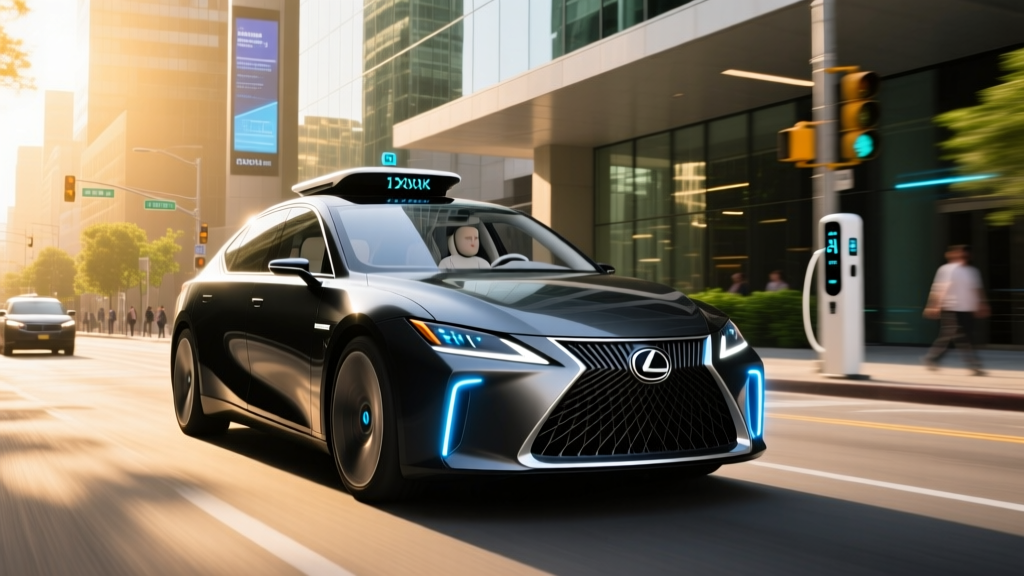
The robotaxi ambitions associated with Lexus live inside Woven by Toyota, the automaker's majority-owned software company headquartered in Tokyo. Woven's autonomy platform is called Teammate, and it uses modified Lexus RX 450h+ and RZ 450e vehicles as test platforms. These are not consumer vehicles — they are sensor-laden development mules operating with safety operators (and increasingly without them) in controlled environments.
Technology Stack
Teammate's sensor suite, as documented in Woven's technical disclosures, includes:
- Multiple lidar units (roof- and bumper-mounted) for high-resolution 3D mapping
- Camera arrays covering 360° vision with redundancy across lighting conditions
- Millimeter-wave radar for velocity detection of moving objects at range
- HD map integration — the vehicle operates only within pre-mapped geofenced zones
- Redundant compute with fallback systems for steering, braking, and power
This is a lidar-plus-camera approach — fundamentally different from Tesla's camera-only FSD architecture. The lidar provides depth data independent of lighting, which matters in dawn/dusk glare, tunnel transitions, and nighttime urban environments.
Where Teammate Robotaxis Operate (and Where They Don't)
| Location | Status | Operator Present? | Public Access |
|---|---|---|---|
| Tokyo, Japan (Odaiba / waterfront districts) | Active testing since 2021; expanded zones in 2025–2026 | Largely driverless in latest phase | Limited invitation-only rides; not a public hail service |
| Fuji Susono (Woven City) | Active testing; dedicated campus environment | Mixed — some fully driverless runs | Internal Toyota/Woven employees and partners |
| Shanghai, China | Testing via partnership with local operators (announced 2024) | Safety operator required under Chinese regulation | Not open to general public |
| United States | No public robotaxi service; Toyota Research Institute (TRI) conducts closed-course R&D in Michigan | N/A | No public access |
Safety Data: What We Know (and What We Don't)
Woven by Toyota has published limited but concrete safety metrics from its Tokyo operations. According to disclosures presented at Japanese government safety briefings and industry conferences:
- Cumulative autonomous miles driven (Teammate fleet, Japan): Over 500,000 miles as of late 2025 reporting
- Disengagement rate: Reported at fewer than 1 intervention per 5,000 miles in the latest Odaiba testing phase (down from ~1 per 800 miles in early 2022)
- At-fault collisions: Zero reported at-fault collisions involving Teammate vehicles in driverless mode through 2025
- Operational Design Domain (ODD): Restricted to mapped urban streets under 45 mph; the vehicle pulls over safely if it exits its ODD or encounters unmapped construction
For context, Waymo — the most data-transparent U.S. robotaxi operator — has reported over 7 million driverless miles with an at-fault crash rate roughly 5.7× lower than human benchmarks in comparable urban environments, per a study published in collaboration with insurance analysts. Teammate's mileage is an order of magnitude smaller, so direct statistical comparison is premature. The trend line on disengagements is encouraging, but sample size matters.
For the consumer Lexus LSS+ 3.0 system, IIHS testing consistently rates Lexus models as Top Safety Pick or Top Safety Pick+ when equipped with LSS+, reflecting strong crash-avoidance performance. That is a Level 2 crash-prevention metric, not an autonomy metric.
Pricing and Access: Robotaxi vs. Rideshare
Because Teammate does not operate a public fare-based service, there is no published per-mile or per-ride price. Where it is relevant to compare:
| Service | Average Cost Per Mile | Average 5-Mile Ride | Availability |
|---|---|---|---|
| Waymo One (Phoenix, SF, LA) | $1.20–$1.80/mi | $8–$14 | Open to public via app in select cities |
| UberX (U.S. average) | $1.50–$2.50/mi | $10–$18 | Nationwide |
| Lyft (U.S. average) | $1.40–$2.30/mi | $9–$16 | Nationwide |
| Teammate (Lexus/Woven) | N/A — no public fare service | N/A | Not available to public in U.S. |
The long-term economic thesis for robotaxis is that removing the driver (who typically earns 60–75% of a rideshare fare) should push per-mile cost below $1.00 at scale. Neither Waymo nor any competitor has publicly confirmed sustained unit-economic profitability at that rate as of 2026, though Waymo has stated it is approaching it in its most mature Phoenix market.
Regulatory Landscape: Who Approves What
Autonomous vehicle regulation is fragmented and jurisdiction-specific:
- Japan (MLIT): The Ministry of Land, Infrastructure, Transport and Tourism has granted Woven by Toyota permits for driverless testing in designated Tokyo zones. Japan's 2023 Level 4 regulatory framework is among the most permissive globally for geofenced urban operations.
- United States (NHTSA + state): NHTSA sets federal vehicle safety standards but does not currently "approve" robotaxi services — that authority falls to individual states. California (CPUC + DMV), Arizona, and Nevada have the most active permitting regimes. Toyota/Woven has not applied for a California DMV driverless testing permit as of the most recent public filings, signaling the U.S. is not a near-term deployment market for Teammate.
- China (MIIT + local): Municipal permits required per city; Toyota's Shanghai testing operates under local autonomous-driving test-plate regulations that require a safety operator.
For consumer Lexus vehicles with LSS+ 3.0, no special permit or approval is needed — these are standard Level 2 ADAS features regulated under existing FMVSS standards.
Current Limitations of Lexus Autonomous Tech
Lexus LSS+ 3.0 (Level 2) Limitations
- Requires continuous driver supervision — hands on/near wheel, eyes on road
- Lane-centering degrades in faded lane markings, construction zones, and heavy rain
- Does not navigate intersections, stop signs, or unprotected left turns autonomously
- No automatic lane changes without driver confirmation
- Cold-weather sensor degradation (camera/snow buildup) can disable features entirely
Teammate Level 4 (Test Fleet) Limitations
- Operates only within pre-mapped geofences — exits trigger a safe pullover, not improvisation
- Heavy rain, snow, and dense fog reduce lidar and camera effectiveness; operations may be suspended
- Cannot handle unmapped construction, temporary traffic-control humans (flaggers), or novel road configurations
- Not available to the public outside invitation-only programs in Japan
- No U.S. deployment timeline has been announced as of 2026
Decision Framework: What This Means for Buyers
Choose a Lexus with LSS+ 3.0 if: You want best-in-class Level 2 driver assistance for highway commuting and collision avoidance, with strong IIHS safety ratings and a mature, well-supported ADAS suite. You understand you are the driver.
Watch Teammate/Woven if: You are tracking the long-term robotaxi landscape and want to see how Toyota's lidar-based approach scales in Japan before it potentially reaches other markets. Do not base a 2026 vehicle purchase on Teammate availability.
Look at Waymo or Cruise successors if: You want to actually ride in a Level 4 robotaxi today in a U.S. city. Lexus is not in this market yet.
Frequently Asked Questions
Is Lexus autonomous driving actually self-driving?
No. Every production Lexus in 2026 uses Level 2 driver-assistance (LSS+ 3.0), which requires the driver to remain fully engaged. The Teammate robotaxi program, developed by Woven by Toyota using Lexus-based prototypes, targets Level 4 but is not a consumer product and is not available in the U.S.
Can I buy a self-driving Lexus in 2026?
No. You can buy a Lexus with excellent Level 2 driver-assist features, but no Lexus sold to consumers operates without a human driver. Level 4 Teammate vehicles are test fleet only.
Where is the Lexus robotaxi available?
Teammate robotaxi testing is concentrated in Tokyo (Odaiba district), Woven City near Mount Fuji, and Shanghai — all with limited, non-public access. There is no U.S. service.
How does Lexus LSS+ compare to Tesla Autopilot or GM Super Cruise?
All three are Level 2 systems. LSS+ 3.0 is generally regarded as conservative and smooth, with strong IIHS crash-avoidance ratings. Super Cruise offers hands-off driving on mapped divided highways with a driver-monitoring camera. Tesla Autopilot/FSD Supervised offers the broadest feature set but requires hands-on supervision and has drawn more regulatory scrutiny. None are self-driving.
Will Lexus ever launch a Level 4 robotaxi in the U.S.?
Toyota and Woven have not announced a U.S. deployment timeline for Teammate. Given Toyota's historically cautious approach to autonomy and the regulatory complexity of U.S. state-by-state permitting, a U.S. launch before 2028–2029 appears unlikely based on current public statements.
How safe is the Teammate robotaxi?
Teammate has reported zero at-fault collisions in driverless mode through over 500,000 cumulative test miles in Japan, with a disengagement rate improving to under 1 per 5,000 miles. Sample size is smaller than Waymo's U.S. data, so direct comparison is limited.