If you have been following autonomous vehicle headlines for the past decade, you have probably seen the promise of "self-driving cars" pushed just over the horizon — again and again. The question many EV buyers and tech enthusiasts ask us is straightforward: when will Level 5 autonomous cars be available? The honest answer, grounded in the engineering, regulatory, and operational realities of 2026, is that Level 5 autonomy — a vehicle that can drive itself anywhere, in any condition, with no human fallback — does not exist in production form today and is not arriving on a consumer showroom floor in the near term.
What does exist is a growing ecosystem of Level 4 robotaxi services operating in geofenced urban corridors, and a separate category of Level 2 driver-assistance systems sold in consumer vehicles. Conflating these two is the single most common source of public confusion about autonomous driving. This guide untangles the SAE levels, examines where driverless rides are actually available right now, reviews the safety data, and explains why the gap between Level 4 and Level 5 is far larger than most marketing materials suggest.
Understanding SAE Automation Levels: Why Level 5 Is a Different Problem Entirely
The SAE International J3016 standard defines six levels of driving automation, from Level 0 (no automation) to Level 5 (full automation under all conditions). The jump from Level 4 to Level 5 is not incremental — it is a fundamental engineering challenge that remains unsolved.
| Level | Name | Who Drives | Where | Example (2026) |
|---|---|---|---|---|
| 0 | No Automation | Human | All roads | Basic cruise control |
| 1 | Driver Assistance | Human + system (one axis) | Limited | Adaptive cruise OR lane-keep |
| 2 | Partial Automation | Human supervises | Limited | Tesla Autopilot, GM Super Cruise, Ford BlueCruise |
| 3 | Conditional Automation | System drives; human on standby | Restricted ODD | Mercedes DRIVE PILOT (approved highways, ≤40 mph, good weather) |
| 4 | High Automation | System (no human needed) | Geofenced ODD | Waymo One, Zoox, Cruise (limited relaunch) |
| 5 | Full Automation | System everywhere | All roads, all conditions | Does not exist in production |
Where Can I Use a Robotaxi Service Right Now?
Level 4 robotaxi services are live and carrying paying passengers in 2026, but availability is tightly constrained by geography, weather, and regulatory approval. Here is where you can actually hail a driverless ride today:
| Service | Operator | Live Cities | Hours | Vehicle |
|---|---|---|---|---|
| Waymo One | Waymo (Alphabet) | Phoenix (metro), San Francisco, Los Angeles, Austin (expanding) | 24/7 in Phoenix/SF; limited hours elsewhere | Jaguar I-PACE (Gen 5 sensor suite) |
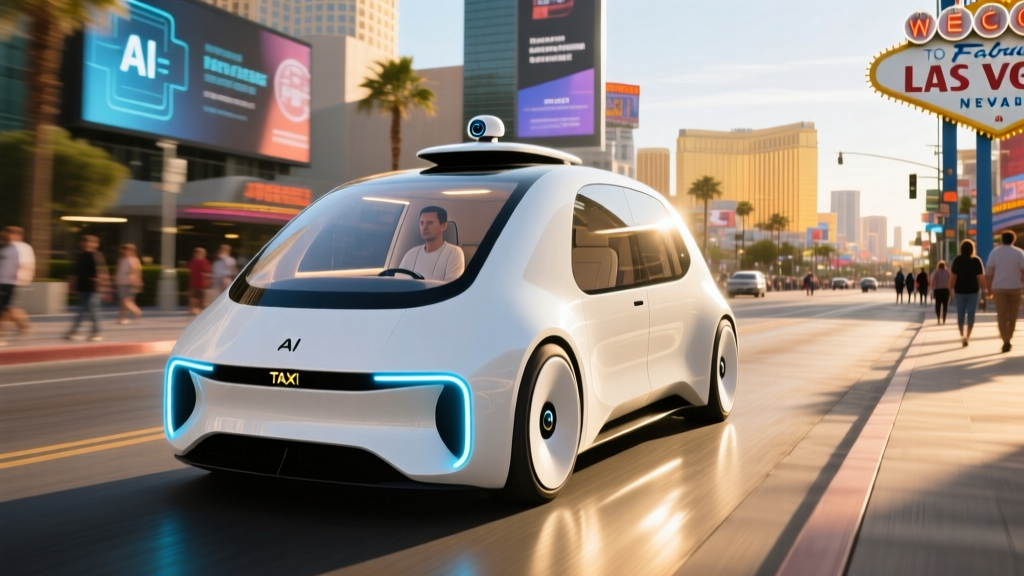
| Zoox | Zoox (Amazon) | Las Vegas (Strip corridor), Foster City, CA (limited) | Limited hours | Zoox purpose-built carriage |
| Cruise | GM/Cruise | Phoenix, Dallas, Houston (gradual relaunch post-2023 suspension) | Limited hours; phased rollout | Chevrolet Bolt EV / Origin (announced) |
| Baidu Apollo Go | Baidu | Wuhan, Beijing, Chongqing, Shenzhen (China) | Extended hours | Apollo RT6 |
Notice what is absent: no service operates across an entire state, on highways between cities, in heavy snow regions, or on unmapped rural roads. Every active Level 4 service runs within a geofenced Operational Design Domain (ODD) — a precisely mapped area with known road geometry, signage, and traffic patterns. Leave the geofence, and the vehicle cannot operate autonomously.
How Much Does a Robotaxi Ride Cost vs. Uber or Lyft?
Pricing for robotaxi services has evolved significantly. Waymo One, the most mature service in the U.S., uses dynamic pricing similar to rideshare platforms but without a human driver's take. Here is how typical fares compare in shared markets as of early 2026:
| Route Example | Waymo One | UberX | Lyft Standard |
|---|---|---|---|
| 5-mile urban trip (Phoenix) | $12–$18 | $11–$16 | $10–$15 |
| 10-mile airport run (SFO) | $25–$38 | $22–$35 | $20–$32 |
| 3-mile downtown (LA) | $9–$14 | $10–$15 | $9–$14 |
Robotaxi fares are now broadly competitive with UberX and Lyft, particularly for shorter trips where the absence of a driver's earnings share offsets the high per-vehicle hardware cost. Waymo's Gen 5 sensor suite — which includes lidar, cameras, and radar — is estimated to add $30,000–$50,000+ per vehicle in hardware alone. Achieving cost parity with rideshare at scale requires both hardware cost reduction and high vehicle utilization (ideally 18–20 hours/day), which is why most operators are still running at a loss or subsidized rates in 2026.
How Safe Are Robotaxis? Examining the Real Data
Safety is the most scrutinized — and most politicized — question in autonomous driving. Let us look at what the data actually shows rather than relying on anecdotes or marketing claims.
• Over 30 million fully driverless miles completed across Phoenix, San Francisco, and Los Angeles.
• A Waymo-published safety study (peer-reviewed with external data) reported a 85% reduction in injury-causing crash rates compared to human benchmarks in equivalent geographies.
• Contact rate (any physical contact with another object) was approximately 5.3 per million miles vs. a human benchmark of ~12.5 per million miles in urban environments.
• Most contact events were low-speed (<10 mph) and involved stationary objects or other vehicles striking the Waymo — not the robotaxi initiating the collision.
However, the data is not uniformly positive across all operators. Cruise's October 2023 incident in San Francisco — where a pedestrian was struck by a human-driven vehicle and then dragged by a Cruise robotaxi that failed to properly detect the fallen person — led to a statewide permit suspension by the California Public Utilities Commission (CPUC) and a near-total operational shutdown that lasted into 2025. Cruise has since relaunched in select cities with revised safety protocols and human-attended testing phases before returning to driverless operation.
The National Highway Traffic Safety Administration (NHTSA) requires all ADS-equipped vehicles to report crashes through its Standing General Order. This data is publicly available and shows that robotaxis are involved in incidents, but the exposure-adjusted rate (per million miles) in geofenced urban service areas appears lower than the human driver baseline for comparable environments. The critical caveat: robotaxis operate in mapped, mostly low-speed urban zones with favorable weather. Comparing their safety record to all human driving — including rural highways and adverse conditions — would be misleading in either direction.
The Technology Stack: Lidar, Cameras, and Why Geofencing Matters
The sensor and software architecture of a Level 4 robotaxi is fundamentally different from a Level 2 consumer vehicle. Understanding this gap explains why Level 5 remains so distant.
Waymo Gen 5 Sensor Suite (Jaguar I-PACE)
- Lidar: Multiple solid-state and spinning units providing 360° 3D point clouds at ranges exceeding 200 meters
- Cameras: 29+ high-resolution cameras covering all directions, optimized for varied lighting
- Radar: 6 imaging radar units for velocity detection and operation in rain/fog where lidar degrades
- HD Maps: Centimeter-precision maps of every road in the service area, updated continuously
- Compute: Custom AI inference hardware processing terabytes of sensor data per hour
Tesla FSD (Supervised) — Camera-Only Approach
- Cameras: 8 surround cameras (Tesla Vision, no lidar or radar since 2022)
- Neural network: End-to-end neural net trained on billions of miles of fleet data
- Limitation: Level 2 — requires active driver supervision at all times
The lidar vs. camera debate is often framed as philosophical, but the engineering reality is pragmatic. Lidar provides direct depth measurement independent of lighting conditions, which is critical for detecting unexpected obstacles at night or in high-contrast scenarios. Camera-only systems rely on learned visual patterns and can struggle with edge cases outside their training distribution. For Level 4 robotaxis operating without a human fallback, most operators (Waymo, Zoox, Cruise, Baidu) use lidar as a redundant safety layer. Tesla's camera-only approach remains unproven at Level 4 or above.
Geofencing is not a limitation that can simply be "scaled away." Each new service city requires thousands of hours of mapping, validation, and regulatory negotiation. A road construction zone, a new traffic signal configuration, or an unusual intersection geometry can require the system to be retrained and re-validated before it can operate safely. This is why expansion is measured in neighborhoods per year, not states per quarter.
The Regulatory Landscape: Who Approves Robotaxi Operations?
There is no single federal "robotaxi license" in the United States. Instead, autonomous vehicle deployment is governed by a patchwork of state and local authorities:
- NHTSA (federal): Sets vehicle safety standards (FMVSS) and collects crash data. NHTSA can issue exemptions for vehicles without steering wheels or pedals (like the Zoox carriage or GM Cruise Origin), but the process is slow and case-by-case.
- State DMVs and PUCs: California's DMV issues testing permits; the CPUC issues commercial deployment permits. Arizona has minimal state-level regulation, which is why Phoenix was Waymo's first commercial market. Texas requires registration with the state but is generally permissive.
- Local governments: Cities can restrict operating hours, zones, and fleet sizes. San Francisco's Board of Supervisors has repeatedly pushed for tighter limits on robotaxi operations due to traffic disruption concerns.
This regulatory fragmentation means that even if a Level 4 system is technically capable of operating in a new city, the legal pathway can take 12–24 months of testing, permitting, and public comment periods. For Level 5 — which would need to operate on every road in every jurisdiction — the regulatory challenge alone is staggering.
Current Limitations: Why Level 5 Remains Distant
The gap between today's Level 4 geofenced robotaxis and a hypothetical Level 5 vehicle is not a matter of slightly better software. It involves solving problems that the autonomous driving industry has not yet cracked:
- Weather: Heavy rain, snow, fog, and ice degrade lidar and camera performance. No current Level 4 service operates in sustained winter conditions. Waymo does not operate in snow in any of its current markets.
- Unmapped roads: Rural roads, private driveways, parking garages with faded markings, and temporary construction zones fall outside the HD-mapped ODD.
- Edge cases: Unusual road users (horse-drawn carriages, oversize loads, funeral processions, emergency scene detours) present scenarios that are difficult to anticipate and train for.
- Highway merging at speed: Most Level 4 services avoid high-speed freeway operation. Merging into 70+ mph traffic with mixed human drivers requires prediction capabilities that are still maturing.
- Liability and insurance: A Level 5 vehicle sold to consumers would require a legal framework assigning liability when no human is in the loop — something no U.S. state has fully resolved for private ownership.
- Hardware cost: A full Level 5 sensor suite would likely add $20,000–$50,000+ to a consumer vehicle's price, making it economically impractical for personal ownership even if the technology existed.
So When Will Level 5 Autonomous Cars Actually Arrive?
Based on the current trajectory of technology, regulation, and deployment data, here is a realistic framework:
- Level 4 robotaxi expansion (2026–2030): More cities, longer hours, some highway segments within geofenced corridors. Still not available for personal purchase. Weather and edge-case limitations persist.
- Level 4 personal vehicles (2030s, optimistic): Limited ODD personal vehicles (e.g., highway-only autonomy on approved routes) may emerge, but will require the driver to take over outside approved zones. Think of it as an expanded Super Cruise, not a chauffeur.
- Level 5 (no credible timeline): A vehicle that can navigate a rural mountain road in a snowstorm, an unmarked festival detour, and a suburban cul-de-sac with equal competence — without any human input — requires solving the "long tail" of driving scenarios. Most serious researchers in the field do not project a date for this. Some believe it may require fundamentally different approaches to AI reasoning that do not yet exist.
The autonomous driving industry has matured past the hype cycle of the late 2010s. The companies that survived — Waymo, Zoox, Baidu Apollo — are running real services with real passengers and publishing real safety data. That is genuinely impressive engineering. But it is Level 4, geofenced, and urban. Level 5 is a different problem, and anyone promising it by a specific year is selling something.
Frequently Asked Questions
Is Tesla FSD self-driving?
No. Tesla Full Self-Driving (Supervised) is a Level 2 driver-assistance system. The driver must remain fully engaged and is legally responsible for the vehicle at all times. The "Supervised" label in Tesla's own branding reflects this. Tesla does not operate a driverless robotaxi service as of 2026.
Can I buy a Level 4 autonomous car?
Not as a consumer in 2026. Level 4 vehicles (Waymo's Jaguar I-PACE fleet, Zoox carriages) are owned and operated by the service companies within their geofenced areas. They are not available for private purchase. The Mercedes DRIVE PILOT system is the closest consumer offering, at Level 3, but it is restricted to specific highways under 40 mph in approved conditions and is only available in Nevada and California.
How do robotaxis handle emergencies or system failures?
Level 4 robotaxis are designed with redundant systems — dual compute platforms, backup power, and redundant braking and steering. If a fault is detected, the vehicle executes a "minimal risk condition" maneuver: it signals, moves to the shoulder or a safe stopping point, and contacts remote support. The vehicle does not continue driving with a degraded system.
Will Level 5 autonomy ever happen?
It is technically possible but faces unsolved challenges in AI generalization, edge-case handling, adverse-weather operation, and regulatory frameworks. Most industry experts project that Level 4 will continue to expand incrementally over the coming decade, while Level 5 — true everywhere, all-conditions autonomy — has no credible production timeline. Treat any specific year prediction with extreme skepticism.
Are robotaxis available in my city?
As of 2026, U.S. robotaxi services are live in Phoenix, San Francisco, Los Angeles, Austin, Las Vegas, Dallas, and Houston (with varying levels of availability and hours). Check the Waymo One, Zoox, or Cruise apps to see if your specific location is within an active service zone. Expansion to new cities is ongoing but slow due to mapping, testing, and regulatory requirements.