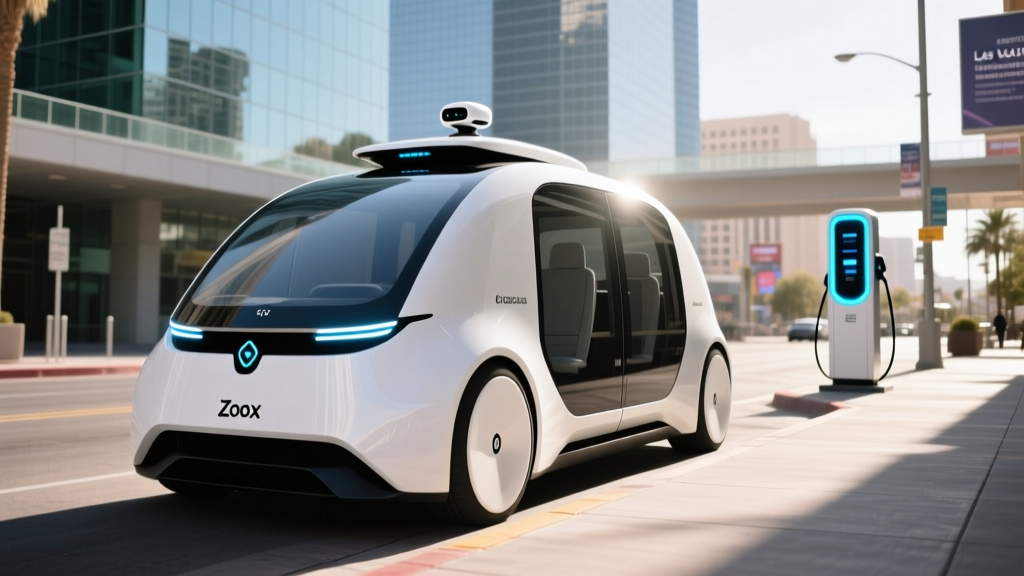
Zoox, the Amazon-owned autonomous vehicle company, has turned Las Vegas into one of its primary proving grounds for fully driverless robotaxi service. Unlike the consumer EVs you can buy at a dealership, the Zoox vehicle is a purpose-built, carriage-style pod with no steering wheel, no pedals, and no driver's seat. It operates at SAE Level 4 — meaning no human behind the wheel, ever, within its approved zone.
If you've been searching for practical details on the Las Vegas Zoox service — where it actually picks up, what a ride costs, whether it's genuinely safe — this guide breaks it all down with concrete figures and real operational context, not marketing promises.
What SAE Level Is Zoox? (And Why It Matters)
SAE Automation Level: Level 4 (High Automation)
Zoox operates at SAE Level 4 within its geofenced service area. This means the vehicle handles all driving tasks — steering, braking, navigating intersections, responding to traffic signals — without any human intervention or supervision. There is no driver seat, no steering wheel, and no expectation that a passenger will take over. If the system encounters a scenario it cannot handle, it is designed to pull over safely rather than hand control to a rider.
This is fundamentally different from Level 2 driver-assist systems like Tesla Autopilot, Ford BlueCruise, or GM Super Cruise, which require an attentive human driver at all times. Zoox passengers are just that — passengers.
| Level | Name | Human Driver Required? | Example |
|---|---|---|---|
| Level 0 | No Automation | Yes — full control | Traditional gas car |
| Level 1 | Driver Assistance | Yes — hands on wheel | Adaptive cruise control |
| Level 2 | Partial Automation | Yes — must supervise | Tesla Autopilot, BlueCruise |
| Level 3 | Conditional Automation | Sometimes — must be ready | Mercedes DRIVE PILOT (limited) |
| Level 4 | High Automation | No — within geofence | Zoox, Waymo |
| Level 5 | Full Automation | No — anywhere, any condition | Does not exist commercially |
Where Can You Ride a Zoox Robotaxi in Las Vegas?
As of early 2026, Zoox operates its driverless service within a defined geofence covering key corridors in Las Vegas. The service area focuses on high-demand zones where the company has extensively mapped and validated its routes.
| City | Status | Service Area Notes |
|---|---|---|
| Las Vegas, NV | Active — driverless rides | Las Vegas Strip corridor, downtown, airport-adjacent zones |
| San Francisco, CA | Active — driverless rides | Select neighborhoods, expanded geofence since 2024 |
| Foster City, CA | Active — earlier testing zone | Suburban peninsula routes |
| Austin, TX | Testing / limited | Pre-commercial driverless testing |
| Atlanta, GA | Testing / limited | Pre-commercial operations |
| Seattle, WA | Testing / limited | Amazon HQ metro area testing |
In Las Vegas specifically, the Zoox geofence includes the Las Vegas Strip and adjacent entertainment districts, parts of downtown, and select connector routes. The company has been testing on public roads in Nevada since 2022 and received its Nevada DMV autonomous vehicle permits to carry passengers without safety drivers.
Key point: You cannot hail a Zoox to just any address. Pickup and drop-off are confined to the mapped geofence, and the app will show you available zones. Attempting to request a ride outside the boundary simply won't work.
How to Use the Zoox App and What a Ride Costs
Riding a Zoox in Las Vegas works similarly to Uber or Lyft, but with important differences:
- Download the Zoox app (iOS/Android) and create an account.
- Check availability — the app shows the current service zone and whether rides are active (service can pause during severe weather or system updates).
- Request a ride — enter your pickup and drop-off within the geofence.
- Wait for your pod — the Zoox vehicle arrives with no driver. Doors unlock automatically.
- Ride — seats face each other in a four-passenger carriage layout. A screen shows your route and a "stop ride" button is always accessible.
Pricing: Zoox vs. Uber vs. Lyft in Las Vegas
During its initial commercial phases, Zoox has offered rides at promotional pricing — and in some periods, free rides — to build ridership and gather operational data. As the service matures toward full commercial pricing, here's how it compares:
| Service | Base Fare | Per-Mile Rate | Typical 3-Mile Ride | Surge Pricing? |
|---|---|---|---|---|
| Zoox | Promo/free phase → est. $2.50 | Est. $1.25–$1.75/mi | ~$6–$8 (post-promo) | No surge (fixed algorithm) |
| UberX | ~$2.50 | ~$1.50–$2.00/mi | ~$8–$14 | Yes — can 2–3x during peak |
| Lyft | ~$2.75 | ~$1.40–$1.90/mi | ~$8–$13 | Yes — prime-time pricing |
| Waymo (where available) | ~$2.00 | ~$1.30–$1.80/mi | ~$7–$11 | Rare, limited surge |
Zoox's long-term pricing strategy is designed to undercut traditional rideshare by eliminating the driver cost, which typically represents 60–75% of a ride fare. However, the company has not published a fixed rate card as of early 2026. Check the app for current pricing in your area.
Zoox Safety Record: What the Data Shows
Zoox Safety Snapshot (through 2025 reporting)
- Autonomous miles driven: Zoox has accumulated millions of driverless miles across its test and commercial fleet in Las Vegas, San Francisco, and Foster City.
- Disengagement rate: Zoox reports remote-assistance interventions (where a teleoperations specialist guides the vehicle through an edge case) at rates that have decreased year-over-year as the system matures. Exact per-million-mile figures are reported to NHTSA under Standing General Order.
- Reported collisions: Under NHTSA's Standing General Order, all Level 4 operators must report crashes. Zoox has reported minor incidents consistent with dense urban driving — primarily low-speed contacts — with no reported passenger fatalities as of early 2026.
- Vehicle design safety: The Zoox vehicle features bidirectional driving (either end can be the "front"), 360-degree sensor coverage, and a symmetrical crash structure. It is designed to protect four forward/rearward-facing passengers in a compartmentalized cabin.
For context, Waymo — the most data-rich robotaxi operator — has published peer-reviewed studies showing its vehicles are involved in fewer injury-causing crashes per million miles than human drivers in comparable urban environments. Zoox has not yet published equivalent comparative studies, but its operational safety record in Las Vegas has not generated major regulatory action or service suspension, which is notable given the scrutiny applied to robotaxi operators after Cruise's 2023 San Francisco incident.
The NHTSA automated vehicle safety portal maintains public records of reported incidents for all ADS-equipped vehicles.
Technology Stack: How the Zoox Vehicle Sees the Road
The Zoox vehicle is not a retrofitted consumer car — it's a ground-up robotaxi platform with a sensor suite designed for full 360-degree perception without blind spots.
| Component | Specification / Role |
|---|---|
| LiDAR | Multiple solid-state and spinning LiDAR units providing 360° 3D point clouds; effective range 150–200+ meters |
| Cameras | High-resolution camera array covering all directions; redundant visual perception for lane markings, traffic signals, signage |
| Radar | Multi-mode radar for object velocity detection and performance in rain/fog where LiDAR/cameras degrade |
| Audio sensors | Microphone arrays to detect emergency vehicle sirens and environmental audio cues |
| Compute | Custom high-performance computing platform running Zoox's full-stack perception, prediction, and planning software |
| HD Maps | Centimeter-accurate pre-mapped routes within the geofence, continuously updated |
| V2X / Connectivity | Cellular connectivity for teleoperations support, fleet management, and real-time traffic integration |
Zoox's approach is distinctly LiDAR-first with camera and radar fusion — a contrast to Tesla's camera-only FSD approach. The LiDAR provides precise depth data independent of lighting conditions, which is critical for nighttime and high-glare environments like the Las Vegas Strip's neon-lit corridors.
The vehicle is also bidirectional: it can drive equally well in either direction, which simplifies routing in tight urban environments and eliminates the need for three-point turns or complex U-turns.
Regulatory Landscape: Who Approves Zoox Operations?
Robotaxi operations in the United States require a patchwork of state and federal approvals. Here's how Zoox is regulated:
- Nevada DMV: Nevada issues Autonomous Vehicle permits that allow driverless testing and commercial operations on public roads. Zoox holds the necessary permits for Las Vegas operations.
- NHTSA (federal): The National Highway Traffic Safety Administration oversees vehicle safety standards. Zoox received a notable exemption from certain Federal Motor Vehicle Safety Standards (FMVSS) — such as requiring a steering wheel and mirrors — because its vehicle has no human driver interface. This is a critical regulatory milestone that distinguishes Zoox from companies retrofitting consumer vehicles.
- California DMV and CPUC: For its California operations, Zoox holds permits from both the DMV (testing) and the California Public Utilities Commission (commercial passenger service).
- NHTSA Standing General Order: Requires all ADS operators to report crashes within specific timeframes, providing a public safety data trail.
The regulatory environment remains actively evolving. Following the Cruise suspension in California in late 2023, regulators in multiple states have increased scrutiny on robotaxi operators. Zoox has benefited from a more cautious, slower-scaling approach — avoiding the rapid geographic expansion that contributed to Cruise's regulatory setback.
Current Limitations: What Zoox Cannot Do (Yet)
Level 4 autonomy is powerful but geographically and environmentally bounded. Here are the real constraints you'll encounter:
- Geofence boundaries: The vehicle will not operate outside its pre-mapped zone. If your destination falls outside the geofence, the app won't let you book the ride. You cannot override this.
- Weather restrictions: Heavy rain, flooding, dust storms (relevant in Las Vegas), or extreme heat events can trigger service pauses. While LiDAR and radar perform better than cameras alone in degraded visibility, the system will pull over or refuse to dispatch if conditions exceed its validated operating envelope.
- Construction zones: Unmapped road changes, temporary lane closures, or major construction can confuse HD map-dependent systems. Zoox vehicles may reroute or request teleoperations guidance, adding time to your trip.
- No highway driving: Current Zoox operations are limited to surface streets within the urban geofence. Highway-speed merging and high-speed lane changes are not part of the Las Vegas service profile.
- Limited passenger assistance: There is no driver to help with luggage, mobility devices, or disputes between passengers. The vehicle accommodates up to four riders but is not wheelchair-accessible in its current configuration.
- Wait times: Fleet size in Las Vegas is still scaling. During peak Strip hours (Friday/Saturday nights, major conventions), wait times may exceed those of Uber/Lyft, which have far more vehicles on the road.
- Edge-case interventions: Encounters with erratic pedestrians, unmarked road hazards, or unusual vehicles (horse-drawn carriages, parade floats) may trigger remote teleoperations assistance, pausing the vehicle until the scenario is resolved.
Zoox vs. Waymo: How Las Vegas Robotaxi Options Compare
| Attribute | Zoox (Las Vegas) | Waymo (Las Vegas) |
|---|---|---|
| Vehicle | Purpose-built Zoox pod (no steering wheel) | Jaguar I-PACE (retrofitted consumer EV) |
| SAE Level | Level 4 (geofenced) | Level 4 (geofenced) |
| Las Vegas presence | Active driverless service | Active driverless service (expanded from Phoenix) |
| Sensor approach | LiDAR + camera + radar fusion | LiDAR + camera + radar fusion (5th-gen) |
| Passenger capacity | 4 (facing each other) | 4 (traditional seating) |
| Pricing model | Promotional / early commercial | Published rates, comparable to UberX |
| Published safety studies | NHTSA SGO reports only | Peer-reviewed comparative crash studies |
| Highway capable | No | Limited (Phoenix freeway pilot) |
Both services are Level 4 and both operate in Las Vegas, but they target slightly different use cases. Zoox's purpose-built pod offers a novel passenger experience (face-to-face seating, no driver's area eating into cabin space), while Waymo's Jaguar I-PACE feels more like a traditional car with an invisible chauffeur. Waymo has more published safety data and a more mature pricing structure; Zoox offers the novelty of a vehicle designed from scratch for autonomy.
Frequently Asked Questions
Is the Las Vegas Zoox service truly self-driving, or is there a remote driver?
There is no driver in the vehicle — no steering wheel, no pedals, no human at all in the front. The vehicle operates autonomously via its onboard AI system. However, Zoox employs remote teleoperations specialists who can guide the vehicle through edge cases (e.g., an unmapped construction zone or an unusual obstacle). This is not "remote driving" in the joystick sense — the specialist provides high-level guidance while the vehicle's system still executes all driving actions. This is consistent with how Level 4 autonomy is defined: the system drives, but can request remote assistance for scenarios outside its operational design domain.
How much does a Zoox ride cost compared to Uber or Lyft?
During promotional periods, Zoox has offered free or heavily discounted rides. As commercial pricing takes effect, industry estimates place Zoox rides at roughly 20–40% below comparable UberX/Lyft fares for the same route, primarily because there is no driver to pay. A typical 3-mile Strip-area ride is expected to cost $6–$8 at standard rates versus $8–$14 for rideshare, though exact pricing depends on Zoox's published rate card in the app.
How safe are Zoox robotaxis based on real data?
Zoox reports incidents to NHTSA under the Standing General Order, and as of early 2026, there have been no reported passenger fatalities. Minor low-speed contacts have occurred — consistent with dense urban driving environments. Zoox has not yet published the kind of peer-reviewed comparative safety studies that Waymo has released, which makes direct statistical comparison difficult. The company's cautious scaling approach (fewer cities, slower expansion) has so far kept it out of the regulatory controversies that affected Cruise in 2023.
Can I use Zoox to get to the Las Vegas airport (Harry Reid International)?
Service availability to and from Harry Reid International Airport (LAS) depends on whether the airport falls within Zoox's current geofence. As of early 2026, the geofence covers the Strip corridor and adjacent areas. Check the Zoox app for real-time zone boundaries — airport service may be available for certain terminals or nearby pickup points, but full terminal access depends on airport authority agreements and geofence mapping.
What happens if the Zoox vehicle encounters a problem during my ride?
The vehicle is designed to execute a "minimal risk condition" — essentially pulling over safely — if it encounters a system fault or a scenario it cannot resolve. A passenger-accessible stop button is available at all times. Remote teleoperations specialists monitor the fleet and can intervene to guide the vehicle. In an emergency, passengers can contact Zoox support via the in-vehicle screen or the app.
Does Zoox operate in bad weather or extreme Las Vegas heat?
Zoox vehicles are designed for Las Vegas conditions, including extreme heat (the vehicle's thermal management system is built for desert climates). However, severe weather events — heavy monsoon rain, flash-flood warnings, or dust storms (haboobs) — can trigger service pauses. The system will not operate in conditions that exceed its validated sensor performance envelope.
Who owns Zoox, and is it the same as Amazon's delivery robots?
Amazon acquired Zoox in 2020 for approximately $1.2 billion. Zoox operates as an independent subsidiary focused on passenger robotaxi service. It is separate from Amazon's Scout delivery robots and the Rivian delivery vans used for Amazon logistics, though the companies share the Amazon corporate umbrella.