What Does a Zoox Robotaxi Ride Actually Cost in Las Vegas?
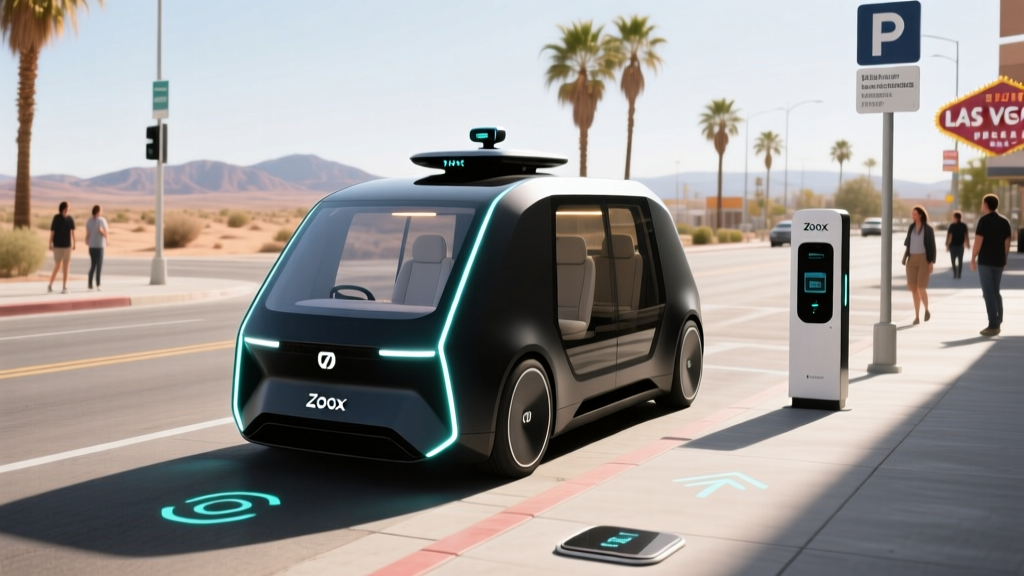
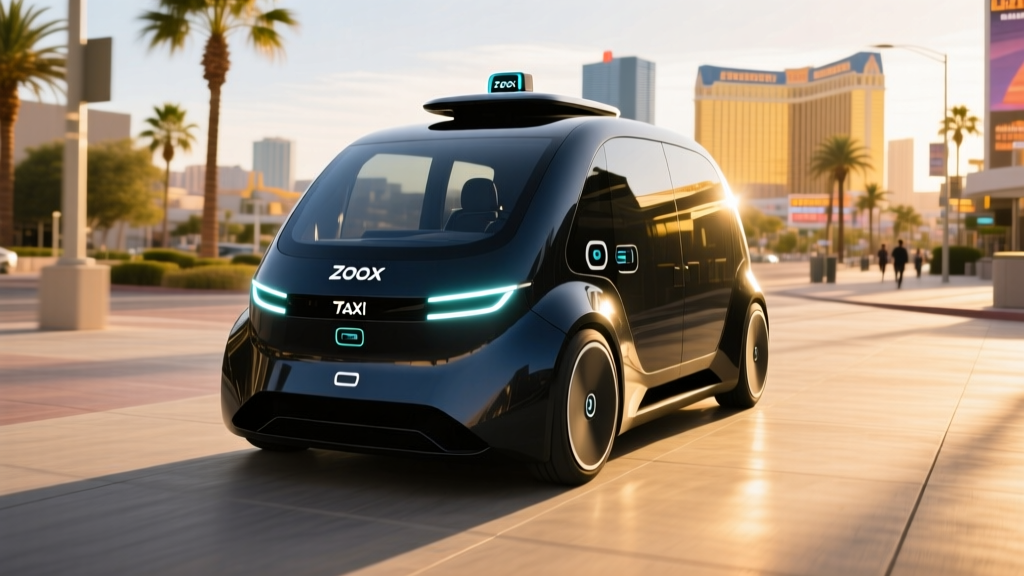
If you've spotted the boxy, steering-wheel-free Zoox vehicle navigating near the Las Vegas Strip, you probably had two questions: can I ride in it, and how much does it cost? As of early 2026, Amazon-owned Zoox operates its purpose-built Level 4 robotaxi in limited Las Vegas service areas, and the pricing model differs meaningfully from traditional rideshare. This guide breaks down the real Las Vegas Zoox cost, where the service runs, what the safety record shows, and where the technology still falls short.
Zoox is not a driver-assist system like Tesla's FSD (Supervised) or GM's Super Cruise. It is a fully driverless, SAE Level 4 service — no human behind the wheel, no pedals, no steering column. Understanding that distinction is essential before comparing costs or safety.
SAE Automation Level: Zoox Is Level 4 (Not Level 2)
Level 2 (Driver Assist): Systems like Tesla Autopilot, Ford BlueCruise, and GM Super Cruise. The driver must remain engaged and supervise at all times. The human is legally responsible.
Level 4 (High Automation — Robotaxi): Zoox, Waymo One. The vehicle handles all driving within its operational design domain (geofenced area, approved conditions). No human driver is present or required. The operator/company bears responsibility.
Zoox vehicles in Las Vegas operate at SAE Level 4 within their approved geofence. There is no driver seat.
Where Can You Use Zoox in Las Vegas Right Now?
Zoox does not operate everywhere in Las Vegas. The service is geofenced to specific corridors, and expansion happens incrementally as regulators approve new zones. As of 2026, the active service area covers:
| Zone | Status | Key Landmarks |
|---|---|---|
| Las Vegas Strip corridor | Active | Major resorts between Mandalay Bay and Wynn/Encore |
| Downtown Las Vegas | Active | Fremont Street area, Arts District |
| Henderson suburbs | Not available | — |
| Harry Reid International Airport (LAS) | Limited / designated pickup | Specific terminal zones only |
| Summerlin | Not available | — |
Zoox's official ride page shows the live service boundary in the app. If your pickup or drop-off falls outside the geofence, the ride cannot be requested. This is a hard limitation — the vehicle will not operate beyond its approved operational design domain (ODD).
Zoox also operates in the San Francisco Bay Area ( Foster City headquarters region and parts of San Francisco proper). The Las Vegas deployment is the company's primary tourist-market testbed, chosen for high ride volume and relatively predictable grid-street routing.
Las Vegas Zoox Cost vs. Uber and Lyft: Pricing Breakdown
Zoox has historically used promotional pricing to build ridership and gather trip data, but the service has moved toward a standard per-ride pricing model. Here is how the Las Vegas Zoox cost compares to traditional rideshare for common Strip-area trips:
| Route | Distance | Zoox (est.) | UberX (est.) | Lyft (est.) |
|---|---|---|---|---|
| Bellagio → Venetian | ~1.5 mi | $8–$12 | $9–$15 | $9–$14 |
| Mandalay Bay → Cosmopolitan | ~2 mi | $10–$14 | $11–$18 | $10–$17 |
| Strip resort → Downtown (Fremont) | ~5 mi | $16–$22 | $18–$30 | $17–$28 |
| Strip resort → LAS Airport (designated zone) | ~4 mi | $14–$20 | $16–$28 | $15–$26 |
Several factors shape the Las Vegas Zoox cost:
- No driver payout. Zoox eliminates the largest cost component in rideshare — the driver's share of the fare. This gives Zoox structural margin flexibility that Uber and Lyft do not have.
- No surge pricing (currently). Zoox has not implemented demand-based surge multipliers as of early 2026. During peak Strip hours (Friday/Saturday 10 PM–2 AM), Uber and Lyft routinely surge 1.5x–3x, making Zoox significantly cheaper during those windows.
- Promotional periods. Zoox periodically offers free or heavily discounted rides to new users. Check the Zoox app for current promotions in Las Vegas.
- Tips are not expected. There is no driver to tip. This alone saves riders 15–20% versus a comparable Uber/Lyft trip.
For a typical tourist spending 3–4 days on the Strip with daily rides between resorts, dinner, and the airport, choosing Zoox where available could reduce ground-transport costs by roughly 20–40% compared to rideshare — primarily due to the absence of surge pricing and tips.
How to Hail a Zoox Robotaxi in Las Vegas
- Download the Zoox app (iOS or Android) and create an account.
- Set your pickup location within the Las Vegas service area. The app confirms whether the location is within the active geofence.
- Confirm your ride. Wait times vary — typically 3–8 minutes on the Strip corridor, longer at the edges of the service zone.
- Verify the vehicle. The app shows the vehicle ID and license plate. The Zoox vehicle is distinctive: a compact, symmetrical, carriage-style design with no hood or trunk, bidirectional driving capability, and large sensor arrays on all corners.
- Unlock and ride. Use the app to unlock the doors. Inside, you'll find bench seating facing each other (up to four passengers), a screen showing the route, and no driver controls whatsoever.
- Arrive and exit. The vehicle stops at your drop-off, and the app prompts you to exit. Payment is automatic.
The experience is closer to an elevator ride than a taxi — you press a button, and the vehicle handles everything. For first-time riders, the absence of a steering wheel and driver takes about 30 seconds to normalize.
Zoox Safety Record: What the Data Shows
Safety is the most scrutinized aspect of robotaxi operations, and rightly so. Zoox, like all autonomous vehicle operators in California and Nevada, is required to report disengagement data, collision reports, and operational metrics to regulators.
Zoox Safety Data Points (through 2025 reporting)
- Operational model: Fully driverless (no safety driver in the vehicle) in Las Vegas and San Francisco commercial service.
- Vehicle design: Purpose-built from the ground up — not a retrofitted consumer car. Includes redundant braking, steering, and computing systems. Crumple zones and airbag systems designed for bidirectional travel.
- Top speed: Limited to approximately 75 mph (though urban operations rarely exceed 35–45 mph).
- Collision reporting: Zoox reports minor contact incidents to the NHTSA as required. As with all robotaxi operators, most reported incidents involve low-speed contact with other human-driven vehicles, not at-fault high-severity crashes.
- Remote assistance: Zoox vehicles can request remote guidance from a human operations specialist when encountering ambiguous scenarios (construction zones, unusual obstacles). This is not remote driving — the specialist provides high-level route guidance, not real-time steering input.
For context, NHTSA's Standing General Order requires all Level 2 and above automated driving systems to report crashes. Zoox's public incident record through 2025 shows a small number of low-severity contacts, consistent with urban operations in dense traffic. No fatalities involving Zoox vehicles have been publicly reported as of early 2026.
Compare this to Waymo One, which has published data showing its vehicles are involved in fewer police-reported crashes per million miles than human benchmarks in the same operating cities. Zoox has not yet published an equivalent large-scale comparative study, largely because its fleet and total miles driven are smaller than Waymo's.
Under the Hood: Zoox's Technology Stack
The Zoox vehicle is not a modified Toyota or Jaguar — it is a ground-up robotaxi platform, which gives it engineering advantages over retrofitted vehicles:
Sensor Suite
- LiDAR: Multiple solid-state and spinning LiDAR units providing 360-degree, high-resolution 3D point clouds. LiDAR gives precise depth perception regardless of lighting — critical for nighttime Strip operations where neon, headlights, and pedestrian crowds create visual chaos.
- Cameras: A comprehensive array of high-resolution cameras covering all directions, used for lane detection, traffic signal recognition, pedestrian classification, and semantic understanding of the scene.
- Radar: Forward and side-facing radar for velocity detection of other vehicles and objects, particularly useful in rain or fog where camera and LiDAR performance can degrade.
- Microphones: External audio sensors to detect emergency vehicle sirens and other acoustic cues.
Computing and Redundancy
- Dual-redundant compute platforms — if one system fails, the backup can bring the vehicle to a controlled stop.
- Redundant braking and steering actuators, so a single-point mechanical failure does not result in loss of control.
- Bidirectional driving: the vehicle is symmetrical and can travel in either direction, which simplifies U-turns and dead-end navigation.
Geofencing and HD Mapping
- Zoox relies on high-definition maps of its service area, updated frequently. The vehicle localizes itself within these maps using LiDAR and GPS.
- The geofence is a hard boundary. If the vehicle approaches the edge of its approved zone, it will not proceed and will reroute or request remote guidance.
This multi-sensor approach contrasts with Tesla's camera-only FSD strategy. Zoox, like Waymo, treats LiDAR as essential for production robotaxi safety — the redundancy of overlapping sensor modalities reduces the risk that a single sensor failure or edge-case misclassification leads to a dangerous situation.
Regulatory Landscape: Who Approves Zoox Operations?
Robotaxi operations in the United States are governed by a patchwork of state and federal regulations. Zoox's ability to operate in Las Vegas depends on several regulatory layers:
- Nevada DMV and NDOT: Nevada was one of the first states to create a legal framework for autonomous vehicle testing and commercial deployment. Operators must obtain permits, demonstrate safety case documentation, and maintain insurance. The Nevada DMV oversees autonomous vehicle permits.
- NHTSA (federal): The National Highway Traffic Safety Administration sets vehicle safety standards (FMVSS). Zoox received a notable exemption from certain FMVSS requirements (such as the mandate for a steering wheel and mirrors) because its purpose-built vehicle was designed without traditional driver controls. This exemption was granted under NHTSA's limited exemption process for novel vehicle designs.
- Local jurisdictions: Clark County and the City of Las Vegas have authority over road use, pickup/drop-off zones, and traffic enforcement. Zoox coordinates with local authorities on designated stops, particularly on the Strip and near major venues.
- Insurance and liability: In a Level 4 robotaxi, the operator (Zoox/Amazon) bears liability for the driving task. Riders are passengers, not drivers. This is a fundamental legal difference from Level 2 systems, where the human driver remains liable.
The regulatory environment remains fluid. Other cities and states are watching Nevada and California closely, and federal legislation for a unified AV framework has been proposed repeatedly but not enacted as of 2026.
Current Limitations: Where Zoox Cannot Go
Despite its Level 4 capability, Zoox operates under significant constraints that riders should understand before relying on the service:
- Geofence boundaries. You cannot ride to Henderson, Summerlin, Boulder City, or most residential suburbs. If your destination is outside the zone, the app will not allow the ride.
- Weather restrictions. Heavy rain, flooding (a real concern during Las Vegas monsoon season, July–September), or extremely low-visibility conditions can cause the service to pause or restrict operations. LiDAR and camera performance degrades in heavy precipitation.
- Construction zones. Unexpected road closures or major construction reroutes can confuse the HD map. The vehicle may stop, wait, or request remote guidance — adding time to your trip.
- No highway/freeway driving. Zoox operations in Las Vegas are surface-street only. The vehicle does not merge onto I-15 or US-95. Airport trips use surface roads.
- Limited passenger capacity. The Zoox vehicle seats up to four passengers. There is no trunk space for large luggage — airport runs with multiple suitcases may not be practical.
- Wait times at peak hours. Fleet size is still limited compared to Uber/Lyft. During major events (CES, Super Bowl, New Year's Eve on the Strip), wait times can stretch to 15–20 minutes or the service may pause if demand overwhelms the fleet.
- Accessibility. Zoox vehicles are designed with wheelchair-accessible entry, but availability of accessible vehicles may be limited — check the app for options.
These limitations are not unique to Zoox. Waymo One in Phoenix and San Francisco operates under similar constraints: geofenced, surface-street, weather-sensitive. Level 4 autonomy is a solved problem within a narrow domain, not a universal replacement for all driving scenarios.
Is Zoox Worth It for Your Las Vegas Trip?
Choose Zoox if:
- Your trip is within the Strip/Downtown geofence and you want to avoid surge pricing.
- You're traveling light (carry-on or no luggage).
- You want the experience of riding in a purpose-built, steering-wheel-free robotaxi.
- You're riding during peak hours when Uber/Lyft surge to 2x or more.
Stick with Uber/Lyft if:
- You need to go to the suburbs, the airport with heavy luggage, or anywhere outside the Zoox geofence.
- You're on a tight schedule during a major event (fleet availability may be limited).
- You need a child seat or have specific accessibility requirements not yet fully supported.
Frequently Asked Questions
Is the Las Vegas Zoox cost really cheaper than Uber?
For short Strip trips, Zoox pricing is generally comparable to or slightly below standard UberX/Lyft fares. The real savings come during surge periods — Zoox does not currently apply surge multipliers, while Uber and Lyft can surge 2x–3x on busy nights. Factor in the eliminated tip, and Zoox can be 20–40% cheaper during peak demand.
Is Zoox truly self-driving, or is there a remote driver?
Zoox is a genuine SAE Level 4 driverless vehicle. There is no steering wheel, no pedals, and no human driver in the vehicle. Remote assistance specialists can provide high-level guidance (e.g., confirming a route around construction), but they do not steer or control the vehicle in real time. This is fundamentally different from Level 2 systems like Tesla FSD (Supervised), which require a licensed driver behind the wheel at all times.
Can I take Zoox from the Las Vegas airport to my hotel?
Zoox has limited airport service to designated pickup zones at Harry Reid International (LAS). Check the Zoox app for current airport availability and pickup instructions. Not all terminals or areas may be supported, and luggage space in the Zoox vehicle is limited.
How safe are Zoox robotaxis compared to human drivers?
Zoox publishes collision data to NHTSA as required. Through early 2026, no fatalities have been reported in Zoox vehicles. Most incidents involve minor, low-speed contact with human-driven vehicles. The company's smaller fleet size means total miles driven are lower than Waymo's, making statistical comparison to human benchmarks less robust. Zoox's multi-sensor stack (LiDAR, radar, cameras) and redundant systems are designed to reduce single-point failure risks.
What happens if the Zoox vehicle encounters something it can't handle?
The vehicle will stop safely, assess the situation, and if needed, request remote guidance from a Zoox operations specialist. In a worst-case scenario, the vehicle is designed to pull over and wait. You can contact Zoox support through the in-vehicle screen or the app at any time.
Does Zoox operate 24/7 in Las Vegas?
Zoox operates extended hours in Las Vegas, but not necessarily 24/7. Service hours may be reduced during late-night/early-morning windows or paused during severe weather or special events that overwhelm the operational design domain. Check the app for real-time availability.