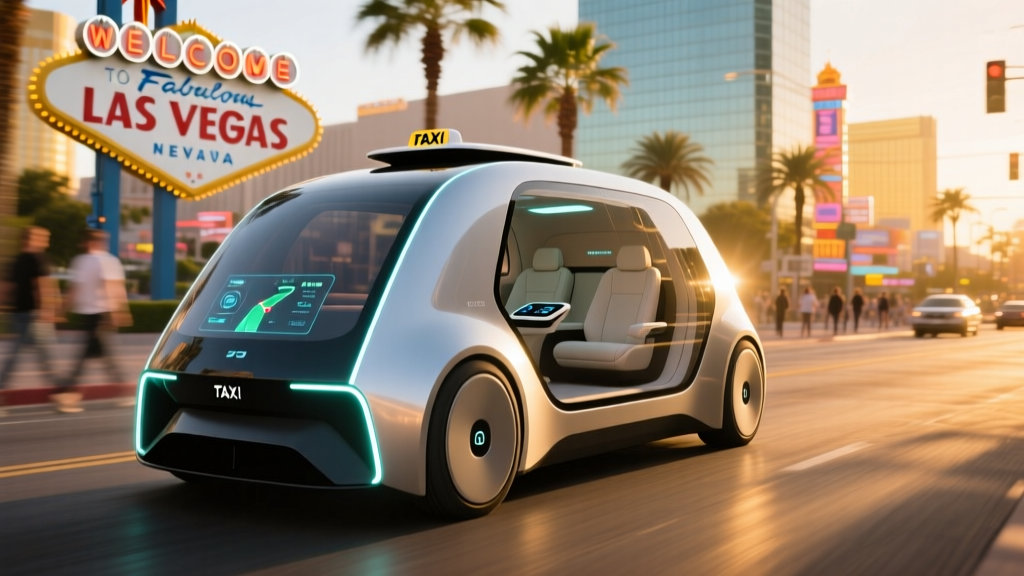
If you have visited the Las Vegas Strip recently, you may have spotted a white Jaguar I-PACE with a prominent roof-mounted sensor array gliding through traffic without anyone behind the wheel. Las Vegas driverless taxis are no longer a futuristic concept — they are a regulated, commercially operating transportation option in specific zones of the city. But how do they actually work, how much do they cost, and what does the safety data say?
This guide breaks down the current state of autonomous ride-hailing in Las Vegas: which services are live, where you can catch a ride, what the technology looks like under the hood, and the real limitations you should know before summoning one.
Are Las Vegas Driverless Taxis Truly Self-Driving?
The short answer: yes, the robotaxis operating commercially in Las Vegas are genuinely driverless — but only within strict boundaries. These vehicles operate at SAE Level 4 automation, which means the system performs all driving tasks without human intervention, but only within a defined operational design domain (ODD). This is fundamentally different from the Level 2 driver-assist systems in consumer vehicles.
| Level | Name | Who Drives? | Example |
|---|---|---|---|
| Level 0 | No Automation | Human | Basic car with no assist features |
| Level 1 | Driver Assistance | Human (system assists steering OR speed) | Adaptive cruise control |
| Level 2 | Partial Automation | Human (system assists steering AND speed) | Tesla Autopilot, GM Super Cruise, Ford BlueCruise |
| Level 3 | Conditional Automation | System (human must take over on request) | Mercedes DRIVE PILOT (limited markets) |
| Level 4 | High Automation | System (no human needed within ODD) | Waymo One, Zoox (commercial robotaxi) |
| Level 5 | Full Automation | System (all conditions, everywhere) | Does not yet exist commercially |
Source: SAE International J3016
Consumer systems like Tesla's Full Self-Driving (Supervised) and GM's Super Cruise remain Level 2 — the driver must remain attentive and is legally responsible for the vehicle at all times. Robotaxis from Waymo, by contrast, have no driver in the front seat. The vehicle is responsible. That distinction is critical for understanding both the capability and the regulatory framework.
Where Can You Use Robotaxis in Las Vegas Right Now?
As of early 2026, Waymo is the primary operator of fully driverless commercial robotaxi service in Las Vegas, running under its Waymo One brand. The service launched its Las Vegas operations after an extended testing and validation period on the city's roads.
| Operator | Status | Service Area | Hours |
|---|---|---|---|
| Waymo One | Live — driverless commercial service | Las Vegas Strip corridor, downtown Las Vegas, Harry Reid International Airport (select routes), surrounding neighborhoods within geofence | 24/7 in core zones |
| Motional (Hyundai/Aptiv) | Limited operations / testing | Select Strip routes (partnership with Uber/Lyft for select rides) | Limited hours |
| Zoox (Amazon) | Testing — no public commercial service in LV yet | N/A (public rides in Las Vegas not yet available) | N/A |
Service areas and hours are subject to change. Check the Waymo app for current geofence boundaries.
Waymo's Las Vegas geofence covers a meaningful portion of the tourist corridor — roughly from the southern end of the Strip near Mandalay Bay up through the Convention Center area and into parts of downtown, including the Arts District. Harry Reid International Airport pickups and drop-offs have been phased in on select routes. However, the geofence does not cover the entire metropolitan area. Suburban Henderson, Summerlin, and remote parts of North Las Vegas fall outside the current operational zone.
The key practical point: you can reliably hail a driverless Waymo for most Strip hotel-to-hotel trips, downtown restaurant runs, and airport transfers within the geofenced area. You cannot use one to drive to Red Rock Canyon or Lake Mead.
How Much Does a Robotaxi Ride Cost vs. Uber and Lyft?
Waymo prices its rides to be competitive with Uber and Lyft, and in many cases the fares are comparable to a standard UberX or Lyft ride — sometimes slightly cheaper during non-surge periods, sometimes slightly more during peak demand. The key difference: Waymo does not currently implement surge pricing in the same aggressive way that rideshare platforms do.
| Route (Approximate) | Waymo One | UberX / Lyft | UberX Surge (Fri/Sat Night) |
|---|---|---|---|
| McCarran Airport → Mid-Strip hotel (~4 mi) | $12–$18 | $11–$16 | $22–$35 |
| Mid-Strip → Downtown (~5 mi) | $14–$20 | $13–$19 | $25–$40 |
| South Strip → North Strip (~6 mi) | $15–$22 | $14–$20 | $28–$45 |
| Strip hotel → Convention Center (~2 mi) | $8–$12 | $8–$11 | $16–$25 |
Estimated fare ranges based on typical non-surge pricing, early 2026. Actual fares vary by time, demand, and route. Waymo pricing does not include tip (tipping is optional in the app).
How to book: Download the Waymo One app (available on iOS and Android), create an account, enter your pickup and drop-off locations, and confirm the ride. The app shows you the exact fare upfront before you confirm — no surprises. The vehicle arrives, you unlock it via the app, and the ride proceeds without a driver. In-app features let you adjust climate controls, add stops, and contact support.
One cost advantage: you do not tip a robotaxi driver (there is no driver). Waymo does offer an optional in-app tip feature that goes toward the fleet operations staff, but it is not expected the way a 15–20% rideshare tip is. For a $16 airport ride, your total cost is $16 — not $19.20.
The Technology Stack: What Powers a Las Vegas Robotaxi?
Waymo's current-generation robotaxi, built on the Jaguar I-PACE platform, carries a sensor suite that costs significantly more than the vehicle itself. Here is what makes Level 4 autonomy possible:
- LiDAR: Multiple custom-designed LiDAR units providing a 360° point cloud with detection range exceeding 500 meters. LiDAR (Light Detection and Ranging) creates a precise 3D map of the environment using laser pulses — it works in total darkness and is not fooled by headlight glare or shadows.
- Cameras: A suite of high-resolution cameras covering 360° with improved dynamic range for reading traffic lights, detecting brake lights, and identifying pedestrians at distance — even in bright Nevada sunlight.
- Radar: Imaging radar units for velocity detection of moving objects and performance in rain or dust, complementing LiDAR and camera data.
- Audio detection: External microphones that detect sirens from emergency vehicles, allowing the system to pull over proactively.
- Compute: Custom-designed Waymo AI processing units handling sensor fusion, prediction, and planning in real time — processing millions of data points per second.
- HD Maps: Centimeter-precision pre-mapped routes within the geofence, updated regularly to reflect construction, lane changes, and new signage.
The camera-only vs. LiDAR debate is one of the most consequential in autonomous driving. Tesla's FSD relies exclusively on cameras and neural networks (a "vision-only" approach). Waymo, Zoox, Motional, and virtually every other robotaxi operator use LiDAR as a core sensor, arguing that the redundancy of multiple sensor modalities — LiDAR, cameras, and radar — is essential for safety-critical Level 4 operation where no human is available as a backup.
Waymo's approach is also heavily dependent on geofencing. The system does not attempt to drive everywhere. Instead, it operates within zones that have been extensively mapped, tested, and validated. If you request a ride outside the geofence, the app simply will not let you book it. This constraint is both the system's greatest strength (high reliability within the zone) and its greatest limitation (no flexibility beyond it).
Safety Record: What the Data Actually Shows
Safety is the single most important question for anyone considering a robotaxi ride. Here is what the publicly available data indicates:
- Waymo cumulative autonomous miles: Over 40 million fully driverless miles completed across all operating cities (Phoenix, San Francisco, Los Angeles, Las Vegas) as of late 2025, per Waymo's published safety reports.
- Injury-causing crash rate: Waymo's own analysis, reviewed by third-party researchers, indicates its driverless vehicles are involved in injury-causing crashes at a rate approximately 85% lower than the human driving benchmark in comparable urban environments.
- Police-reported crash rate: Waymo data shows a roughly 57% reduction in police-reported crashes compared to human drivers in the same geographies.
- NHTSA Standing General Order: All Level 4 operators are required to report crashes to the National Highway Traffic Safety Administration under a Standing General Order. This data is publicly accessible and provides a baseline for accountability.
- Contact rate: The rate at which riders contact Waymo support during a trip (for issues like route concerns, vehicle behavior, or discomfort) has trended downward as the system has matured, though exact current figures are not always published per city.
Context matters here. Robotaxis operate in dense urban environments with pedestrians, cyclists, construction zones, and unpredictable human drivers. The incidents that have drawn media attention — such as vehicles stopping in travel lanes, minor low-speed collisions with stationary objects, or interactions with emergency vehicles — are real and should not be dismissed. However, the data consistently shows that at the fleet level, robotaxis are involved in fewer serious crashes per million miles than human drivers in comparable conditions.
It is also worth noting that every robotaxi crash is scrutinized in a way that human driving crashes are not. A fender-bender between two human drivers on the Strip happens dozens of times daily and makes no news. A robotaxi tapping a bollard at 5 mph generates a regulatory filing and a news cycle. This attention is appropriate for a new technology — but it can distort perception of the overall safety record.
Regulatory Landscape: Who Approves Robotaxi Operations?
Robotaxi operations in the United States are governed by a patchwork of state and federal regulations. In Nevada, the framework is relatively permissive compared to some states:
- Nevada DMV: The Nevada Department of Motor Vehicles issues autonomous vehicle testing and deployment permits. Operators must demonstrate safety validation, insurance coverage, and compliance with state reporting requirements before offering commercial service.
- NHTSA (Federal): The National Highway Traffic Safety Administration sets federal motor vehicle safety standards (FMVSS) and requires crash reporting under the Standing General Order for vehicles with Level 2+ and above automation. NHTSA does not currently "approve" robotaxi deployments — that authority largely falls to states — but it can investigate and issue recalls.
- Local jurisdictions: Clark County and the City of Las Vegas have input on operational details such as pickup/drop-off zones, particularly on the Strip and near the airport. Coordination with local first responders (fire, police, EMS) is required so that emergency personnel know how to interact with a driverless vehicle.
- Insurance requirements: Nevada requires autonomous vehicle operators to carry substantial liability insurance — significantly more than a personal auto policy — to cover potential incidents during driverless operation.
Nevada was one of the first states to pass autonomous vehicle legislation (AB 511 in 2011, updated since), which created a legal framework for testing and deployment. This early regulatory clarity is one reason Las Vegas attracted robotaxi operators alongside Phoenix (Arizona has similarly permissive rules) and San Francisco (California's DMV and CPUC both play roles).
Current Limitations: What Robotaxis Cannot Do
Understanding the limitations is as important as understanding the capabilities. Las Vegas driverless taxis in 2026 are impressive — but they are not a replacement for all transportation needs.
- Geofence boundaries: Service is restricted to the mapped operational zone. No rides to Hoover Dam, Valley of Fire, or suburban addresses outside the geofence.
- Severe weather: While Las Vegas rarely sees heavy rain or snow, monsoon-season dust storms and flash-flood conditions can trigger service suspensions. The system is designed to pull over safely if sensor confidence drops below threshold.
- Construction zones: Major, unexpected road construction can confuse the system or cause the vehicle to take conservative routes. Waymo's HD maps are updated regularly, but real-time construction changes can still cause delays or rerouting.
- Pickup/drop-off precision: The vehicle may not stop at the exact front door of your hotel. It uses designated or mapped pickup points, which might mean a short walk from the valet area to the actual vehicle location.
- No highway driving beyond mapped routes: While Waymo vehicles can handle highway speeds on mapped freeway segments (for example, portions of I-15 between the airport and the Strip), they do not handle arbitrary highway navigation the way a human driver would.
- Edge cases: Unusual scenarios — a person directing traffic with hand signals, an oversized load partially blocking a lane, a parade route — can cause the vehicle to stop and wait or request remote assistance from a Waymo operations specialist.
- Accessibility: The Jaguar I-PACE fleet is not wheelchair-accessible. Waymo has announced plans to integrate more accessible vehicles (including the purpose-built Zeekr robotaxi), but availability in Las Vegas has not been confirmed as of early 2026.
- Passenger capacity: Current vehicles seat up to 3 passengers in the rear. Large groups or parties with substantial luggage may need to book multiple rides or use a traditional rideshare XL option.
The remote assistance model is worth understanding. If a Waymo vehicle encounters a scenario it cannot resolve autonomously — for example, a double-parked delivery truck blocking the only lane — it does not simply sit there indefinitely. It contacts a remote operations specialist who can assess the situation via the vehicle's cameras and authorize a safe maneuver, such as crossing a double yellow line to go around the obstruction. This human-in-the-loop model is a key part of how Level 4 systems manage edge cases today.
Frequently Asked Questions
Where can I use a driverless taxi in Las Vegas right now?
Waymo One operates commercially across the Las Vegas Strip corridor, parts of downtown, and select routes to and from Harry Reid International Airport. The exact service boundary is visible in the Waymo app — enter your pickup and destination to confirm availability. Service runs 24/7 in the core zone.
How much does a robotaxi ride cost compared to Uber or Lyft?
Typical fares range from $8–$22 for most trips within the Las Vegas service area, comparable to standard UberX or Lyft pricing. The main cost advantage appears during surge periods: Waymo does not currently apply the same aggressive surge multipliers that rideshare platforms do, so a Friday night ride that would cost $35 on Uber might be $18 on Waymo. There is also no expected tip.
How safe are Las Vegas driverless taxis — is there real data?
Waymo has published safety data covering over 40 million driverless miles across its operating cities. Their analysis, supported by third-party review, shows injury-causing crash rates approximately 85% lower than human benchmarks in comparable urban driving. All crashes are reported to NHTSA under a federal Standing General Order. No autonomous technology is risk-free, but the fleet-level data indicates a strong safety record in the environments where these vehicles operate.
Is a Waymo robotaxi truly self-driving, or is there a hidden driver?
There is no driver. Waymo One vehicles in Las Vegas operate at SAE Level 4 — the system handles all driving tasks within its operational zone without any human behind the wheel. The front seats are empty. This is categorically different from Level 2 systems like Tesla Autopilot or Ford BlueCruise, which require an attentive human driver at all times.
What happens if the robotaxi gets confused or encounters a problem?
The vehicle will pull over safely or stop in place and contact a remote operations specialist via its cellular connection. The specialist can view the surroundings through the vehicle's cameras and authorize a safe maneuver or dispatch roadside assistance if needed. You can also contact Waymo support directly through the in-app button or the in-vehicle screen at any time during your ride.
Can I take a robotaxi from the Las Vegas airport?
Yes — Waymo has phased in Harry Reid International Airport service on select routes. Availability depends on your exact terminal and destination. Check the Waymo app when you land to confirm that your specific pickup point is within the service zone.
What vehicle does Waymo use in Las Vegas?
Waymo's Las Vegas fleet consists primarily of the Jaguar I-PACE, a fully electric SUV with a 90 kWh battery pack (NMC chemistry) and an EPA-estimated range of approximately 234 miles. The vehicle is modified with Waymo's 6th-generation sensor suite, custom compute hardware, and redundant braking and steering systems. The modifications add significant weight and power draw, so the operational range per charge is lower than a stock I-PACE — Waymo manages fleet charging to ensure vehicles rotate back to depots before reaching low state of charge.
Will robotaxis replace Uber and Lyft in Las Vegas?
Not in the near term. Robotaxis are limited by their geofence, cannot handle every trip type, and have fleet sizes that are a fraction of the rideshare driver population. They are a complementary option — particularly strong for predictable, short-to-medium trips within the core tourist zone — not a wholesale replacement. Expect both options to coexist for years.