The Reality of Robotaxis on the Las Vegas Strip
Las Vegas has become one of the most active proving grounds for commercial robotaxi service in the United States. Unlike consumer-facing driver-assist systems — Tesla's FSD (Supervised), GM's Super Cruise, Ford's BlueCruise — which are SAE Level 2 features requiring constant driver attention, the driverless taxis operating in parts of Las Vegas are genuinely uncrewed vehicles. There is no one behind the wheel. These are SAE Level 4 services: fully autonomous within a defined operational design domain (ODD), with no expectation that a passenger will intervene.
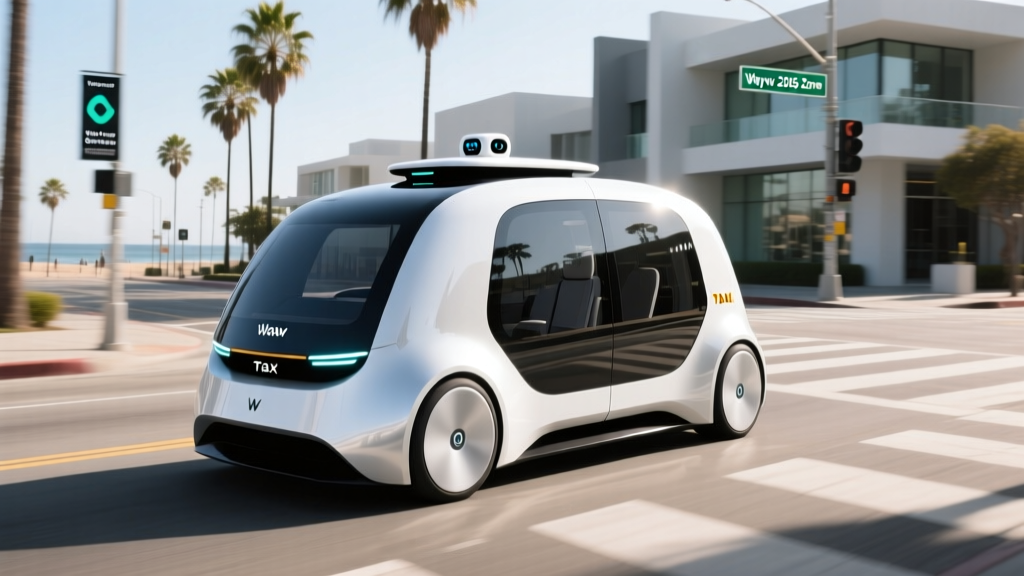
As of early 2026, the primary operator offering paid, fully driverless rides to the public in the Las Vegas area is Waymo, which expanded its commercial service footprint beyond its original Phoenix, San Francisco, and Los Angeles markets. Other players — including Cruise (now restructured under GM's revised autonomy strategy) and Zoox (Amazon's purpose-built robotaxi subsidiary) — have tested or announced Las Vegas operations, but availability varies. This guide breaks down exactly what's running, what it costs, and what the safety record actually shows.
| Level | Classification | Who Drives | Example |
|---|---|---|---|
| Level 2 | Driver Assistance | Human (must monitor) | Tesla FSD (Supervised), BlueCruise, Super Cruise |
| Level 3 | Conditional Automation | System (in limited conditions, human on standby) | Mercedes Drive Pilot (selected markets) |
| Level 4 | High Automation | System (no human needed within ODD) | Waymo One, Zoox (geofenced areas) |
| Level 5 | Full Automation | System (everywhere, all conditions) | Does not exist commercially |
Source: SAE International J3016
Where Can You Use a Driverless Taxi in Las Vegas Right Now?
The geofenced service area matters more than the city name. Robotaxis don't operate everywhere in Las Vegas — they run within a carefully mapped zone that the operator and state regulators have approved.
| Operator | Status | Service Area | Hours | How to Book |
|---|---|---|---|---|
| Waymo | Commercial (paid, driverless) | Parts of the Strip corridor, Harry Reid International Airport, select suburban zones | 24/7 in approved ODD | Waymo app (iOS/Android) |
| Zoox | Limited commercial / testing | Restricted test zones; expanding | Limited hours | Zoox app (invite/waitlist) |
| Motional (Hyundai/Aptiv JV) | Testing / limited pilot | Designated test corridors | N/A for public | Not publicly bookable |
Waymo's Las Vegas footprint covers a meaningful slice of the tourist corridor — including key hotel pickups along Las Vegas Boulevard and rides to and from Harry Reid International Airport (LAS). However, the geofence does not extend to all suburbs, mountain roads, or construction-heavy detour routes. If your destination falls outside the ODD, the app will decline the ride and suggest a nearby drop-off point within bounds.
Practical tip: Open the Waymo app before you plan your trip and enter your exact pickup and drop-off addresses. The app will confirm whether both points fall within the active service area. Geofence boundaries expand periodically as regulators approve new zones, so a route that wasn't available in 2025 may be bookable now.
How Much Does a Las Vegas Driverless Taxi Cost vs. Uber and Lyft?
Robotaxi pricing has evolved as operators move from subsidized early-access programs toward sustainable commercial fares. In Las Vegas, Waymo's pricing is generally competitive with UberX and Lyft standard rides — and in some cases, slightly cheaper during off-peak hours because there's no human driver compensation baked into the fare.
| Service | Typical Fare (5-mile Strip ride) | Surge Pricing | Tipping | Wait Time |
|---|---|---|---|---|
| Waymo (driverless) | $10–$16 | Dynamic pricing (less volatile than rideshare surge) | Not available/expected | 3–8 min (within ODD) |
| UberX | $12–$22 | Surge pricing during peak hours/events | Expected (15–20%) | 2–10 min |
| Lyft Standard | $11–$20 | Prime Time pricing during demand spikes | Expected (15–20%) | 3–12 min |
Key differences beyond the base fare:
- No tipping: There's no driver to tip in a Waymo, which effectively reduces your total cost by 15–20% compared to rideshare.
- No surge volatility: Waymo uses dynamic pricing, but it tends to be less aggressive than Uber/Lyft surge multipliers during major conventions (CES, SEMA) or fight nights.
- Promotional pricing: Waymo frequently offers first-ride discounts and promotional credits for new users in newly launched markets. Check the app for current offers.
- Accessibility: Waymo has been expanding its wheelchair-accessible vehicle (WAV) fleet, though availability in Las Vegas remains more limited than standard vehicles. Request WAV rides through the app with additional lead time.
How Safe Are Robotaxis? The Real Data
Safety is the most scrutinized question in autonomous vehicles, and it deserves a data-driven answer — not marketing claims or anecdotal fear. Waymo publishes periodic safety reports and has submitted collision data to the National Highway Traffic Safety Administration (NHTSA) as required for autonomous driving systems.
- Total fully autonomous miles driven (all markets): Over 50 million driverless miles across Phoenix, San Francisco, Los Angeles, and Las Vegas combined.
- Contact rate vs. human benchmarks: Waymo's internal analysis and third-party studies (including research published by the Insurance Institute for Highway Safety, IIHS) have shown that Waymo vehicles are involved in police-reported crashes at a lower rate per million miles than human drivers in comparable urban environments — approximately 85% fewer injury-causing crashes and 57% fewer property-damage-only crashes compared to human benchmarks.
- Most common incident type: Low-speed contacts (under 10 mph), typically rear-end events where the robotaxi stopped conservatively and a human-driven vehicle behind it did not. These are overwhelmingly property-damage-only events with no injuries.
- Critical incidents: Extremely rare relative to miles driven. NHTSA Standing General Order requires all ADS operators to report crashes involving injury, fatality, or significant property damage. Waymo's reported critical incidents remain a small fraction of the human-driver baseline for equivalent urban driving.
Sources: NHTSA AV Safety Data, Waymo Safety Reports, IIHS research publications
For context, the human-driver fatality rate in the United States is approximately 1.35 deaths per 100 million vehicle miles traveled (NHTSA FARS data). Robotaxi services have not accumulated enough miles to produce statistically comparable fatality rates — but the available contact and injury data strongly suggests that Level 4 systems operating within their approved ODD outperform average human drivers in urban settings, particularly in eliminating impairment-related, distraction-related, and fatigue-related crashes.
What the data does NOT show: That robotaxis are perfect. Edge cases — unusual construction zones, erratic pedestrians, extreme weather — still trigger remote assistance or conservative pullovers. The safety advantage comes from consistency: the system never gets tired, never texts, and never drives impaired.
Under the Hood: The Technology Stack Powering Las Vegas Robotaxis
The vehicles you'll see operating driverless in Las Vegas are not modified consumer cars with a laptop in the trunk. They are purpose-equipped platforms carrying a dense sensor suite that provides 360-degree perception in conditions that would challenge a human driver.
| Component | Specification | Purpose |
|---|---|---|
| LiDAR | Custom-built, roof-mounted + corner units; range 500m+ | 3D point-cloud mapping of surroundings; detects shape, distance, and movement of all objects regardless of lighting |
| Cameras | High-resolution surround-view array (visible spectrum + IR) | Traffic-light state detection, sign reading, lane-marking recognition, pedestrian intent classification |
| Radar | Multi-mode imaging radar (front, rear, sides) | Velocity measurement of moving objects; performs in rain, fog, and dust where cameras/LiDAR degrade |
| Compute Platform | Custom Waymo-designed AV compute unit | Real-time sensor fusion, perception, prediction, and planning at hundreds of decisions per second |
| HD Maps | Centimeter-accurate pre-mapped routes within ODD | Provides static-world context (lane geometry, curb locations, speed limits) that supplements live perception |
| V2X / Connectivity | Cellular + dedicated short-range comms | Remote assistance requests, fleet coordination, real-time traffic and road-closure updates |
LiDAR vs. Camera-Only — Why It Matters: Tesla's consumer FSD (Supervised) system uses a camera-only ("Tesla Vision") approach. Waymo, Zoox, and nearly every other Level 4 operator rely on LiDAR as a primary sensor alongside cameras and radar. The distinction is significant: LiDAR provides direct depth measurement independent of lighting conditions, giving the system reliable distance data at night, in direct sun glare, and in scenarios where camera-based depth estimation can struggle. For a fully uncrewed vehicle with no human fallback, this sensor redundancy is a deliberate engineering choice — not a cost oversight.
The geofencing model means these vehicles operate only on roads that have been extensively mapped and validated. If you've ever wondered why a robotaxi takes a slightly different route than your GPS would suggest, it's because the vehicle is staying within its validated ODD — the roads where its HD maps, tested scenarios, and regulatory approvals all align.
The Regulatory Landscape: Who Approves Driverless Taxis in Nevada?
Nevada was one of the first U.S. states to pass legislation enabling autonomous vehicle testing and commercial deployment (NRS 482A, enacted in 2011 and updated in subsequent sessions). The regulatory framework is multi-layered:
- State level: The Nevada Department of Motor Vehicles (DMV) issues autonomous vehicle testing and deployment permits. Operators must demonstrate safety cases, carry minimum insurance ($5 million in Nevada for AV commercial operations), and comply with data-reporting requirements.
- Federal level: NHTSA regulates vehicle safety standards and requires crash reporting under the Standing General Order for ADS-equipped vehicles. The Federal Motor Vehicle Safety Standards (FMVSS) still apply, though NHTSA has granted limited exemptions for vehicles without traditional controls (steering wheel, pedals) — relevant for Zoox's purpose-built vehicle.
- Local level: Clark County and the City of Las Vegas coordinate on road infrastructure, construction-zone notifications, and first-responder interaction protocols with AV operators. Harry Reid International Airport has its own ground-transportation authority that must separately approve robotaxi pickup/drop-off operations.
This patchwork means that an operator can be approved to run driverless on the Strip but not yet cleared for a specific airport terminal curb, or approved for daytime operations but still expanding nighttime coverage. Regulatory approvals — not technology limitations — are often the binding constraint on where and when you can book a ride.
Current Limitations: What Robotaxis Still Can't Do
- Geofence boundaries: Rides outside the approved ODD are not possible. Suburban areas, rural roads, and many residential neighborhoods are not yet covered.
- Weather constraints: While Las Vegas rarely sees heavy rain or snow, monsoon-season downpours and dust storms (haboobs) can trigger service slowdowns or temporary suspensions. The system is conservative — if sensor confidence drops, the vehicle pulls over safely rather than pushing through.
- Construction zones: Major roadwork with altered lane geometry, temporary barriers, and flaggers can exceed the system's validated scenarios. Waymo receives construction-zone data feeds, but rapidly changing detours may result in rerouting or ride decline.
- Unusual cargo and scenarios: You cannot request a robotaxi to transport unaccompanied minors, large freight, or pets without a human rider. The vehicle interior is monitored, and certain behaviors (vandalism, smoking) will trigger a response.
- Remote assistance delays: In rare edge cases, the vehicle may pause and request remote guidance from a human operations specialist. This typically resolves in seconds to a minute, but it can add to trip time.
- Accessibility gaps: Wheelchair-accessible vehicle availability remains limited compared to the standard fleet. Plan ahead and allow extra wait time for WAV requests.
- No intercity trips: Las Vegas to Henderson, Boulder City, or the Grand Canyon? Not yet. These routes fall outside the geofence and the validated ODD.
These limitations are not failures of the technology — they are the boundaries of the current deployment scope. Each expansion of the geofence, each new weather condition validated, each construction-zone scenario added to the system's training data incrementally widens what's possible. But as a rider in 2026, you should plan your trip knowing these constraints exist.
How to Actually Book and Ride a Driverless Taxi in Las Vegas
- Download the Waymo app (available on iOS and Android). Create an account with your phone number and payment method.
- Enter your pickup and destination. The app will confirm whether both are within the active service area. If not, it will suggest the nearest valid points.
- Confirm your ride. You'll see an estimated fare, wait time, and the vehicle type. No surge surprises — the quoted price is what you'll pay unless you change the route.
- Meet your vehicle. The app shows the car's location in real time. When it arrives, you'll confirm the vehicle by matching the license plate or a unique identifier displayed on the exterior screen.
- Unlock and ride. Tap "Start Ride" in the app or use the exterior door handle button. The vehicle will confirm your identity (in some cases via a PIN displayed in the app) and begin the trip automatically.
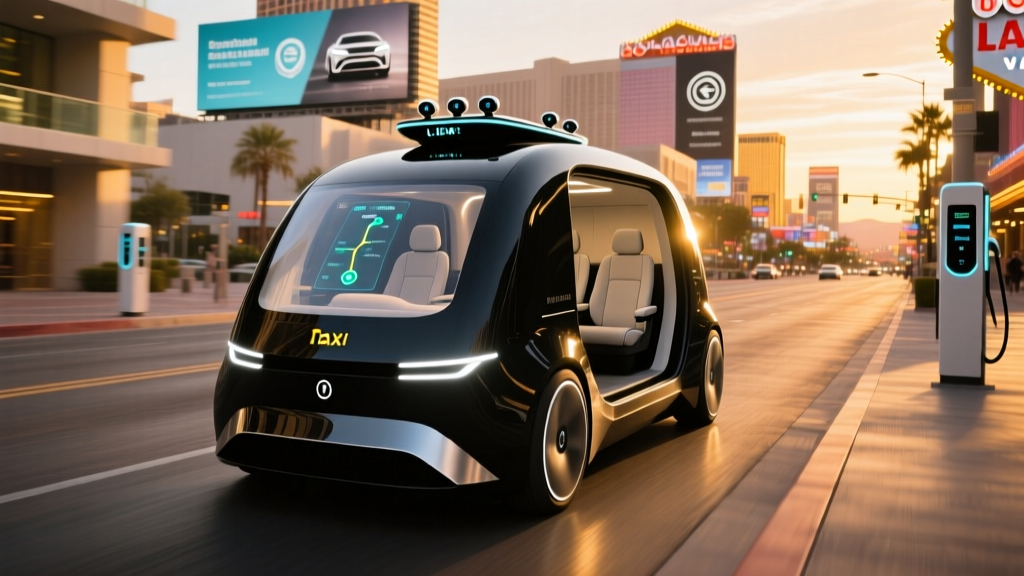
- In-ride experience. A screen displays the route, the vehicle's perception of surrounding traffic, and your ETA. You can adjust climate controls and select music. No one is in the driver's seat.
- Arrival and exit. The vehicle pulls to a safe stopping point. Take all belongings and exit. The fare is charged automatically to your payment method.
Frequently Asked Questions
Is the Las Vegas driverless taxi truly self-driving, or is there a remote driver?
There is no driver in the vehicle — no one behind the wheel, no hidden controls. The car operates autonomously using its onboard SAE Level 4 system. In rare situations, the vehicle may request remote guidance from a human operations specialist who can advise on a path forward (e.g., navigating around an unusual obstacle), but this specialist does not "drive" the car in real time. The vehicle's control systems execute all steering, braking, and acceleration.
Can I hail a robotaxi from any hotel on the Las Vegas Strip?
Most major hotels along the central Strip corridor fall within Waymo's geofenced service area, but coverage is not universal. Always check the app with your exact pickup address. Some hotel pickup points are on private property or in areas where the geofence boundary doesn't extend — the app will direct you to the nearest valid street-side pickup.
What happens if the robotaxi encounters an emergency or accident?
The vehicle is programmed to execute a safe stop (pull to the side of the road, activate hazard lights) if it detects a system fault or an unavoidable collision scenario. In-ride, you have access to a support button that connects you to a live Waymo representative. Emergency services can be dispatched through the app or by calling 911 directly. All vehicles carry standard safety equipment and are monitored by Waymo's fleet operations center 24/7.
How does robotaxi safety compare to a human Uber/Lyft driver?
Based on available data from Waymo's published safety reports and NHTSA crash-reporting records, Waymo's driverless vehicles are involved in fewer police-reported crashes per million miles than the human-driver average in comparable urban environments. The primary advantage is elimination of impairment, distraction, and fatigue — the leading causes of human-driver crashes. That said, robotaxis are not immune to incidents, particularly low-speed rear-end contacts in stop-and-go traffic.
Will robotaxis replace Uber and Lyft in Las Vegas?
Not in the near term. Robotaxi services are limited by geofence boundaries, fleet size, and regulatory approval pace. Uber and Lyft will continue to serve areas outside the robotaxi ODD, handle complex trips (multiple stops, large groups, intercity rides), and operate during conditions where autonomous service may be suspended. The more likely near-term scenario is coexistence: robotaxis for standard point-A-to-B trips within the service zone, rideshare for everything else.
Are there any age or ID requirements to ride alone in a driverless taxi?
Yes. Waymo requires riders to be at least 18 years old with a valid account. Unaccompanied minors cannot ride. You may need to verify your identity during account setup or at vehicle entry.