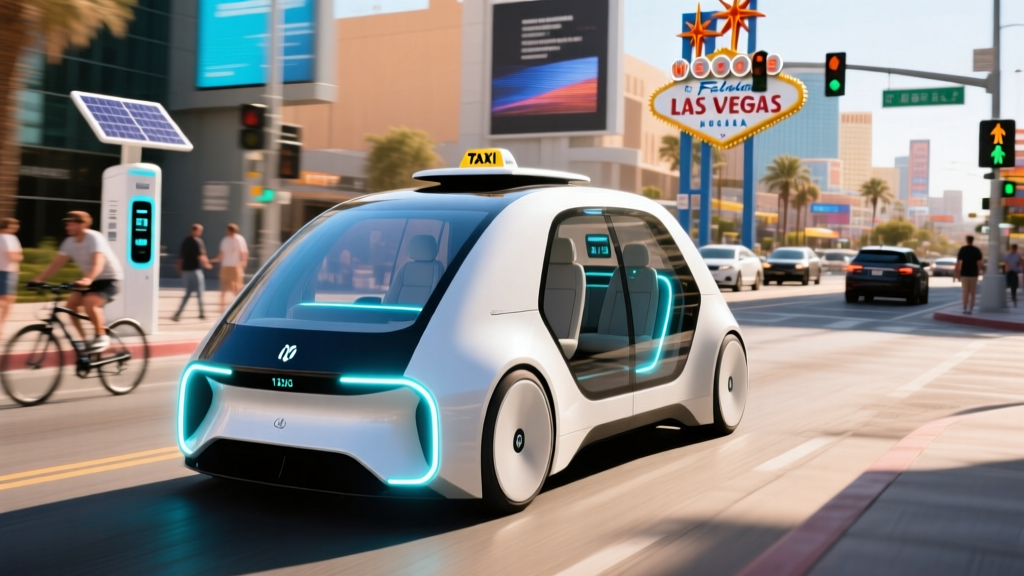
Las Vegas has become one of the most active proving grounds for driverless transportation in the United States. With its grid-like Strip corridor, predictable tourist traffic, and Nevada's permissive regulatory framework, the city hosts multiple autonomous vehicle (AV) programs that let real passengers hail rides with no one behind the wheel. But "autonomous" covers a wide spectrum — from highway lane-keeping assist to truly driverless robotaxis — and the distinction matters if you're deciding whether to step into one.
This guide breaks down exactly which Las Vegas autonomous vehicles you can ride today, how the technology works, what the safety record shows, and where the hard limits still are.
SAE Automation Levels: What "Self-Driving" Actually Means in Vegas
Before we name names, the SAE International J3016 framework is the only reliable way to separate marketing from engineering reality. Every AV discussion collapses into confusion without it.
| Level | Name | Who Drives | Las Vegas Example |
|---|---|---|---|
| Level 2 | Driver Assistance | Human (hands on or eyes on) | Tesla Autopilot / FSD (Supervised), GM Super Cruise on I-15 |
| Level 3 | Conditional Automation | System in narrow conditions; human must take over on request | Mercedes Drive Pilot (limited to 40 mph, not yet deployed in NV) |
| Level 4 | High Automation | System within its Operational Design Domain (ODD); no human needed | Motional IONIQ 5 robotaxi, Waymo (expanding) |
| Level 5 | Full Automation | System everywhere, all conditions | Does not exist commercially anywhere |
Where Can I Ride a Driverless Robotaxi in Las Vegas Right Now?
As of early 2026, two Level 4 services have meaningful Las Vegas footprints, though neither covers the entire metro area.
| Operator | Vehicle | Operational Area | Hours | How to Hail |
|---|---|---|---|---|
| Motional (Hyundai/Aptiv JV) | Hyundai IONIQ 5 (L4-equipped) | Strip corridor, Downtown, Convention Center, Harry Reid Airport (LAS) | ~7 AM – 1 AM, 7 days | Motional app; also bookable via Uber |
| Waymo (Alphabet) | Jaguar I-PACE (6th-gen sensor suite) | Expanding from Strip core to Summerlin and North Las Vegas corridors | 24/7 in core zone | Waymo One app |
Motional has been the more visible presence on the Strip since its 2022 commercial launch, running white IONIQ 5s with a prominent roof lidar array. Rides are available through the standalone Motional app or as an Uber option (select "Autonomous" when booking in the covered zone). Waymo entered Las Vegas with employee-only testing in 2023 and has progressively opened its Waymo One service to the public, leveraging the same 6th-generation hardware it deploys in Phoenix, San Francisco, and Los Angeles.
Both services are geofenced. Request a pickup outside the approved zone — for example, Red Rock Canyon or Lake Mead — and the app will simply decline. Highway driving on I-15 is generally excluded or limited to specific on/off-ramp segments within the ODD.
How the Tech Stack Actually Works: Lidar, Cameras, and HD Maps
Neither Motional nor Waymo uses the camera-only approach Tesla relies on for FSD. Both run redundant, multi-sensor stacks designed for Level 4 operation where there is no human fallback.
Motional IONIQ 5 Robotaxi
- Lidar: Multiple solid-state and spinning units (roof + corners) for 360° depth mapping at 200+ meter range
- Cameras: ~12 high-resolution units covering near-field and traffic-light recognition
- Radars: Forward and corner radars for velocity detection in rain or glare
- Compute: Custom Aptiv/Hyundai redundant computing platform with dual fail-operational paths
- HD Maps: Centimeter-precision maps updated frequently; vehicle localizes within the map even when GPS degrades near casinos
Waymo 6th-Gen Jaguar I-PACE
- Lidar: 4 proprietary roof-mounted units with improved range and lower cost vs 5th-gen
- Cameras: 29 cameras including high-dynamic-range for sun glare on the Strip
- Radars: 6 imaging radars, plus external audio receivers for siren detection
- Compute: Custom Waymo Driver platform with redundant braking and steering actuators
- HD Maps: Continuously updated; Waymo's Las Vegas map covers 80+ square miles and growing
The geofence is not just a line on a map — it reflects where the operator has validated sensor coverage, mapped every lane and curb, and confirmed that the system can handle every intersection geometry. When construction reroutes a lane on Las Vegas Boulevard, the service may temporarily shrink its ODD until the new configuration is verified.
Robotaxi Pricing vs. Uber and Lyft in Las Vegas
Autonomous rides are not yet cheaper than human-driven rideshare on a per-mile basis, but they are competitive — and the pricing model is more transparent.
| Service | Base Fare | Per Mile | Typical Strip→Airport | Surge Pricing |
|---|---|---|---|---|
| Motional (via app) | $2.50 | $1.35 | $11 – $16 | None (fixed algorithmic pricing) |
| Motional (via Uber) | Uber base | Uber per-mile | $13 – $18 | Uber surge applies |
| Waymo One | $2.80 | $1.40 | $12 – $17 | Rare "high-demand" multiplier, capped |
| UberX (human driver) | $2.00 | $1.15 | $10 – $25+ | Frequent surge during events/weekends |
| Lyft (human driver) | $2.00 | $1.10 | $9 – $24+ | Prime-time pricing common |
The robotaxi advantage shows up during peak demand: while UberX can surge 2–3x during a convention or Saturday night, Motional and Waymo prices remain relatively stable. During CES or a Raiders game, a robotaxi can be the cheaper option even if its base rate is higher. Both operators also offer promotional credits for first-time riders — Waymo has been running "$5 off your first three rides" campaigns in new markets.
Safety Record: What the Data Actually Shows
Safety is the most contested question in autonomous vehicles, and Las Vegas-specific public data is thinner than in Phoenix or San Francisco. Here's what we can confirm from NHTSA Standing General Order crash reporting and operator disclosures.
Las Vegas Robotaxi Safety Snapshot
- Waymo national fleet: 50+ million fully driverless miles completed as of late 2025. Peer-reviewed analysis (Swiss Re, 2024) showed a 76% reduction in at-fault injury crashes vs. human benchmarks and 73% fewer property-damage claims.
- Motional: Has logged 2+ million driverless miles across Las Vegas, Los Angeles, and other markets. No reported passenger fatalities. Minor contact incidents (low-speed sideswipes with commercial vehicles) reported to NHTSA — typically under 5 mph, no injuries.
- Disengagement context: Both operators report remote-assist events (vehicle pulls over and contacts a human operations center) roughly once per 5,000–10,000 miles in complex urban zones. This is not a "crash" — it's the system recognizing uncertainty and choosing to stop safely.
- Pedestrian detection: Post-2023 incidents in other markets (notably the Cruise pedestrian-dragging event in San Francisco) prompted industry-wide software updates. Both Waymo and Motional now implement more conservative post-collision behavior and enhanced ground-object detection.
For context, Nevada's DMV and the IIHS both note that human drivers in Las Vegas produce a crash rate of roughly 4.5 police-reported incidents per million vehicle-miles. Robotaxis appear to operate well below that rate for at-fault collisions, though the comparison is imperfect: robotaxis avoid highways, bad weather, and rural roads — all higher-risk environments.
Regulatory Framework: Who Approves Robotaxis in Nevada?
Nevada was the first U.S. state to pass autonomous vehicle legislation (AB 511, 2011), and its framework remains one of the most permissive:
- State level: Nevada DMV issues Autonomous Vehicle Testing and Deployment permits. Operators must submit safety cases, insurance certificates ($5M+ minimum liability), and incident reports.
- Local level: Clark County and the City of Las Vegas coordinate on geofence boundaries, particularly around the Strip (which is technically unincorporated Clark County, not the City of Las Vegas).
- Federal level: NHTSA retains authority over vehicle safety standards (FMVSS). Current FMVSS still assume a human driver, which is why robotaxis use vehicles that technically have steering wheels and pedals even when no one occupies the seat. Waymo's purpose-built "Zeeky" vehicle (no steering wheel) has required an FMVSS exemption petition.
- Airport access: Harry Reid International Airport (LAS) has a specific operating agreement with Motional for autonomous pickups at designated zones — a notable regulatory milestone, as airports are typically the most restrictive jurisdictions.
Unlike California, Nevada does not require operators to publish disengagement reports, which limits public visibility into system performance. Advocacy groups including the Consumer Federation of America have pushed for standardized reporting; as of 2026, Nevada has not adopted such a mandate.
Current Limitations: What Robotaxis in Vegas Still Cannot Do
Hard Constraints for Las Vegas Autonomous Vehicles
- Geofence boundary: No rides to Hoover Dam, Valley of Fire, or suburban Henderson outside the mapped zone. The app will refuse the request.
- Highway driving: I-15 and US-93 are largely excluded. Airport runs use surface streets and dedicated ramp segments only.
- Weather: While Las Vegas rarely sees snow, monsoon-season flash rain and dust storms (haboobs) can trigger service suspension. Lidar performance degrades in heavy particulate conditions.
- Construction zones: Unmapped lane shifts on the Strip cause the vehicle to pull over and request remote-assist or cancel the ride. Expect 5–15 minute delays during active roadwork.
- Pedestrian density: Fremont Street Experience and New Year's Eve on the Strip represent edge cases with unpredictable pedestrian behavior. Services may shrink their geofence or suspend operations during mega-events.
- Accessibility: Current robotaxi fleets use standard IONIQ 5 and Jaguar I-PACE vehicles — neither offers wheelchair-accessible ramp entry. Waymo has announced WAV plans but availability in Las Vegas is limited.
- No multi-stop trips: You cannot add a stop at a pharmacy or ask the car to wait. One origin, one destination.
- Age and rider rules: Riders must be 18+. Unaccompanied minors are not permitted. No pets (service animals excepted).
These are not software bugs that a quick update will fix — they reflect the current boundaries of what Level 4 systems can safely handle without a human fallback. Operators expand the ODD incrementally as they validate each new scenario.
Las Vegas Autonomous Vehicles vs. Consumer Level 2: Don't Confuse Them
A common confusion among visitors: renting a Tesla with Autopilot or FSD (Supervised) and assuming it's the same technology as the driverless IONIQ 5 passing them on Las Vegas Boulevard. It is not.
| Dimension | Tesla FSD (Supervised) / GM Super Cruise | Motional / Waymo Robotaxi |
|---|---|---|
| SAE Level | Level 2 | Level 4 |
| Who is the driver | You (legally and physically) | The system |
| Liability in a crash | You | Operator (Motional/Waymo) |
| Operational area | Any public road | Geofenced zone only |
| Sensor suite | Cameras only (Tesla) or cameras + lidar (GM) | Lidar + cameras + radars + HD maps |
| Can you nap | No — eyes-on or hands-on required | Yes — no driver seat occupied |
| Cost to you | Vehicle purchase ($35K–$100K+) + FSD subscription | Per-ride fare ($10–$20 typical) |
If you rent a Tesla in Las Vegas, you are using a sophisticated driver-assist system. You remain responsible for every lane change, stop, and collision. The robotaxis you see operating without drivers are a fundamentally different category — purpose-built, heavily sensor-laden, geofenced, and commercially insured by the operator.
Frequently Asked Questions
Where can I use a robotaxi service right now in Las Vegas?
Motional covers the Strip, Downtown, Las Vegas Convention Center, and Harry Reid Airport (LAS). Waymo One covers a similar core zone and is expanding toward Summerlin and North Las Vegas. Neither covers the broader metro area, highways, or destinations outside the mapped geofence.
How much does a robotaxi cost compared to Uber or Lyft?
Base fares are comparable — roughly $12–$17 for a Strip-to-airport ride. The robotaxi advantage emerges during peak demand: while UberX surges 2–3x during conventions or weekend nights, Motional and Waymo pricing stays relatively flat. Promotional credits often make first rides cheaper than rideshare.
How safe are Las Vegas robotaxis based on real data?
Waymo's national fleet has logged 50+ million driverless miles with a peer-reviewed 76% reduction in at-fault injury crashes vs. human benchmarks. Motional has 2+ million driverless miles with no passenger fatalities. Both operators' crash rates appear well below the Las Vegas human-driver average of ~4.5 incidents per million miles, though robotaxis avoid higher-risk environments like highways and bad weather.
What are the current limitations of Las Vegas autonomous vehicles?
Geofenced zones only (no Hoover Dam or Valley of Fire), no highway driving, service suspension during dust storms or heavy rain, pull-overs in unmapped construction zones, no wheelchair-accessible vehicles in wide availability, no multi-stop trips, and age restrictions (18+). These reflect hard boundaries of current Level 4 capability, not temporary glitches.
Is this truly self-driving, or is it just driver-assist like Tesla Autopilot?
Robotaxis from Motional and Waymo are SAE Level 4 — truly driverless within their geofenced operational area, with no human in the vehicle and the operator bearing liability. Tesla Autopilot and FSD (Supervised) are SAE Level 2 — advanced driver-assist where you remain the legal driver, fully responsible for the vehicle. They are fundamentally different categories and should never be conflated.
Can I hail a robotaxi from the Las Vegas airport?
Yes, from Harry Reid International Airport (LAS) via Motional, which has a designated autonomous pickup zone. Waymo's airport access has been expanding. Check the app for current availability at the time of your arrival — pickup zones are specific and may require a short walk to a marked area.
What happens if the robotaxi encounters a situation it can't handle?
The vehicle pulls over safely and contacts a remote-assistance operator who can guide it through the scenario or dispatch a human driver. This is not a failure — it's the designed fallback behavior. Expect a 5–15 minute delay when it happens, which occurs roughly once per 5,000–10,000 miles in complex urban zones.