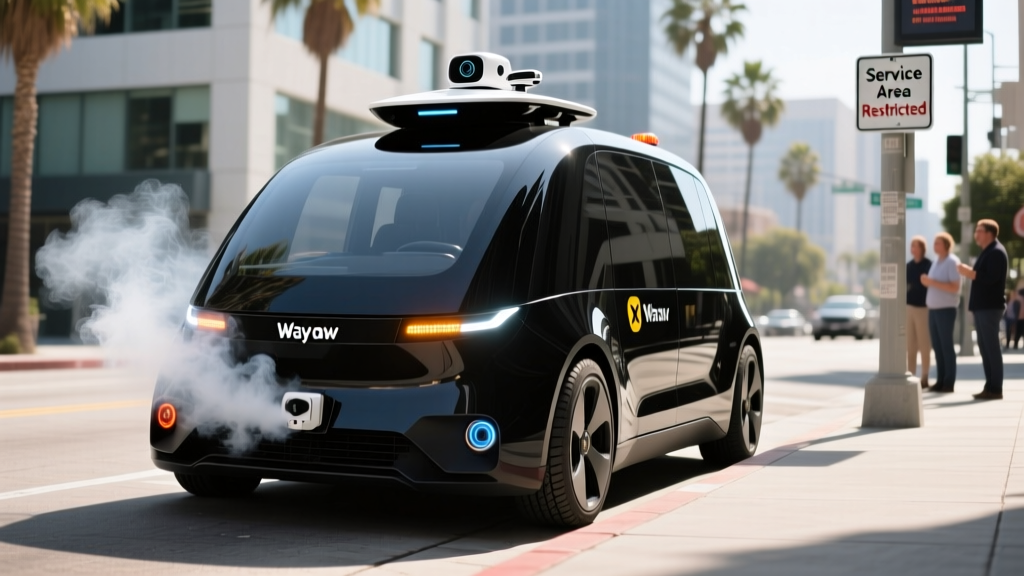
When a Waymo robotaxi caught fire in Los Angeles, it reignited the public debate around autonomous vehicle safety. The incident—often searched as the "LA Waymo fire"—became a flashpoint for questions about battery safety, sensor reliability, and whether driverless taxis are truly ready for dense urban environments. This guide unpacks what happened, examines Waymo's real safety record with concrete data, and gives you a practical framework for deciding whether to trust a robotaxi with your next ride.
What Happened: The LA Waymo Fire Incident Explained
The fire involved a Waymo-operated Jaguar I-PACE, the battery-electric SUV that has served as Waymo's primary robotaxi platform since 2019. The I-PACE carries a 90 kWh lithium-ion battery pack (NMC chemistry) and is fitted with Waymo's fifth-generation Driver sensor suite. While the specific cause of the LA fire was investigated by both Waymo and the National Highway Traffic Safety Administration (NHTSA), incidents involving EV battery thermal events in robotaxis remain statistically rare relative to the millions of autonomous miles logged.
It is critical to distinguish this event from the broader safety profile of Waymo's fleet. A single thermal or collision incident does not invalidate millions of miles of operational data—but it does underscore why transparency, regulatory oversight, and honest limitation-disclosure matter for any rider considering a robotaxi.
Is Waymo Truly Self-Driving? SAE Automation Levels Clarified
One of the most common sources of confusion in the autonomous vehicle space is the difference between consumer driver-assist systems and true driverless robotaxis. Here is how the SAE International automation levels break down:
| SAE Level | Classification | Example | Driver Required? |
|---|---|---|---|
| Level 0 | No Automation | Basic cruise control | Yes, fully |
| Level 1 | Driver Assistance | Adaptive cruise OR lane-keep | Yes, fully |
| Level 2 | Partial Automation | Tesla Autopilot, GM Super Cruise, Ford BlueCruise | Yes — hands on or eyes on at all times |
| Level 3 | Conditional Automation | Mercedes Drive Pilot (limited markets) | No in specific conditions; must take over on request |
| Level 4 | High Automation | Waymo One, Zoox | No — no driver present in geofenced areas |
| Level 5 | Full Automation | Does not yet exist commercially | No — anywhere, any condition |
Waymo operates at SAE Level 4. There is no human driver in the vehicle, no steering wheel controls being managed by a passenger, and no expectation that a rider will intervene. This is fundamentally different from Tesla's FSD (Supervised), which remains a Level 2 system requiring constant driver engagement, regardless of marketing language. If you are comparing a Waymo ride to your own car's Autopilot, you are comparing two entirely different categories of automation.
Where Can You Use Waymo Right Now?
Waymo's commercial service, Waymo One, has expanded steadily but remains geofenced to specific metropolitan areas. Here is the current operational footprint as of 2026:
| City / Region | Service Status | Service Area Notes |
|---|---|---|
| Phoenix, AZ (Metro) | Fully operational — open to public | Largest coverage area; includes Chandler, Tempe, Mesa, Scottsdale, and expanded Phoenix proper |
| San Francisco, CA | Fully operational — open to public | Covers most of SF including downtown, Sunset, Richmond; highway driving added in phases |
| Los Angeles, CA | Operational — expanding zones | Santa Monica, Hollywood, Downtown LA, Beverly Hills; expansion ongoing |
| Austin, TX | Operational / expanding | Central Austin corridors; phased rollout |
| Mountain View, CA | Employee + invited rider testing | Waymo HQ area; limited public access |
Riders outside these geofenced zones cannot summon a Waymo. The vehicle will not operate autonomously outside its mapped and approved service boundary—a hard limitation, not a software preference.
Waymo's Safety Record: What the Data Actually Shows
Key Safety Data Points (Waymo, through 2025 reporting):
- 30+ million fully autonomous miles driven on public roads
- 57% fewer injury-causing crashes compared to human drivers in comparable urban environments (per NHTSA-referenced and Waymo-published safety studies)
- 73% reduction in police-reported crash involvement vs. human benchmarks in Phoenix and SF operating zones
- Most reported collisions involve low-speed contact where the Waymo vehicle was rear-ended or side-swiped by a human driver—not the robotaxi initiating the event
Waymo publishes periodic safety performance data and participates in NHTSA's Standing General Order requiring crash reporting for ADS-equipped vehicles. The LA fire incident, while attention-grabbing, represents an extremely small fraction of total fleet operations. For context, conventional vehicles experience roughly one fire per 20 million miles driven across all causes (NHTSA estimates), and EVs generally exhibit lower fire rates per mile than internal combustion vehicles—though EV battery fires are harder to extinguish and draw disproportionate media coverage.
The honest caveat: Waymo's data is partly self-reported, and independent third-party validation at scale remains limited. Riders should view the safety statistics as encouraging but not infallible.
How Much Does Waymo Cost vs. Uber and Lyft?
Waymo One pricing is designed to compete directly with Uber and Lyft in the same markets. Based on rider reports and published fare data from Los Angeles and San Francisco:
| Ride Scenario | Waymo One (est.) | UberX (est.) | Lyft (est.) |
|---|---|---|---|
| Short trip (~3 miles, off-peak) | $10–$14 | $11–$16 | $10–$15 |
| Medium trip (~8 miles, off-peak) | $18–$26 | $20–$30 | $19–$28 |
| Airport run (~15 miles, peak) | $35–$50 | $40–$65 | $38–$60 |
| Surge pricing behavior | Moderate surge caps | Can spike 2–3x | Can spike 2–3x |
Waymo generally avoids the extreme surge multipliers seen on Uber and Lyft during peak demand, partly because fleet supply is algorithmically managed rather than dependent on independent drivers choosing to log on. However, Waymo fares are rarely the absolute cheapest option—they compete on reliability and novelty as much as price. Tipping is not expected (there is no driver), though the app allows optional gratuity for cleaning or assistance-related feedback.
Under the Hood: Waymo's Technology Stack
Waymo's approach to autonomous driving differs sharply from camera-only systems like Tesla's. The fifth-generation Waymo Driver relies on sensor redundancy across three modalities:
- LiDAR: Custom-built rooftop and bumper-mounted units generating a real-time 3D point cloud of the environment. LiDAR provides precise distance measurement independent of lighting conditions—a critical advantage at night or in glare.
- Cameras: Multiple high-resolution cameras covering 360° around the vehicle for object classification, traffic-light state detection, and signage recognition.
- Radar: Imaging radar for velocity detection of moving objects and performance in rain or fog where LiDAR and cameras degrade.
This sensor fusion approach is more expensive per vehicle (estimated $100,000+ in sensor and compute hardware per I-PACE) but provides the redundancy required for Level 4 operation without a human fallback. Waymo also relies on HD pre-mapped routes—the vehicle knows the lane geometry, speed limits, and intersection configurations of every street in its service area before it drives there. This geofencing is both a strength (high confidence in known areas) and a limitation (the vehicle cannot simply drive into an unmapped neighborhood).
Compared to Tesla's vision-only FSD approach, Waymo's stack is heavier, costlier, and more constrained geographically—but it is also the only system currently trusted to operate with zero human in the driver's seat at commercial scale in the United States.
Regulatory Oversight: Who Approves Robotaxi Operations?
Robotaxi deployment in the United States involves a patchwork of state and federal regulation:
- California (CPUC & DMV): The California Public Utilities Commission issues permits for commercial passenger service. The DMV manages testing permits and tracks disengagement reports. Waymo holds both a testing permit and a commercial deployment permit in California.
- Arizona: Took a permissive approach early, allowing Waymo to launch commercially in Phoenix with fewer regulatory gates. The Arizona Department of Transportation oversees general road-use compliance.
- Federal (NHTSA): Does not currently "approve" autonomous vehicles for deployment but mandates crash reporting under Standing General Order and can open defect investigations. NHTSA has investigated several Waymo incidents, including low-speed collisions and the standing-general-order reporting compliance.
- Texas: Austin's rollout required coordination with the city's transportation department and state-level autonomous vehicle legislation (Texas passed AV-enabling legislation in 2017).
The regulatory landscape remains fragmented. There is no single federal "robotaxi license." Each state sets its own rules for testing and commercial deployment, which is why Waymo's expansion is city-by-city rather than nationwide.
Current Limitations: What Waymo Cannot Do
Understanding what a robotaxi cannot handle is as important as knowing its strengths. These are the operational boundaries riders should expect:
- Heavy weather: Waymo vehicles reduce speed or pull over in heavy rain, snow, or dense fog. LiDAR and camera performance degrade in precipitation. Phoenix and LA were chosen partly because of favorable weather.
- Geofencing: The vehicle will not drive outside its pre-mapped, regulator-approved zone. You cannot take a Waymo from Santa Monica to Malibu if the boundary ends at Pacific Palisades.
- Construction zones: While Waymo handles minor lane shifts, major unmapped construction can cause the vehicle to stop and request remote assistance (a human teleoperations specialist reviews the situation and provides guidance).
- Emergency vehicles: Waymo vehicles are programmed to pull over for emergency vehicles, but complex multi-lane emergency scenes can cause extended stops or route re-planning delays.
- Unprotected left turns: In heavy, aggressive traffic (common in LA), Waymo can be overly conservative on unprotected left turns, sometimes waiting through multiple light cycles.
- No highway driving in all markets: Highway-capable operations have been phased in gradually and are not available in all zones.
What this means for riders: A Waymo ride is not equivalent to a human driver who can improvise through any situation. Expect conservative driving behavior, occasional stops for remote-assist clearance, and hard refusals to drive outside the service area. If your route involves unpredictable conditions or off-map destinations, a conventional rideshare is still the more flexible option.
Frequently Asked Questions
Was anyone injured in the LA Waymo fire?
Public reports indicate the vehicle was unoccupied or had completed its trip at the time of the thermal event in several widely covered incidents. Waymo's protocol is to pull over safely and evacuate riders well before any battery-related issue escalates. Specific incident details vary, and NHTSA investigation reports provide the most authoritative account.
How do Waymo's EV battery fires compare to human-driven EVs?
EV battery thermal events are rare across all platforms—roughly 1 fire per 80–100 million EV miles driven, based on aggregated insurance and NHTSA data. The Jaguar I-PACE has had a higher recall history for battery-related concerns than some competitors, which is why Waymo's fleet management includes continuous battery health monitoring. The fire risk is not zero, but it is not unique to autonomous operation.
Can I use Waymo if I'm visiting LA or Phoenix?
Yes. Waymo One is open to the public in Phoenix, San Francisco, Los Angeles, and Austin. Download the Waymo One app, create an account, and request a ride within the service zone. No waitlist is required in most operational cities as of 2026.
Is Waymo safer than driving myself?
Waymo's published data shows a 57–73% reduction in injury-causing and police-reported crashes compared to human drivers in comparable urban environments. However, this data covers specific geofenced urban corridors in favorable weather. Rural driving, highway driving at high speed, and adverse conditions are not fully represented in the comparison.
What happens if the Waymo vehicle gets confused or stuck?
Waymo uses remote assistance (not remote driving). A human specialist reviews the vehicle's sensor data and provides a high-level guidance decision—such as confirming it is safe to proceed around an obstacle. The vehicle still executes all driving maneuvers autonomously. The remote assistant does not steer or brake the car in real time.
Will Waymo come to my city?
Waymo has signaled expansion intent for Miami, Atlanta, and additional California markets, but each new city requires regulatory approval, HD mapping, and extensive testing. Expansion timelines are measured in years, not months. Check the Waymo website for the latest city announcements, and treat any announced city as preliminary until commercial rides are actually bookable in the app.