John Deere's Autonomous Tractor Lineup: What Actually Drives Itself in 2026?
Search for "self driving tractor John Deere" and you'll find a tangle of marketing terms, YouTube demos, and vague promises about fully driverless farming. Here's the reality: John Deere does not sell a fully autonomous, Level 4 or Level 5 tractor today. What the company does offer is a sophisticated suite of Level 1 and Level 2 automation features that reduce operator workload, improve precision, and in some configurations allow hands-off steering for extended periods — always with a human in the cab or on the property.
This matters because conflating driver-assist automation with true driverless operation leads to costly mistakes in the field and dangerous misunderstandings on the road. Below, we break down exactly what John Deere's autonomy stack can do, where it operates, what it costs, and what the real limitations are for the 2026 model year.
SAE Automation Levels: Where John Deere Tractors Actually Sit
The Society of Automotive Engineers (SAE) defines six levels of driving automation, from Level 0 (no automation) to Level 5 (full automation in all conditions). While these levels were designed for on-road vehicles, they apply equally to off-highway agricultural equipment. Here's how John Deere's current technology maps to each level:
| SAE Level | Description | John Deere Status (2026) |
|---|---|---|
| Level 0 | No automation — full human control | Legacy tractors without AutoTrac |
| Level 1 | Single-axis assist (steering OR speed) | AutoTrac guidance — automated steering, operator controls speed and implements |
| Level 2 | Combined steering + speed assist | AutoTrac + AutoTrac Turn Automation — operator supervises, hands-off steering, automated headland turns |
| Level 3 | Conditional automation — system drives, human takes over on request | Not commercially available on production tractors |
| Level 4 | High automation in defined ODD (no human needed) | Autonomous 8R concept (announced); limited pilot programs only |
| Level 5 | Full automation in all conditions | Does not exist in agriculture |
The critical takeaway: production John Deere tractors sold today are Level 2 at most. The operator must remain present, aware, and ready to intervene. This is functionally identical to Tesla's Autopilot or GM's Super Cruise on highways — the system assists, but the human is legally and operationally responsible.
Technology Stack: GPS, Cameras, Lidar, and the AutoTrac Ecosystem
John Deere's automation relies on a layered sensor and software stack rather than a single breakthrough technology. Here's what's under the hood of a 2026-era 8R or 9RX equipped with the full automation package:
Core Guidance: StarFire RTK GPS
The foundation is Deere's StarFire 7000 receiver with Real-Time Kinematic (RTK) correction, delivering ±1 inch (2.5 cm) pass-to-pass accuracy. This satellite-guided system handles straight-line and curved-path steering across fields, eliminating overlap and skips. RTK requires a base station or mobile RTK network subscription (typically $1,200–$1,800/year depending on region and provider).
Machine Vision: See & Spray
Deere's See & Spray system uses forward-facing cameras and onboard AI to distinguish crops from weeds in real time, activating spray nozzles only where needed. The 2026 generation processes imagery at roughly 30 frames per second across a 120-foot boom width, reducing herbicide use by an average of 60–77% compared to broadcast spraying, per Deere's published field data. This is not autonomous driving, but it is autonomous decision-making for implement control.
Sensors and Obstacle Detection
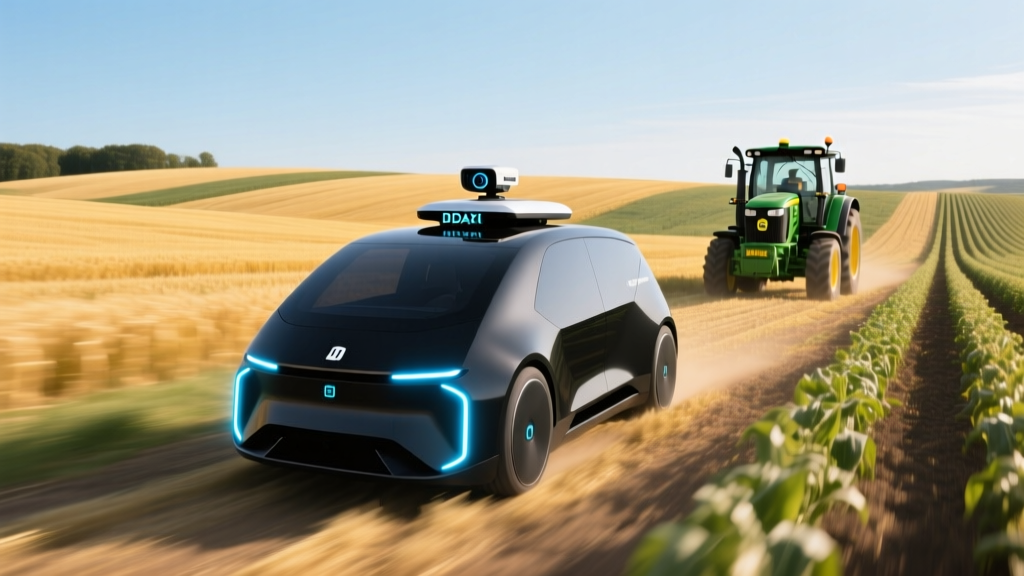
Current production models use ultrasonic sensors and radar for basic proximity alerts. Unlike Waymo's robotaxis, John Deere production tractors do not currently rely on high-resolution lidar for navigation. The autonomous 8R concept tractor (unveiled at CES and shown at subsequent ag expos) includes a roof-mounted lidar array and 360° camera system, but this configuration is not available for purchase as of early 2026.
Software Platform: John Deere Operations Center
All automation features feed into the John Deere Operations Center, a cloud-connected platform that stores field boundaries, guidance lines, application maps, and machine telemetry. Operators plan passes on a tablet or desktop, then the tractor executes the plan via AutoTrac. Over-the-air (OTA) updates push improvements to guidance algorithms and machine-vision models.
Where Can You Use John Deere's Autonomous Features Right Now?
Unlike robotaxis limited to specific city geofences, John Deere's automation features work anywhere you have GPS signal and RTK correction access. That said, practical availability depends on several factors:
| Feature | Availability | Requirements |
|---|---|---|
| AutoTrac (Level 1 steering) | Worldwide — any field with GPS | SF-RTK activation ($0 included on many models), StarFire receiver |
| AutoTrac Turn Automation | North America, Europe, Australia, Brazil | AutoTrac + compatible display (Gen 4 or G5Plus), subscription activation |
| See & Spray (machine vision) | US and Canada (expanding to Europe 2026–2027) | See & Spray–equipped sprayer, Operations Center subscription, cellular connectivity |
| AutoTrac RowSense (harvester) | North America, Europe, South America | RowSense feelers on header, compatible combine |
| Autonomous 8R (Level 4 concept) | Not commercially available — pilot programs only | N/A |
RTK correction coverage is strongest in the US Midwest, the Canadian Prairies, Western Europe, Southern Brazil, and Eastern Australia. In regions without mobile RTK networks, operators must set up a local base station (approximately $5,000–$8,000 for hardware) or accept reduced accuracy with SF-RTK satellite correction (±2 inch pass-to-pass).
What Does It Cost? Pricing John Deere's Automation Features
John Deere doesn't sell autonomy as a single package — it's an à la carte stack of hardware, software activations, and subscriptions. Here's a realistic cost breakdown for a 2026 model year 8R 410 tractor:
| Component | Approximate Cost | Notes |
|---|---|---|
| Base 8R 410 tractor (MSRP) | ~$420,000–$470,000 | Varies by configuration, dealer, region |
| StarFire 7000 receiver | Included on most new models | Previously ~$12,000 add-on; now standard on Row Crop tractors |
| AutoTrac activation | Included | Standard on most new Deere ag tractors since ~2020 |
| AutoTrac Turn Automation | ~$3,500–$5,000 one-time activation | Requires G5Plus display or Gen 4 with latest software |
| SF-RTK annual subscription | ~$1,500–$2,500/year | Required for ±1 inch accuracy; varies by provider |
| See & Spray system (sprayer) | ~$45,000–$65,000 premium over conventional sprayer | Includes cameras, processors, nozzle controllers |
| JD Operations Center (premium tier) | ~$0–$600/year | Basic tier free; premium adds advanced analytics |
Compared to the cost of hiring skilled tractor operators — which in the US Midwest averages $18–$25/hour during peak planting and harvest seasons, with availability increasingly scarce — the automation stack pays for itself on operations running 2,000+ field hours annually. Deere and independent ag economists estimate AutoTrac alone saves $15–$22/acre in reduced overlap (fuel, seed, fertilizer, chemical), based on a typical 2,000-acre corn-soybean rotation.
Safety Record: What the Data Shows
Unlike robotaxis, which operate in chaotic urban environments with pedestrians, cyclists, and unpredictable traffic, agricultural automation works in controlled, low-speed, geofenced field environments. This fundamentally changes the safety calculus.
John Deere AutoTrac Safety Data Points
- Estimated field hours on AutoTrac globally: Over 2 billion cumulative hours since the system launched in 2002 (per Deere corporate communications).
- Operating speed range: Typically 3–15 mph in field operations; road transport up to 25–31 mph depending on model and tire configuration (automation features are disengaged during road transport).
- Reported incidents: John Deere does not publish a public incident database for AutoTrac. The NHTSA tracks on-road incidents involving agricultural equipment, but these overwhelmingly involve human-operated tractors in road-traffic collisions, not automation failures.
- Key safety mechanism: AutoTrac disengages immediately when the operator touches the steering wheel, hits the brake, or exits the seat (on models with seat-switch integration). The system also disengages at speeds above the configured field threshold.
The most significant safety concern with Level 2 agricultural automation is operator complacency — the same issue documented extensively in automotive ADAS research by the IIHS. When a system steers reliably for hours on end, operators may look at phones, doze, or leave the cab. Deere's operator-presence systems (seat switches, steering-wheel torque sensors) are designed to prevent this, but enforcement varies by model year and configuration.
For the autonomous 8R concept (Level 4), Deere has stated that pilot deployments include 360° obstacle detection, emergency stop systems, and remote monitoring. However, no large-scale safety data has been published for this platform as of early 2026.
Current Limitations: What John Deere's Automation Cannot Do
Understanding the boundaries is as important as understanding the capabilities. Here are the hard limitations of the current production stack:
- No driverless operation: A human must be in the cab on all production models. There is no "send the tractor to the field by itself" feature.
- GPS dependency: AutoTrac requires continuous GPS signal. Tree canopies, steep terrain, tall structures, and solar interference can degrade accuracy or cause disengagement.
- No road-use autonomy: AutoTrac and related guidance features are designed for field use only. They do not handle road navigation, intersections, traffic, or road-shoulder detection. Road transport is fully manual.
- Weather sensitivity: Heavy rain, dust storms, and fog can degrade See & Spray camera performance. StarFire GPS works in most weather, but extreme ionospheric interference (solar storms) can reduce RTK accuracy.
- Headland complexity: AutoTrac Turn Automation handles standard headland turns, but complex field shapes, point rows, and terraced terrain may require manual override. Operators report spending 10–20% of field time managing turns and transitions.
- Implement compatibility: Not all implements support full automation integration. Older or third-party implements may lack the ISOBUS connectivity required for automated control.
- Cellular requirement for cloud features: See & Spray model updates, Operations Center sync, and remote diagnostics require cellular connectivity, which is unreliable in many rural areas.
- No night-vision autonomy: While AutoTrac steering works at night (GPS doesn't need light), See & Spray and obstacle detection systems are limited in low-light conditions without auxiliary lighting.
Regulatory Landscape: Who Governs Autonomous Tractors?
Agricultural automation occupies a regulatory gray zone compared to on-road autonomous vehicles. Key points for 2026:
- No federal autonomous-vehicle framework for off-road equipment: The NHTSA's autonomous vehicle regulations apply to on-road vehicles. Agricultural tractors operating exclusively on private farmland are not subject to NHTSA's Level 4/5 deployment rules.
- Road transport is regulated: When a tractor travels on public roads (common between fields), standard DOT and state agricultural-equipment rules apply — lighting, slow-moving vehicle (SMV) emblems, width restrictions, and operator licensing where required. Automation features must be disengaged.
- Liability framework: If an AutoTrac-equipped tractor causes damage or injury, liability generally falls on the operator (who is required to supervise), not Deere. This mirrors automotive Level 2 liability. Deere's terms of service and operator manuals explicitly state the operator is responsible at all times.
- International variation: The EU's Machinery Regulation (2023/1230), which took effect in 2024, includes updated provisions for autonomous agricultural machinery, but implementation varies by member state. Australia and Brazil have fewer specific regulations but follow general workplace-safety frameworks.
- Insurance considerations: Farm-insurance providers increasingly ask about automation features. Some offer premium discounts for GPS guidance (reduced overlap = fewer boundary disputes and crop-damage claims), while others treat automation as an added-risk factor. Consult your insurer directly.
For the latest regulatory guidance, the OSHA agricultural safety standards and your state's department of agriculture are the most relevant starting points.
The Autonomous 8R Concept: What's Announced vs. Available
John Deere's autonomous 8R concept tractor — first shown at CES 2022 and refined in subsequent demonstrations — is the company's most visible step toward Level 4 field autonomy. Here's what we know and what remains unconfirmed:
- Design: A modified 8R with no cab, roof-mounted lidar, 360° cameras, and a redesigned chassis optimized for autonomous operation.
- Intended use case: High-acreage row-crop operations where repetitive passes (tillage, planting, spraying) can be fully automated.
- Pilot programs: Deere has conducted limited field trials with select large-scale farming operations, primarily in the US Midwest. Details on participant count and acreage covered have not been publicly disclosed.
- Commercial availability: Not announced. Deere executives have indicated a phased rollout approach, likely beginning with supervised autonomy (Level 2–3) on existing platforms before moving to cabless Level 4 machines. No firm timeline has been committed to as of early 2026.
- Estimated pricing: Not disclosed. Industry analysts project a significant premium over the current 8R platform, potentially $80,000–$150,000 additional for the autonomous sensor and compute package, plus ongoing software subscriptions.
If you see the autonomous 8R described as "available" or "on sale" in any publication, treat it with skepticism. It remains a concept and pilot-stage platform.
Frequently Asked Questions
Is John Deere's AutoTrac truly self-driving?
No. AutoTrac is a Level 1–2 driver-assist system. It automates steering along pre-programmed guidance lines, but the operator must remain in the cab, monitor the system, control speed and implement functions, and be ready to take over immediately. It is functionally equivalent to lane-centering assist on a highway — helpful, but not autonomous.
Can I leave the cab while AutoTrac is running?
Technically, the tractor will continue to follow its guidance line if the seat switch is not configured to disengage AutoTrac. However, doing so violates Deere's operator manual, voids your liability protection, and is extremely dangerous. A tractor is a multi-ton machine operating near ditches, obstacles, and potentially other workers. Never leave a running tractor unattended.
How accurate is AutoTrac compared to a skilled operator?
With SF-RTK correction (±1 inch), AutoTrac is significantly more consistent than even the best human operator, especially over long shifts and in low-visibility conditions (dust, night). Deere's data shows overlap reduction from a typical 8–10% (manual) to under 2% with RTK AutoTrac, which translates directly into input savings.
Does See & Spray work on all crops?
See & Spray is currently optimized for corn, soybeans, and cotton in broadcast and post-emergence applications. Deere has been expanding the crop and weed library through OTA updates. Performance on specialty crops, small grains, and forage crops is limited or unavailable as of 2026.
What happens when GPS signal is lost in the field?
AutoTrac will alert the operator and disengage steering automation if GPS signal drops below the configured threshold. The operator must take over steering immediately. In areas with known signal issues (near windbreaks, in valleys), experienced operators pre-plan guidance lines to minimize passes through problematic zones.
Will a fully autonomous John Deere tractor be available soon?
John Deere has not committed to a commercial launch date for the cabless autonomous 8R. The company's stated approach is incremental — expanding Level 2 features on existing platforms while conducting Level 4 pilot programs. A reasonable expectation based on public statements and industry timelines is limited commercial availability of Level 4 features on specific models sometime in the 2027–2030 window, but this is speculative and not confirmed by Deere.
How does John Deere's autonomy compare to competitors?
CNH Industrial (Case IH, New Holland) offers comparable GPS guidance and has demonstrated its own autonomous concept tractor. AGCO (Fendt, Massey Ferguson) uses the Trimble/AGCO guidance ecosystem with similar Level 1–2 capabilities. Startups like Monarch Tractor offer fully electric, cab-optional autonomous tractors for specialty crops (vineyards, orchards) at a smaller scale. John Deere's advantage is its integrated ecosystem — the Operations Center, See & Spray, and dealer-support network — rather than any single autonomy breakthrough.