If you've searched for a Jaguar Waymo price expecting to buy a self-driving Jaguar, you've landed in the wrong showroom. The Jaguar I-PACE vehicles you see navigating Phoenix, San Francisco, and Los Angeles streets aren't for sale — they're part of Waymo's commercial robotaxi fleet. You can't purchase one, but you can hail one. This guide breaks down exactly how Waymo's Jaguar-based service works, what a ride costs, where it operates, and what the safety data actually shows.
What the Jaguar I-PACE Waymo Robotaxi Actually Is
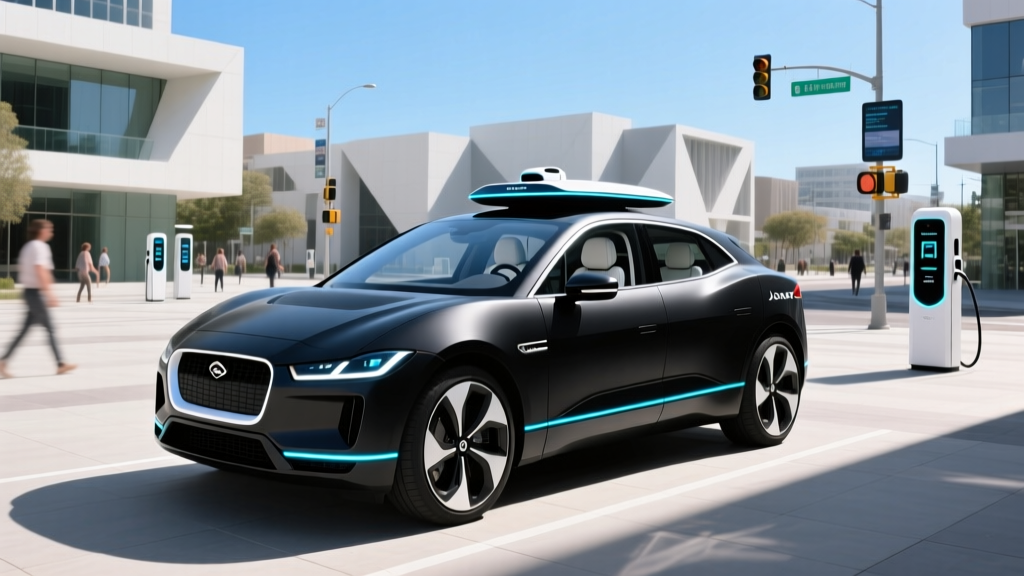
Waymo — Alphabet's autonomous driving subsidiary — partnered with Jaguar Land Rover to build a custom version of the all-electric Jaguar I-PACE specifically engineered for driverless operation. These aren't stock I-PACE models with bolt-on sensors. The "Waymo Edition" I-PACE integrates Waymo's fifth-generation (and now transitioning to sixth-generation) autonomous driving hardware directly into the vehicle's electrical architecture during assembly at JLR's Graz, Austria facility.
The Jaguar I-PACE was a strategic choice for Waymo's early commercial fleet:
- 90 kWh battery pack (84 kWh usable) provides enough energy for a full day of robotaxi duty cycles
- All-electric powertrain reduces per-mile operating costs vs. internal combustion — critical for fleet economics
- Premium ride quality positions the service as a quality competitor to Uber Black, not just a budget option
- Wire-compatible architecture allows Waymo to integrate redundant steering, braking, and computing systems
As of 2026, Waymo's fleet includes thousands of Jaguar I-PACE robotaxis alongside newer vehicles based on the Geely-sourced Zeekr platform, which Waymo designed from the ground up as a purpose-built robotaxi.
SAE Automation Level: This Is Level 4, Not Driver-Assist
⚙️ SAE Level 4 — High Automation (Driverless, Geofenced)
The Waymo robotaxi service operates at SAE Level 4 within its approved operational design domain (ODD). This means:
- No human driver is present — the vehicle handles all driving tasks within its service area
- No passenger intervention is expected or required — there is no steering wheel or pedal set accessible to riders in Waymo's custom Zeekr vehicles, and the I-PACE fleet has these controls locked/disabled for passengers
- The system handles all edge cases within its geofenced area — if it encounters a situation it cannot handle, it performs a minimal-risk maneuver (safe pullover), not a handoff to the passenger
- Geofenced operation only — these vehicles do not operate outside their approved service boundaries
This is fundamentally different from Level 2 systems like Tesla Autopilot, GM Super Cruise, or Ford BlueCruise, which require a licensed, attentive driver behind the wheel at all times. Waymo's Jaguar I-PACE robotaxis are genuinely driverless within their operational area.
Where Can I Ride a Waymo Jaguar I-PACE Right Now?
Waymo One, the company's commercial ride-hailing service, operates in a growing but still limited set of metro areas. Here is the current availability as of early 2026:
| City / Region | Status | Service Area Notes |
|---|---|---|
| Phoenix Metro, AZ | ✅ Fully operational, open to public | Largest service area (~600+ sq mi); includes Chandler, Tempe, Mesa, Scottsdale, Phoenix Sky Harbor Airport |
| San Francisco, CA | ✅ Fully operational, open to public | Covers most of SF proper plus parts of Daly City and South SF; 24/7 service |
| Los Angeles, CA | ✅ Fully operational, open to public | Service area expanding across LA basin; covers Hollywood, Santa Monica, Downtown, Beverly Hills and surrounding areas |
| Austin, TX | ✅ Operational / expanding | Launched service in late 2025; coverage area growing |
| Atlanta, GA | 🔄 Expansion announced / limited access | Partnership with Hyundai; phased rollout in progress |
Important caveat: Even within these metro areas, Waymo's service is geofenced. You cannot hail a ride to or from a location outside the approved operational boundary. The Waymo One app will only show pickup and dropoff points within the service area. If your destination is outside the geofence, the app won't let you book the trip.
How Much Does a Waymo Ride Cost? Pricing vs. Uber & Lyft
There is no "Jaguar Waymo price" in the sense of purchasing the vehicle — but there is a per-ride cost to use the service. Waymo One uses dynamic pricing similar to Uber and Lyft, factoring in distance, time, and demand. Here's how typical fares compare:
| Route Example | Waymo One | UberX | Lyft Standard |
|---|---|---|---|
| Short trip (~3 mi, Phoenix) | $8 – $13 | $7 – $12 | $7 – $11 |
| Medium trip (~8 mi, SF) | $18 – $28 | $16 – $25 | $15 – $24 |
| Airport trip (~15 mi, PHX) | $30 – $45 | $28 – $42 | $26 – $40 |
| Longer trip (~20 mi, LA) | $40 – $60 | $35 – $55 | $33 – $52 |
Key pricing takeaways:
- Waymo fares are generally comparable to UberX/Lyft, sometimes a few dollars more, sometimes a few dollars less depending on demand and route
- No surge pricing in the traditional sense — Waymo has used promotional pricing and waitlist prioritization rather than aggressive surge multipliers
- No tipping expected — there's no driver to tip, which effectively saves you 15-20% vs. a rideshare trip where tipping is customary
- Waymo occasionally offers promotional credits for new users, bringing initial rides below Uber/Lyft pricing
- Wait times vary — in Phoenix, typical wait is 3-8 minutes; in SF and LA, it can be 5-15 minutes during peak hours
To use Waymo One, download the Waymo One app (iOS/Android), create an account, enter your destination, and the app will confirm availability, estimated fare, and pickup location. The vehicle arrives driverless, you unlock it via the app, and the ride proceeds autonomously.
Waymo's Safety Record: What the Data Shows
📊 Safety Data Points (through 2025)
- 30+ million fully driverless miles completed across Waymo's fleet as of late 2025, per Waymo's published safety reports
- 75% reduction in injury-causing crash rates compared to human benchmarks in comparable operating environments, according to Waymo's peer-reviewed analysis using NHTSA data
- No passenger fatalities recorded in Waymo's driverless commercial operations
- Minor contact incidents do occur — typically low-speed (<10 mph) contacts with stationary objects, other vehicles in complex urban scenarios, or pedestrians stepping into the vehicle's path at very close range
- California DMV disengagement reports are not directly applicable to Waymo's driverless operations, as those reports cover testing with a safety driver — Waymo's commercial service has no safety driver to "disengage" to
Waymo's safety record is among the most transparent in the autonomous vehicle industry, but context matters. The company publishes periodic safety reports comparing its crash rates to human benchmarks using methodology reviewed by external researchers. The Insurance Institute for Highway Safety (IIHS) has noted that robotaxi services operating in geofenced urban areas show promising crash-avoidance data, though the sample sizes remain smaller than the billions of human-driven miles needed for definitive statistical comparison.
What the data does NOT show: Waymo has not demonstrated Level 4 safety in all conditions. The service avoids operating in heavy snow, dense fog, or extreme weather events. Its safety record reflects performance within its approved ODD — a carefully mapped, sensor-rich urban environment — not arbitrary point-to-point driving anywhere in America.
Technology Stack: Lidar, Cameras, and Radar Working Together
Waymo Driver Sensor Suite (5th/6th Generation)
Unlike Tesla's camera-only approach, Waymo uses a redundant multi-sensor fusion system combining three complementary technologies:
| Sensor Type | Function | Advantage |
|---|---|---|
| Lidar (roof-mounted + side units) | 3D point-cloud mapping of surroundings up to 500m | Works in darkness; provides precise distance measurements independent of lighting |
| Cameras (360° array, high-res) | Object classification, traffic light/sign reading, lane detection | High semantic understanding; reads text and colors |
| Radar (multiple units) | Velocity detection, tracking moving objects through occlusions | Penetrates fog and light rain; measures relative speed directly |
| Audio sensors | Emergency vehicle siren detection | Detects sirens before visual line-of-sight |
Waymo also relies on HD pre-mapped routes — centimeter-accurate maps of every road in its service area, updated regularly. The vehicle cross-references live sensor data against these maps for localization and route planning. This is fundamentally different from Tesla's vision-only approach, which attempts to drive using real-time perception alone without pre-mapping.
Computing: Custom-designed Waymo compute units process sensor data in real time, with redundant systems ensuring that a single hardware failure cannot disable the vehicle. The Jaguar I-PACE Waymo Edition includes redundant power, steering, and braking actuators — if the primary system fails, a backup can bring the vehicle to a safe stop.
Current Limitations: What Waymo Robotaxis Cannot Do
For all their capability, Waymo's Jaguar I-PACE fleet operates under significant constraints. Understanding these limitations is essential before you book a ride:
- 🌧️ Weather restrictions: Waymo does not operate in heavy rain, snow, or dense fog. In Phoenix during monsoon season and in SF during heavy rain events, the service may pause or restrict operations. The lidar-camera-radar stack degrades in low-visibility conditions.
- 🗺️ Geofence boundaries: You cannot ride outside the approved service area. Trips that start or end outside the geofence are rejected by the app. Expansion happens gradually — neighborhoods are added after extensive mapping and validation.
- 🚧 Construction zones: While Waymo handles many construction scenarios, major unplanned road closures or complex multi-stage detours can cause the vehicle to pull over and wait, or reroute conservatively, adding time to your trip.
- 🏠 No valet or door-to-door in private areas: The vehicle picks up and drops off at the curb on public roads. It will not enter parking garages, private driveways, or gated communities.
- 👶 Accessibility limitations: The Jaguar I-PACE fleet is not wheelchair-accessible. Waymo has committed to ADA-accessible vehicles in its next-generation Zeekr-based fleet, but the Jaguar models require passengers to enter a standard SUV cabin.
- 🐕 No pets (service animals excepted): Service animals are permitted, but personal pets are not allowed in Waymo vehicles.
- ⏱️ Wait times in low-demand areas: At the edges of the service area or during off-peak hours, you may wait 10-20 minutes for a vehicle, or the app may show no availability.
Regulatory Landscape: Who Approves Robotaxi Operations
Robotaxi operations in the United States require a patchwork of state and local approvals — there is no single federal "robotaxi license." Here's how the regulatory framework works:
- State-level authorization: Each state determines whether driverless commercial operations are permitted. Arizona (under Governor Ducey's 2018 executive order and subsequent legislation) was first to broadly permit driverless operations. California requires permits from both the California DMV (testing and deployment) and the California Public Utilities Commission (CPUC) (commercial passenger service).
- Federal role: NHTSA sets vehicle safety standards and investigates crashes, but does not currently issue permits for autonomous driving operations. The Federal Motor Vehicle Safety Standards (FMVSS) were written for human-driven vehicles — Waymo has received limited exemptions for vehicles without traditional controls (mirrors, steering wheels in the Zeekr platform).
- Local/municipal approval: Cities and counties can influence operations through permitting, curb-use rules, and emergency services coordination. San Francisco's Board of Supervisors has held contentious hearings on Waymo's expansion, reflecting local community concerns about traffic impacts and emergency vehicle interactions.
- Incident reporting: States like California require autonomous vehicle operators to report any contact incidents, disengagements, and law enforcement interactions within defined timeframes.
The Jaguar I-PACE Fleet's Future: Transition to Zeekr
The Jaguar I-PACE has been Waymo's workhorse since the company's earliest commercial operations, but the fleet is evolving. Waymo's next-generation vehicle, developed with Geely's Zeekr brand, is a purpose-built robotaxi — no steering wheel, no pedals, lower floor for easier entry, and designed from the ground up for driverless operation rather than adapted from a consumer vehicle.
As of 2026, both Jaguar I-PACE and Zeekr vehicles operate in Waymo's fleet. The Jaguar models remain in active service and are maintained by Waymo's fleet operations teams. JLR has not announced a consumer-available self-driving I-PACE, and there is no indication that Waymo's autonomous driving technology will be offered as a consumer feature in Jaguar vehicles you can buy. The partnership is strictly a fleet-supply arrangement.
Frequently Asked Questions
Can I buy a Jaguar I-PACE Waymo Edition for personal use?
No. The Waymo Edition I-PACE is a fleet-only vehicle with custom hardware and software that is not available for consumer purchase. The standard Jaguar I-PACE you can buy at a dealership does not include Waymo's autonomous driving system and is not self-driving.
Is Waymo safer than Uber or Lyft?
Waymo's published data shows injury-causing crash rates approximately 75% lower than human benchmarks in comparable environments. However, Waymo operates in controlled, geofenced urban areas and pauses service in adverse weather. Uber and Lyft drivers operate everywhere, in all conditions. A direct apples-to-apples comparison is difficult, but within Waymo's operating domain, the safety data is strong. The NHTSA continues to monitor and investigate autonomous vehicle incidents across all operators.
How does Waymo handle emergencies or accidents?
Waymo vehicles are equipped with a rider support button and in-cabin communication system. If the vehicle encounters an issue, it performs a minimal-risk maneuver (pulling to the curb safely). A remote support team monitors the fleet and can provide guidance. In the event of a collision, the vehicle contacts emergency services automatically, and Waymo's incident response team is dispatched.
Does Waymo work in the rain?
Light rain — yes, the service continues. Heavy rain, flooding, or monsoon conditions — service may be restricted or paused entirely. Waymo's sensor suite (lidar, cameras, radar) degrades in low-visibility conditions, and the company takes a conservative approach to weather-related service decisions.
What's the difference between Waymo and Tesla's Full Self-Driving?
These are fundamentally different systems operating at different SAE levels. Waymo is Level 4 driverless — no human driver is present, and the system handles all driving within its geofenced area. Tesla FSD (Supervised) is Level 2 driver-assist — the human driver must remain fully attentive, hands on or near the wheel, and is legally responsible for the vehicle at all times. Tesla FSD can technically operate on any road, but it requires constant supervision. Waymo requires no supervision but only operates in specific, pre-mapped areas.
How much does a Waymo ride cost compared to owning a car?
For occasional urban trips, Waymo fares ($8-$60 per ride depending on distance) can be cost-competitive with car ownership when you factor in insurance, fuel/charging, parking, depreciation, and maintenance. For daily commuting or frequent trips, a Waymo-heavy lifestyle can exceed the cost of owning an EV and charging at home. The breakeven point depends heavily on your mileage, local parking costs, and how often you need a vehicle.