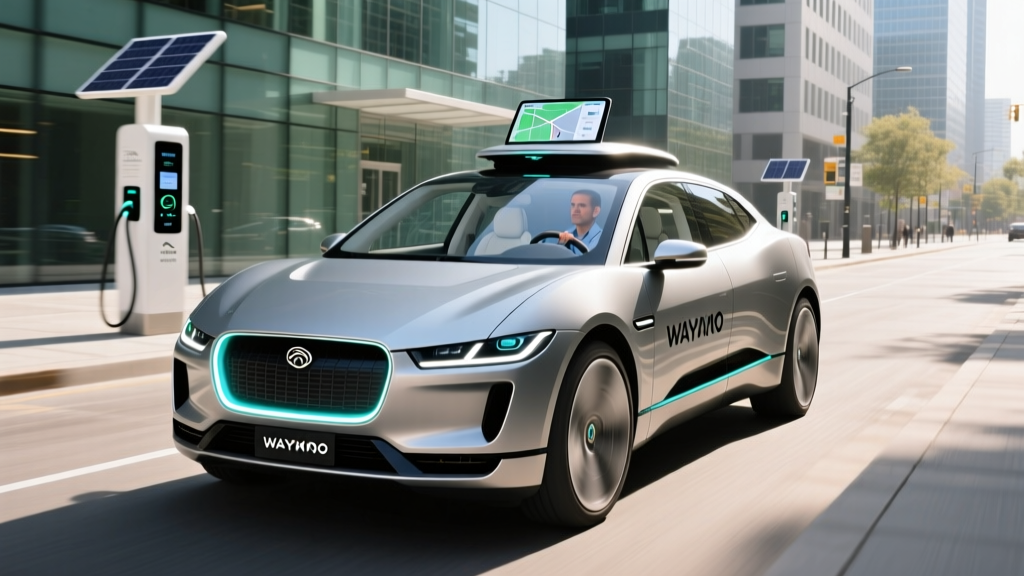
The Jaguar I-PACE has been Waymo's primary robotaxi platform since 2018, and as of 2026, the all-electric SUV remains the backbone of the Waymo One commercial fleet. If you've seen a white I-PACE bristling with rooftop sensors gliding through Phoenix or San Francisco without anyone behind the wheel, you've witnessed SAE Level 4 autonomy in real-world deployment. This guide breaks down exactly what the Jaguar I-PACE Waymo robotaxi is, where you can ride one, what it costs, and the hard data behind its safety record.
What Is the Jaguar I-PACE Waymo and How Autonomous Is It?
The Jaguar I-PACE Waymo is a purpose-built autonomous vehicle created through a partnership between Jaguar Land Rover and Waymo (Alphabet's self-driving subsidiary). Waymo takes a stock I-PACE — a 90 kWh battery electric SUV with an EPA-rated 234 miles of range — and integrates its fifth-generation Waymo Driver hardware suite. The result is a vehicle that operates with no human driver present.
The Jaguar I-PACE Waymo operates at SAE Level 4, meaning the system performs all driving tasks within its defined operational design domain (ODD) — specific geofenced areas under mapped conditions — with zero human intervention required. There is no steering wheel interaction, no driver monitoring camera watching your eyes, and no expectation that a passenger will take over. This is fundamentally different from Level 2 systems like Tesla Autopilot or GM Super Cruise, which require constant driver supervision. Level 4 robotaxis carry no driver; Level 2 driver-assist systems are not self-driving.
Understanding this distinction matters because consumer marketing often blurs the line. A Tesla Model Y running FSD (Supervised) is a Level 2 vehicle with an engaged driver. The Jaguar I-PACE Waymo picking you up curbside in downtown Phoenix is Level 4 with an empty driver's seat. The I-PACE you can buy at a Jaguar dealer is a conventional EV with Level 2 ADAS; the Waymo-modified version is not available for consumer purchase.
Where Can You Ride a Jaguar I-PACE Waymo Right Now?
As of early 2026, Waymo One — the commercial ride-hailing service using the I-PACE fleet — operates in a defined set of metropolitan areas. Service is geofenced, meaning the car will only operate within mapped zones that Waymo has validated.
| City | Status | Coverage Area | Hours |
|---|---|---|---|
| Phoenix, AZ (East Valley) | Fully operational | ~230 sq mi (Chandler, Tempe, Mesa, Gilbert, Scottsdale, downtown Phoenix) | 24/7 |
| San Francisco, CA | Fully operational | Most of SF proper, Daly City, parts of San Bruno | 24/7 |
| Los Angeles, CA | Operational (expanding) | Downtown LA, Hollywood, West LA, Santa Monica, Mid-City | 24/7 |
| Austin, TX | Launched (limited zone) | Central Austin, South Austin corridor | Limited hours, expanding |
Phoenix remains Waymo's most mature market, with the broadest coverage and longest operational history. San Francisco launched commercially in 2022 after regulatory approval from the California Public Utilities Commission (CPUC) and has since expanded significantly. Los Angeles entered commercial service in 2024, and Austin began limited operations in late 2025.
To use Waymo One, download the Waymo app (iOS/Android), enter your pickup and drop-off within the service zone, and a Jaguar I-PACE will arrive — typically within 3–8 minutes in dense coverage areas. No driver is present. You sit wherever you like, and the car handles the entire trip.
Waymo Driver Technology Stack: Lidar, Cameras, and the I-PACE Platform
The fifth-generation Waymo Driver suite mounted on the Jaguar I-PACE represents one of the most sensor-dense autonomous platforms in commercial operation. Unlike Tesla's camera-only approach, Waymo uses a redundant multi-sensor architecture:
Sensor Array
- Lidar: Multiple custom-built 360° lidar units (roof-mounted and integrated into body panels) providing high-resolution 3D point clouds up to 500+ meters. Lidar operates independently of ambient light, giving consistent performance at night.
- Cameras: A suite of high-resolution cameras covering 360° around the vehicle, handling lane detection, traffic signal recognition, pedestrian classification, and sign reading.
- Radar: Imaging radar units for velocity detection of moving objects, functioning through rain and fog where lidar and cameras degrade.
- Audio detection: External microphones that detect emergency vehicle sirens and trigger appropriate pull-over behavior.
- GPS/IMU/HD Maps: Centimeter-accurate localization using pre-built high-definition maps combined with real-time inertial measurement and GPS.
Compute and Redundancy
Custom Waymo-designed compute hardware processes sensor fusion in real time. The system has redundant steering, braking, and power systems — if a primary system fails, backup actuators bring the vehicle to a safe stop.
Jaguar I-PACE as Platform
The I-PACE's 90 kWh lithium-ion battery (NMC chemistry) provides sufficient energy for a full day of robotaxi operation. The vehicle's drive-by-wire architecture — electric power steering, regenerative braking, and electric drivetrain — integrates cleanly with Waymo's autonomous control systems. The I-PACE's 234-mile EPA range means vehicles typically return to Waymo depots for charging once per shift, with DC fast charging at up to 100 kW (10–80% in approximately 45 minutes).
The geofencing approach is critical: Waymo does not attempt to drive everywhere. Each square mile of the operational domain is mapped in centimeter-level detail, and the vehicle will not operate outside these boundaries. If a route would leave the geofence, the app simply won't allow the booking.
Safety Record: What the Data Actually Shows
Waymo's safety data is among the most extensively documented in the autonomous vehicle industry, though interpreting it requires context about where and how these vehicles operate.
- Total autonomous miles driven: Over 50 million fully driverless miles across the fleet (NHTSA standing general order reporting).
- Injury-causing crash rate: Waymo published peer-reviewed data showing a 85% reduction in injury-causing crash rate compared to human baseline drivers in comparable urban environments.
- Police-reported crash rate: Approximately 57% lower than human benchmarks in Waymo's operating cities.
- Contact incidents: The majority of reported incidents involve low-speed contact (under 15 mph), often with the Waymo vehicle being rear-ended or sideswiped by human drivers — not the robotaxi initiating contact.
- NHTSA Standing General Order: Waymo is required to report all crashes involving its ADS-equipped vehicles within 24 hours, providing a transparency floor that most automakers lack.
It's worth noting the operational context: Waymo's I-PACE fleet operates primarily in well-mapped urban and suburban corridors at moderate speeds. The vehicles are not navigating rural mountain passes or unmapped construction zones. The safety comparison is most valid against urban human driving, where the majority of injury-causing crashes occur at intersections, in crosswalks, and during lane changes — precisely the scenarios where sensor redundancy and 360° awareness provide an advantage.
Incidents that do make headlines — a Waymo I-PACE contacting a chain-link fence, or briefly entering a construction zone — are cataloged and reported to regulators. Waymo's response typically involves fleet-wide software updates to address the specific edge case. This iterative loop (incident → analysis → simulation testing → OTA update) is a structural advantage of a centralized fleet versus individual human drivers who don't receive software patches after near-misses.
Pricing: Waymo One vs. Uber and Lyft
Waymo One pricing is designed to be competitive with conventional rideshare, not premium. Fares are calculated on a per-ride basis using distance, time, and demand — similar to UberX or Lyft standard pricing.
| Trip Type | Waymo One | UberX | Lyft |
|---|---|---|---|
| Short trip (3 mi, ~10 min) | $9–$13 | $8–$14 | $8–$13 |
| Medium trip (8 mi, ~20 min) | $17–$24 | $16–$25 | $15–$24 |
| Airport trip (15 mi, ~30 min) | $28–$38 | $25–$40 | $24–$38 |
| Surge pricing frequency | Rare | Common | Common |
The key differentiator is pricing stability. Waymo does not currently implement aggressive surge pricing the way Uber and Lyft do during peak demand. Wait times can be slightly longer during high-demand periods instead of prices spiking 2–3x. Waymo also offers subscription-style weekly ride passes in some markets, which can reduce per-ride costs for frequent users.
One practical note: Waymo does not offer shared/pool rides or multi-stop trips in most markets yet. If you need to pick up a friend along the way, you'll need Uber or Lyft for that flexibility.
Regulatory Landscape: Who Approves Robotaxi Operations?
Deploying a driverless vehicle commercially in the United States requires navigating a patchwork of state and federal regulations. There is no single federal "robotaxi license" — instead, Waymo must secure approvals at multiple levels:
- Federal (NHTSA): The National Highway Traffic Safety Administration sets vehicle safety standards. Waymo has received exemptions from certain Federal Motor Vehicle Safety Standards (FMVSS) that assume a human driver (e.g., steering wheel and mirror requirements for future purpose-built vehicles). NHTSA also mandates crash reporting through the Standing General Order.
- California (DMV + CPUC): The California DMV issues testing and deployment permits. The CPUC authorizes commercial passenger service and sets fare rules. Waymo holds a Driverless Deployment Permit from the DMV and a commercial service authorization from the CPUC.
- Arizona: Arizona has taken a permissive approach since 2015, with executive orders enabling autonomous vehicle testing and commercial operation with minimal state-level bureaucracy. Waymo's Phoenix operations benefit from this regulatory environment.
- Texas (Austin): Texas passed autonomous vehicle legislation (HB 2932) establishing a framework for commercial AV deployment, with local coordination required for geofencing and operational zones.
This state-by-state approach means expansion is not simply a matter of Waymo choosing a new city — each market requires regulatory engagement, local government coordination, and often public comment periods. This is why Waymo's geographic expansion, while steady, moves at the pace of regulatory approval rather than software capability.
Current Limitations: What the Jaguar I-PACE Waymo Cannot Do
Level 4 autonomy is powerful within its operational domain, but the boundaries of that domain are real. Here are the hard constraints of the Jaguar I-PACE Waymo fleet as of 2026:
Operational Limitations
- Geofenced only: The vehicle will not drive outside its mapped service area. If your destination crosses the geofence boundary, the app will not allow the booking.
- Heavy weather restrictions: During heavy rain, fog, or dust storms (particularly in Phoenix monsoon season), Waymo may restrict or suspend service. Lidar performance degrades in heavy precipitation, and the system is designed to pull over safely rather than push through conditions beyond its sensor capability.
- Construction zones: While Waymo handles many temporary lane configurations, major unmapped construction can cause the vehicle to stop and request remote assistance. Waymo's fleet operations team can provide remote guidance, but this adds delay.
- No highway expansion yet: Waymo's urban robotaxi service primarily operates on surface streets. While the I-PACE is highway-capable (top speed 124 mph), Waymo One rides are largely confined to urban corridors under ~65 mph.
- No car seats or accessibility equipment: The fleet does not provide child safety seats. Wheelchair-accessible vehicles remain limited, though Waymo has begun pilot programs with accessible I-PACE configurations.
- Passenger capacity: The I-PACE seats up to 4 passengers in the robotaxi configuration (driver's seat is unused but present). No large-group or XL options.
- Pets: Service animals are permitted. Pet policies vary by market and are not universally accommodated.
- No trunk access: In most configurations, passengers cannot access the I-PACE's rear cargo area (25.3 cu ft behind rear seats). Airport runs with multiple large suitcases may not fit.
These limitations are not theoretical — they directly affect usability. If you live on the edge of the Phoenix geofence, your commute might work in one direction but not the other. If you're trying to get to Sky Harbor Airport during a monsoon downpour, Waymo may not be available. These are the trade-offs of a Level 4 system: extremely capable within its domain, but with hard boundaries rather than graceful degradation.
The Jaguar I-PACE as a Robotaxi Platform: Why This EV?
Waymo's selection of the Jaguar I-PACE was not arbitrary. The I-PACE offered specific advantages for autonomous fleet operation:
- Premium interior: The I-PACE cabin is quiet, well-appointed, and comfortable — important for a rider experience where the passenger is the only occupant and first impressions matter.
- Drive-by-wire readiness: The I-PACE's fully electric powertrain (394 hp, 512 lb-ft torque across dual motors) integrates cleanly with autonomous control. Electric steering, braking, and throttle response are inherently digital.
- Adequate range: The 90 kWh NMC battery provides 234 miles of EPA range, enough for a full shift of urban trips before returning to a depot for charging.
- Manufacturing partnership: Jaguar Land Rover committed to a dedicated production line for Waymo-spec I-PACE vehicles, ensuring consistent sensor integration and wiring harness compatibility at scale.
That said, the I-PACE is aging. Introduced for the 2019 model year, the platform is now over seven years old. Waymo has announced partnerships with Geely (for the Zeekr RT robotaxi) and Hyundai for next-generation platforms. These future vehicles will be purpose-built without steering wheels or mirrors, designed from the ground up for autonomous operation. The I-PACE remains the current workhorse, but it represents the first generation of what will be an evolving hardware lineage.
Frequently Asked Questions
Is the Jaguar I-PACE Waymo truly self-driving?
Yes — within its geofenced service area, the Jaguar I-PACE Waymo operates at SAE Level 4 with no human driver present. The driver's seat is empty. This is categorically different from Level 2 driver-assist systems like Tesla Autopilot or Ford BlueCruise, which require an attentive human driver at all times. Waymo's robotaxi handles all driving tasks, makes all decisions, and is responsible for all outcomes within its operational domain.
How much does a Waymo ride cost compared to Uber or Lyft?
Waymo One fares are generally comparable to UberX and Lyft standard pricing — roughly $9–$13 for a short 3-mile trip and $28–$38 for an airport-length ride. The key advantage is pricing stability: Waymo rarely surges, while Uber and Lyft can spike 2–3x during peak hours. Waymo does not currently offer shared rides or multi-stop trips.
Can I buy a Jaguar I-PACE with Waymo's self-driving technology?
No. The Waymo Driver hardware and software are proprietary and not available for consumer purchase. The I-PACE you can buy from a Jaguar dealer includes standard Level 2 ADAS features (adaptive cruise control, lane-keeping assist) but nothing approaching Waymo's Level 4 autonomy. Waymo's technology is exclusively deployed through its fleet operations.
How safe are Waymo robotaxis in real-world operation?
Waymo has published peer-reviewed data showing an 85% reduction in injury-causing crashes and a 57% reduction in police-reported crashes compared to human driving benchmarks in comparable urban environments. The fleet has accumulated over 50 million driverless miles. Most reported incidents involve low-speed contact where the Waymo vehicle was struck by a human driver, not the reverse. All incidents are reported to NHTSA under the Standing General Order.
What happens if the Waymo I-PACE encounters a situation it can't handle?
The vehicle is designed to execute a "minimal risk condition" — it will slow down, pull to the side of the road, and stop safely. Waymo's remote fleet operations team can then provide guidance or dispatch roadside assistance. The vehicle will not attempt maneuvers beyond its capability envelope; it defaults to stopping rather than guessing.
Will Waymo expand to more cities with the Jaguar I-PACE?
Waymo has announced intentions to expand to additional markets, but each city requires regulatory approval and extensive mapping. Austin came online in late 2025, and additional cities are expected through 2026–2027. Future expansion markets will likely use next-generation purpose-built vehicles (like the Zeekr RT) rather than additional I-PACE units, as Waymo transitions to platforms designed without steering wheels.