The Short Answer: Is Zoox Free?
No, Zoox is not free. Amazon's autonomous ride-hailing service charges fares comparable to Uber and Lyft, though Zoox has periodically offered promotional free or heavily discounted rides during limited launch events and early-access periods in select cities. As of 2026, regular Zoox rides are priced per trip using a base fare plus per-mile and per-minute model — similar to conventional rideshare — and there is no standing "free ride" program for the general public.
That said, Zoox has been known to offer introductory credits to new riders in newly launched markets, and Amazon Prime members have occasionally received promotional ride credits. These are time-limited marketing incentives, not a permanent free service. If you've seen headlines about free Zoox rides, they almost certainly refer to one of these launch promotions or media preview events.
Where Can You Ride Zoox Right Now?
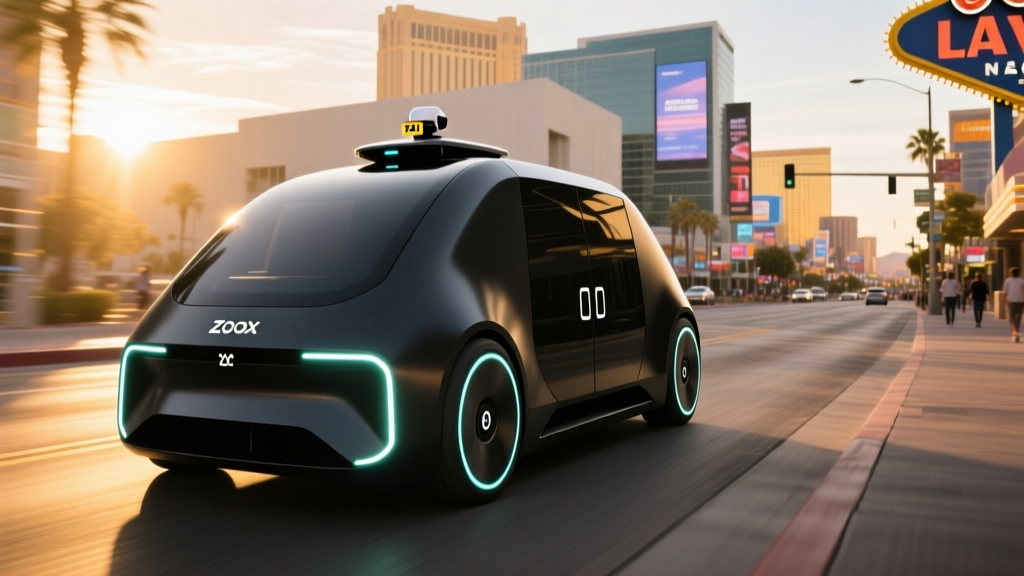
Zoox operates its purpose-built, steering-wheel-free robotaxi in a limited number of U.S. cities under state-issued autonomous vehicle permits. The service area in each city is geofenced — meaning the vehicle will only operate within approved zones, typically covering downtown cores, airport corridors, and high-density commercial districts.
| City | Status | Service Area | Hours |
|---|---|---|---|
| Las Vegas, NV | Commercial service (live) | Las Vegas Strip corridor, downtown, airport route | Limited hours, expanding |
| San Francisco, CA | Commercial service (live) | SoMa, Financial District, Mission (geofenced) | Select hours |
| Foster City, CA | Testing / limited access | Headquarters vicinity | Employee/invite-only |
| Austin, TX | Testing (announced) | TBD — not yet open to public | N/A |
| Atlanta, GA | Testing (announced) | TBD — not yet open to public | N/A |
Zoox's commercial footprint is considerably smaller than competitor Waymo, which operates at scale in Phoenix, San Francisco, Los Angeles, and Austin. If you're outside the geofenced zones in Las Vegas or San Francisco, you cannot currently hail a Zoox. The company has signaled plans to expand, but each new city requires state and local regulatory approval — a process that takes months to years.
To request a ride where available, users download the Zoox app (iOS/Android), enter a pickup and dropoff within the service zone, and the nearest vehicle is dispatched. There is no option to hail from outside the geofence.
Zoox Pricing vs. Uber and Lyft: What Does a Ride Cost?
Zoox prices its rides to be competitive with standard rideshare tiers. While exact fares vary by city, time of day, and trip distance, here is a representative comparison based on reported Zoox fares and typical rideshare pricing in the same markets:
| Service | Base Fare | Est. Total (5 mi) | Surge Pricing | Tipping |
|---|---|---|---|---|
| Zoox | ~$2.50 | $12–$18 | Yes (peak hours) | No (driverless) |
| UberX | ~$2.50–$3.00 | $13–$20 | Yes | Optional |
| Lyft Standard | ~$2.50–$3.00 | $13–$19 | Yes | Optional |
| Waymo One | ~$2.50 | $12–$18 | Yes | No |
The bottom line: Zoox is not cheaper than Uber or Lyft by a significant margin, and it's not free. The value proposition is the novelty of a fully driverless experience in a purpose-built vehicle (no steering wheel, no driver seat, bidirectional seating), not cost savings. Tipping is not expected or possible since there is no human driver.
During promotional launch windows, Zoox has offered ride credits (e.g., $25 off your first three rides) to early adopters. Amazon has also bundled Zoox credits with Prime membership in limited tests. These promotions are not guaranteed and expire quickly.
Is Zoox Truly Self-Driving? Understanding the Autonomy Level
Zoox operates at SAE Level 4 — meaning the vehicle handles all driving tasks within its defined operational design domain (ODD) with no human driver present and no expectation of human intervention. This is fundamentally different from consumer driver-assist systems like Tesla Autopilot, Ford BlueCruise, or GM Super Cruise, which are SAE Level 2 and require an attentive human driver behind the wheel at all times.
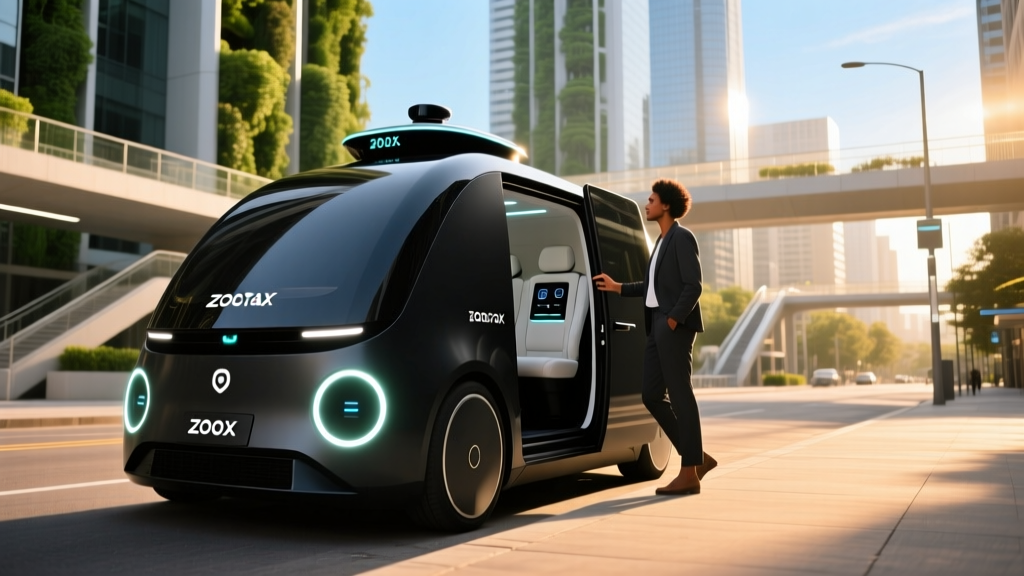
In practical terms: there is no steering wheel, no pedals, and no driver seat in the Zoox vehicle. You are a passenger, not a driver.
This distinction matters enormously. When people ask "is Zoox self-driving?" the answer is yes — within its geofenced service area, under approved conditions, the vehicle operates with zero human input. The SAE J3016 standard defines six levels of automation:
| Level | Name | Who Drives? | Examples |
|---|---|---|---|
| 0 | No Automation | Human | Conventional vehicles |
| 1 | Driver Assistance | Human (system assists steering OR speed) | Adaptive cruise control, lane-keep assist |
| 2 | Partial Automation | Human (must supervise at all times) | Tesla Autopilot/FSD Supervised, BlueCruise, Super Cruise |
| 3 | Conditional Automation | System (human must be ready to take over) | Mercedes DRIVE PILOT (limited markets, <40 mph) |
| 4 | High Automation | System (no human driver needed in ODD) | Zoox, Waymo One |
| 5 | Full Automation | System (all conditions, everywhere) | Does not yet exist commercially |
Zoox is Level 4, not Level 5. It cannot drive everywhere, in all weather, on all road types. Its autonomy is bounded by its geofence, its approved hours of operation, and its operational design domain — which excludes scenarios like heavy snow, unmapped construction zones, or certain complex intersections that haven't been validated.
Zoox Technology Stack: Sensors, Compute, and the Purpose-Built Vehicle
Unlike Waymo, which retrofits its sensor suite onto the Jaguar I-PACE, Zoox designed its vehicle from the ground up as a robotaxi. The result is a compact, symmetrical, bidirectional vehicle with no steering wheel, no traditional dashboard, and four inward-facing seats. Here's what powers it:
Zoox Sensor & Compute Stack
- LiDAR: Multiple solid-state and spinning LiDAR units providing 360° 3D point-cloud mapping out to ~150+ meters
- Cameras: High-resolution camera array covering all directions for object classification, traffic-light recognition, and lane detection
- Radar: Forward and surround radar for velocity detection and redundancy in low-visibility conditions
- Compute: Custom onboard computing platform running Zoox's proprietary perception, prediction, and planning stack
- HD Maps: Centimeter-accuracy pre-mapped routes within the geofence, continuously updated
- V2X: Vehicle-to-infrastructure communication in supported corridors
Zoox uses a sensor-fusion approach (LiDAR + cameras + radar), which differs from Tesla's camera-only FSD strategy. The redundancy is a deliberate design choice for Level 4 operations where no human fallback exists.
The vehicle itself is battery-electric, with a reported battery capacity in the 60–80 kWh range (exact specs are proprietary). It's designed for urban speeds — typically up to 35–45 mph in its current operational areas — and features four-wheel steering for tight urban maneuvering. The bidirectional design means the vehicle can drive equally well in either direction, simplifying U-turns and dead-end navigation.
Zoox's AI stack handles perception (what's around the vehicle), prediction (what other road users will do next), and planning (what the vehicle should do). Unlike consumer ADAS, the system must handle all edge cases within its ODD without handing off to a human — which is why the geofence exists. Roads and intersections that haven't been mapped and validated are simply excluded from the service area.
Safety Record: What the Data Shows
Autonomous vehicle safety is measured primarily through two metrics: disengagement rate (how often a safety driver or remote operator must intervene) and collision rate per million miles. For fully driverless operations like Zoox's commercial service, the relevant metric is collision rate and remote-assistance intervention frequency.
Key safety data points:
- Testing miles: Zoox has logged millions of autonomous miles in testing across Foster City, San Francisco, Las Vegas, and other cities since 2020.
- Commercial operations: Since launching paid service, Zoox has completed tens of thousands of driverless trips. The company reports no at-fault collisions involving pedestrians or cyclists in commercial operations as of early 2026.
- Remote assistance: Like Waymo, Zoox employs remote operators who can be summoned by the vehicle when it encounters an ambiguous scenario (e.g., an unusual construction zone). These are not "remote drivers" — they provide high-level guidance (e.g., "proceed around the cone"), and the vehicle executes the maneuver autonomously.
- NHTSA Standing General Order: Under NHTSA's Standing General Order, all Level 2+ and Level 4 operators must report crashes involving their automated systems. Zoox's reported incidents have been minor (low-speed contact, no injuries) in public filings.
For context, the human driver fatality rate in the U.S. is approximately 1.35 deaths per 100 million vehicle miles (per NHTSA data). Robotaxi operators have not recorded a passenger fatality in commercial operations. However, robotaxi miles are a tiny fraction of total vehicle miles, and the operational domain (low-speed, geofenced urban areas) is inherently lower-risk than highway driving. Direct statistical equivalence claims should be treated cautiously.
Regulatory Landscape: Who Approves Robotaxi Operations?
Zoox cannot simply launch in any city it chooses. Robotaxi operations in the U.S. require a patchwork of state and local approvals:
- California (CPUC + DMV): The California Public Utilities Commission (CPUC) issues permits for commercial robotaxi service. The California DMV issues testing permits and publishes annual disengagement reports. Zoox holds both.
- Nevada (DMV + PUCN): Nevada's regulatory framework is generally more permissive for AV testing and deployment. Zoox received approval for commercial operations on the Las Vegas Strip through state-level authorization.
- Federal (NHTSA): NHTSA does not currently "approve" AV operations but mandates crash reporting, sets Federal Motor Vehicle Safety Standards (FMVSS), and can issue exemptions for vehicles like Zoox's that lack steering wheels and mirrors. Zoox received a limited FMVSS exemption from NHTSA to operate its purpose-built vehicle without traditional controls.
- Texas, Georgia, and other states: AV regulations vary widely. Some states have permissive frameworks (Arizona, Texas); others require extensive permitting. Zoox's announced expansion to Austin and Atlanta is contingent on completing state and local approval processes.
The regulatory process is the primary bottleneck for expansion. Each new city requires geofence mapping, local government coordination, first-responder training (how to interact with a driverless vehicle in an emergency), and permit approval — a process that typically takes 12–24 months per market.
Current Limitations: What Zoox Cannot Do
- Geofence restriction: Zoox only operates within pre-mapped, approved zones. You cannot request a ride to or from a location outside the geofence — even if it's just a few blocks away.
- Weather limitations: Heavy rain, fog, and snow can degrade LiDAR and camera performance. Zoox may suspend service during severe weather events. Light rain is generally manageable.
- Speed limits: The vehicle is optimized for urban speeds (typically under 45 mph). It does not currently operate on highways or freeways.
- Construction zones: While the system can handle minor lane shifts and cones, major unmapped construction may trigger a remote-assistance request or a reroute.
- Limited hours: Service is not 24/7 in all markets. Operating hours are defined by the permit and may expand over time.
- No intercity trips: Zoox is strictly an urban last-mile service. You cannot take it from San Francisco to Los Angeles.
- Accessibility: The purpose-built vehicle is designed with wheelchair accessibility in mind, but availability of accessible vehicles may be limited in early deployment phases.
- Pets and large cargo: Policies on animals (other than service animals) and oversized items are restrictive, similar to rideshare policies.
These limitations aren't unique to Zoox — they apply to all current Level 4 robotaxi services, including Waymo. The technology is advancing, but Level 5 (drive anywhere, in any condition, with no restrictions) remains a long-term goal, not a near-term reality.
Frequently Asked Questions
Is Zoox completely free to ride?
No. Zoox charges fares comparable to UberX and Lyft Standard. Promotional free rides or credits are occasionally offered during market launches or through Amazon Prime partnerships, but these are temporary and limited. Regular rides cost roughly $12–$18 for a typical 5-mile urban trip.
How do I get a Zoox ride?
Download the Zoox app (available on iOS and Android), create an account, and enter a pickup and dropoff location within the active service geofence. If both points are inside the zone, a vehicle will be dispatched. The service is currently live in Las Vegas and San Francisco, with other cities in testing.
Is there a human driver in the Zoox vehicle?
No. The Zoox vehicle has no steering wheel, no pedals, and no driver seat. It is a fully driverless SAE Level 4 robotaxi. Remote operators are available to provide high-level guidance if the vehicle encounters an unusual scenario, but they do not "drive" the vehicle in real time.
How does Zoox compare to Waymo?
Both are Level 4 robotaxi services, but Waymo has a significantly larger commercial footprint (Phoenix, San Francisco, Los Angeles, Austin) and more accumulated commercial miles. Zoox differentiates with its purpose-built vehicle (no steering wheel, bidirectional) and Amazon's logistics and capital backing. Pricing is comparable between the two.
What happens if the Zoox vehicle gets stuck or confused?
The vehicle will pull over safely and request remote assistance. A remote operator reviews the situation via the vehicle's sensor feed and provides a high-level resolution (e.g., "proceed around the obstacle"). The vehicle then executes the maneuver autonomously. If the situation cannot be resolved, the trip may be ended and the passenger rerouted.
Can Zoox drive in the rain or at night?
Yes, in light rain and at night — these conditions are within its operational design domain. However, heavy rain, dense fog, or severe weather may cause service suspension. The LiDAR and camera systems are designed to function in low-light conditions, but sensor performance degrades in extreme weather.
Is Zoox safe? Has anyone been injured in a Zoox vehicle?
Zoox reports no passenger or pedestrian fatalities in its commercial operations. Under NHTSA's Standing General Order, reported incidents have been minor (low-speed, no injuries). The vehicle operates at urban speeds within geofenced areas, which inherently reduces risk compared to highway driving. As with any transportation mode, zero risk does not exist, but available data indicates a strong safety record.
Will Zoox come to my city?
Zoox has announced testing plans for Austin and Atlanta, with commercial service contingent on regulatory approval. Expansion to additional cities is expected but follows a deliberate, permit-driven process. Check the Zoox app or website for the latest availability map.